

Committee Chairman
Kane and The Great Khali named to the WWE Hall of Fame
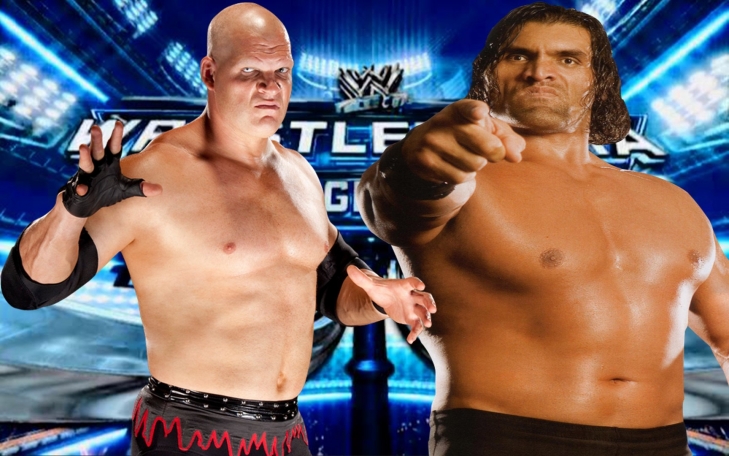
Two weeks away from Wrestlemania, it was announced that two former World Heavyweight Champions, Kane and the Great Khali will be entering the WWE Hall of Fame.
Glenn Jacobs, who performed for over two decades as Kane, had his induction announced on this morning’s WWE Network program, The Bump. The announcement for Khali came from a video from WWE Now India, where it was announced by his former on-screen manager, Ranjin Singh.
Jacobs first joined the WWE as Isaac Yankem DDS, the personal dentist for Jerry Lawler. After a year, he was repackaged as the fake “Diesel”, which was also brief. In the Fall of 1997, third time was the charm for Jacobs, as became Kane, the kayfabe brother of the Undertaker, which would become the persona he wrestled under for over twenty years.
Kane became one of the most durable characters in WWE history, going through many changes and winning multiple titles along the way. He would have huge matches against the Undertaker, Mick Foley, Triple H and many others and was twice the Heavyweight Champion, and a Grand Slam Champion (winning four major titles) with the WWE. He last appeared as a surprise entrant in this year’s Royal Rumble.
From India, Khali debuted for the WWE in 2006, and would win the World Heavyweight Title in July the following season. Standing well over seven feet tall, Khali was not a good wrestler, but he would prove to be marketable in the Indian market. Late in his career, he would be a comedic wrestler, portraying a Punjabi Playboy.
In our latest ranking of those to consider for the WWE Hall of Fame, Kane was at #6, with Khali all the way back at #202.
The 2021 Class also comprises Molly Holly and Eric Bischoff.
It will be a dual ceremony with the 2020 Class; the Bella Twins, JBL, Jushin “Thunder” Liger, “The British Bulldog” Davey Boy Smith and the New World Order (Hulk Hogan, Scott Hall, Kevin Nash & Sean Waltman.
We would like to congratulate both Kane and the Great Khali for obtaining this honor.
Batista removed from this year's WWE Hall of Fame
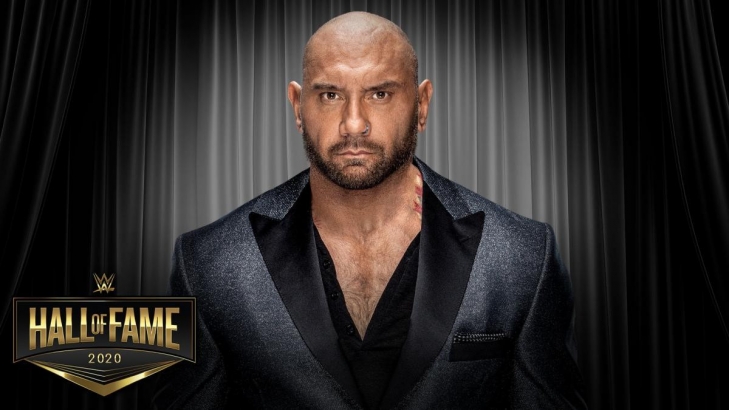
So, we have one less WWE Hall of Famer?
Batista was scheduled to enter the WWE Hall of Fame as part of the COVID-19-pushed back Class of 2020. As we have learned, due to scheduling conflicts, the former multi-time WWE Champion will not be inducted this year. It had been speculated as Batista was no longer listed as part of the Hall on WWE.com, and the “Animal” himself, confirmed it on Twitter:
To the @WWEUniverse Unfortunately due to previous obligations I am unable to be a part of the @WWE #HOF this year. By my request they have agreed to induct me at a future ceremony where I’ll be able to properly thank the fans and people who made my career possible #DreamChaser”
We assume that Batista will be part of a future class.
The 2020 Class now comprises the Bella Twins, JBL, Jushin “Thunder” Liger, “The British Bulldog” Davey Boy Smith and the New World Order (Hulk Hogan, Scott Hall, Kevin Nash & Sean Waltman. Eric Bischoff and Molly Holly have already been named to the 2021 Class.
We will be paying close attention to see who else will be part of the 2021 Class, and we will revise our Notinhalloffame WWE list after Wrestlemania.
Our All-Time Top 50 Oakland Athletics have been revised

Yes, we know that this is taking a while!
As many of you know, we here at Notinhalloffame.com are slowly generating the 50 of each major North American sports team. That being said, we have existing Top 50 lists out and we always consistently look to update them when we can and based on necessity. As such, we are very happy to present the pre-2021 update of our top 50 Oakland Athletics of all-time.
As for all of our top 50 players in baseball we look at the following:
1. Advanced Statistics.
2. Traditional statistics and how they finished in the American League.
3. Playoff accomplishments.
4. Their overall impact on the team and other intangibles not reflected in a stat sheet.
There is only one new addition near the bottom part of our list. As always, we announce our top five immediately, but out full list can be found here.
1. Lefty Grove
2. Rickey Henderson
3. Jimmie Foxx
4. Eddie Plank
5. Al Simmons
There was some minor tinkering on the list due to the changing values from Baseball Reference. No active Athletics made the list, but the altering advanced stats led to former 1930s Rightfielder, Wally Moses, replacing Jack Barry.
We welcome your input and commentsand as always, we thank you for your support.
Our All-Time Top 50 Seattle Mariners have been revised
Yes, we know that this is taking a while!
As many of you know, we here at Notinhalloffame.com are slowly generating the 50 of each major North American sports team. That being said, we have existing Top 50 lists out and we always consistently look to update them when we can and based on necessity. As such, we are very happy to present the pre-2021 update of our top 50 Seattle Mariners of all-time.
As for all of our top 50 players in baseball we look at the following:
1. Advanced Statistics.
2. Traditional statistics and how they finished in the American League.
3. Playoff accomplishments.
4. Their overall impact on the team and other intangibles not reflected in a stat sheet.
There is only one new addition near the bottom part of our list. As always, we announce our top five immediately, but out full list can be found here.
There was some minor tinkering on the list due to the changing values from Baseball Reference. The new entry is current staff ace, Marco Gonzales, who debuts at #48.
We welcome your input and commentsand as always, we thank you for your support.
