


Site Admin
7. Buddy Bell
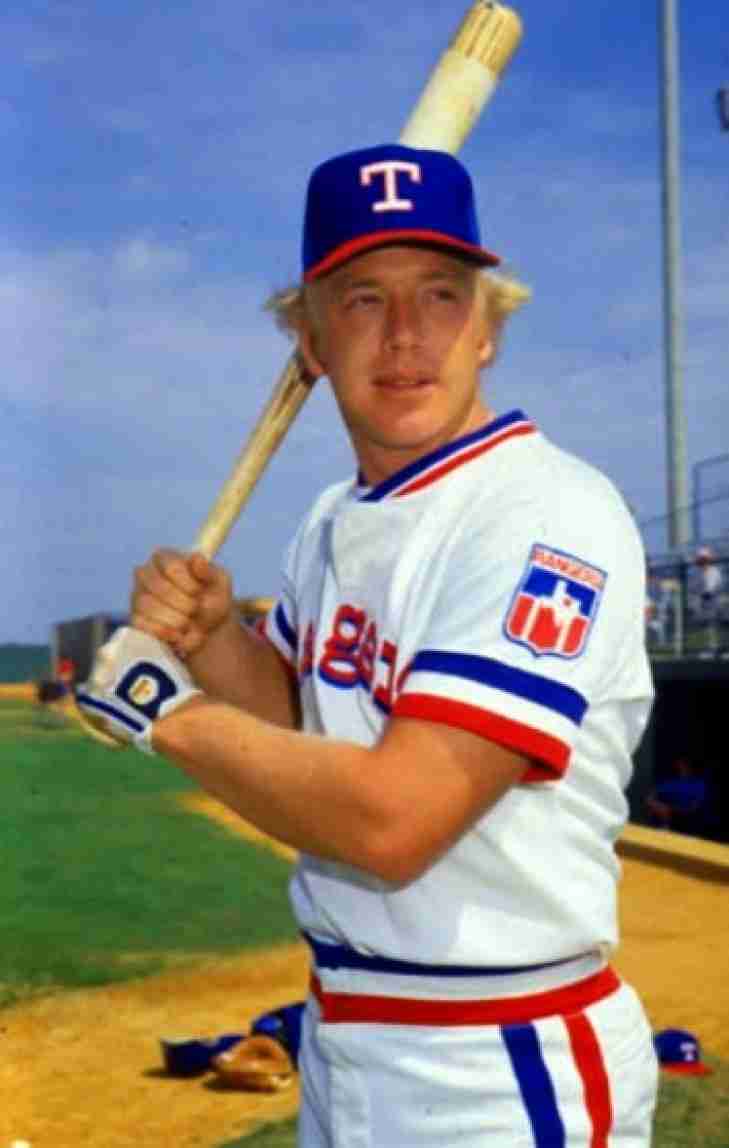
When the Texas Rangers acquired Buddy Bell prior to the 1979 season, they recognized him as a reliable veteran, yet few anticipated the exceptional defensive mastery and offensive performance that would soon manifest in Arlington. Assuming the responsibilities at third base for a franchise still establishing its presence within the American League, Bell immediately revolutionized the left side of the field. His arrival signified the commencement of a distinguished individual era, characterized by his soft hands, superior reflexes, and exceptional positional authority, establishing him as the foremost defensive third baseman of his generation.
Bell’s first season in Texas in 1979 is regarded as one of the franchise's best. He appeared in all 162 games, setting club records with 670 at-bats and 200 hits, including 42 doubles and 101 RBIs. This season clearly demonstrated Bell’s importance, showing he was not just a supporting player but a key leader who could lead a major-league lineup and effectively neutralize the opposing team's running game.
Bell's spectacular debut triggered an exceptional streak of defensive excellence. Over seven seasons in Arlington, he was an unstoppable force on defense, winning six straight Gold Glove Awards from 1979 to 1984. He made challenging cross-body throws seem effortless and regularly robbed opponents of extra-base hits down the line, amassing an impressive 15.7 defensive bWAR with the Rangers—placing him third in franchise history after Iván Rodríguez and Jim Sundberg.
While his glove earned him national acclaim, his bat remained a model of lethal consistency. Bell was an advanced contact hitter who routinely hit near or above .300, peaking with a blistering .329 average in 1980 and a .315 mark in 1984. Across his primary tenure with Texas, he accumulated 1,060 hits and maintained a stellar .293 batting average, providing a steady, high-leverage presence even as the teams around him frequently struggled to reach .500.
His sustained excellence earned him four American League All-Star selections as a Ranger, making him the proud face of a franchise starved for national recognition. Though he was eventually traded back to his hometown Cincinnati Reds during the 1985 season—before returning briefly for a 34-game swan song to close his career in 1989—his peak years were defined by the fans in Arlington who watched him dominate the hot corner daily.
In 2004, the Rangers inducted Bell into their Hall of Fame.
3. Juan Gonzalez
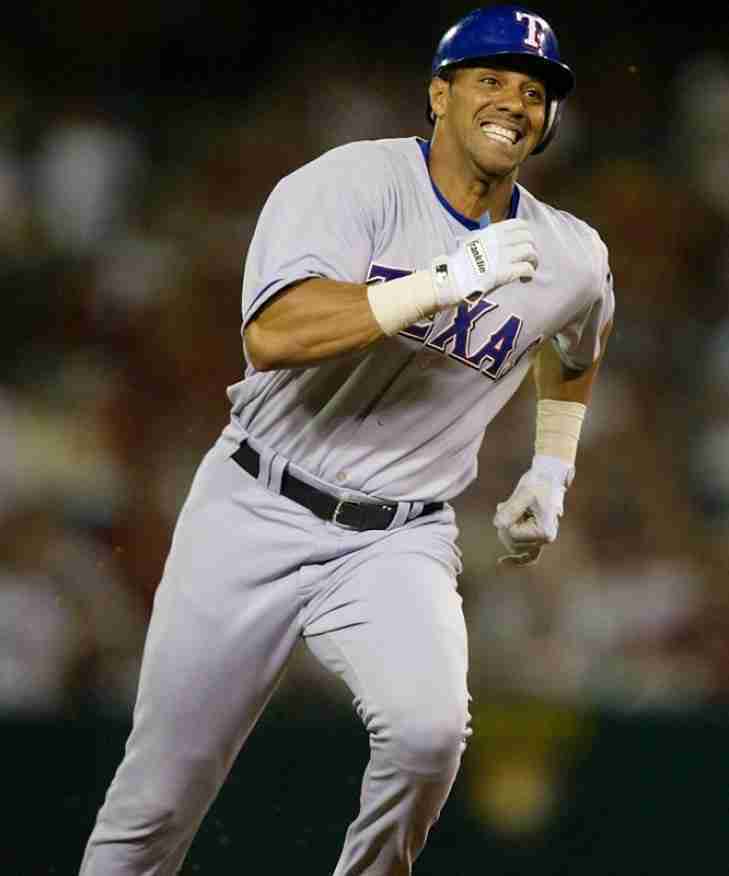
Signed by the Texas Rangers as a 16-year-old free agent, Juan González quickly made a big impact in the major leagues, earning a reputation as a formidable player. Known as “Juan Gone,” he set the pace for the franchise's first modern championship era with powerful, high-velocity line drives during Texas summers. During his two tenures in Arlington, the tall slugger consistently elevated the organization’s power stats, blending raw strength with a keen ability to drive in runners, cementing his status as a legendary power hitter.
His debut in the early 1990s marked a shift in leadership within the junior circuit. González made his towering home runs a personal trademark, winning back-to-back American League home run titles with 43 homers in 1992 and then an impressive 46 during a standout 1993 All-Star season. He dominated opposing pitchers with an aggressive, powerful right-handed swing, effortlessly clearing the fences and posting seven seasons with at least 100 RBIs for the team.
In 1996, González delivered an exemplary display of high-leverage hitting, recording 47 home runs and 144 RBIs while achieving an impressive .314/.368/643 slash line over 134 games. This performance earned him his first American League Most Valuable Player Award and contributed significantly to Texas’s inaugural postseason appearance. He continued this exceptional performance in 1998, establishing a historic dominance in run production. Demonstrating systematic dismantling of major-league pitching, he drove in an extraordinary league-leading 101 runs before the All-Star break. He concluded the season with 42 home runs and a career-high 157 RBIs, thereby securing his second American League MVP award.
After the 1999 season, González was in the final year of his contract and increasingly demanded a lucrative extension reflecting his top-tier value. Management, wary of committing long-term and significant money to a hitter with growing back issues, feared losing their star for nothing. Consequently, in November, they executed a bold trade, sending the two-time MVP to the Detroit Tigers in a nine-player deal for a promising group led by Gabe Kapler and Francisco Cordero.
While he would eventually return to Arlington via free agency for a highly productive two-year encore from 2002 through 2003, injuries severely limited his playing time, drawing a quiet curtain over his peak years.
Over his 1,400 games with Texas, he achieved exactly 1,592 hits, 296 doubles, and a strong .293 batting average, complemented by a remarkable .565 slugging percentage. He is the all-time leader for the Rangers in both home runs (372) and runs batted in (1,180), solidifying his key value within a detailed algorithmic assessment. In 2015, the organization honored his legacy by inducting Juan "Juan Gone" González into the Texas Rangers Hall of Fame.
2. Rafael Palmeiro
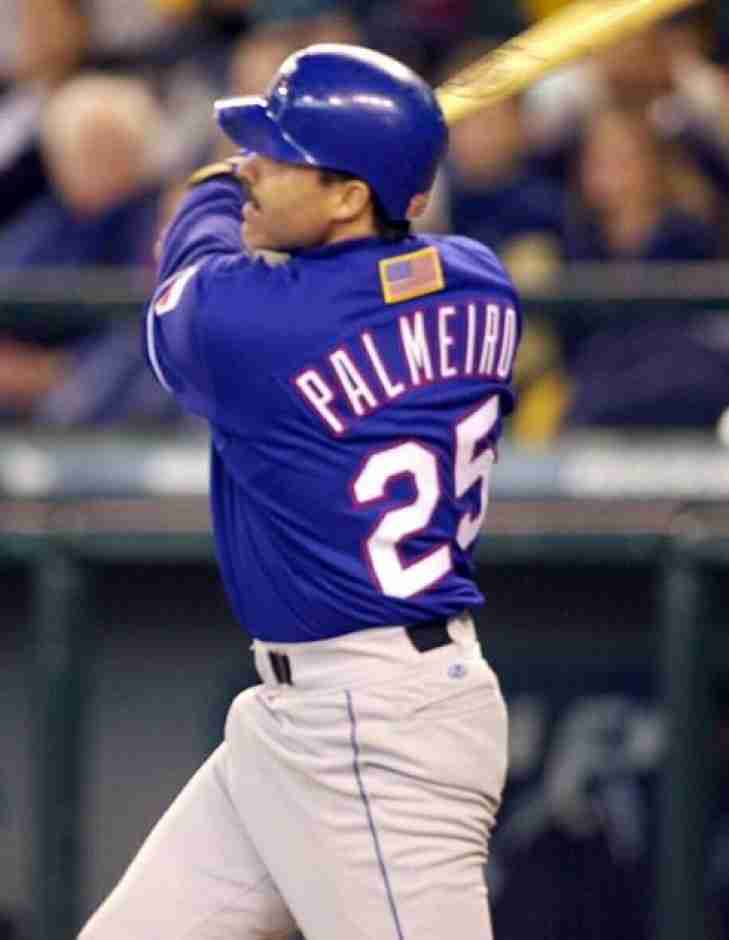
When assessing the purely mechanical precision of a left-handed swing, very few hitters in the modern expansion era have matched the metronomic, smooth-operating consistency of the Cuban-born first baseman. Rafael Palmeiro was never a flamboyant or eccentric figure on the field; instead, he approached the act of producing high-caliber offensive output as a mandatory routine. Throughout two distinct, highly productive multi-year periods in Arlington, the exceptionally durable slugger quietly compiled some of the most remarkable, volume-rich statistics in the franchise's history. However, while his performance at the plate clearly demonstrates elite, mid-lineup capability, his legacy remains disconnected from the sport’s formal honors—traumatized by a sudden, late-career decline that permanently reshaped his standing in the historical record.
His arrival before 1989 was the result of an exciting, big trade with the Chicago Cubs that brought fresh energy and a talented group to Texas. Palmeiro made consistently powerful contact a daily habit, quickly becoming a standout player in the American League. In 1990, he passionately took on junior circuit pitching, leading the major leagues with 191 hits and achieving an impressive .319 batting average.
He substantiated this assertion during a remarkable 1991 All-Star campaign, leading the league with 49 doubles, while accumulating 203 hits and hitting 26 home runs. His career progression peaked notably in the 1993 season when he hit a career-high 37 home runs and led the league with 124 runs scored, thereby establishing himself as one of the premier positional assets nationwide.
Following the conclusion of that remarkable 1993 campaign, a highly publicized and progressively contentious contractual dispute arose between Palmeiro's representatives and the Texas front office concerning his long-term market valuation. Rather than offering a lucrative extension to their domestic star, the management made a decisive strategic shift that winter, allowing him to depart in free agency and sign with Baltimore. Concurrently, Texas replaced him at first base by signing Will Clark.
The move significantly heightened Palmeiro's determination, leading to five exceptional years on the East Coast. However, the appeal of Arlington remained irresistible, prompting a substantial five-year contract upon his return through free agency prior to the 1999 regular season. This second stint was when his innate physical strength truly reached its peak.
In 1999, Palmeiro delivered an exemplary offensive performance, recording a career-high 47 home runs and generating 148 runs batted in. His impressive slash line of .324/.420/630 earned him a Silver Slugger Award and a commendable fifth-place finish in the Most Valuable Player (MVP) voting. Notably, he also received a Gold Glove Award that summer, despite participating in only 128 games as the designated hitter and 28 games at first base. Had he been positioned as an outfielder demonstrating comparable offensive productivity, rather than occupying the constricted roles of first baseman and designated hitter, his record would likely have included double the number of All-Star selections, totaling eight.
He sustained that thunderous output with consecutive 43-homer, 39-homer, and 38-homer campaigns, maintaining a relentless pace through the conclusion of his second Texas departure in 2003. Across his 1,573 games with the Rangers, he accumulated exactly 1,692 hits, 321 home runs, 335 doubles, and 1,039 runs batted in, all backed by an exceptional .290 batting average and a lethal .519 slugging percentage. Advanced analytics strongly reinforce the sheer density of his localized peak, anchoring his magnificent footprint with a spectacular 44.6 franchise position bWAR—a total that ranks among the absolute highest in club history.
Naturally, the broader historical narrative faces a massive, legacy-tarnishing controversy. Following a return to the Orioles late in his active journey, where he joined the ultra-exclusive 3,000-hit and 500-home run clubs, Palmeiro notoriously wagged his finger at a congressional hearing while denying performance-enhancing drug use, only to test positive for stanozolol just months later. The severe fallout completely crushed his public image, resulting in a strict, permanent exclusion from both the National Baseball Hall of Fame and the official Texas Rangers Hall of Fame.
1. Ivan Rodriguez
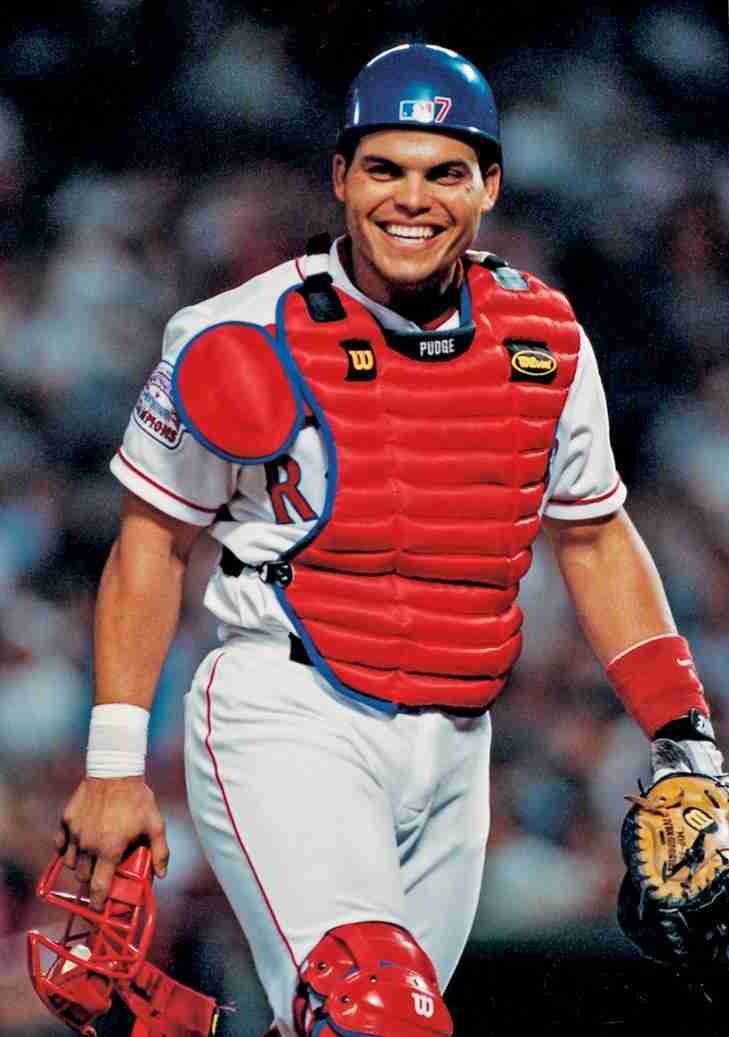
When examining the most comprehensive and physically formidable forces to have ever directed the game from behind the plate, there exists an unparalleled, gold-standard benchmark that exceeds the scope of modern archives within the junior circuit. Signed out of Puerto Rico as a teenager, Iván “Pudge” Rodríguez did not merely occupy a premium defensive position for the Texas Rangers; he fundamentally redefined it as a platform for innovative athletic excellence. Making his highly anticipated Major League debut in June 1991 at the age of 19, the compact and swift catcher rapidly established himself as the definitive face of the franchise. During an illustrious initial twelve-season tenure in Arlington, "I-Rod" combined a lethal, high-velocity arm that effectively neutralized opposing running games with a potent, free-swinging bat, thereby cementing his reputation as the premier catcher of his generation and the undisputed greatest Texas Ranger of all time.
His introductory period in the American League immediately transformed the manner in which opposing managers devised their offensive strategies. Equipped with a predatory release and exceptional footwork, Rodríguez made erasing baserunners a personal discipline. He secured ten consecutive American League Gold Glove Awards from 1992 to 2001, consistently throwing out over fifty percent of potential base stealers, thereby instilling considerable apprehension among baseline tacticians.
Nonetheless, while his extraterrestrial defensive presence redefined the position, his rapid offensive development is what truly propelled him into the highest echelons of baseball immortality. He systematically dismantled Major League Baseball pitching staffs to achieve eight individual seasons with a batting average significantly exceeding the .300 threshold for Texas, demonstrating an uncommon combination of exceptional contact proficiency and sustained power that earned him six Silver Slugger Awards and five seasons with at least 20 home runs.
Rodríguez's 1999 season was truly remarkable, marking the peak of his career. He delivered an outstanding offensive performance that set new standards for modern catchers. Throughout the season, he consistently outdid other American League pitchers, achieving career highs with 35 home runs and 113 RBIs. He also contributed 199 hits, scored 116 runs, and stole 25 bases in 144 games. His efficiency was outstanding, with a impressive .332/.356/558 slash line and a bWAR of 6.4, earning him the 1999 American League Most Valuable Player Award and helping Texas secure a division title.
By the end of the 2002 campaign, injuries like a broken thumb, knee tendonitis, and herniated disc limited the franchise catcher to an average of 103 games over three years. With the team in a rebuilding phase and burdened by hefty payrolls elsewhere, management hesitated to commit long-term to a catcher with durability issues. After a public, tense salary dispute over his market value, they let him go into free agency, marking their first significant departure that winter. Rodríguez used this move to rebound, signing a one-year deal with the Florida Marlins and helping them win the 2003 World Series.
Following subsequent, highly productive years that included a stellar run in Detroit and a brief, deeply nostalgic 28-game return to Arlington in 2009, he left behind a volume-dense statistical fortress that dominates the bedrock of local history.
Across his 1,507 games strictly representing the Rangers, Rodríguez accumulated exactly 1,747 hits, 352 doubles, 217 home runs, 842 runs batted in, and 866 runs scored, entirely validated by a stellar .304 career average with the club. Advanced analytical filters heavily reinforce the sheer density of his peak on the Texas turf, anchoring his magnificent localized footprint with an exceptional, franchise-best 50.0 position bWAR.
For a solid decade, if you asked any fan, coach, or executive in the sport which catcher they would choose to build a franchise around, his name was the only acceptable answer.
The definitive, final punctuations on his immortal life on the diamond arrived exactly as deserved for an inner-circle legend: the BBWAA officially righted the historical ledger by electing Rodríguez into the National Baseball Hall of Fame in 2017 on his very first year of eligibility, followed immediately by the organization beautifully hanging his iconic number 7 in the stadium rafters—punctuating a legendary journey that began with a 2013 induction into the Texas Rangers Hall of Fame
