


Site Admin
14. Reggie White
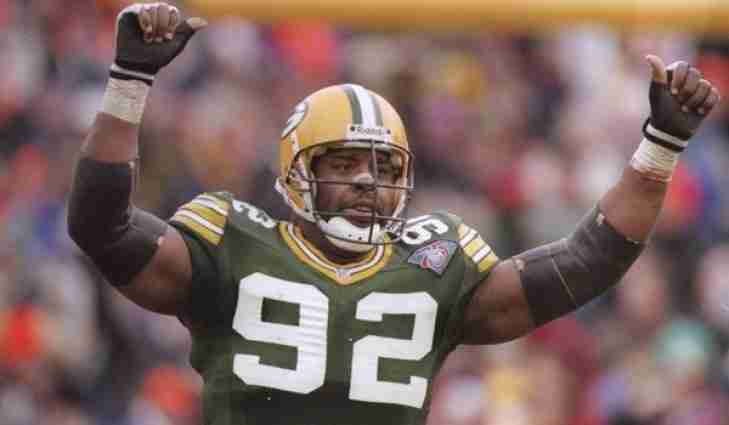
When Reggie White shocked the sports world by signing a four-year, $17 million contract with Green Bay in the spring of 1993, he didn't just choose a new football team—he single-handedly transformed the entire trajectory of the Packers franchise. At a time when cold, small-market Titletown was viewed across the league as an undesirable destination for elite talent, the NFL’s premier defensive player chose Green Bay over major market suitors like San Francisco and Washington. White’s decision shattered the stigma, instantly legitimizing the organization and signaling to the league that the Packers were built to win.
Arriving in Wisconsin near Motown at age 32 after eight legendary seasons in Philadelphia, the "Minister of Defense" immediately brought the confident swagger and leadership vital for a championship team, complementing rising star quarterback Brett Favre. His presence attracted future talent, demonstrating to other high-profile veterans that Green Bay was an ideal destination to pursue a championship.
White remained an absolute force on the field, utilizing his signature, unblockable hump move to physically overpower tackle after tackle. Across his six seasons in Green Bay, he earned six consecutive Pro Bowl selections and two First-Team All-Pro honors (1995 and 1998). His impact peaked in 1996, when he anchored a unit that allowed the fewest points and fewest yards in the NFL. In Super Bowl XXXI against New England, White put on a defensive masterclass, recording a Super Bowl-record three sacks in the second half to slam the door on the Patriots and deliver Green Bay its first Lombardi Trophy in 29 years.
Two years later, at age 37, White authored a sensational final chapter in Green Bay by capturing the 1998 NFL Defensive Player of the Year award after recording 16.0 sacks. He retired from the Packers that season as the franchise's all-time sack leader, leaving behind a revived culture of winning that permanently reshaped modern Green Bay football.
In his six seasons with the Packers, White played in 96 regular-season games with 95 starts for Green Bay (232 career). He compiled 68.5 sacks, 301 combined tackles, 14 forced fumbles, eight fumble recoveries, and one interception for the Packers, along with a Super Bowl XXXI championship ring. A six-time Pro Bowler, two-time First-Team All-Pro, 1998 NFL Defensive Player of the Year, and member of the NFL’s 1990s All-Decade Team, White was posthumously enshrined into the Pro Football Hall of Fame in 2006, inducted into the Packers Hall of Fame in 2007, and had his No. 92 retired by the franchise.
Seriously, this might be one of the greatest franchise-altering free agent signings ever.
17. Jerry Kramer
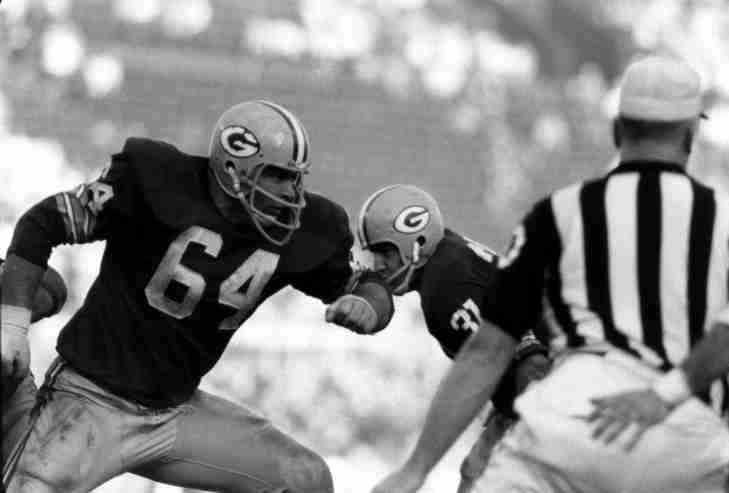
Arriving in Green Bay as a fourth-round pick out of Idaho in 1958, Jerry Kramer quickly emerged as the fierce physical engine driving Vince Lombardi’s relentless offensive line. Matched with Fuzzy Thurston in the interior, Kramer’s rare combination of downfield mobility and raw power transformed the iconic "Packer Sweep" from a simple ground play into an unstoppable football juggernaut.
Kramer's impact extended far beyond routine blocking duties. A versatile star, he also doubled as the team's primary placekicker for several seasons, famously boot-kicking three field goals in freezing conditions to secure the 1962 NFL Championship over New York. His defining moment came in the iconic 1967 "Ice Bowl" victory against Dallas, when his legendary wedge block cleared the path for Bart Starr’s game-winning quarterback sneak. During his decade-plus tenure in Titletown, Kramer earned five First-Team AP All-Pro selections (1960, 1962, 1963, 1966, 1967) and three Pro Bowl nods, helping Green Bay win five NFL titles and the first two Super Bowls.
For decades, Kramer was the most glaring omission from Canton, the only member of the NFL 50th Anniversary All-Time Team not enshrined. The long-awaited correction finally arrived in 2018 when the Seniors Committee selected him for induction into the Pro Football Hall of Fame, decades after his 1975 entry into the Green Bay Packers Hall of Fame.
In green and gold, Kramer played in 130 regular-season games with 119 starts, plus nine postseason contests (all 9 starts). He also amassed 119 regular-season starts, four fumble recoveries, 29 field goals, and 90 extra points.
1. Aaron Rodgers
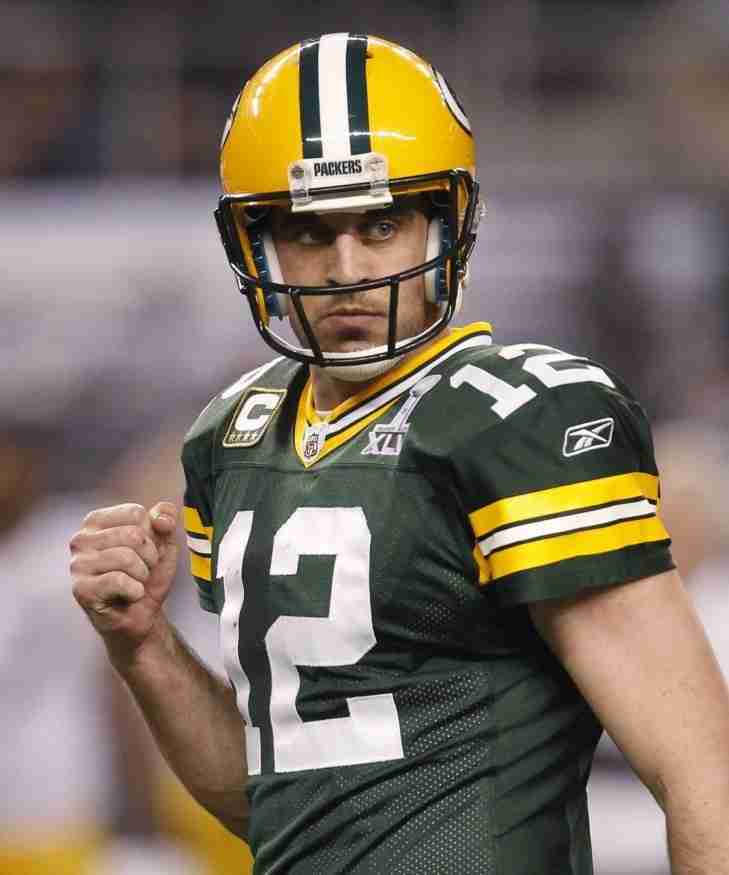
On draft night in 2005, Aaron Rodgers sat in the green room watching an agonizing fall down the draft board until the Green Bay Packers finally picked him 24th overall. Intended as Brett Favre's successor, Rodgers spent three years on the bench, navigating an awkward relationship with the legendary quarterback. When Favre was traded to the New York Jets in 2008, Rodgers took over as the starter under heavy scrutiny, quickly demonstrating precise passing, exceptional mobility, and a rare talent for protecting the football.
Rodgers quickly proved he was not just a replacement but an upgrade in efficiency. He threw for over 4,000 yards with 28 touchdowns in his first year as a starter, but his true coronation came in 2010. After barely making the postseason as a wild-card team, Rodgers went on a postseason tear for the ages, culminating in a pristine performance in Super Bowl XLV. Passing for 304 yards and three touchdowns against the Pittsburgh Steelers, he earned Super Bowl MVP honors and delivered Green Bay its fourth Lombardi Trophy.
In the following season, Rodgers delivered one of the most statistically impressive campaigns in NFL history. In 2011, he threw for 4,643 yards and 45 touchdowns, with only six interceptions, and set the NFL single-season passer rating record at 122.5. He earned his first AP NFL MVP award by a wide margin, solidifying his reputation as the top quarterback in the league. His signature style—marked by exceptional accuracy, a quick flick of the wrist for powerful throws, and a keen ability to draw defensive offsides through his hard count—became the model for modern quarterbacking.
Rodgers won his second MVP award in 2014 after throwing 38 touchdowns to just five picks, consistently leading Green Bay to deep playoff runs. Yet despite regular-season brilliance and four NFC Championship Game appearances, postseason heartbreak began to define the mid-2010s Packers. Agonizing, high-profile playoff losses—often exacerbated by defensive collapses or special teams blunders—left fans and analysts debating whether Green Bay was squandering the prime of a talent whose individual ceiling was as high as anyone to ever play the position.
As his career progressed into the late 2010s, friction brewed between Rodgers and the front office. Tensions reached a boiling point in the spring of 2020 when general manager Brian Gutekunst traded up in the first round of the draft to select quarterback Jordan Love without consulting Rodgers. Fueled by the perceived slight, Rodgers responded with a late-career revival that shattered any narrative of his decline, capturing back-to-back NFL MVPs in 2020 and 2021 behind staggering touchdown-to-interception totals of 48-to-5 and 37-to-4.
Off the field, Rodgers increasingly became a lightning rod for national controversy. His public media appearances—most notably on The Pat McAfee Show—and unvarnished views on organization management, media narratives, and holistic health frequently dominated headlines. The drama peaked during the 2021 season over his vaccination status, after revealing he was "immunized" despite not taking the COVID-19 vaccine, leading to intense public backlash, league fines, and a media firestorm that overshadowed his stellar play on the field.
His relationship with Green Bay management remained a rollercoaster of contract standoffs, cryptic offseason retirement hints, and public grievances regarding how veteran teammates were treated. Yet, even amidst the off-field noise and drama, Rodgers continued to operate as an absolute surgical force on the field, holding the defense accountable while throwing Hail Marys that seemed to defy the laws of physics.
Following a disappointing 8–9 campaign in 2022, the long-brewing divorce finally materialized in April 2023 when the Packers traded Rodgers to the New York Jets, bringing a dramatic 18-year era in Titletown to an official end. While his exit was messy and polarizing, his individual brilliance in Green Bay remains mathematically and historically unequaled by any quarterback who ever put on a helmet.
In Green Bay, Rodgers played in 230 regular-season games, completing 4,758 passes for 57,521 yards, 475 touchdowns, and just 105 interceptions—boasting the lowest career interception percentage in NFL history. A four-time NFL MVP (2011, 2014, 2020, 2021), four-time First-Team All-Pro, and a selection to the NFL 2010s All-Decade Team, Rodgers stands as statistically the most dominant player in Green Bay Packers history.
We also understand if you disagree with the assessment as to who is at the top of this list.
13. Jim Taylor
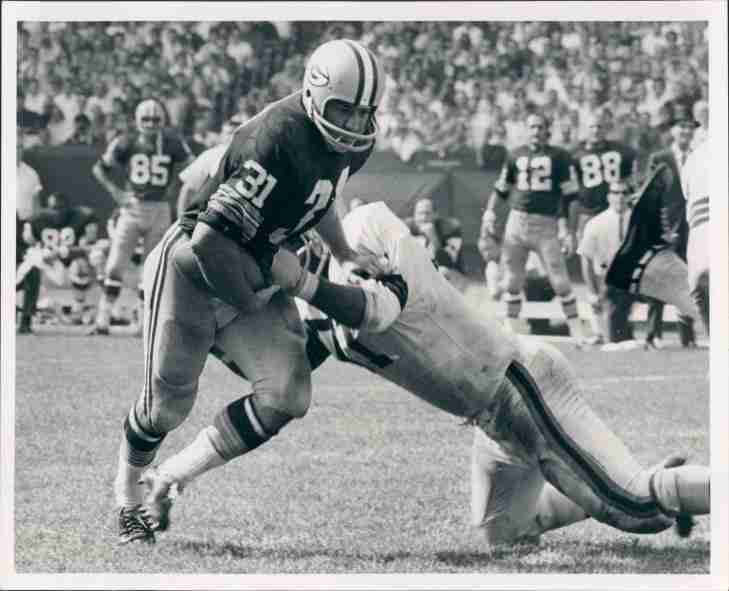
Standing just 6-foot-0 and roughly 215 pounds, Jim Taylor didn't fit the physical mold of a traditional early-60s battering ram, yet he ran with a ferocious, head-seeking contact style that terrified linebackers. Selected out of LSU in the second round of the 1958 draft, Taylor became the bruising interior half of Vince Lombardi's iconic backfield tandem alongside Paul Hornung, seeking out contact on every single carry and establishing the physical identity of Green Bay's dynasty.
Operating behind Lombardi's famed sweep and relentless inside-zone runs, Taylor put together five straight 1,000-yard campaigns from 1960 through 1964, earning five consecutive Pro Bowl selections along the way. His absolute peak arrived in 1962, when he put together one of the most dominant rushing seasons in pro football history. Taylor wrested the league rushing title away from Jim Brown, exploding for 1,474 rushing yards and 19 rushing touchdowns to capture NFL MVP honors. When the Packers needed him most in the sub-zero wind chill of the 1962 NFL Championship Game against the Giants, Taylor carried the ball 31 times for 85 grueling yards, scoring Green Bay's lone touchdown in a gritty 16–7 victory.
Twice leading the NFL in rushing touchdowns (1961 and 1962), Taylor became the first back in league history to post five consecutive 1,000-yard seasons. He served as the primary workhorse on four NFL Championship teams in Green Bay and capped off his Packers tenure by scoring a touchdown in the franchise's Super Bowl I victory over Kansas City. When he departed for New Orleans in 1967, only Jim Brown stood ahead of him on the NFL’s all-time rushing leaderboard.
Taylor played in 119 regular-season games for Green Bay (133 career). He compiled 8,207 rushing yards, 175 receptions for 1,727 receiving yards, and 91 total touchdowns (81 rushing, 10 receiving), alongside four NFL Championship rings and a Super Bowl I title. A five-time Pro Bowler, 1962 First-Team All-Pro, 1962 NFL MVP, and member of the NFL’s 1960s All-Decade Team, Taylor was inducted into the Packers Hall of Fame in 1975 and enshrined into the Pro Football Hall of Fame in 1976.
