


Site Admin
7. John Mackey
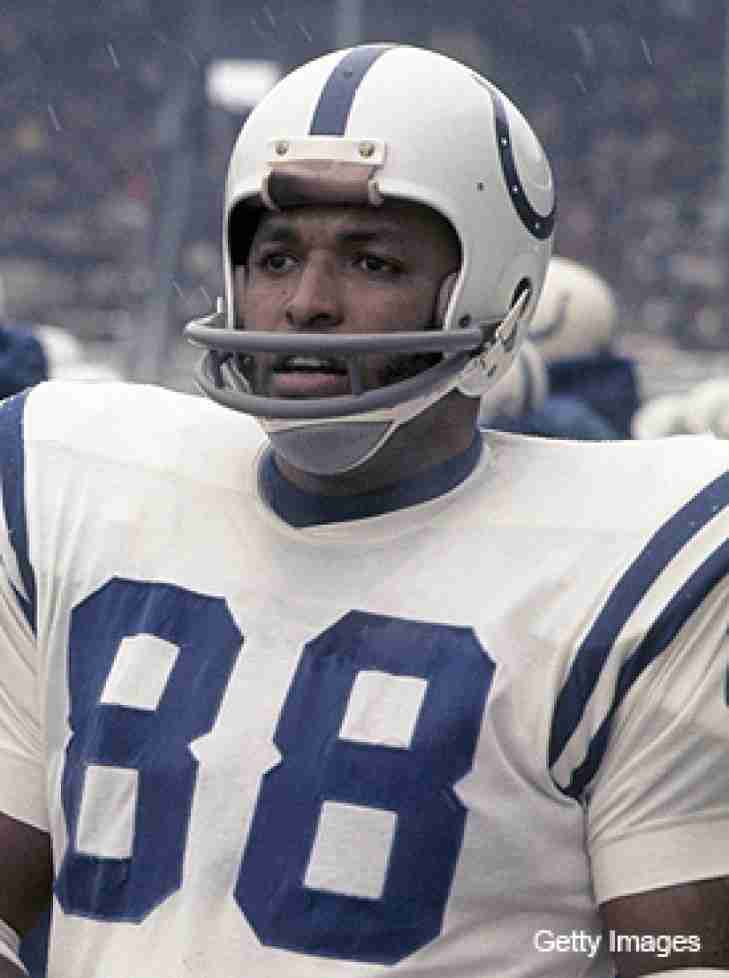
Drafted in the second round out of Syracuse in 1963, John Mackey arrived in Baltimore as a formidable athlete who revolutionized the tight end position. With a height of 6-foot-2 and a weight of 224 pounds, combined with sprinting speed and remarkable open-field balance, Mackey changed the role from mere blocker to a significant deep threat, consistently outrunning linebackers and breaking through secondaries.
Playing alongside legendary Hall of Fame quarterback Johnny Unitas, Mackey quickly established himself as one of football's most dynamic run-after-catch threats. Of his 38 career receiving touchdowns with the Colts, six covered 50 or more yards, including a career-high 89-yard catch against Detroit in 1966. His combination of raw power and top speed transformed simple seam passes into highlight-reel plays, and his exceptional blocking solidified the Colts' ground game. A three-time First-Team AP All-Pro (1966-1968) and five-time Pro Bowler in Baltimore, he was a key offensive force during the franchise's late-1960s period of winning dominance.
Mackey's most memorable moment came in Super Bowl V against the Dallas Cowboys. In the second quarter, Unitas's pass was tipped by receiver Eddie Hinton and Cowboys defensive back Mel Renfro, then caught by Mackey, who ran 75 yards unimpeded for a historic touchdown. This play ignited Baltimore's 16–13 win and earned him his first Super Bowl ring, adding to his 1968 NFL Championship.
Beyond his staggering athletic feats, Mackey served as the second president of the NFL Players Association following the 1970 AFL-NFL merger, courageously fighting for player free agency and pension rights. After concluding his playing career with a single season in San Diego in 1972, his game-changing impact earned him selection to the NFL 1960s All-Decade Team and enshrinement as only the second tight end in the Pro Football Hall of Fame in 1992.
In Baltimore, Mackey compiled 320 receptions, 5,126 receiving yards, and 38 receiving touchdowns.
12. Jeff Saturday
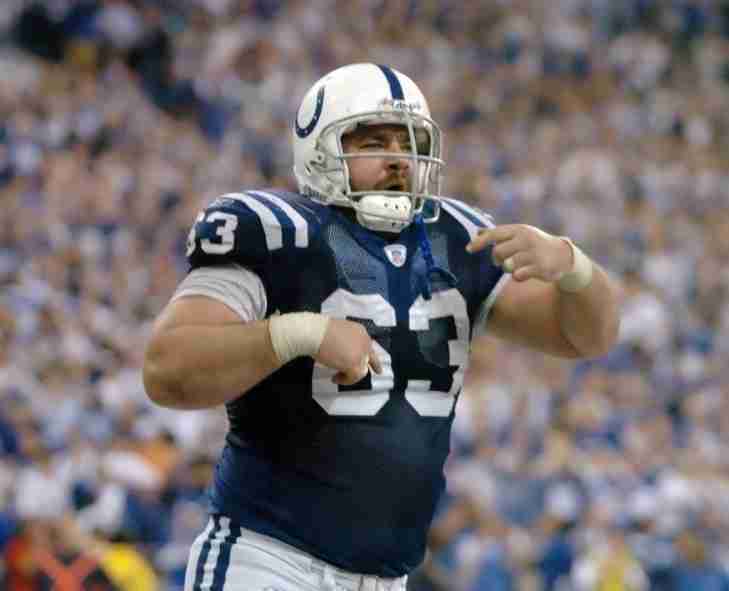
Unheralded out of North Carolina and bypassed entirely in the 1998 NFL Draft, Jeff Saturday took an unlikely road to gridiron prominence. Cut by the Baltimore Ravens without taking a snap, he was selling electrical supplies when former college teammate Nate Hobgood-Chittick helped arrange an audition for Indianapolis executives. Signed in 1999, the 6-foot-2, 295-pound center quickly used his leverage, football IQ, and lateral quickness to lock down the middle of the offensive line.
Inserted into the starting lineup full-time in 2000, Saturday formed an almost telepathic partnership with quarterback Peyton Manning at the line of scrimmage. Given free rein to call out protections and make pre-snap adjustments in Howard Mudd's scheme, Saturday spent more than a decade diagnosing complex defensive fronts in real-time. His synchronization with Manning became the backbone of the Colts’ high-powered No-Huddle offense, anchoring an offensive line that consistently surrendered the fewest sacks in the league—including NFL-low marks in 2004, 2005, and 2006.
Saturday’s top individual performance echoed the franchise’s prime years. A two-time First-Team AP All-Pro (2005, 2007) and two-time Second-Team All-Pro (2006, 2009), he was also named the NFL Alumni Offensive Lineman of the Year in 2007. He received five Pro Bowl nods in Indianapolis and a sixth in his final season with Green Bay. The highlight of his career was in the 2006 AFC Championship Game against New England, where he recovered a vital fumble in the end zone for a touchdown and blocked to secure the win, propelling the Colts to Super Bowl XLI, where they beat Chicago 29–17.
Remarkably durable throughout his tenure, Saturday played in 132 consecutive games at one point, and over his 13 seasons, he started 188 of his 197 games played for the franchise. After finishing his playing career with a single season in Green Bay in 2012, he cemented his legacy in Circle City history when he was inducted into the Indianapolis Colts Ring of Honor in 2015.
6. Raymond Berry
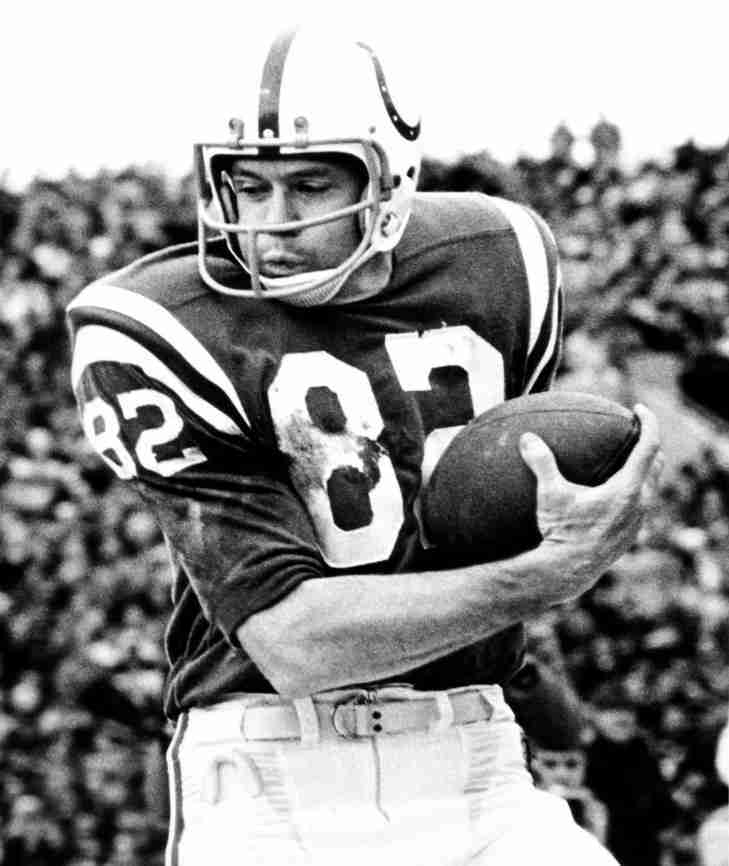
Overcoming a shortened leg, wearing a back brace, and dealing with poor eyesight that required thick-lensed glasses on the field, Raymond Berry turned physical adversity into legendary mastery. Drafted out of SMU in the 20th round in 1954, Berry spent hours after practice running routes until dark, pioneering precise route running and turning wide receiver play into a science.
Berry's relentless pursuit of perfection made him an ideal opponent for Johnny Unitas, forming the iconic passing duo of the 1950s. Though he lacked top-tier speed, Berry designed more than 50 different route variations, employing deceptive head fakes, quick cuts, and precise footwork to break away from defenders. With soft, dependable hands and a well-known grip-strengthening routine, he rarely let the ball slip and significantly reduced fumble occurrences.
His peak years, from 1957 through 1960, saw him dominate the league with mechanical precision. Berry led the NFL in receiving yards three times (1957, 1959, 1960) and in receptions three times (1958–1960), capturing the receiving "Triple Crown" in 1959 by leading the league in catches (66), yards (959), and receiving touchdowns (14). He earned three consecutive First-Team All-Pro honors (1958–1960) and was selected to six Pro Bowl rosters.
When championship stakes were highest, Berry was untouchable. In "The Greatest Game Ever Played"—the 1958 NFL Championship Game against the New York Giants—Berry caught 12 passes for 178 yards and a touchdown, including three critical receptions on the game-tying drive late in regulation to set up Baltimore's overtime victory. He followed that up with another title in 1959, cementing the Colts as a dominant force of the era.
Retiring as the NFL's all-time leader in receptions and receiving yards at the time, Berry's relentless work ethic established the modern template for route-running technique.
Berry compiled 631 receptions, 9,275 receiving yards, and 68 receiving touchdowns, along with two NFL Championship titles (1958, 1959). He was named to the NFL 1950s All-Decade Team, 75th Anniversary Team, and 100th Anniversary Team. Berry was enshrined in the Pro Football Hall of Fame in 1973 and inducted into the Colts Ring of Honor.
5. Marvin Harrison
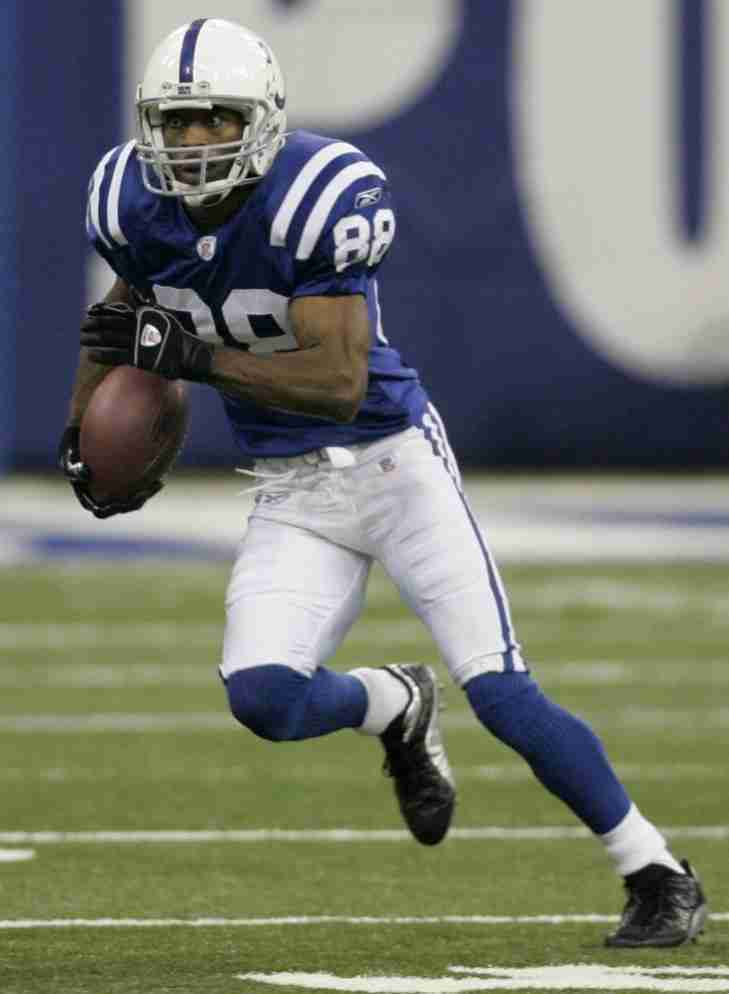
Quiet, unassuming, and ruthlessly clinical on the field, Marvin Harrison redefined route-running precision from the moment the Indianapolis Colts selected him 19th overall out of Syracuse in 1996. While he showed immediate promise over his first two seasons, his career reached supersonic speeds in 1998 with the arrival of rookie quarterback Peyton Manning. Together, they forged the most prolific and telepathic passing partnership in pro football history, completely torching NFL secondary schemes for a decade.
Harrison’s playing style relied on spatial mastery rather than physical frame. Operating at a lean 6-foot-0, he possessed an uncatchable release off the line of scrimmage, using sudden, violent footwork and quick hands to render press coverage completely useless. Opposing cornerbacks couldn't jam him, and his ability to sink his hips and make full-speed breaks on 90-degree angles left defenders flailing in open space.
Beyond his routes, Harrison was arguably the greatest boundary artist the sport has ever seen. He specialized in tiptoeing the sidelines, adjusting late to deep balls over his shoulder, and plucking passes out of the air with sticky, effortless hands before defenders could even react. His refusal to engage in trash talk or elaborate celebrations only heightened his terrifying aura; he simply handed the ball to the referee and lined up to destroy the defense again on the very next snap.
His absolute statistical peak from 1999 through 2002 stands as one of the most blistering four-year stretches by any receiver in gridiron history. During this span, Harrison averaged 120 receptions, 1,580 yards, and nearly 13 touchdowns per season. The masterpiece arrived in 2002, when he shattered Herman Moore's single-season record by hauling in an astonishing 143 receptions for 1,722 yards and 11 touchdowns—a mark that stood untouched for 17 years.
When the Colts finally broke through to win Super Bowl XLI over Chicago, Harrison served as the veteran offensive anchor. By the time he hung up his cleats, his telepathic chemistry with Manning had yielded NFL records for the most completions (953), passing yards (12,766), and passing touchdowns (112) by a QB-WR duo.
Harrison played in 190 regular-season games with 188 starts. He compiled 1,102 receptions, 14,580 receiving yards, and 128 receiving touchdowns, along with a Super Bowl XLI championship ring. An eight-time Pro Bowler, three-time First-Team All-Pro, two-time NFL receiving yardage leader, and member of the NFL’s 2000s All-Decade Team, Harrison was inducted into the Colts Ring of Honor in 2011 and enshrined into the Pro Football Hall of Fame in 2016.
