


Site Admin
14. John Kasay
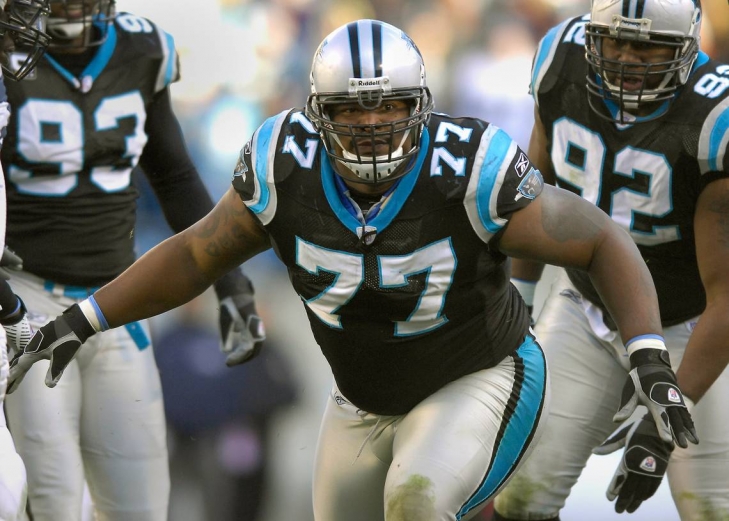
Drafted by the Seattle Seahawks in the fourth round of the 1991 NFL Draft out of Georgia, John Kasay spent four solid years in the Pacific Northwest before taking a leap in 1995. Signing as an unrestricted free agent with the expansion Carolina Panthers, the left-footed placekicker became the very first star player signed in franchise history and served as the scoring backbone of the organization for 16 seasons.
Kasay developed a lengthy career based on smooth mechanics, icy composure under pressure, and exceptional leg strength from long range. Throughout two decades of football in the Carolinas, he excelled in high-pressure situations, delivering low, powerful kickoffs and precise, rhythmic kicks on critical fourth-quarter drives. This made him one of the most dependable long-range kickers of his era.
Kasay made a remarkable impact during Carolina's 1995 expansion, scoring 26 field goals and establishing the franchise. His most outstanding individual achievement came in 1996 (not 2006), during a historic season that propelled the second-year Panthers to the NFC Championship. Kasay set an NFL single-season record at that time with 37 field goals and scored a league-high 145 points. His exceptional performance earned him his first Pro Bowl selection and Second-Team All-Pro honors.
Despite roster changes and championship campaigns, Kasay was the team's steady heartbeat. He made crucial postseason kicks in Carolina's journey to Super Bowl XXXVIII in 2003, successfully converting 9 out of 10 playoff field goals that month.
Even in his late thirties, his leg remained strong; Kasay, in 2006, made over 88% of his kicks and scored 28 field goals in 2008, contributing to Carolina's return to the playoffs.
After serving as the team's leading scorer for 16 years, Carolina released the veteran in August 2011 to make space for younger players. Kasay quickly signed with the NFC South rival New Orleans Saints for the 2011 season, where he made 28 field goals at age 42 before retiring. During his time with the Panthers, he made 351 field goals and scored a total of 1,482 points, a franchise record that remains unmatched. In 2019, he was inducted into the Panthers Hall of Honor.
10. Kris Jenkins
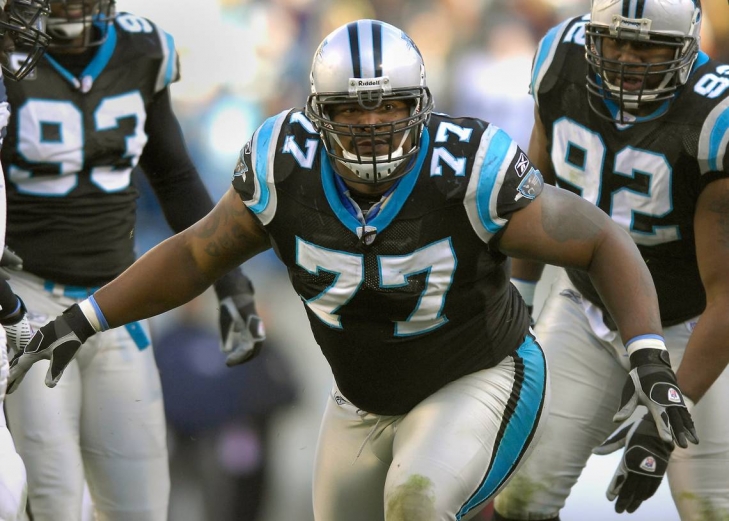
Taken in the second round (44th overall) of the 2001 NFL Draft out of Maryland, Kris Jenkins arrived in Charlotte as a massive interior force with rare, explosive agility. Seizing the starting right defensive tackle job early in his 2001 rookie campaign, Jenkins immediately transformed Carolina’s front four into a nightmarish matchup for opposing rushing attacks.
Standing 6 feet 4 inches tall and weighing over 335 pounds, Jenkins combined raw power with surprising agility, confusing interior offensive linemen. Playing as a defensive tackle with Brentson Buckner and Julius Peppers, he focused on defeating single blocks at the snap, forcing double-team blocks, and aggressively disrupting run plays before ball carriers could reach the line of scrimmage.
Jenkins made a significant leap from his rookie flashes to become a dominant force in 2002. He finished the season with 7.0 sacks and established himself as the top interior run-stopper in the league, earning a first Pro Bowl and a First-Team All-Pro honor. He continued his excellence into 2003 with an equally impactful 5.0 sacks, helping lead a defense that took Carolina to Super Bowl XXXVIII. His interior pass-rushing prowess once again earned him a Pro Bowl selection and a First-Team All-Pro recognition.
As Jenkins was establishing himself as the leading interior tackle of his time, misfortune struck. Serious injuries cut short his next two seasons, with only one game in 2004 (shoulder) and four games in 2005 (ACL tear). These injuries limited him to just five games over two years, depriving him of what could have been his peak statistical years.
Jenkins showed impressive resilience by recovering fully in 2006. He regained his position at the core of the defense and delivered an outstanding season, earning his third Pro Bowl pick with the team.
After seven seasons as the defensive line's emotional and physical anchor, Jenkins was traded as defensive schemes shifted and salary considerations changed. In February 2008, Carolina sent Jenkins to the New York Jets, where he immediately earned his fourth career Pro Bowl selection in his first year in the AFC. With Carolina, Jenkins played in 85 regular-season games (79 starts), recording 20.5 sacks and 216 total tackles.
9. Jake Delhomme
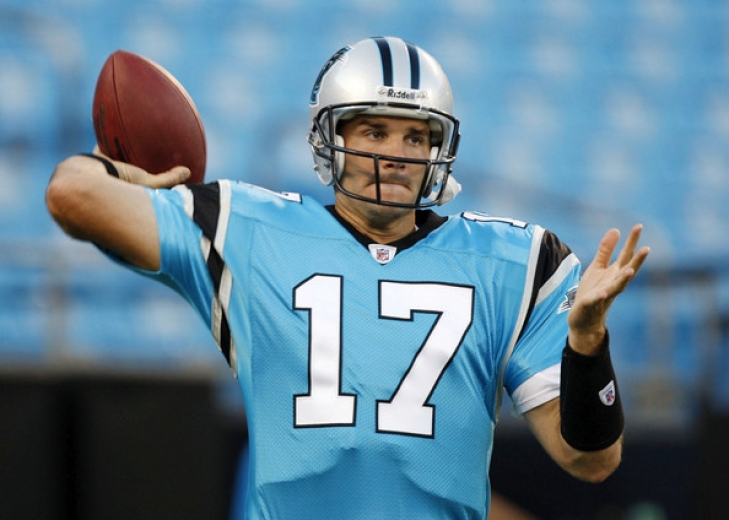
Unrated and overlooked as an undrafted free agent out of Southwestern Louisiana in 1997, Jake Delhomme spent six years grinding on practice squads, in NFL Europe, and backing up Aaron Brooks in New Orleans. Signing with Carolina in 2003, he stepped off the bench in Week 1 to ignite a second-half comeback victory—and immediately captured the heart of the franchise.
Delhomme brought intense fire, rapid decision-making, and an unshakeable late-game clutch factor to Foxboro-style cardiac games. Operating John Fox’s run-heavy, play-action offense, he possessed the rare courage to stand in against interior pressure and launch vertical boundary strikes to receivers like Steve Smith Sr. and Muhsin Muhammad. His hallmark was his Fourth-Quarter magic—Delhomme earned the nickname "Ragin' Cajun" for his ability to lead dramatic, game-winning drives when everything was on the line.
Delhomme’s first season in 2003 was like a Hollywood story. He set an NFL record with seven game-winning drives during the regular season, leading the "Cardiac Cats" to the playoffs. In four playoff games, he threw for 987 yards, including an exciting double-overtime win in St. Louis. He also set an NFL postseason record with an 85-yard touchdown pass to Muhsin Muhammad in Super Bowl XXXVIII.
He built on his impressive streak over the following two years. In 2004, even though he lost key offensive players to injury, Delhomme achieved a career-high 3,886 passing yards and 29 touchdowns. His peak came in 2005 when he threw for 3,421 yards and 24 touchdowns, earning his first Pro Bowl selection. Delhomme then guided Carolina to away playoff wins against the Giants and Bears, advancing to the NFC Championship Game.
After missing three games due to a thumb injury in 2006, adversity struck again in 2007 when Delhomme suffered a season-ending Tommy John elbow injury just three games into the year. He made a triumphant return in 2008, throwing for 3,288 yards and leading Carolina to a 12–4 record and an NFC South title. However, the season ended on a crushing note when he threw five interceptions in a playoff loss to Arizona on his birthday.
Believing in his leadership, the organization signed Delhomme to a lucrative five-year contract extension in the spring of 2009. But the magic faded in 2009. Plagued by turnovers and a nagging finger injury that landed him on injured reserve, Delhomme struggled through 11 starts. In March 2010, the Panthers made the difficult business decision to release the veteran quarterback. He closed out his career with brief stops in Cleveland (2010) and Houston (2011).
In his seven seasons in Charlotte (2003–2009), Delhomme started 90 regular-season games, accumulating 19,258 passing yards, 120 touchdowns, and a franchise-record 21 game-winning drives. He also won five postseason games as a starter.
7. Muhsin Muhammad
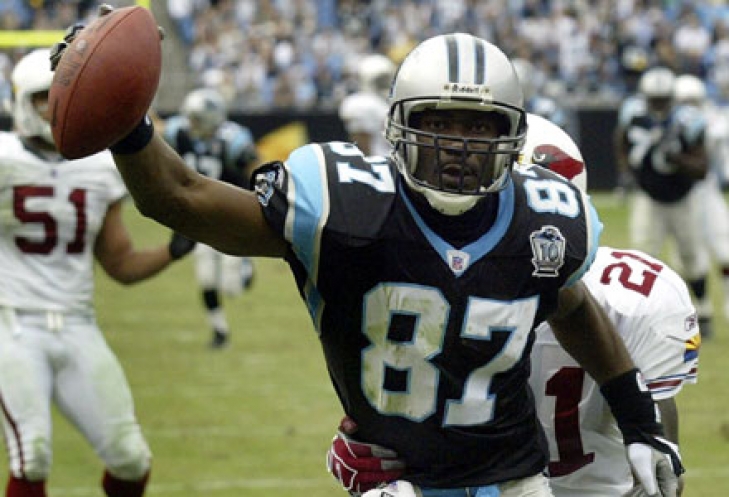
Drafted 43rd overall in the second round of the 1996 NFL Draft from Michigan State, Muhsin Muhammad joined Charlotte during the team's second year. Known as "Moose" for his formidable size and aggressive playing style, he developed into a top possession receiver and a highly regarded blocking wideout in modern NFL history.
Muhammad brought a running back's physical mindset to the wide receiver position. Operating on the outside, he was renowned for his elite contested-catch radius, using heavy hands and strong body positioning to shield off cornerbacks on intermediate slants and dig routes. Equally vital was his commitment to the dirty work of the offense: Muhammad was widely regarded as one of the league's top run-blocking receivers, regularly cracking down on linebackers and sealing the boundary edges to spring tailbacks like Stephen Davis and DeShaun Foster for massive gains.
After a quiet start to his career, Muhammad exploded in 1999, catching 96 passes for 1,253 yards and eight touchdowns, earning his first Pro Bowl selection. He followed that in 2000 by co-leading the NFL with 102 receptions for 1,183 yards, cementing his status as a premier volume receiver.
Muhammad was crucial in Carolina's journey to Super Bowl XXXVIII in 2003. During the title game against New England, he made a memorable 85-yard touchdown catch from Jake Delhomme, marking the longest touchdown reception in Super Bowl history.
His best season came in 2004. With injuries across the offense, Muhammad carried Carolina's passing attack and led the NFL in receiving yards (1,405) and receiving touchdowns (16), catching 93 passes. That transcendent performance earned him First-Team All-Pro honors and his second Pro Bowl invitation.
A contract dispute following his career year led to a three-season stint with the Chicago Bears (2005–2007), during which he helped guide the Bears to an appearance in Super Bowl XLI.
Muhammad returned to Charlotte in 2008, offering veteran leadership with Steve Smith Sr. During that season, he caught 65 passes for 923 yards, contributing to Carolina's 12–4 record. In Week 2, he became the 29th NFL player to exceed 10,000 career receiving yards.
After his final season in 2009, Muhammad retired with 11,438 career receiving yards and 62 touchdowns. Over his 11 seasons with Carolina, he caught 696 passes for 9,255 receiving yards and 50 touchdowns in 155 regular-season games. The franchise inducted Muhammad into the Carolina Panthers Hall of Honor in 2023, alongside Julius Peppers.
