

24. Doug Smith

Doug Smith spent his entire career with the Los Angeles Rams after going undrafted out of Bowling Green in 1978. He began as a backup center and later played right guard during his first few seasons, earning his way onto the roster through consistent work. By 1982, he had become the permanent starting center, a role he held for the rest of his time in Los Angeles. Smith was not a high-profile prospect coming out of college, but he proved durable enough to stay healthy and productive for more than a decade.
Once he settled at center, Smith became the anchor of a strong offensive line. From 1984 through 1989, he earned Pro Bowl selections every year. Those seasons coincided with multiple playoff appearances for the Rams, including runs that featured Eric Dickerson in the backfield and later Jim Everett at quarterback. Smith was a steady technician who handled the calls at the line and kept the pocket clean. He played alongside other longtime linemen and helped the unit stay balanced between the run and the pass.
The Rams reached the postseason in six of the seasons after Smith became the full-time starter. He started the large majority of the games he played and rarely missed time once he locked in the center spot. His quickness off the ball and reliability in pass protection made him a fit for the schemes the Rams ran during that stretch. Smith stayed the starter through the late 1980s even as the roster turned over around him.
He played through the 1991 season before retiring. In L.A., he appeared in 180 games across 14 seasons, an impressive total for an undrafted player. Those numbers reflect both his longevity and the trust the coaching staff placed in him at the most important interior position.
Smith’s six consecutive Pro Bowl selections mark the peak of his career, while the full 14 seasons show the foundation he built from an overlooked start. He gave Los Angeles a reliable center who helped the offensive line compete in the playoffs for years.
30. Rich Saul

Rich Saul arrived in Los Angeles as an eighth-round pick from Michigan State in 1970 and spent his first several seasons on the bench. He played special teams and backed up at multiple spots on the offensive line before winning the starting center job in 1975. Once he took over the position, he became a steady presence in the middle of the line. Saul was a smart, physical blocker who made the line calls and helped the Rams stay among the better rushing teams in the league.
Beginning in 1976, he earned a Pro Bowl selection every year through 1981, a six-year run that covered the peak of his career. Those teams won the NFC West repeatedly and reached Super Bowl XIV after the 1979 season. Saul started at center in that game against Pittsburgh and played on an offensive line that included other longtime Rams such as Tom Mack, Dennis Harrah, and Jackie Slater. In 1980, he earned Second-Team All-Pro honors while the Rams continued to contend. He was known for his quickness off the ball and his ability to execute cut blocks in the run game.
Saul remained the starter through the 1981 season even as the Rams began to slip from their earlier form. He played in every game that year and closed out his career after a 6-10 finish. In his 12 NFL campaigns, he appeared in 176 games and started 106, a stretch of durability that included consecutive regular-season appearances for most of his time in Los Angeles.
He retired after 1981. With the Rams, he finished as a six-time Pro Bowl center who helped the franchise reach the Super Bowl and remain competitive throughout the late 1970s and early 1980s. His consistency at the position and the recognition he earned over those six seasons marked him as one of the more reliable interior linemen of his era.
Saul later remained connected to the game in the Los Angeles area. He is remembered as the center who anchored the Rams’ line during one of the more successful stretches in franchise history.
29. Dennis Harrah

Dennis Harrah spent his entire 13-year career with the Los Angeles Rams after they selected him 11th overall out of Miami in the 1975 Draft. He came off the bench as a rookie, playing special teams while backing up at guard. The next year he won the starting right guard job and held that spot for the rest of his time in Los Angeles. Harrah was a large, athletic lineman who could pull in the run game and hold up in pass protection, and he quickly became a regular on an offensive line that helped the Rams win the NFC West six times.
He earned the first of his six Pro Bowl selections in 1978 and followed it with two more consecutive nods in 1979 and 1980. Those years came during a stretch when the Rams reached the playoffs repeatedly and advanced to Super Bowl XIV after the 1979 season. Harrah was part of a strong front that included other longtime starters, and the unit helped open holes for the running game while protecting the quarterbacks. He missed time with injuries in some seasons but remained the primary right guard whenever he was healthy.
After a quieter stretch in the early 1980s, Harrah returned to the Pro Bowl for three straight years from 1985 to 1987. In 1986, he earned First-Team All-Pro honors, his highest individual recognition. That second peak came as the Rams again contended in the NFC West, and Harrah still started and played at a high level into his mid-30s. He was also a team captain for six seasons, reflecting the respect he earned from teammates and coaches.
Harrah played his final season in 1987 and retired afterward. As a Ram, he appeared in 168 games and started 144. Those totals, along with the six Pro Bowl selections and the All-Pro nod, marked a long and productive career at a demanding position.
He later made the Rams’ 40th Anniversary Team. Harrah gave Los Angeles a durable and consistent right guard who helped the offense stay competitive through multiple coaching changes and roster turns over more than a decade.
27. Nolan Cromwell

Nolan Cromwell spent his entire 11-year NFL career with the Los Angeles Rams after they drafted him in the second round out of Kansas in 1977. He began as a backup and special-teams contributor, then moved into the starting free safety role in his third season. Cromwell quickly showed the range and anticipation that would define his game, and he helped the Rams reach Super Bowl XIV in his first year as a full-time starter.
He peaked in the early 1980s. From 1980 to 1982, Cromwell earned First-Team All-Pro honors each season, and he added a fourth consecutive Pro Bowl selection in 1983. In 1980, he intercepted eight passes, led the team in that category, and earned NFC Defensive Player of the Year honors. Cromwell was a classic free safety of that era, reading routes early and closing on the ball with enough speed to turn potential completions into turnovers. He also returned four of his interceptions for touchdowns during his career.
Cromwell remained a starter for most of his remaining time in Los Angeles, even as the defensive scheme shifted and he sometimes moved between free and strong safety. The Rams continued to reach the playoffs in several of his later seasons, and he stayed productive as a ball hawk who could still make plays in coverage. Injuries limited him at times in the mid-1980s, but he kept his place on the field through 1987.
He retired after the 1987 season. As a Ram, he finished with 37 interceptions and 671 interception-return yards, the franchise record for return yardage at the time. Those numbers, along with his four Pro Bowl selections and three All-Pro nods, marked him as one of the better safeties of his generation.
After his playing days concluded, Cromwell moved into coaching and later won a Super Bowl as the special-teams coach for the Green Bay Packers in Super Bowl XXXI. He was also named to the NFL’s 1980s All-Decade Team, a fitting recognition for the range and playmaking he brought to the Rams secondary for more than a decade.
23. Charlie Cowan

Charlie Cowan spent his entire 15-year career with the Los Angeles Rams after they drafted him in the fourth round out of New Mexico Highlands in 1961. The team converted him from a college fullback to the offensive line, and he settled in quickly enough to start games as a rookie. Over the years, he shifted between left guard, right tackle, and left tackle, showing he could handle whatever spot the line needed. Cowan was not flashy, but he was a steady presence who protected the quarterback and opened lanes for the run.
He became a regular starter by the mid-1960s and earned his first recognition late in the decade. From 1968 to 1970, he was selected to the Pro Bowl each season. Cowan also earned Second-Team All-Pro honors twice, in 1968 and 1973. Those years came as the Rams built strong teams on both sides of the ball, and his consistency on the line helped keep the offense balanced. He played next to longtime teammates like Joe Scibelli and Tom Mack, forming a durable front that protected Roman Gabriel and the quarterbacks who followed.
Cowan’s durability stood out over the long haul. He appeared in 206 games for the Rams, a franchise record at the time he retired. He started the large majority of those contests and stayed healthy enough to play into his late 30s. The Rams reached the playoffs several times during his later seasons, including NFC Championship appearances, and Cowan remained part of the line through those runs.
He played his final season in 1975 and retired afterward. With Los Angeles, he was never considered the franchise's best lineman, but his length of service and reliable play earned him a place among the more substantial contributors of his era. Cowan blocked for a succession of quarterbacks and running backs without missing extended time, which was rare for an offensive lineman in that period.
His three Pro Bowl selections and two All-Pro nods reflect the peak of his career, while the 206 games speak to the steadiness that defined the rest of it. Cowan gave the Rams a versatile and dependable presence up front for a decade and a half.
22. Jim Benton

Jim Benton was one of the first true stars for the Cleveland Rams after they selected him out of Arkansas in the 1938 Draft. As a rookie, he led the NFL in yards per reception, even though his 418 yards look modest by today’s standards. The game was different then, and Benton quickly showed he could stretch the field. In 1939 he led the league in touchdown receptions with seven and earned a Pro Bowl selection. After a solid 1940 season, he stepped away for a year to coach high school football, something more common in that era when salaries were low.
He returned in 1942, but World War II depleted rosters and the Rams suspended operations. Benton spent 1943 with the Chicago Bears, helping them win the NFL Championship. He came back to Cleveland when the Rams resumed play in 1944 and immediately re-established himself as a dangerous end. Benton had a long reach and reliable hands, and he specialized in big downfield plays rather than piling up short catches.
The 1945 season was the high point of his career with the Rams. He led the NFL with 1,067 receiving yards in only nine games and earned First-Team All-Pro honors. On Thanksgiving, he caught 10 passes for 303 yards against Detroit, a single-game record that stood for decades. Benton also contributed in the championship game as Cleveland beat Washington for the title. The next year the franchise moved to Los Angeles, and Benton led the league again in receiving yards with 981 while also topping the NFL in receptions with 63. He earned another All-Pro selection.
Benton played one more season in Los Angeles before retiring after 1947. As a Ram, he finished with 4,566 receiving yards. At the time of his retirement, he ranked second all-time in the NFL in receiving yards, behind only Don Hutson. Those numbers were exceptional for an era that still favored the run.
Benton was named to the NFL’s 1940s All-Decade Team. He won two championships, one with the Bears and one with the Rams, and his big-play ability helped the franchise establish itself both in Cleveland and after the move to Los Angeles.
21. Roman Gabriel

Roman Gabriel stood out the moment he arrived in Los Angeles. At 6-foot-5 and more than 220 pounds, the North Carolina State product looked more like a linebacker than the second overall pick in the 1962 Draft. He spent his first few seasons sharing snaps with veterans Zeke Bratkowski and Bill Munson before new head coach George Allen ended the competition in 1966 and named him the clear starter. Gabriel answered with a steady season and quickly built a reputation for protecting the ball in an era when interceptions were common.
He found his rhythm in 1967 and earned the first of three consecutive Pro Bowl nods. That year he threw for 2,779 yards and 25 touchdowns as the Rams went 11-1-2. Gabriel combined a strong arm with enough size and toughness to run on short-yardage plays when the defense stacked the box. In 1969, he put together his best season with the club, throwing 24 touchdowns against only seven interceptions and winning NFL MVP. Los Angeles won 11 games and reached the playoffs, though the postseason run ended in a loss.
From 1966 to 1972, Gabriel finished among the league’s top ten in passing yards in most seasons. He was a careful passer who still pushed the ball downfield, and the Rams’ strong defenses during those years made his steady play even more valuable. He stayed the primary quarterback into the early 1970s even as the supporting cast and coaching staff shifted around him.
After the 1972 season, Gabriel left Los Angeles and signed with the Philadelphia Eagles. With the Rams, he threw for 22,223 yards and 154 touchdowns. Those numbers stood as franchise records for years, and the touchdown total remains the highest in team history.
Gabriel earned four Pro Bowl selections in his career, three of them with the Rams, along with the 1969 MVP award. He took longer than most high draft picks to become the full-time starter, but once he did, he gave Los Angeles one of the more reliable and productive quarterbacks of that era.
18. Henry Ellard

The Rams selected Henry Ellard in the second round out of Fresno State in 1983, and he immediately showed he could contribute in multiple ways. The Rams used him early on as both a wide receiver and a punt returner. He led the NFL in punt-return average as a rookie and kept producing big returns the next year. In 1984, he earned First-Team All-Pro and Pro Bowl honors as a returner after taking two punts back for touchdowns, one of 83 yards and another of 69. He also caught passes, but his return work gave him extra chances to impact games while the offense was still finding its balance.
Ellard’s role expanded as a receiver, and he became a consistent deep threat with precise routes and the speed to separate. From 1988 through 1991, he topped 1,000 receiving yards each season. In 1988 he led the NFL with 1,414 yards and earned another First-Team All-Pro selection. He finished fourth in the league in receiving yards the next year and second the year after that, posting 1,382 and 1,294 yards respectively. Those seasons established him as one of the better wideouts in the league and the clear lead receiver for the Rams.
He stayed productive in Los Angeles after that stretch, though the yardage totals dipped as the offense changed. Ellard finished his time with the Rams after the 1993 season. With the club, he totaled 593 receptions and 9,761 receiving yards, both franchise records at the time he left. He also added strong return numbers earlier in his career that helped set up the offense.
Ellard signed with the Washington Redskins and had three more 1,000-yard seasons there. With the Rams, he earned three Pro Bowl selections and two All-Pro nods, one as a returner and one as a receiver. His early return ability and steady production later made him one of the franchise’s more reliable offensive weapons during the 1980s and early 1990s.
38. LeRoy Irvin

LeRoy Irvin arrived as a third-round pick out of Kansas in 1980 and made his mark first as a return man. In his second season, he led the NFL in punt return yards and yards per return, earning First-Team All-Pro honors as a special-teams player. Against Atlanta that year, he returned two punts for touchdowns and set a still-standing single-game record with 207 return yards. He was quick, decisive, and dangerous with the ball in his hands. The Rams used him sparingly on returns after that, but the early reputation was already set.
He transitioned into a full-time cornerback and became a steady presence in the secondary. In 1985 and 1986, he earned Pro Bowl selections. The second of those seasons brought another First-Team All-Pro nod, this time at his natural position. Irvin was a ball-hawking corner with quick feet and a willingness to jump routes. He finished his Rams career with 34 interceptions and returned five of them for touchdowns. He also scored four times on special teams, giving him 10 total touchdowns. Those numbers came while the Rams made the playoffs seven times during his tenure, including NFC Championship appearances in 1985 and 1989.
The strongest stretch was clear. The early return success and the mid-decade Pro Bowl seasons showed he could produce in two different roles. After 1986, the interception totals dropped, and the individual awards stopped. He remained a starter for a few more seasons, but the big plays became less frequent. The Rams released him after the 1989 season.
Irvin spent one final year with Detroit before retiring. With the Rams, he was a two-time Pro Bowler and a rare player who earned First-Team All-Pro honors as both a punt returner and a cornerback. He compiled 34 interceptions with 2,240 all-purpose yards.
35. Jack Reynolds

Jack Reynolds earned the nickname “Hacksaw” the hard way. After a tough loss at Tennessee, he took a hacksaw to an old car and cut it in half to burn off his frustration. The Rams liked the intensity enough to take him 22nd overall in 1970. He spent his first few seasons coming off the bench on a veteran defense before winning the starting middle linebacker job in 1973. Once he got there, he stayed there. Reynolds was a tough, instinctive player who diagnosed runs quickly and filled gaps with force. He wasn’t the biggest or fastest linebacker, but he rarely missed assignments and played with a constant edge.
The Rams of the mid-to-late 1970s were regular contenders, and Reynolds was a steady presence in the middle of the defense. He earned Pro Bowl selections in 1975 and 1980. In between those honors, he helped the team win the NFC West multiple times and reach the playoffs almost every year. He played in Super Bowl XIV after the 1979 season. Individual awards were limited, yet teammates and coaches trusted him in the biggest games. He finished with 145 games for Los Angeles and started the large majority of them once he took over the job.
The Rams released him after the 1980 season. He signed with San Francisco and won two Super Bowls there, but that chapter came after he left Los Angeles. As a Ram, he was a two-time Pro Bowler who had started for most of a decade and helped the franchise stay competitive through the 1970s. The early years were quiet. The middle stretch brought the Pro Bowls and the playoff runs. The end was abrupt.
Reynolds left behind a reputation for toughness and reliability. He was the middle linebacker who showed up every week, made the calls, and hit people. The Super Bowls came later with another team, but the bulk of his career and the nickname that stuck were built in Los Angeles.
28. Lawrence McCutcheon

Lawrence McCutcheon was the Rams’ top rusher for much of the 1970s after they selected him in the third round out of Colorado State in 1972. He saw almost no action as a rookie, then took over as the starting running back in 1973 under new coach Chuck Knox. That year he rushed for 1,097 yards and earned the first of five consecutive Pro Bowl selections. McCutcheon was a durable back who thrived in Knox’s run-heavy scheme, carrying the ball between the tackles and also contributing as a receiver.
From 1973 to 1977, he led the Rams in rushing every season and finished among the league’s top five in rushing yards four times. He topped 1,000 rushing yards in four of those years and posted more than 1,500 yards from scrimmage in both 1974 and 1976. In 1974, he earned Second-Team All-Pro honors while finishing high in yards from scrimmage and all-purpose yards. McCutcheon also had a standout playoff performance in 1975, rushing for 202 yards in a win over the St. Louis Cardinals. Those seasons established him as one of the league’s more consistent backs, even if he rarely got the same attention as some of the era’s bigger names.
Injuries limited him in 1978, and by 1979 he was sharing carries with younger backs. He still contributed in the postseason as the Rams reached Super Bowl XIV. In that game, McCutcheon threw a 24-yard touchdown pass on a halfback option that briefly gave Los Angeles the lead before Pittsburgh pulled away. The Rams made the playoffs in each of his final seven seasons, and he remained a reliable piece of the offense throughout that stretch.McCutcheon left the Rams after the 1979 season and finished his career with brief stops in Denver, Seattle, and Buffalo. With Los Angeles, he rushed for 6,186 yards and 23 touchdowns while adding 1,683 receiving yards and 12 more scores. Those totals made him the franchise’s all-time leading rusher when he departed.
His five straight Pro Bowl selections and the four 1,000-yard seasons capture the heart of his career with the Rams. McCutcheon was sometimes overlooked compared with other runners of the decade, but his production and durability made him one of the steadiest contributors on those Los Angeles teams.
46. Marc Bulger
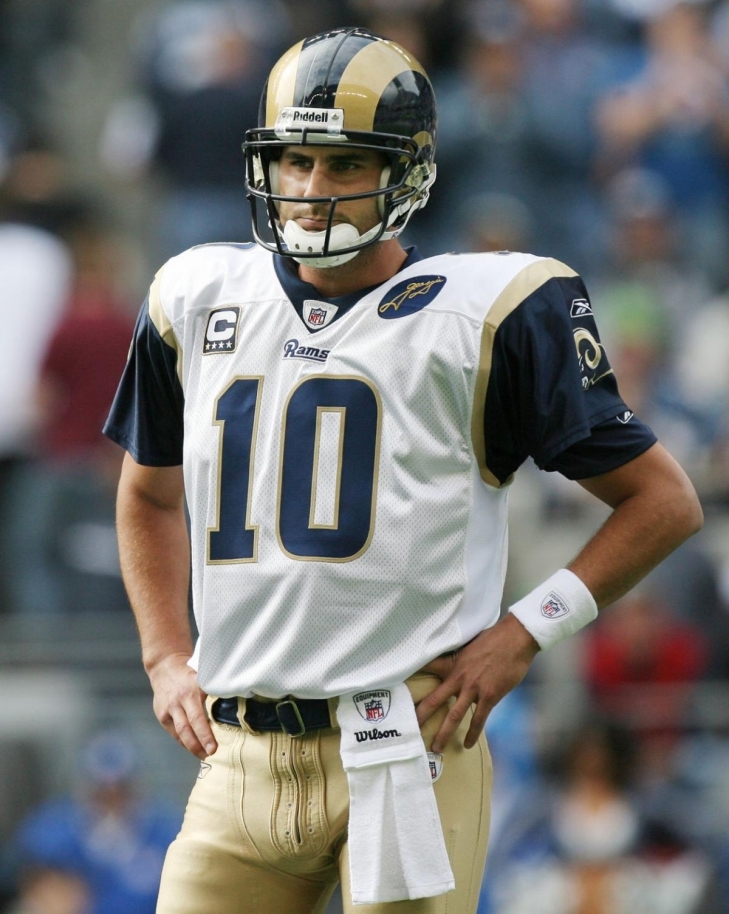
Marc Bulger had the dubious task of replacing Kurt Warner as the starting quarterback for the St. Louis Rams, but it took time—which, given how long it took Warner to land the job, was appropriate.
The New Orleans Saints selected Bulger in the sixth round of the 2000 draft out of West Virginia. He never made the roster there, spent a brief time on the Atlanta Falcons’ practice squad, and eventually landed on the St. Louis Rams’ practice squad late in the 2000 season. He re-signed with the Rams in January 2001 and spent that year as the third-string quarterback, inactive for the entire regular season and Super Bowl run. In 2002, after the Rams started 0-5 and both Warner and Jamie Martin went down, Bulger stepped in. He went 6-1 as a starter, completing 64.5 percent of his passes for 1,826 yards, 14 touchdowns, and only six interceptions, and earned team MVP honors.
Mike Martz named him the full-time starter in 2003. Bulger responded by leading the Rams to a 12-4 record and an NFC West title, throwing for 3,845 yards and 22 touchdowns. He earned the first of two Pro Bowl selections that year (the other came in 2006) and was named Pro Bowl MVP. He continued as the starter through the mid-2000s, posting strong seasons in 2004 (3,964 yards) and a career-high 4,301 yards with 24 touchdowns in 2006. After that 2006 campaign, the Rams signed him to a six-year, $65 million extension, making him the highest-paid player in franchise history. Injuries and a declining offensive line took a toll afterward; the team went 6-42 from 2007 to 2009, and Bulger’s efficiency dropped amid heavy sacks and limited protection.
On April 5, 2010—his 33rd birthday—the Rams released him, clearing the way for the selection of Sam Bradford with the first overall pick. Bulger spent 2010 as a backup with the Baltimore Ravens without playing a regular-season snap, then retired in August 2011.
Over his career, Bulger compiled 22,814 passing yards, 122 touchdowns, 93 interceptions, 62.1 percent completion rate, with an 84.4 passer rating.
39. Kent Hill

Kent Hill was a first-round pick out of Georgia Tech in 1979 and won the starting left guard job as a rookie. He was one of the few new faces in the lineup when the Rams reached Super Bowl XIV. At 6-5 and around 260 pounds, he had the size to hold up inside and the feet to pull or protect the pass. He stayed in the starting lineup for most of the next seven seasons and rarely missed games.
The individual recognition started quickly. He made the Pro Bowl in 1980 and then earned four more selections from 1982 through 1985. Those years lined up with some of the era's best offensive stretches, including the 1984 season, when he helped open holes for Eric Dickerson’s record 2,105 rushing yards. Hill was a durable, physical guard who could move people in the run game and stay in front of pass rushers. He started 102 of the 107 games he played as a Ram and was a steady presence on lines that kept the team competitive.
The early success and the Pro Bowl run were the high points. He remained a starter into the mid-1980s, but the production and the awards tapered off after 1985. In 1986, he appeared in only two games for Los Angeles before the Rams traded him to Houston. The move ended a stretch defined by durability and consistent play rather than flashy moments.
With the Rams, he was a five-time Pro Bowler who held down left guard for most of a decade. The 1980 selection and the four-year run that followed marked the strongest period of his career. The later seasons brought fewer accolades and a quick exit. He finished his time in Los Angeles as a reliable interior lineman who helped the offense move the ball, especially when the Rams leaned on the run.
37. Jack Snow

Jack Snow was taken eighth overall in the 1965 draft, but he never played a snap for the team that picked him. The rights quickly moved to the Los Angeles Rams, where he spent his entire 11-year career. A Notre Dame product with good size and soft hands, he stepped into the starting lineup as a rookie and stayed there for most of the next decade. Snow was not the flashiest receiver of his era, yet he had a knack for the deep ball and the toughness to work across the middle. Roman Gabriel trusted him on those routes, and Snow rarely dropped the ones he got his hands on.
The clear peak arrived in 1967. He caught only 28 passes, but they went for 735 yards and eight touchdowns, a 26.3-yard average that led the NFL. That production earned him a Pro Bowl selection. In one game against Baltimore, he scored on 53- and 80-yard catches. He was the kind of receiver who could take a short throw and turn it into a long gain, or stretch the field when Gabriel looked his way. The numbers weren’t huge by modern standards, but in a run-heavy offense, they stood out.
He kept producing after that. In 1970 he finished fifth in the league in receptions and ninth in receiving yards with 51 catches for 859 yards and seven touchdowns. He remained a starter through 1974 and helped the Rams reach the playoffs several times. The later seasons brought fewer targets and fewer big plays. By 1975, he was mostly a reserve, and the production dropped sharply. The deep threat was still there on occasion, but the volume was gone.
Snow retired after the 1975 season with 340 catches for 6,012 yards and 45 touchdowns, all of them with the Rams. The 1967 season was the one that earned him a Pro Bowl selection. The years around it were solid and steady, not spectacular. He was a reliable target for Gabriel on teams that mixed a strong running game with enough passing to keep defenses honest. The early career was promising, the middle stretch brought the best numbers, and the end was quieter.
After football, he stayed connected to the game as a Rams broadcaster. The receiver, who once led the league in yards per catch, finished his career with the same team that acquired him before he ever played a down. The totals were respectable for the era, and the Pro Bowl year remains the clearest highlight.
36. Joe Scibelli

Joe Scibelli showed up as a 10th-round pick in 1961 out of American International and Notre Dame, a late-round guard who looked nothing like a prototype NFL lineman. He stood about 6-1 and carried a top-heavy build that made him easy to overlook. The Rams still gave him the right guard job early, and he held it for most of the next 15 years. Scibelli wasn’t the strongest or most athletic blocker, but he was smart, consistent, and willing to work. He became known for chewing raw garlic before games and breathing on defensive linemen at the snap, a small psychological edge he never stopped using.
His peak came in 1968, when he made the Pro Bowl. That was the only time he earned the honor, yet he remained a starter for years after. In 1973, he received First-Team All-Pro recognition from the Newspaper Enterprise Association while the Rams led the league in scoring and total yards. He played alongside Charlie Cowan for the entire stretch and later next to Tom Mack, forming one of the era’s more durable interior lines. The Rams won division titles in 1967, 1969, and from 1973 through 1975, and Scibelli was a constant on those teams. He served as a team captain for a long stretch and was named the Rams’ most valuable offensive lineman five times by the alumni association.
He played every season from 1961 through 1975 and finished with 202 games, one of only five players in franchise history to reach 200. The early years were quiet. The middle stretch brought the Pro Bowl, the All-Pro nod, and the division titles. The later years were the work of a veteran who simply kept showing up and getting the job done on teams that were still competitive. He retired after the 1975 season.
Scibelli left behind a reputation for durability and reliability more than highlight-reel plays. He was the right guard who stayed in the lineup for a decade and a half, helped the offense score, and occasionally made opponents wrinkle their noses before the snap. The one Pro Bowl was the clear peak. The rest was the steady, unglamorous work that keeps an offensive line together. He died of cancer in 1991 at 52, but the longevity record and the garlic stories remained.
34. Tom Newberry

Tom Newberry was a second-round pick out of Wisconsin-La Crosse in 1986, a small-school prospect who didn’t exactly look the part of an NFL left guard. He stood about 6-2 and started his career a little light for the position, yet he won the starting job as a rookie and made the All-Rookie team. The Rams had bet on his quick feet and aggressive style, and he repaid them by anchoring the left side almost immediately. He was the kind of guard who preferred to fire out and create holes in the run game rather than sit back and pass-block, and it showed early.
The peak came fast. In 1987, he earned Second-Team All-Pro honors. The next two seasons he was First-Team All-Pro and a Pro Bowl selection both years. Those 1988 and 1989 campaigns marked him as one of the league’s better interior linemen. He helped the Rams reach the playoffs in both of those seasons and again in 1986, and he was a key piece of the line that protected Jim Everett and opened lanes for the run game. The individual awards dried up after that, but the production did not. Newberry kept starting and kept playing at a high level even as the Rams slipped from contention.
He stayed with Los Angeles through the 1994 season. Over those nine years, he played in 131 games and started 128, a stretch of durability that made him a constant on the offensive line. The early years brought the accolades and the playoff runs. The later ones were quieter, the work of a reliable veteran on teams that were no longer among the NFC’s best. He still did the job, even if the spotlight had moved on.
Newberry left after 1994 and spent one final season with the Pittsburgh Steelers, starting at center in their Super Bowl XXX appearance. With the Rams, he finished as a two-time First-Team All-Pro and Pro Bowl guard who had made the All-Rookie team and started nearly every game he played. The peak was short but clear. The rest of the tenure was the steady, unglamorous work that keeps an offense functioning. It was a solid career built on quickness and toughness from a player most teams had overlooked.
19. Isiah Robertson

Isiah Robertson joined the Los Angeles Rams as the 10th overall pick out of Southern in 1971 and made an immediate impact. He stepped in as the starting strongside linebacker and won Defensive Rookie of the Year after intercepting four passes. He also earned a Pro Bowl selection and Second-Team All-Pro honors that season. Robertson was a fast, athletic linebacker who could cover tight ends and running backs while also rushing the passer and stopping the run.
He built on that start with a strong run through the mid-1970s. From 1973 to 1977, he earned Pro Bowl honors every year and was named All-Pro each season, including two First-Team selections. Robertson intercepted three passes in 1973 and returned one for a touchdown, then matched his career high with four interceptions in both 1975 and 1976. One of those 1975 picks went 76 yards for a score. He was a consistent presence on a Rams defense that helped the team win multiple division titles and reach NFC Championship games.
Robertson’s combination of speed and instincts kept him around the ball. He also contributed in the playoffs, including an interception in a postseason game against Washington. The Rams were one of the better teams in the NFC during his time, and his play at outside linebacker was a regular part of that success. He stayed productive into the late 1970s even as his role adjusted slightly under a new coaching staff.
After the 1978 season, the Rams traded him to the Buffalo Bills. With Los Angeles, he played eight seasons and recorded 18 interceptions along with solid contributions against the run and as a pass rusher. Those numbers, plus the six Pro Bowls and multiple All-Pro nods, ranked among the best by any linebacker in franchise history at the time.
Robertson finished his career in Buffalo and later received recognition in various halls of fame for his college and professional work. With the Rams, he was one of the most productive and decorated linebackers of the 1970s, delivering from the moment he arrived and staying at a high level for most of his time in Los Angeles.
20. Tom Fears

Tom Fears spent his entire nine-year NFL career with the Los Angeles Rams after they drafted him out of UCLA. He was originally projected as a defensive back, but the team moved him to offense, where he became a reliable end who helped advance the passing game. As a rookie in 1948, he led the NFL with 51 receptions. The next year he led the league again with 77 catches, setting a new single-season record at the time.
He broke his own mark in 1950 with 84 receptions for a league-leading 1,116 yards and earned First-Team All-Pro honors. That season included an 18-catch game against Green Bay, which stood as an NFL record for years. Fears was not the fastest receiver, but he ran precise routes and was willing to catch the ball in traffic. Those skills made him a consistent target for the Rams’ quarterbacks during a period when the team reached the NFL Championship Game in consecutive seasons.
His peak with the Rams came in 1951. Injuries limited him to seven games, yet he still contributed to another title-game appearance. In the championship against the Cleveland Browns, with the score tied, Fears caught a short pass and turned it into a 73-yard touchdown that put Los Angeles ahead for good. It was the franchise’s first championship since moving to the West Coast.
Injuries began to take a larger toll after that. Fears remained a useful piece of the offense for several more seasons, but he never again matched the production of his early years. He played his final games in 1956. With the Rams, he finished with 400 receptions, 5,397 yards, and 38 touchdowns.
Fears was inducted into the Pro Football Hall of Fame in 1970. He was the first NFL player of note born in Mexico, and his early receiving records helped show what a dedicated pass-catcher could do in an era still dominated by the run. His 1951 championship catch remains one of the signature moments of his Rams career.
33. Fred Dryer
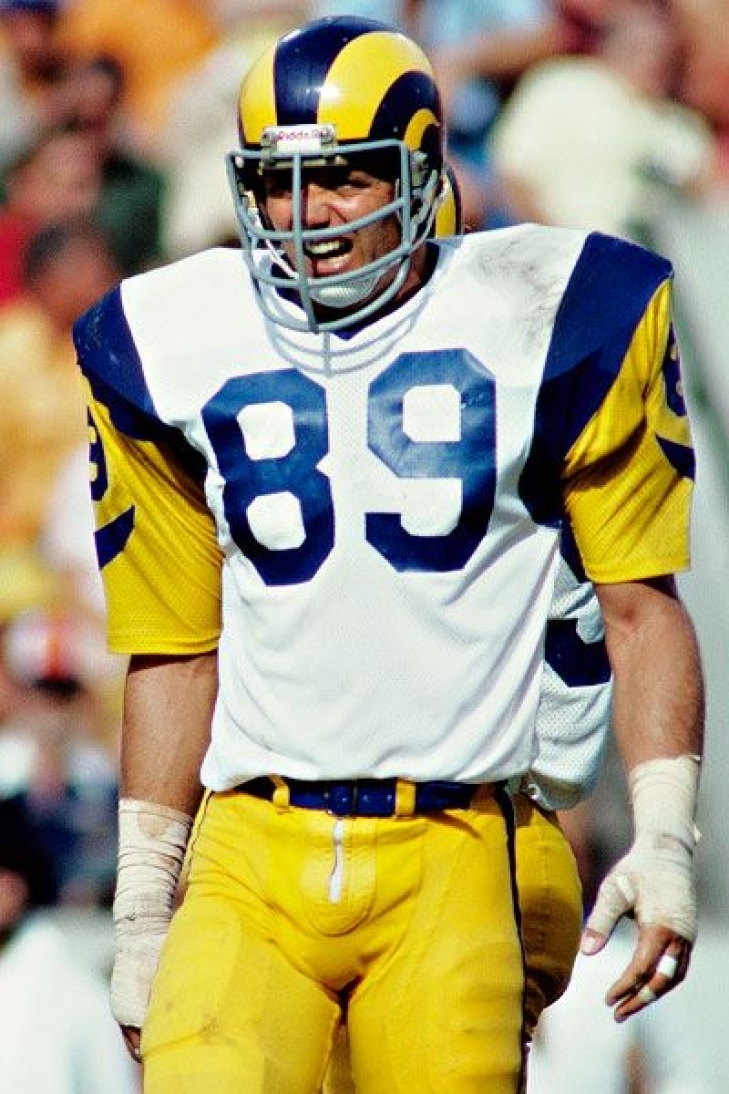
Fred Dryer took a long and messy path to Los Angeles. A first-round pick of the New York Giants in 1969 out of San Diego State, he played well enough in New York but grew unhappy, and the feeling was mutual. The Giants traded him to New England. Dryer refused to play for the Patriots without a new contract, so they moved him along to the Rams. The deal finally put him back in Southern California, exactly where he wanted to be.
Once he settled in as a defensive end, the production followed. In 1973, he did something no one else has ever done: he recorded two safeties in the same game against Green Bay, both in the fourth quarter of a 24-7 win. The next year he tied Jack Youngblood for the unofficial league lead with 15 sacks and earned First-Team All-Pro honors. He followed that with a Pro Bowl selection in 1975. Dryer was a long, athletic pass rusher who could close on quarterbacks quickly, and for a few seasons he was one of the league’s better ends.
The Rams kept contending, and Dryer stayed a regular part of the defensive line. He helped them reach Super Bowl XIV after the 1979 season. By then the individual awards had dried up, but he was still productive enough to start and contribute. The sack totals were no longer league-leading, yet he remained a reliable presence opposite Youngblood on teams that won the NFC West repeatedly.
Dryer played through the 1981 season before retiring. With the Rams, he was a one-time Pro Bowler and All-Pro who set a still-standing record with those two safeties and helped the franchise reach the Super Bowl. The peak years were strong. The later ones were more ordinary, the kind of solid but unspectacular work that keeps a defense together without drawing headlines.
After football, he built a second career as an actor. He starred as the title character in the long-running NBC series Hunter, a move that made him better known to many people than anything he did on the field. The defensive end who once chased down two quarterbacks in the same quarter for safeties ended up chasing criminals on television, which felt like a fitting second act for a player who always seemed to have a flair for the dramatic.
41. Dick Bass

Dick Bass was the second overall pick in the 1959 draft out of the University of the Pacific and spent his entire career with the Los Angeles Rams. At about 5-10 and 200 pounds he was small for a fullback, but he earned the nickname “The Scooter” for his low, shifty running style and ability to slip tackles. He broke into the lineup quickly and became the team’s main ball carrier for most of the 1960s. Bass could run between the tackles or bounce outside, and he was a reliable receiver out of the backfield as well.
The strongest stretches came in 1962 and 1966. In 1962 he rushed for 1,033 yards and earned a Pro Bowl selection while finishing third in the league in rushing. He followed that with another Pro Bowl in 1963. After a couple of quieter seasons, he bounced back in 1966 with 1,090 rushing yards, eight touchdowns, and a third Pro Bowl nod. That year he was also named Comeback Player of the Year. He finished third in rushing yards twice overall and led the Rams in rushing several times. The combination of volume on the ground and production as a receiver made him a dual-threat back in an era that still valued the fullback as a featured runner.
The 1962 and 1966 seasons were the clear high points. There were down years in between, including a stretch of lower totals and injuries that limited him in 1964. He remained productive into the later 1960s, though the big individual seasons became less frequent. By 1969, he was mostly a reserve and appeared in only one game before retiring.
Bass finished his Rams career with 5,417 rushing yards and 34 touchdowns on the ground, plus 204 catches for 1,841 yards and seven scores. The three Pro Bowl seasons and the pair of 1,000-yard campaigns stand as the strongest stretches. The rest was the steady work of a small but elusive fullback who stayed productive for a full decade. He left as one of the franchise’s leading rushers of his era and a player who made the most of his size and quickness.
