


Committee Chairman
31. Brad Penny
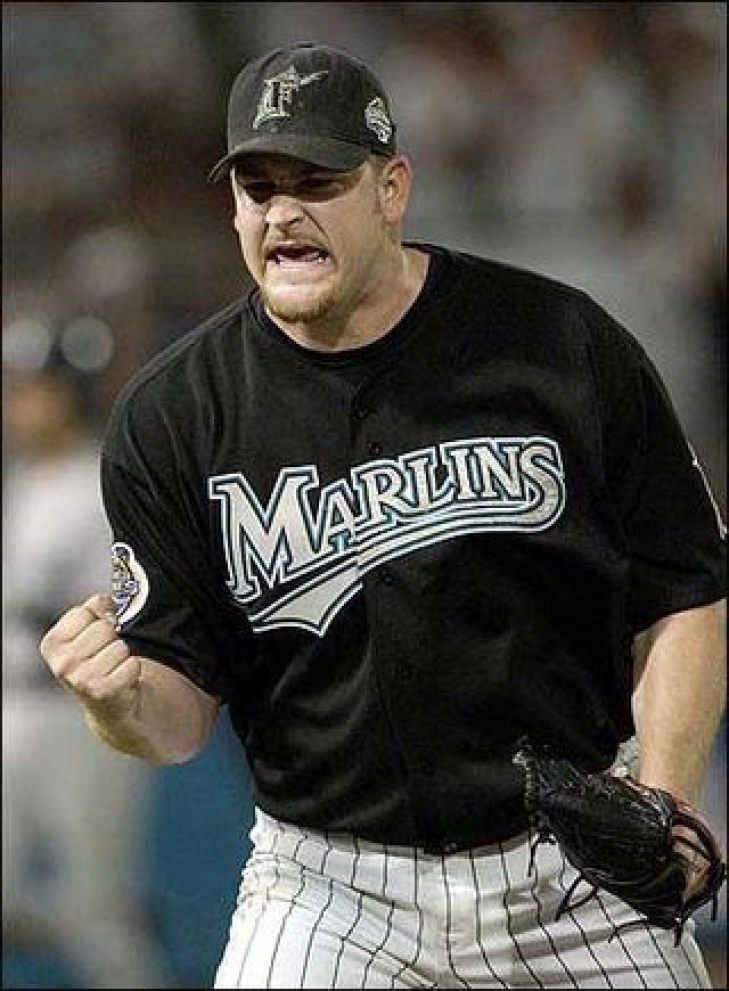
Traded to the Marlins while still in the minors with Arizona, Brad Penny proved himself a hard-throwing right-hander with a commanding mound presence. He quickly went from prospect to reliable starter. Although he later became an All-Star in Los Angeles, his time in Miami was marked by consistent pitching that helped secure the franchise's second championship.
In 2000, Penny became a regular in the rotation, and by 2001, he proved he belonged with a 3.69 ERA and a personal best of 154 strikeouts over 205 innings. During these early seasons, he served as a consistent presence despite roster changes. By 2003, he had established the dependability essential for a deep playoff run, ending the regular season with 14 wins and helping Florida secure a Wild Card spot.
The best story of Penny’s career in South Florida was the 2003 World Series. During baseball’s biggest stage, Penny started and won both Game 1 and Game 5. He was a giant of efficiency in those two outings, allowing only five runs over 14 innings (a 3.21 ERA) and outdueling David Wells and José Contreras. While he wasn't named the MVP of the series, his two victories were the foundational pillars that allowed the Marlins to secure their second World Series title in six games.
He was traded to the Dodgers at the 2004 Trade Deadline but returned for a brief stop a decade later, though he did not play much in his second run. With the Marlins, he had a record of 50-43 with a 4.12 ERA and 583 Strikeouts.
.
28. Brian Anderson
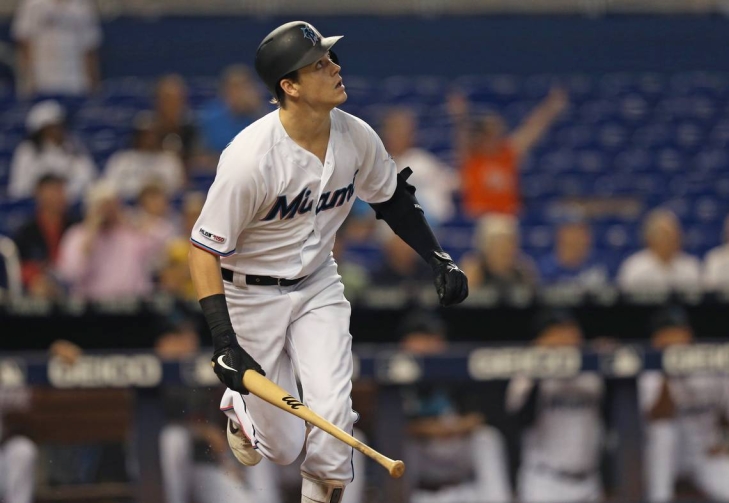
A former Arizona Razorback, Brian Anderson has spent the first six years of his career with the Miami Marlins, debuting in 2017 with 25 Games, keeping his rookie eligibility intact for the following year.
In 2018, Anderson demonstrated his value by appearing in 156 games, leading all Marlins players in plate appearances and runs scored. His 161 hits and .273 average earned him a fourth-place finish in the National League Rookie of the Year voting, establishing him as a foundational piece of the franchise's future. He paired that offensive efficiency with a strong arm, often sliding into right field to accommodate team needs while maintaining a high level of performance at third base.
During the 2019 season, authoring a campaign that saw him set career highs in multiple power categories. He blasted 20 home runs and drove in 66 runs while posting a solid .811 OPS before a fractured hand in August cut his year short. Despite the injury, he remained a central figure in the clubhouse, eventually becoming the first player in the history of the Marlins' home park to record a three-homer game in 2020.
Between 2021 and 2022, he was restricted to fewer than 100 games each season, which hampered his ability to regain the power stroke he showed earlier in his run. He eventually departed in November 2022 after being non-tendered, signing as a free agent with the Milwaukee Brewers.
Anderson compiled 487 hits, 57 home runs, and a .257 batting average as a Marlin.
Our All-Time Top 50 Minnesota Twins have been updated to reflect the 2021 Season
Yes, we know that this is taking a while!
As many of you know, we here at Notinhalloffame.com are slowly generating the 50 of each major North American sports team. That being said, we have existing Top 50 lists out and we always consistently look to update them when we can and based on necessity. As such, we are very happy to present our pre-2022 revision of our top 50 Minnesota Twins.
As for all of our top 50 players in baseball we look at the following:
1. Advanced Statistics.
2. Traditional statistics and how they finished in the American League.
3. Playoff accomplishments.
4. Their overall impact on the team and other intangibles not reflected in a stat sheet.
You will have to forgive us, as this was very anti-climactic, but we thought it was worth reporting our efforts. There were no changes in our Top 50, as there were no active Twins on the list going into the season, and nobody from 2021 cracked our Top 50.
As always, we present our top five.
2. Rod Carew
5. Joe Mauer
You can find the entire list here.
We welcome your input and comments and as always, we thank you for your support.
Awards - HOF? Part Sixty-Three: The ABA MVP
We here at Notinhalloffame.com thought it would be fun to take a look at the major awards in North American team sports and see how it translates into Hall of Fame potential.
Needless to say, different awards in different sports yield hall of fame potential. In basketball, the team sport with the least number of players on a roster, the dividend for greatness much higher. In baseball, it is not as much as a great individual season does not have the same impact.
Last time, we looked at the MLB All-Star Game MVP. This time, we return to Basketball, with the ABA, and the now defunct league’s MVP.
The trophy was awarded every year of the league’s existence, beginning in 1968 and concluding in 1976.
How many ABA MVPs made the Naismith Basketball Hall of Fame?
Let’s find out!
The following are the past players who have won the ABA MVP who are eligible for the Naismith Basketball Hall of Fame and have been enshrined.
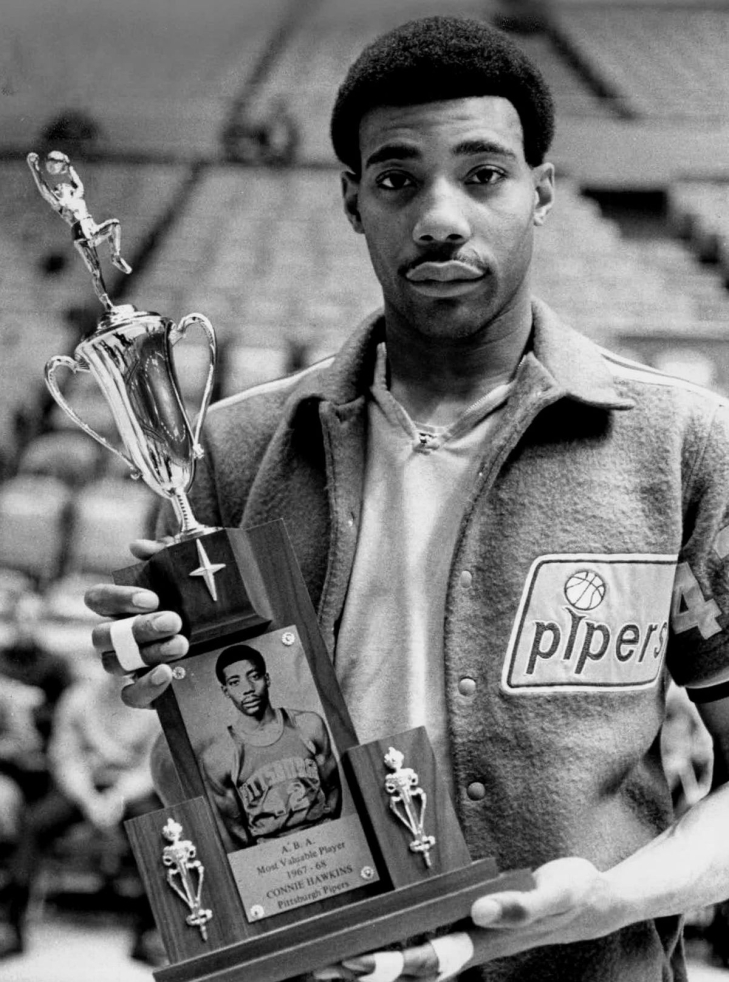
1968: Connie Hawkins, Pittsburgh Pipers, 44.9 MP, 26.8 PPG, 13.5 RPG, 4.6 APG, N/A SPG, N/A BPG, 17.9 WS.
Hawkins was involved in the Iowa point shaving scandal that rocked college basketball, though it is widely believed he had nothing to do with it. Nevertheless, he was blackballed from college hoops and went undrafted, essentially being banned from earning a living in pro basketball. Hawkins became a streetball superstar, but had a pro lifeline when the ABA formed, and he signed with Pittsburgh, the team he led to the first ABA Title, while he won the first ever ABA Scoring Title. An ABA All-Star this year, he would later join the Phoenix Suns in 1969, and would go to four consecutive All-Star Games.
Inducted into the Hall of Fame in 1992.
1969: Mel Daniels, Indiana Pacers, 38.6 MP, 24.0 PPG, 16.5 RPG, 1.5 APG, N/A SPG, N/A BPG, 8.6 WS.
A member of the Minnesota Muskies as an ABA rookie, Mel Daniels won the league’s first Rebounding Title, and won it again this year. Daniels led the Pacers to the ABA Title the following season.
Inducted into the Hall of Fame in 2012.
1968: Mel Daniels, Minnesota Muskies, 22.2 MP, 15.6 PPG, 1.4 RPG, 2.2 APG, N/A SPG, N/A BPG, 9.2 WS.
Mel Daniels was drafted by the Cincinnati Royals (9th Overall), but he opted for the higher salary of the Minnesota Muskies. As a rookie, Daniels led Minnesota to the Finals where they lost to Pittsburgh, and he began a streak of seven All-Star Games. The Muskies were struggling financially, and moved to Florida, but not with Daniels who they traded to Indiana. As a Pacer, Daniels won two MVPs and three ABA Titles
Inducted into the Hall of Fame in 2012.
1971: Mel Daniels, Indiana Pacers, 38.7 MP, 21.0 PPG, 18.0 RPG, 2.2 APG, N/A SPG, N/A BPG, 11.4 WS. (2)
Daniels won his third Rebounding Title this year, and though he would not win the ABA Championship this year, he would take them to wins in the next two. He would be named to the All-ABA Team, went to seven ABA All-Star Games, and was a five-time All-ABA Selection.
Inducted into the Hall of Fame in 2012.
1972: Artis Gilmore, Kentucky Colonels, 43.6 MP, 23.8 PPG, 17.8 RPG, 2.7 APG, N/A SPG, 5.0 BPG, 19.8 WS.
Gilmore also won the ABA Rookie of the Year Award, and remained with Kentucky for the remainder of the ABA’s existence. Following the dissolution of the Colonels, Gilmore played for the Bulls, Spurs and Celtics, with the Center appearing in 11 total All-Star Games.
Inducted into the Hall of Fame in 2011.
1973: Billy Cunningham, Carolina Cougars, 38.7 MP, 24.1 PPG, 12.0 RPG, 6.3 APG, 2,6 SPG, N/A BPG, 11.9 WS.
Billy Cunningham was the lead player for the Philadelphia 76ers, and surprisingly jumped to Carolina of the ABA in 1972, though he fought to get out of that contract when he felt that the Cougars reneged on a bonus. The court disagreed, and Cunningham was a Cougar for two years, winning the MVP in his first year there. Cunningham returned to the Sixers in 1974, playing two more years before retiring.
Inducted into the Hall of Fame in 1986.
1974: Julius Erving, New York Nets, 40.5 MP, 27.4 PPG, 10.7 RPG, 5.2 APG, 2.3 SPG, 2.4 BPG, 16.5 WS.
The ABA had a “Hardship Exemption” that allowed Julius Erving to enter the ABA in 1971, earlier than he would have been in the NBA. The Virginia Squires landed him in the draft, and “Dr. J” played for the Squires in his first two pro seasons. Legal entanglements saw Erving try to play for Atlanta of the NBA, but his NBA rights were held by Milwaukee, and he was still contractually bound to Virginia. The Squires were in financial disarray, and sold his contract to the New York Nets, with whom Erving agreed to play for, and he won his second straight scoring title, and led the Nets to their first ABA Title.
Inducted into the Hall of Fame in 1993.
1975 Co-Winner: Julius Erving, New York Nets, 40.5 MP, 27.9 PPG, 10.9 RPG, 5.5 APG, 2.2 SPG, 1.9 BPG, 17.6 WS. (2)
Erving remained dominant, and he would become the first back-to-back winner of the ABA MVP. Erving led the ABA in PER (26.2), and it was the third year in a row he did so. He also topped the league in Win Shares and VORP (10.3).
Inducted into the Hall of Fame in 1993.
1975 Co-Winner: George McGinnis, Indiana Pacers, 40.4 MP, 29.8 PPG, 14.3 RPG, 6.3 APG, 2.6 SPG, 0.7 BPG, 11.6 WS.
McGinnis began his pro career with the Pacers in 1971, and this was his fourth and final season in the ABA, and also his best. He won the Scoring Title, and had previously taken Indiana to two ABA Championships. McGinnis joined the 76ers after, but returned to the Pacers later when they were a NBA franchise.
Inducted into the Hall of Fame in 2017.
1976: Julius Erving, New York Nets, 38.6 MP, 29.3 PPG, 11.0 RPG, 5.0 APG, 2.5 SPG, 1.9 BPG, 17.7 WS. (3)
In the final year of the ABA, Erving closed it out in style, winning his third straight MVP, and leading the Nets to their second ABA Title. Erving again led the ABA in PER (28.7) and VORP (10.3), and as the ABA merged with the NBA, the Nets looked like they would instantly compete, or so it would seem. The New York Knicks balked at territorial rights, and the Nets were forced to offer financial compensation, so much so, that the Nets had to sell Erving’s contract to Philadelphia. Erving led the Sixers to the NBA Title in 1983, and was the MVP in 1981, becoming the only player to win the MVP in both leagues.
Inducted into the Hall of Fame in 1993.
The following are the players who have won the ABA MVP who are eligible for the Naismith Basketball Hall of Fame and have not been selected:
None.
Let’s update our tally, shall we?
|
Award in Question |
Percentage of recipients who have entered the HOF |
Percentage of recipients by year who have entered the HOF. |
|
NBA MVP |
100% |
100% |
|
NHL Art Ross |
100% |
100% |
|
ABA MVP |
100% |
100% |
|
NHL Hart Trophy |
93.6% |
96.3% |
|
NBA Finals MVP |
91.3% |
94.9% |
|
NHL Norris |
90.5% |
96.4% |
|
NHL Ted Lindsay Award |
90.0% |
|
|
NBA All-Star Game MVP |
89.5% |
91.7% |
|
NHL Conn Smythe |
74.2% |
85.4% |
|
NFL Bert Bell Award |
73.7% |
71.4% |
|
NFL AP Offensive Player of the Year |
73.1% |
79.4% |
|
NFL AP MVP |
68.3% |
74.0% |
|
NFL Walter Payton Man of the Year |
66.7% |
66.7% |
|
NHL Lady Byng |
63.8% |
76.0% |
|
NFL Defensive Player of the Year |
60.8% |
71.1% |
|
NFL Super Bowl MVP |
60.6% |
64.9% |
|
NHL Mark Messier Leadership Award |
60.0% |
60.0% |
|
NBA Defensive Player of the Year |
58.3% |
56.5% |
|
NHL Vezina |
57.1% |
66.3% |
|
NBA Rookie of the Year |
56.5% |
56.5% |
|
MLB MVP |
55.0% |
60.2% |
|
NFL Pro Bowl MVP |
52.3% |
54.8% |
|
MLB Lou Gehrig Award |
51.9% |
51.9% |
|
MLB Roberto Clemente Award |
47.4% |
47.4% |
|
NHL Calder Trophy |
46.5% |
46.5% |
|
NBA J. Walter Kennedy Citizenship Award |
46.0% |
46.0% |
|
MLB/NL/AL Cy Young Award |
44.4% |
55.4% |
|
MLB All-Star Game MVP |
41.3% |
44.0% |
|
MLB Babe Ruth Award |
37.0% |
39.3% |
|
NHL King Clancy Award |
36.8% |
36.8% |
|
NHL Frank J. Selke Trophy |
33.3% |
36.7% |
|
MLB World Series MVP |
33.3% |
36.8% |
|
MLB Hutch Award |
33.1% |
33.1% |
|
NFL Offensive Rookie of the Year |
28.6% |
28.6% |
|
NHL Bill Masterton Memorial Trophy |
27.9% |
27.9% |
|
MLB Edgar Martinez Award |
26.7% |
17.2% |
|
MLB Delivery Man of the Year |
25.0% |
50.0% |
|
MLB (NL/AL) Silver Slugger (Designated Hitter) |
25.0% |
30.8% |
|
MLB Comeback Player of the Year |
25.0% |
25.0% |
|
MLB (NL/AL) Silver Slugger (Shortstop) |
23.5% |
52.6% |
|
MLB (NL/AL) Gold Glove |
21.7% |
36.8% |
|
NHL William M. Jennings Trophy |
20.7% |
40.4% |
|
NFL Defensive Rookie of the Year |
20.6% |
20.6% |
|
MLB (NL/AL) Silver Slugger (Catcher) |
20.0% |
22.5% |
|
MLB (NL/AL) Gold Glove (Second Base) |
18.8% |
39.8% |
|
MLB Rolaids Reliever of the Year |
18.6% |
33.3% |
|
MLB (NL/AL) Gold Glove (Shortstop) |
18.2% |
35.1% |
|
MLB (NL/AL) Silver Slugger (Pitcher) |
18.2% |
20.1% |
|
MLB (NL/AL) Silver Slugger (Second Base) |
16.7% |
32.7% |
|
MLB (NL/AL) Gold Glove (Outfield) |
16.7% |
30.1% |
|
NBA Sixth Man of the Year |
16.7% |
18.5% |
|
MLB NLCS/ALCS MVP |
16.1% |
15.3% |
|
MLB (NL/AL) Silver Slugger (Outfield) |
15.7% |
25.2% |
|
MLB (NL/AL) Gold Glove (Third Base) |
14.3% |
14.3% |
|
MLB (NL/AL) Silver Slugger (Third Base) |
13.6% |
14.3% |
|
MLB (NL/AL) Silver Slugger (First Base) |
13.6% |
13.3% |
|
MLB (NL/AL) Rookie of the Year |
13.3% |
13.3% |
|
MLB (NL/AL) Gold Glove (Catcher) |
10.3% |
15.2% |
|
MLB Hank Aaron Award |
9.1% |
14.3% |
|
NBA Most Improved Player of the Year |
5.3% |
3.2% |
|
MLB (NL/AL) Gold Glove (First Base) |
3.8% |
3.2% |
|
NFL AP Comeback Player of the Year |
0.0% |
0.0% |
So, who is up next?
The following are the players who have won the ABA MVP who have retired but have not met the mandatory years out of the game to qualify for the Naismith Basketball Hall of Fame:
None.
The following are the past players who have won the ABA MVP are eligible for the Naismith Basketball Hall of Fame and are still active.
None.
Nothing will change in this going forward as the ABA MVPs are perfect for Hall of Fame induction. As this is now a defunct category, this feels like more than a footnote going forward.
So, what is up next?
We stay with the ABA, and look at their past Rookies of the Year.
As always, we thank you for your support, and look for that soon.
