


Committee Chairman
Our All-Time Top 50 Cincinnati Reds have been updated to reflect the 2021 Season

Yes, we know that this is taking a while!
As many of you know, we here at Notinhalloffame.com are slowly generating the 50 of each major North American sports team. That being said, we have existing Top 50 lists out and we always consistently look to update them when we can and based on necessity. As such, we are very happy to present our pre-2022 revision of our top 50 Cincinnati Reds.
As for all of our top 50 players in baseball we look at the following:
1. Advanced Statistics.
2. Traditional statistics and how they finished in the National League.
3. Playoff accomplishments.
4. Their overall impact on the team and other intangibles not reflected in a stat sheet.
The Reds did not make the 2021 Playoffs, nor did anyone crack the top 50, however there was one slight change, that impacted the top five, as Joey Votto moved into the #5 spot.
As always, we present our top five.
1. Pete Rose
2. Johnny Bench
4. Joe Morgan
5. Joey Votto
You can find the entire list here.
Votto took over #5 from Hall of Famer, Barry Larkin.
We welcome your input and comments and as always, we thank you for your support.
Awards - HOF? Part Sixty-Four The ABA Rookie of the Year
We here at Notinhalloffame.com thought it would be fun to take a look at the major awards in North American team sports and see how it translates into Hall of Fame potential.
Needless to say, different awards in different sports yield hall of fame potential. In basketball, the team sport with the least number of players on a roster, the dividend for greatness much higher. In baseball, it is not as much as a great individual season does not have the same impact.
Last time, we looked at the ABA MVP. This time, we look at the ABA Rookie of the Year.
The trophy was awarded every year of the league’s existence, beginning in 1968 and concluding in 1976.
How many ABA Rookies of the Year made the Naismith Basketball Hall of Fame?
Let’s find out!
The following are the past players who have won the ABA Rookie of the Year who are eligible for the Naismith Basketball Hall of Fame and have been enshrined.
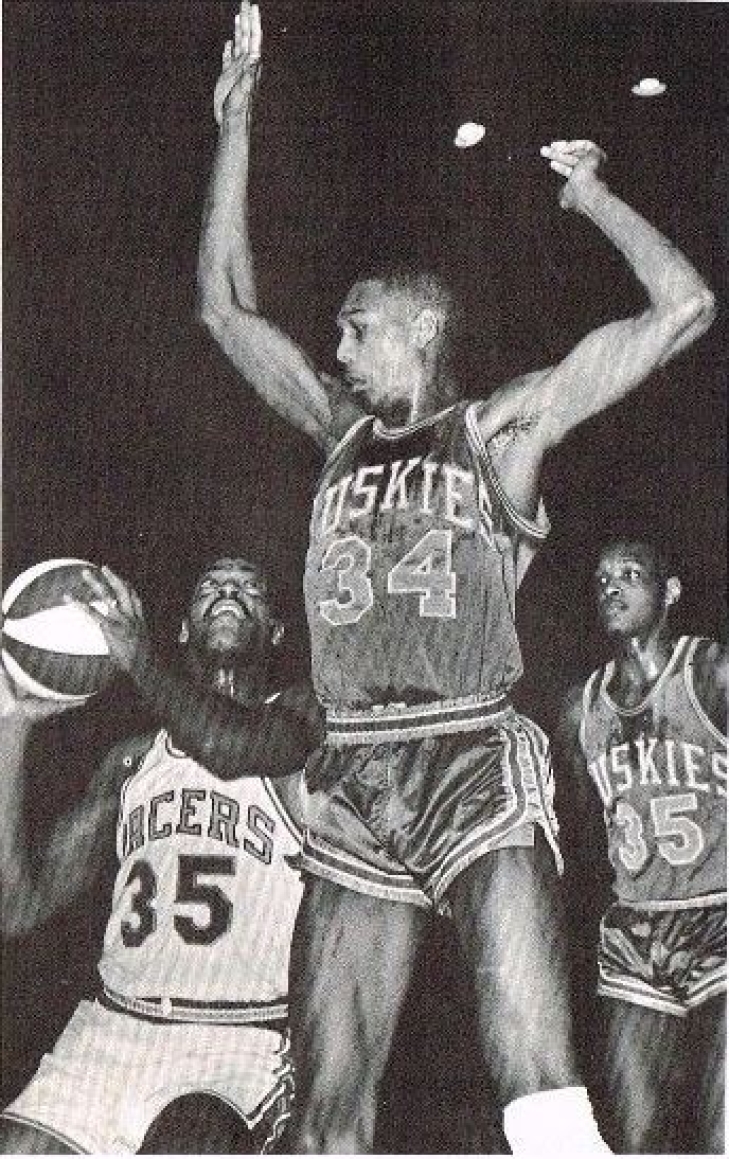
1968: Mel Daniels, Minnesota Muskies, 22.2 MP, 15.6 PPG, 1.4 RPG, 2.2 APG, N/A SPG, N/A BPG, 9.2 WS.
Mel Daniels was drafted by the Cincinnati Royals (9th Overall), but he opted for the higher salary of the Minnesota Muskies. As a rookie, Daniels led Minnesota to the Finals where they lost to Pittsburgh, and he began a streak of seven All-Star Games. The Muskies were struggling financially, and moved to Florida, but not with Daniels who they traded to Indiana. As a Pacer, Daniels won two MVPs and three ABA Titles
Inducted into the Hall of Fame in 2012.
1970: Spencer Haywood, Denver Nuggets, 45.3 MP, 30.0 PPG, 19.5 RPG, 2.3 APG, N/A SPG, N/A BPG, 9.2 WS.
Opting to turn pro after his sophomore year in college, Spencer Haywood’s only option was the ABA, as the NBA then had a rule that a player could not turn professional until his class graduated. Haywood then played one year with Denver of the ABA, winning both the MVP and Rookie of the Year, becoming the only player to do so. He also led the league in Minutes and Rebounds and Points per Game. Following this season, Haywood joined the NBA with Seattle, and successfully challenged to join the league in a case that went to the Supreme Court. Haywood later would be a four-time NBA All-Star, and won an NBA Title with the Lakers.
Inducted into the Hall of Fame in 2015.
Co-Winner 1971: Charlie Scott, Virginia Squires, 37.9 MP, 27.1 PPG, 5.2 RPG, 5.6 APG, N/A SPG, N/A BPG, 7.2 WS.
Charlie Scott signed with the Virginia Squires before the NBA Draft, hence why he fell to the Seventh Round, where he was chosen by the Celtics. Scott was an ABA All-Star this year, and an All-ABA Selection, and was so the year after although he did not complete his second season. He bolted for the NBA for Phoenix, who traded for his rights. Scott was a three-time NBA All-Star, and would later be an NBA Champion when he was with Boston in 1976.
Inducted into the Hall of Fame in 2018.
Co-Winner 1971: Dan Issel, Kentucky Colonels, 39.4 MP, 29.9 PPG, 13.2 RPG, 2.0 APG, N/A SPG, N/A BPG, 10.7 WS.
Issel led the ABA in Points per Game, and it was the second highest of his career. An All-Star as a rookie, Issel was an All-Star through the end of the ABA and was so again when the leagues merged, giving him seven in total. He was a five-time All-ABA Selection.
Inducted into the Hall of Fame in 1993.
1972: Artis Gilmore, Kentucky Colonels, 43.6 MP, 23.8 PPG, 17.8 RPG, 2.7 APG, N/A SPG, 5.0 BPG, 19.8 WS.
Gilmore also won the ABA MVP, and remained with Kentucky for the remainder of the ABA’s existence. Following the dissolution of the Colonels, Gilmore played for the Bulls, Spurs and Celtics, with the Center appearing in 11 total All-Star Games.
Inducted into the Hall of Fame in 2011.
1976: David Thompson, Denver Nuggets, 37.4 MP, 26.0 PPG, 6.3 RPG, 3.7 APG, 1.6 SPG, 1.2 BPG, 12.4 WS.
Taken number one by the Atlanta Hawks, David Thompson instead opted to play for Denver of the ABA, in what would be the last year of the ABA. An All-Star this year, Thompson remained with the Nuggets when the leagues merged. He would later go to four more All-Star Games in the NBA, three with Denver and one with Seattle.
Inducted into the Hall of Fame in 1996.
The following are the players who have won the ABA Rookie of the Year who are eligible for the Naismith Basketball Hall of Fame and have not been selected:
1969: Warren Jabali, Oakland Oaks, 35.8 MP, 21.5 PPG, 15.6 RPG, 1.4 APG, N/A SPG, N/A BPG, 5.8 WS.
Jabali was a Fourth Round Pick from Wichita State, but instead he opted to go to Oakland od the ABA. The Shooting Guard helped Oakland with the Title that year, and he would later be a four-time ABA All-Star, competing his entire pro career in the upstart league. He also played for Washington, Indiana, Florida, Denver and San Diego.
Eligible Since 1981.
1973: Brian Taylor, New York Americans, 32.3 MP, 15.3 PPG, 3.2 RPG, 2.8 APG, N/A SPG, N/A BPG, 3.6 WS.
With all due respect the Taylor, this was the weakest Rookie of the Year in ABA history, but he would go on to be a two-time ABA All-Star and two-time ABA Champion with New York. He would later play in the NBA in Kansas City, Denver and San Diego.
Eligible Since 1988.
1974: Swen Nater, Virginia Squires and San Antonio Spurs, 30.1 MP, 14.1 PPG, 12.6 RPG, 1.6 APG, 0.4 SPG, 0.8 BPG, 8.7 WS.
A two-time NCAA Champion at UCLA, Nater chose the ABA over the Milwaukee Bucks, who took him 18th Overall. Nater was first drafted in the ABA in 1972 by the Miami Floridians, but when they folded, Virginia took him in the Dispersal Draft. As good as he was, the Squires traded him for a draft pick and $300,000 to San Antonio 17 Games into his rookie year. He led the ABA in Field Goal Percentage, and was the ABA Rebounding leader as a sophomore. Nater, would later win an NBA Rebounding Title as a member of the San Diego Clippers in 1978/79.
Eligible Since 1990.
1975: Marvin Barnes, Spirits of St. Louis, 39.9 MP, 24.0 PPG, 15.6 RPG, 3.2 APG, 1.2 SPG, 1.6 BPG, 8.6 WS.
Selected second overall by the 76ers, Providence’s Marvin Barnes instead opted to sign with St. Louis, where he was an All-Star in both of his seasons in the league. When the ABA merged with the NBA, St. Louis was disbanded, and he joined the Detroit Pistons, but was not as successful in the NBA. He would also play a year each in Buffalo, Boston and San Diego.
Eligible Since 1986.
Let’s update our tally, shall we?
|
Award in Question |
Percentage of recipients who have entered the HOF |
Percentage of recipients by year who have entered the HOF. |
|
NBA MVP |
100% |
100% |
|
NHL Art Ross |
100% |
100% |
|
ABA MVP |
100% |
100% |
|
NHL Hart Trophy |
93.6% |
96.3% |
|
NBA Finals MVP |
91.3% |
94.9% |
|
NHL Norris |
90.5% |
96.4% |
|
NHL Ted Lindsay Award |
90.0% |
|
|
NBA All-Star Game MVP |
89.5% |
91.7% |
|
NHL Conn Smythe |
74.2% |
85.4% |
|
NFL Bert Bell Award |
73.7% |
71.4% |
|
NFL AP Offensive Player of the Year |
73.1% |
79.4% |
|
NFL AP MVP |
68.3% |
74.0% |
|
NFL Walter Payton Man of the Year |
66.7% |
66.7% |
|
NHL Lady Byng |
63.8% |
76.0% |
|
NFL Defensive Player of the Year |
60.8% |
71.1% |
|
NFL Super Bowl MVP |
60.6% |
64.9% |
|
NHL Mark Messier Leadership Award |
60.0% |
60.0% |
|
ABA Rookie of the Year |
60.0% |
60.0% |
|
NBA Defensive Player of the Year |
58.3% |
56.5% |
|
NHL Vezina |
57.1% |
66.3% |
|
NBA Rookie of the Year |
56.5% |
56.5% |
|
MLB MVP |
55.0% |
60.2% |
|
NFL Pro Bowl MVP |
52.3% |
54.8% |
|
MLB Lou Gehrig Award |
51.9% |
51.9% |
|
MLB Roberto Clemente Award |
47.4% |
47.4% |
|
NHL Calder Trophy |
46.5% |
46.5% |
|
NBA J. Walter Kennedy Citizenship Award |
46.0% |
46.0% |
|
MLB/NL/AL Cy Young Award |
44.4% |
55.4% |
|
MLB All-Star Game MVP |
41.3% |
44.0% |
|
MLB Babe Ruth Award |
37.0% |
39.3% |
|
NHL King Clancy Award |
36.8% |
36.8% |
|
NHL Frank J. Selke Trophy |
33.3% |
36.7% |
|
MLB World Series MVP |
33.3% |
36.8% |
|
MLB Hutch Award |
33.1% |
33.1% |
|
NFL Offensive Rookie of the Year |
28.6% |
28.6% |
|
NHL Bill Masterton Memorial Trophy |
27.9% |
27.9% |
|
MLB Edgar Martinez Award |
26.7% |
17.2% |
|
MLB Delivery Man of the Year |
25.0% |
50.0% |
|
MLB (NL/AL) Silver Slugger (Designated Hitter) |
25.0% |
30.8% |
|
MLB Comeback Player of the Year |
25.0% |
25.0% |
|
MLB (NL/AL) Silver Slugger (Shortstop) |
23.5% |
52.6% |
|
MLB (NL/AL) Gold Glove |
21.7% |
36.8% |
|
NHL William M. Jennings Trophy |
20.7% |
40.4% |
|
NFL Defensive Rookie of the Year |
20.6% |
20.6% |
|
MLB (NL/AL) Silver Slugger (Catcher) |
20.0% |
22.5% |
|
MLB (NL/AL) Gold Glove (Second Base) |
18.8% |
39.8% |
|
MLB Rolaids Reliever of the Year |
18.6% |
33.3% |
|
MLB (NL/AL) Gold Glove (Shortstop) |
18.2% |
35.1% |
|
MLB (NL/AL) Silver Slugger (Pitcher) |
18.2% |
20.1% |
|
MLB (NL/AL) Silver Slugger (Second Base) |
16.7% |
32.7% |
|
MLB (NL/AL) Gold Glove (Outfield) |
16.7% |
30.1% |
|
NBA Sixth Man of the Year |
16.7% |
18.5% |
|
MLB NLCS/ALCS MVP |
16.1% |
15.3% |
|
MLB (NL/AL) Silver Slugger (Outfield) |
15.7% |
25.2% |
|
MLB (NL/AL) Gold Glove (Third Base) |
14.3% |
14.3% |
|
MLB (NL/AL) Silver Slugger (Third Base) |
13.6% |
14.3% |
|
MLB (NL/AL) Silver Slugger (First Base) |
13.6% |
13.3% |
|
MLB (NL/AL) Rookie of the Year |
13.3% |
13.3% |
|
MLB (NL/AL) Gold Glove (Catcher) |
10.3% |
15.2% |
|
MLB Hank Aaron Award |
9.1% |
14.3% |
|
NBA Most Improved Player of the Year |
5.3% |
3.2% |
|
MLB (NL/AL) Gold Glove (First Base) |
3.8% |
3.2% |
|
NFL AP Comeback Player of the Year |
0.0% |
0.0% |
So, who is up next?
The following are the players who have won the ABA Rookie of the Year who have retired but have not met the mandatory years out of the game to qualify for the Naismith Basketball Hall of Fame:
None.
The following are the past players who have won the ABA Rookie of the Year are eligible for the Naismith Basketball Hall of Fame and are still active.
None.
Nothing will change in this going forward as none of the ABA Rookies of the Year who have not been inducted feel like they have Hall of Fame potential. As this is now a defunct category, this feels like more than a footnote going forward.
So, what is up next?
We stay with the ABA, and look at their past ABA All-Star Game MVPs.
As always, we thank you for your support, and look for that soon.
Remembering 21
On paper, the antics of a group of MIT college nerds may not make for compelling viewing, but if you’re a bit of a casino buff then is 21 a classic movie that you should check out?
Bill’s Blackjack Brigade
For around two decades at the tail-end of the 20th century, a team of US students made waves in the casino gaming world for proving that, when it comes to blackjack, it is possible to beat the house.
In 1977, Bill Kaplan, a Harvard grad, discovered the art of card counting in blackjack and proceeded to win $35,000 in just nine months. Setting up the MIT Blackjack Team in the aftermath of his success, Kaplan would lead the group of current and ex-students at the Massachusetts Institute of Technology as they took on and beat the house at prestigious casinos across the world.
Achieving global notoriety, Kaplan and the MIT Blackjack team captured the attention of writers and creatives, including a certain Ben Mezrich. The aspiring author would go on to compile the most salient and salacious escapades of those MIT students in Bringing Down the House: The Inside Story of Six MIT Students Who Took Vegas for Millions, which formed the basis of Robert Luketic’s 2008 heist movie, 21.
Based on True Events
All of that backstory is, of course, inconsequential to the average movie-goer, so Luketic, along with producer and star Kevin Spacey, naturally needed to add some Hollywood sparkle into the mix.
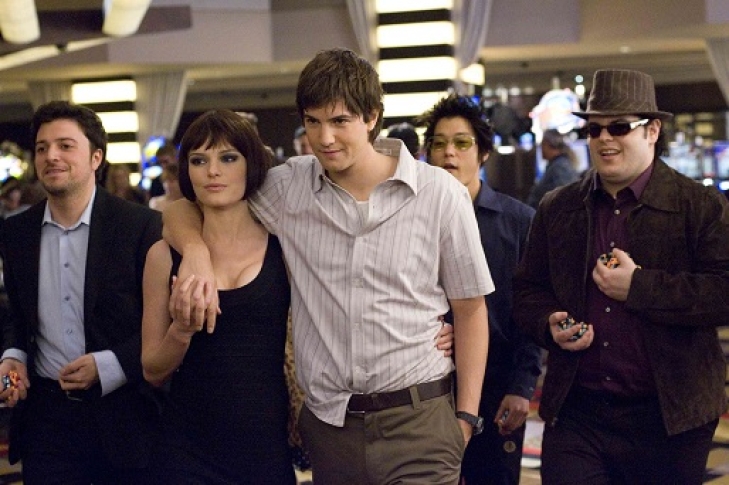
In 21, the antics of the blackjack team are conveyed through the eyes of the exceptionally gifted MIT student, Ben Campbell (played by Jim Sturgess). Campbell’s ultimate goal is to attend Harvard Medical School, but there’s the matter of the $300k tuition fees that stand in his way.
Campbell’s classmates, noticing the brainiac’s propensity for all things mathematics, introduce him to a certain Mickey Rosa (Kevin Spacey), the man behind an underground group of blackjack players who also happen to be members of the student faculty.
The group is determined to win big in Vegas after swotting up on card counting and they invite Campbell along with them. Although he’s hesitant at first, he’s soon persuaded to join the team and so begins his initiation into the fascinating world of this centuries-old casino staple.
After racking up several big wins in a short space of time, it’s not long before Campbell, Rosa and the team come under the microscope of loss prevention specialist, Cole Williams (Laurence Fishburn), an anti-card counting proponent who suspects there might be something more at play than just these maths and science geniuses’ gift for the game.
Is it any good?
A purveyor of rom-coms more than heist movies, 21 is Luketic's attempt to go down a grittier route. In some respects he succeeds, but in others he most certainly fails.
Enjoyable hijinks are afoot in the film’s zippy Vegas scenes as Campbell and his crew adopt new identities with each and every table they hit. Moody lighting and almost slapstick costumery doesn’t exactly make these parts of the film true to life, but they nevertheless portray the ultimate Vegas casino fantasy.
Sturgess and his romantic lead, Kate Bosworth, shine in their respective performances of the Harvard wannabe and Jill, the prettiest girl in the school who also happens to be a maths genius. But it’s this romance-driven subplot that is the film’s undoing. In the words of Rotten Tomatoes’ critical consensus, 21 had all the makings of a fascinating study but Luketic made a grave error by “supplant[ing] the true story on which it is based with mundane melodrama”.
Fishburn and Spacey lend a touch of gravitas to proceedings in their roles as Williams and Rosa, although the former was mostly given one-note material to work with and Spacey has a tendency to go full-ham even when it's not needed.
As for the main star of the film, Blackjack, there’s enough gaming content here to make this a worthy addition to a games night, but casino nerds shouldn’t look too closely at the casino scenes. For the rest of us, 21 is an entertaining, fluffy movie, but it could've been so much more if Luketic had gone all out and given us an insider look at professional casino gaming.
Our All-Time Top 50 New York Yankees have been updated to reflect the 2021 Season
Yes, we know that this is taking a while!
As many of you know, we here at Notinhalloffame.com are slowly generating the 50 of each major North American sports team. That being said, we have existing Top 50 lists out and we always consistently look to update them when we can and based on necessity. As such, we are very happy to present our pre-2022 revision of our top 50 New York Yankees.
As for all of our top 50 players in baseball we look at the following:
1. Advanced Statistics.
2. Traditional statistics and how they finished in the American League.
3. Playoff accomplishments.
4. Their overall impact on the team and other intangibles not reflected in a stat sheet.
The Yankees had another playoff run in 2022, but when you are the most accomplished team in baseball, it takes a lot to move up this list or even debut on it. However, both of this did happen, with one debut and one elevation.
As always, we present our top five, which did not change.
1. Babe Ruth
2. Lou Gehrig
4. Joe DiMaggio
5. Derek Jeter
You can find the entire list here.
Brett Gardner moved up one spot to #35.
The new entry is current First Baseman, Aaron Judge, who comes in at #49.
Judge’s entry knocks Hank Bauer off of the list.
We welcome your input and comments and as always, we thank you for your support.
