


Committee Chairman
17. Randy Arozarena
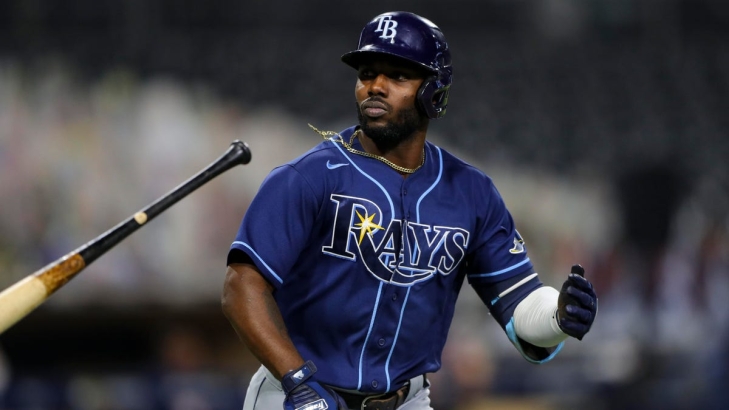
Randy Arozarena's journey to becoming a baseball star is truly inspiring. From facing a daring escape across the ocean from Cuba to Mexico in a small boat, to showcasing his talent in the Mexican League, his perseverance paid off when the St. Louis Cardinals signed him in 2016. Although he showed exciting potential during a brief stint in 2019, the competitive Cardinals roster limited his opportunities. In January 2020, he was traded to the Tampa Bay Rays in a move that sparked one of the most exciting and culturally rich runs in recent franchise history.
Arozarena’s debut in St. Petersburg during the regular season faced a big delay because of a tough battle with COVID-19, which limited him to just 23 games. But as soon as the expanded 2020 postseason started, he delivered an incredible, record-shattering performance that made headlines. Wearing a pair of lucky cowboy boots in the clubhouse, he became a powerhouse, earning the ALCS MVP award and hitting an astonishing 10 home runs—breaking the MLB record for a single postseason. His timely hitting helped the underdog Rays win the American League pennant, quickly making the charismatic outfielder a beloved hero around the world.
Remarkably still rookie-eligible for the 2021 campaign, Arozarena effectively confirmed his postseason reputation by receiving the American League Rookie of the Year Award. He supported manager Kevin Cash's lineup with 145 hits, 32 doubles, 20 home runs, and 20 stolen bases, demonstrating an exceptional combination of power and speed. He again reached the 20-homer mark in 2022, exerting significant influence over division opponents and solidifying his role as the emotional core of the franchise.
His cultural impact peaked remarkably during the historic 2023 season. Prior to the commencement of the major league schedule, Arozarena garnered international attention while representing Mexico in the World Baseball Classic, achieving an impressive .450/.607/900 slash line and executing a viral, home-run-robbing catch against Japan. He carried this momentum back to St. Petersburg, where he was elected as a fan-voted All-Star starter, coinciding with the team's introduction of a dedicated "Randy Land" seating area in left field. By August, he set a new major league record as the first player to begin his career with three successive seasons of at least 20 home runs and 20 stolen bases, concluding the summer with 23 home runs and a career-high 80 walks.
During his 2024 campaign in Tampa, Arozarena experienced an extended slump that resulted in a trade to the Seattle Mariners in July. Despite this, his power-speed model remained resilient. He achieved his fourth consecutive 20/20 season by the end of 2024, and remarkably extended this record to five consecutive 20/20 campaigns during his outstanding 2025 season with Seattle. In total, Arozarena accumulated 531 hits, 94 stolen bases, and 85 home runs while with the Mariners.
8. Yandy Diaz
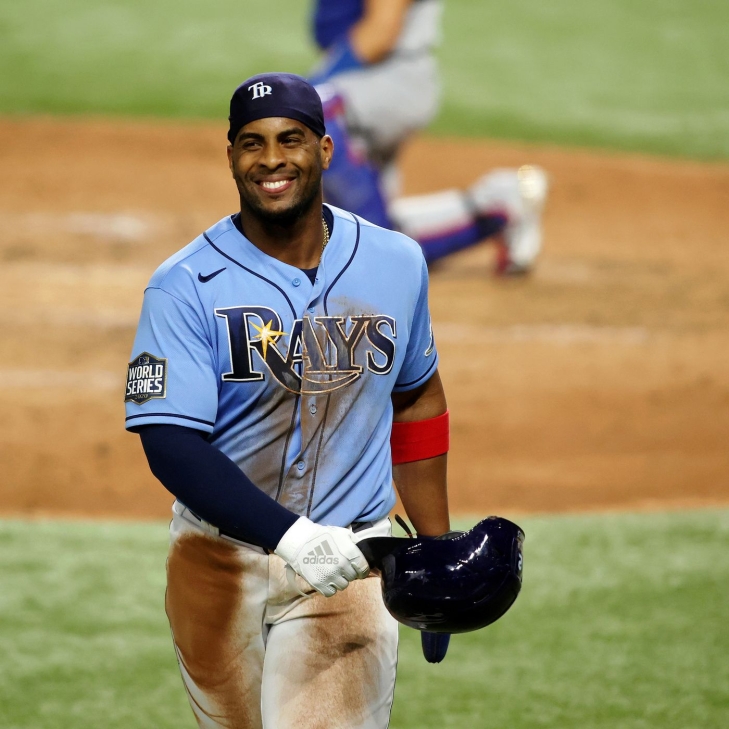
When a player risks everything to pursue a dream in the open market, discovering a team that fully understands and maximizes his unique physical talents can transform a raw prospect into a model of hitting efficiency. Yandy Díaz defected from Cuba at 21, eventually signing with the Cleveland Indians and debuting in the majors in 2017. Cleveland recognized his exceptional bat-to-ball skills but struggled to find a permanent role or address his extreme ground-ball tendencies. His career changed dramatically in December 2018 when the Tampa Bay Rays acquired him in a strategic three-team trade. In Tampa, Díaz found the ideal combination of opportunity, analytical support, and patience, turning his powerful forearms and low strikeout rates into a top-tier offensive force.
His initial campaigns in 2019 and 2020 under the dome showed moments of high-efficiency performance. However, recurring severe hamstring strains and other physical setbacks consistently delayed his development. After regaining full health in the following summers, Díaz made getting on base a daily priority. He alternated between first and third base and offered reliable contribution across the infield.
The pinnacle of his career in the batter's box was achieved during a remarkable and historic 2023 regular-season performance. Demonstrating exceptional prowess, Díaz delivered an outstanding offensive display, systematically defeating American League pitching to achieve a career-high 35 doubles and 22 home runs, while driving in 78 runs. His remarkable efficiency was evident in his .410 on-base percentage, leading to his first American League batting title with an impressive .330 batting average. This distinguished performance resulted in his selection as a starting player in his first All-Star Game, the receipt of a Silver Slugger Award, and an impressive sixth-place finish in the American League Most Valuable Player voting.
Diaz regressed in 2014, where his over-the-fence power cooled to 14 home runs and his slugging slid to .414. Yet, demonstrating the unyielding baseline that defines his profile, he remained a remarkably safe high-volume producer, lashing out 158 hits and breaking a modern franchise record with an incredible 20-game hitting streak.
His exceptional resilience and skillful recovery in the 2025 season have cemented his lasting legacy in franchise history. Díaz's consistent elite batting control confirmed it's a permanent trait in the division, as he skillfully neutralized major-league threats. Over 150 games, he achieved 155 hits, 29 doubles, and 16 home runs. His flawless plate discipline stood out at the top of the order, with 61 walks and just 92 strikeouts, leading to a .284 batting average and a .356 on-base percentage—further strengthening the Rays' reputation for efficient offense.
Now actively stepping into the current 2026 regular season, the 34-year-old table-setter remains a vital vanguard of the club's competitive ceiling, with management signaling their absolute confidence by officially picking up his 2026 contract option.
Notinhalloffame NHL Cup Standings Update (150)
If you are a regular visitor at Notinhalloffame.com, you know that we created the Notinhalloffame NHL Cup, where in every regular season game, we award points (5-4-3-2-1) to the top five performers. This is the second year that we have done this, and Edmonton’s Connor McDavid won the first one.
To keep everyone regularly in the loop this time, we have decided to give regular updates, starting at when the first player cracked 40 Points, and tell all of you the top ten. We will this going forward with every update as the first player breaches the elevated ten-point threshold afterward.
Here is the current top ten, based on the first player to breach 140 Notinhalloffame Cup Points:
1. Connor McDavid, Edmonton Oilers. 152 Cup Points: 72 Games, 60 G, 78 A, 138 P, +16, 16.3 PS. (#1 on last update)
What more can we say about McDavid’s 2022/23 Season. He is running away with every major statistical category, and has a commanding lead in Cup Points. Last year’s Notinhalloffame NHL Cup winner is extending his lead and he is currently the league-leader in Goals (60), Assists (78), Points (138) and Point Shares (16.3). The Hart, Pearson, Richard and Art Ross are his to lose, and he won’t. Is this the best year of his life? He would agree, but only if the Oilers win it all!
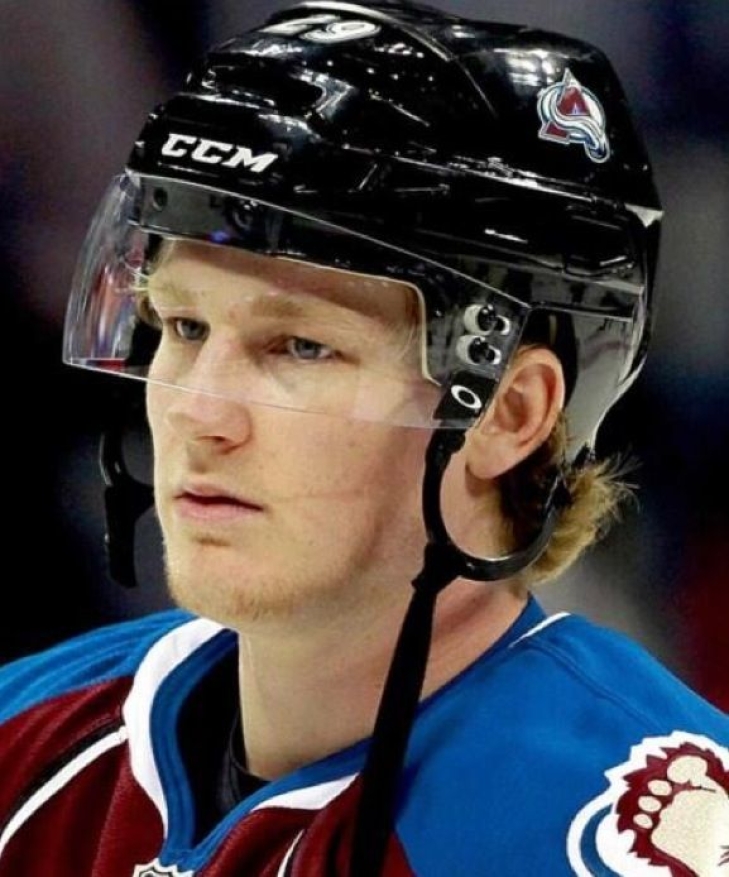
2. Nathan MacKinnon, Colorado Avalanche, 114 Cup Points: 59 Games, 30 G, 60 A, 90 P, +22, 10.1 PS. (#2 on last update)
MacKinnon is playing phenomenal hockey, is ranked very high in Cup Points considering how few games he has played relatively to the rest of the top ten. He is third in Points per Game (1.53), and sixth in Points (90).
3. David Pastrnak, Boston Bruins. 112 Cup Points: 70 Games, 48 G, 45 A, 93 P, +30, 12.1 PS. (#2 on last update)
Pastrnak falls back to #3. The top offensive Bruins player is second in Goals (45), fifth in Points (86), eighth in Plus/Minus (+30) and is also leading the NHL in Shots (333).
4. Mikko Rantanen, Colorado Avalanche. 102 Cup Points: 70 Games, 47 G, 38 A, 85 P, +9, 10.3 PS. (#5 on last update)
Rantanen moved back up to #4, and it is the Avalanche who are the first team with two ranked players. He is the current leader in Even Strength Goals (36), third in Goals (47) and is on a team that could repeat as Stanley Cup Champions.
5. Matthew Tkachuk, Florida Panthers, 103 Cup Points: 68 Games, 34 G, 62 A, 96 P, +23, 10.7 PS. (#9 on last update)
Tkachuk has been on fire lately, and at present is sixth in Assists (62) an fourth in Points (96). He is only eight Points away from last year’s total.
6. Linus Ullmark, Boston Bruins. 102 Cup Points: 43 Games, 35-5-1, 1.95 GAA, .937 Save Percentage, 11.5 PS. (#6 on last update)
Ullmark is the odds-on favorite for the Vezina and is currently the league leader in Wins, GAA and Save Percentage. Our question, is can he do this is the playoffs?
7. Elias Pettersson, Vancouver Canucks, 100 Cup Points: 68 Games, 33 G, 56 A, 89 P, +13, 9.4 PS. (#7 on last update)
Pettersson is having his best year to date, albeit on an abysmal Canucks team. He is currently tenth in Assists (56) and eighth in Points (89).
8. Brayden Point, Tampa Bay Lightning. 98 Cup Points: 72 Games, 44 G, 38 A, 82 P, +3, 9.7 PS. (#4 on last update)
Point is having a good year, and is a point-per-game player, there are still quite a few players with higher point tallies than the Tampa Center, who dropped four spots in our last update. Saying that, Point has been the most clutch player for the Lightning, and is currently fourth in Goals (44).
9. Jack Hughes, New Jersey Devils. 97 Cup Points, 66 Games, 37 G, 44 A, 81 P, +7, 9.3 PS. (#7 on last update)
For the second update in a row, Hughes fell two spots and has been a bit of a slump. The two-time All-Star has fallen out of the top ten in Goals, but is having the best year of his life.
10. Jason Robertson, Dallas Stars, 94 Cup Points: 71 Games, 41 G, 48 A, 89 P, +30, 11.5 PS. (Not on last update)
Robertson makes an appropriate return to the top ten, as the first-time All-Star is in seventh in Goals (41), eighth in Points (89) and eighth in Plus/Minus (30).
Minnesota’s Kirill Kaprizov, fell off the top ten.
Our next update will occur when the first player breaks 160 Cup Points.
Notinhalloffame NBA Cup Standings Update (260)
If you are a regular visitor at Notinhalloffame.com, you know that we created the Notinhalloffame NBA Cup, where in every regular season game, we award points (5-4-3-2-1) to the top five performers. This is the third year that we have done this, and Denver’s Nikola Jokic won the first two.
To keep everyone regularly in the loop this time, we have decided to give regular updates, starting at when the first player cracked 100 Points, and tell all of you the top ten. We will this going forward with every update as the first player breaches the elevated ten-point threshold afterward.
Here is the current top ten, based on the first player to breach 260 Notinhalloffame Cup Points:
1. Nikola Jokic, Denver Nuggets, 263 Cup Points: 65 Games, 24.3, PPG, 11.9 RPG, 9.9 APG, 1.3 SPG, 0.6 BPG, 31.9 PER, 14.5 WS. (#1 on last ranking)
The two-time defending MVP (and NIHOF Cup Champion) remains at the top, and is the first to break 250 Cup Points. Jokic is leading the league in PER (31.9), Win Shares (14.5), VORP (8.5) and Box Plus/Minus (13.2). He is also averaging a triple-double, is leading the NBA in that stat, and is second in Rebounds per Game.
2. Joel Embiid, Philadelphia 76ers, 256 Cup Points: 59 Games, 33.2 PPG, 10.2 RPG, 4.2 APG, 1.1 SPG, 1.6 BPG, 31.5 PER, 11.2 WS. (#2 on last ranking)
Embiid remains in the number two hole, and is a bona fide MVP contender, and in a dogfight with Jokic. He is currently the scoring leader (33.2) and is second in PER (31.5). Embiid is also in the top five in Wins Shares, VORP and Box Plus/Minus. Could this be the season he takes Philadelphia all the way to a title and finish “The Process?”
3. Jayson Tatum, Boston Celtics, 243 Cup Points: 68 Games, 30.1 PPG, 8.9 RPG, 4.7 APG, 1.0 SPG, 0.8 BPG, 23.4 PER, 9.2 WS. (#3 on last ranking)
Tatum climbed back into the top three. He is still a huge threat to win this award, though the MVP, that he was once in contention for won’t fall his way this season. He should finish over 30 Points per Game (he is currently sixth).
4. Giannis Antetokounmpo, Milwaukee Bucks, 240 Cup Points: 57 Games, 31.2 PPG, 11.9 RPG, 5.5 APG, 0.7 SPG, 0.8 BPG, 28.8 PER, 7.9 WS. (#4 on last ranking)
The two-time MVP would have probably been on the top had he not missed a series of Games earlier in the season. He is now a six-time All-Star, and is in the top five in both Points and Rebounds per Game.
5 TIE. Luka Doncic, Dallas Mavericks, 232 Cup Points: 58 Games, 32.9 PPG, 8.6 RPG, 8.2 APG, 1.5 SPG, 0.5 BPG, 29.3 PER, 9.3 WS. (#4 on last ranking)
Doncic is back, and the man who was once in the top spot held on to his rank. He is second in scoring (33.0), and was an early MVP contender, but that may not the case anymore.
5 TIE. Shai Gilgeous-Alexander, Oklahoma City Thunder, 232 Cup Points: 61 Games, 31.4 PPG, 4.8 RPG, 5.5 APG, 1.6 SPG, 1.1 BPG, 27.2 PER, 10.2 WS. (#6 on last ranking)
Gilgeous-Alexander went to his first All-Star Game, and is shattering last year’s averages, which were already good. He is currently dealing with some nagging injuries, but you have to imagine just how pathetic the Thunder would be without SGA.
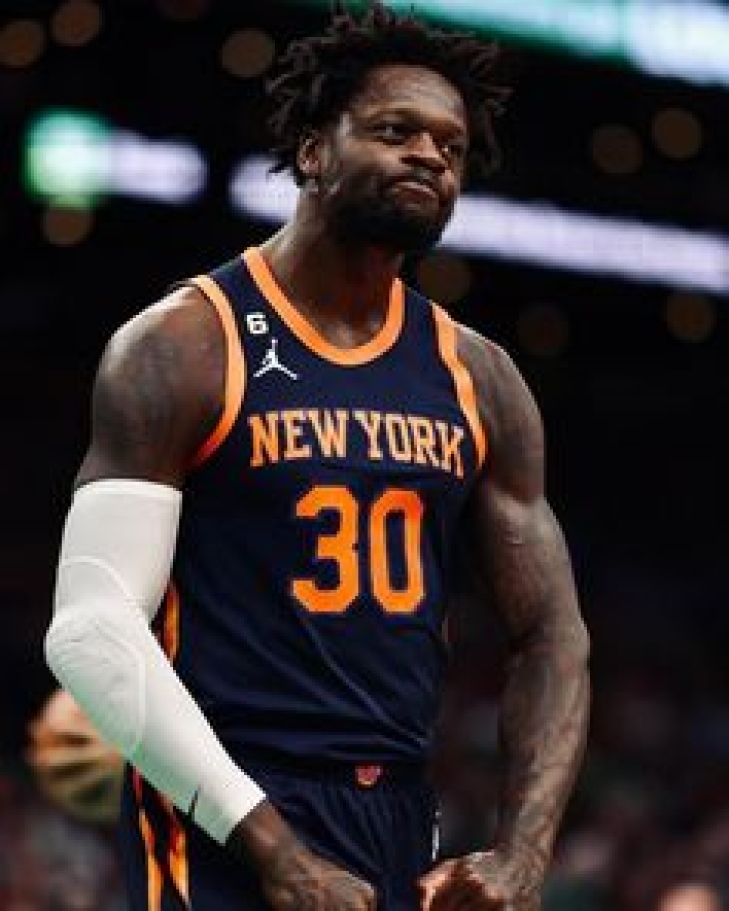
7. Julius Randle, New York Knicks, 225 Cup Points: 74 Games, 25.5 PPG, 10.1 RPG, 4.2 APG, 0.6 SPG, 0.3 BPG, 20.6 PER, 8.2 WS. (#7 on last ranking)
Randle holds in at #7, and currently has a higher PPG (25.2), than his first All-Star year two years ago (24.1).
8. Trae Young, Atlanta Hawks, 222 Cup Points: 66 Games, 26.8 PPG, 3.1 RPG, 10.0 APG, 1.2 SPG, 0.2 BPG, 22.6 PER, 6.3 WS. (#8 on last ranking)
Young is the face of an intriguing Hawks squad, but was unable to make the NBA All-Star Team. This could be the player that intrigues us he most in the next two years.
9. Lauri Markkanen, Utah Jazz, 209 Cup Points: 64 Games, 25.7 PPG, 8.6 RPG, 1.9 APG, 0.6 SPG, 0.6 BPG, 22.5 PER, 8.3 WS. (Not on last ranking)
Markkanen roars back into the top ten with his highest position to date. This unexpected campaign could be a one-off or the start of something special.
10. Domantas Sabonis, Sacramento Kings, 208 Cup Points: 70 Games, 19.0 PPG, 12.5 RPG, 7.3 APG, 0.8 SPG, 0.5 BPG, 23.3 PER, 11.1 WS. (#10 on last ranking)
Sabonis is currently the NBA leader in Rebounds per Game (12.6). He added a third All-Star this year.
Memphis’s Ja Morant fell off the top ten.
Our next update will happen after the first player breaches 260 Cup Points.
