


Committee Chairman
Our All Time Top 50 Tampa Bay Rays have been updated to reflect the 2022 Season
Yes, we know that this is taking a while!
As many of you know, we here at Notinhalloffame.com are slowly generating the 50 of each major North American sports team. That being said, we have existing Top 50 lists out and we always consistently look to update them when we can and based on necessity. As such, we are very happy to present our post 2022 revision of our top Tampa Bay Rays.
As for all of our top 50 players in baseball we look at the following:
1. Advanced Statistics.
2. Traditional statistics and how they finished in the American League.
3. Playoff accomplishments.
4. Their overall impact on the team and other intangibles not reflected in a stat sheet.
Last year, Tampa was not able to make the playoffs, but they were contenders. On a young team, this allowed, four new entrants on our Top 50.
As always, we present our top five, which was not affected by the last season:
3. Ben Zobrist
4. David Price
5. Kevin Kiermaier
You can find the entire list here.
Kiermaier, who is now a Toronto Blue Jay, did not do enough to move past his number five spot.
Brandon Lowe, moved up one rank to #15.
Of the highest four new entries, we have Infielder, Yandy Diaz, who enters this list at #29.
2021 American League Rookie of the Year, Randy Arozarena, debuts at #30.
An All-Star last year, Shane McClanahan enters at #43, and fellow hurler, Tyler Glasnow moved up two spots to #45.
Outfielder, Manuel Margot debuts at #50.
We welcome your input and comments and as always, we thank you for your support.
Our All-Time Top 50 Boston Red Sox Have Been Updated to reflect the 2022 Season
Yes, we know that this is taking a while!
As many of you know, we here at Notinhalloffame.com are slowly generating the 50 of each major North American sports team. That being said, we have existing Top 50 lists out and we always consistently look to update them when we can and based on necessity. As such, we are very happy to present our post 2022 revision of our top 50 Boston Red Sox.
As for all of our top 50 players in baseball we look at the following:
1. Advanced Statistics.
2. Traditional statistics and how they finished in the American League.
3. Playoff accomplishments.
4. Their overall impact on the team and other intangibles not reflected in a stat sheet.
Last year, the Red Sox had one of their worst seasons in years, and there were no new entrants, with only one elevation.
As always, we present our top five, which had no changes.
1. Ted Williams
2. Carl Yastrzemski
4. Wade Boggs
5. Cy Young
You can find the entire list here.
The only change came from the now San Diego Padre, Xander Bogaerts, who jumped to #21 from #29 off his fourth (and final) All-Star with Boston.
We welcome your input and comments and as always, we thank you for your support.
42. Manuel Margot
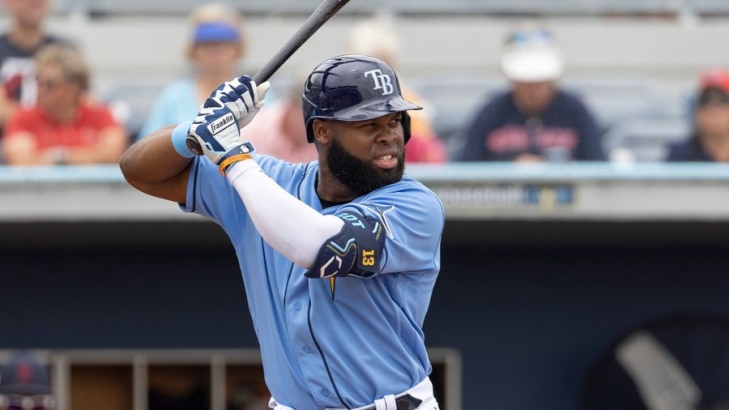
When Manuel Margot arrived in St. Petersburg before the 2020 season, which was shortened due to the pandemic, he brought exactly what the current Tampa Bay roster needs: exceptional defensive versatility across all three outfield positions. After being traded from San Diego following four key years in the National League, the Dominican outfielder was not meant to be a middle-of-the-order power hitter. Instead, his value lies in his excellent range that prevents runs and his versatile glove, which aligns seamlessly with Kevin Cash’s defensive strategies.
While his regular-season performance was modest, with a.264 batting average and only 19 home runs over four years, Margot shined brightest during the high-pressure 2020 postseason. He dramatically improved, using surprising power to hit five playoff home runs during the team's journey to the American League Pennant.
That October, his most defining moment took place at Petco Park, his old stadium, during Game 2 of the ALCS versus Houston. As he tracked a high, drifting fly ball by George Springer into the right-field corner, Margot sprinted over 100 feet into foul territory, battling the bright afternoon sun. He leapt at the peak of his jump, caught the ball, and blindly flipped over the padded railing, tumbling onto a concrete walkway below. He quickly reappeared, triumphantly holding his glove high to secure a memorable out that embodied the selfless, relentless defense of that pennant-winning team.
He remained a highly reliable platoon asset and a respected clubhouse presence through the 2023 season, helping guide the organization to multiple postseason appearances before the front office executed a typical financial pivot. Prior to the 2024 campaign, the Rays traded the veteran outfielder to the Los Angeles Dodgers to reallocate payroll. He accumulated 320 hits, 19 home runs, and 153 RBIs.
21. Shane McClanahan
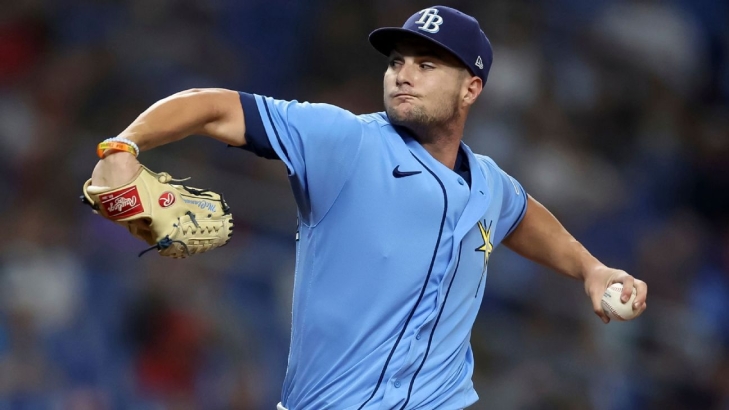
The story of Shane McClanahan’s major league career is still very much an open book, but his early chapters have perfectly illustrated the Tampa Bay Rays' uncanny ability to continuously identify, refine, and unleash elite pitching talent. Selected 31st overall in the 2018 amateur draft out of the University of South Florida, the left-hander didn't have to pack his bags very far to begin his professional journey, keeping his high-octane fastball right in his home state.
McClanahan officially joined the starting rotation in April 2021, instantly changing the dynamic of the staff with an aggressive, power-pitching approach. He attacked big-league hitters without a hint of hesitation, grinding his way to a 10–6 record across 25 starts. That electric debut campaign earned him a seventh-place finish in the American League Rookie of the Year voting and served notice that the Rays had found their next frontline anchor.
That potential fully blossomed into true stardom during a spectacular 2022 sophomore campaign. Armed with a devastating changeup and a high-90s heater, McClanahan dominated the junior circuit, earning the honor of starting the All-Star Game for the American League. He concluded that brilliant breakout summer with a 12–8 record, an elite 2.54 ERA, and a microscopic 0.926 WHIP while striking out 194 batters in 166.1 innings—a performance that landed him sixth in the AL Cy Young voting. He maintained that elite trajectory into 2023, securing a second consecutive All-Star nod and racing out to an 11–2 record with a 3.29 ERA.
However, the high-stress nature of modern power pitching caught up to him that August, as his season was abruptly cut short by the news that he required a second career Tommy John surgery. The recovery process wiped out his entire 2024 campaign and delayed his highly anticipated return.
Will a healthy McLanahan bring another All-Star year in 2026?
