

7. Pedro Martinez
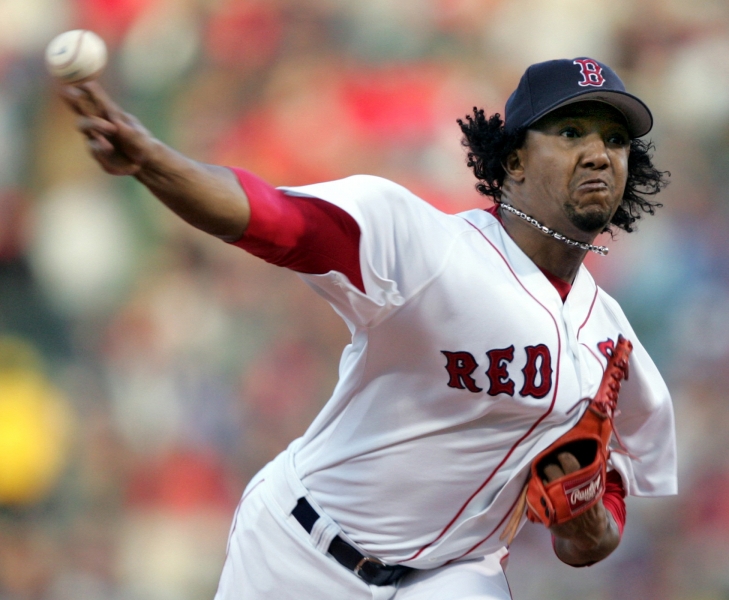
The Montreal Expos’ loss was the Boston Red Sox's eternal gain. Arriving via trade in 1998, Pedro Martinez didn’t just join the Boston rotation; he revolutionized it. After a stellar debut season where he finished second in Cy Young voting, Martinez embarked on a two-year stretch that defied the laws of physics. In 1999, he secured the Pitching Triple Crown, leading the American League in Wins (23), ERA (2.07), and Strikeouts (313). His 1.39 FIP that year remains a beacon of dominance, signaling a pitcher who was entirely independent of his defense.
If 1999 was a masterpiece, 2000 was a miracle. Martinez authored a 1.74 ERA in an era where the league average was nearly three runs higher. He set an MLB record at the time with a 0.737 WHIP, essentially rendering the opposition's bats obsolete. While he finished fifth in MVP voting that year, his second consecutive Cy Young confirmed what the Lab already knew: Pedro was the most dominant force on the planet. His postseason contributions during this peak were equally legendary, particularly his six hitless relief innings against Cleveland in the 1999 ALDS—a definitive highwater mark.
Despite a shoulder injury in 2001, Pedro remained untouchable upon his return. In 2002, he went 20–4, leading the league in ERA (2.26), Strikeouts (239), and WHIP (0.923). Though he was controversially denied a third straight Cy Young in favor of Barry Zito, the metrics proved Pedro was the superior outlier. He followed this with another ERA title in 2003 (2.22), continuing to suppress runs at a rate that seemed impossible given the offensive explosion occurring across the rest of the league.
The final chapter of his Boston story was the most emotional. While 2004 was statistically his "weakest" regular season, it served as his crowning achievement. Pedro was the emotional and competitive heart of the team that broke the 86-year curse. His performance in the 2004 World Series—seven shutout innings to earn a win in Game 3, was the perfect exclamation point on his Fenway tenure, ensuring that he left Boston not just as a statistical titan, but as a champion.
Pedro left Boston for the Mets in 2005, carrying with him a spectacular record of 117–37, a 2.52 ERA, and 1,683 strikeouts. His winning percentage in a Red Sox uniform is a staggering testament to his efficiency. Inducted into the Baseball Hall of Fame in 2015, the Red Sox wasted no time retiring his Number 45 that same year. Pedro represents the pinnacle of peak value, a player who proved that in the right hands, a baseball could be a weapon of pure mathematical dominance.
Pedro Martinez to headline the 2018 Canadian Baseball HOF Class
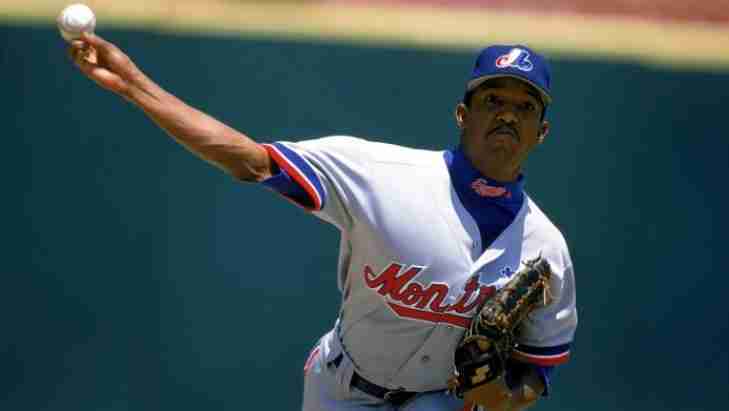
Pedro Martinez, who is already in the Baseball Hall of Fame in Cooperstown, New York, now enters his second Baseball Hall. The native of the Dominican Republic pitched four seasons (1994-97) for the Montreal Expos where he compiled a 55-33 record with a 3.06 ERA. Martinez would win his first of three Cy Young Awards (1997) as an Expo.
Former Toronto Blue Jay, Lloyd Moseby, joins Martinez. Moseby was with the Jays for the entire decade of the 80’s where he was one third of an incredible outfield with George Bell and Jesse Barfield. As a Blue Jay, Moseby would win a Silver Slugger (1983) and had 1,319 Hits with 149 Home Runs. He was also an All Star in 1986.
The third inductee is baseball historian William Humber.
The induction will take place on June 16th in St. Mary’s Ontario.
We here at Notinhalloffame.com would like to congratulate the latest inductees to the Canadian Baseball Hall of Fame.
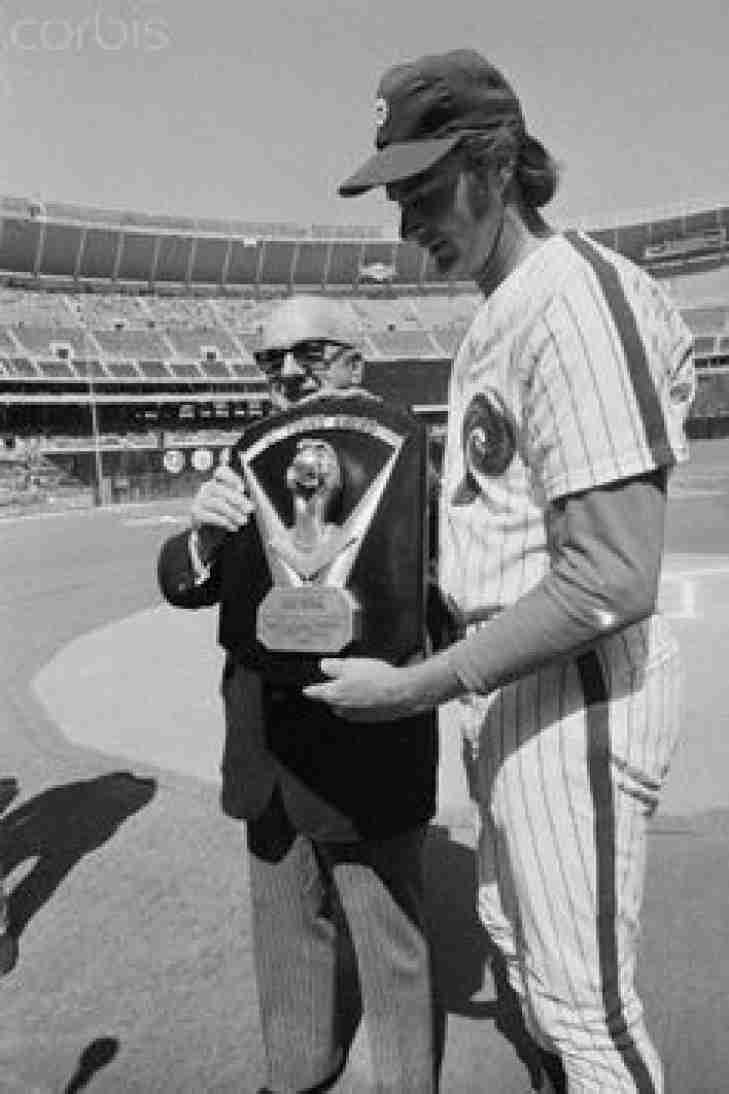
Awards = HOF? Part Twenty-One: The Cy Young Award
13. Pedro Martinez
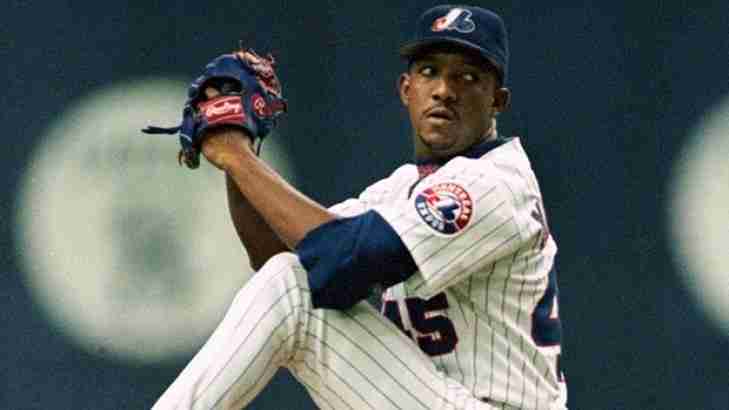
The trade that brought Pedro Martínez to Montreal before the 1994 season is a landmark moment in Expos history. Acquired from the Los Angeles Dodgers for second baseman Delino DeShields, this slender right-hander with an explosive, whip-like delivery quickly defied the idea that he was too slight to handle the physical demands of a major league starter. Over four remarkable summers in Quebec, Martínez evolved his raw, high-velocity pitches into a dominant force in the major leagues.
His debut before the Olympic Stadium crowd was immediately memorable. In the challenging 1994 season, Martínez served as a crucial yet overlooked driver for the remarkable Expos team, which led Major League Baseball with a 74–40 record before the players' strike unexpectedly ended their championship hopes. That summer, he posted an 11–5 record, demonstrating that his powerful fastball and developing changeup could consistently deceive top major league hitters.
As the organization was gradually compelled to dismantle its core due to increasing financial constraints, Martínez individually took on the burden of carrying the franchise. He achieved his first career All-Star selection in 1996 with 222 strikeouts, but this was just a preview of the extraordinary, record-breaking performance he delivered in 1997.
That 1997 campaign remains one of the most exceptional single-season pitching performances ever observed on a Major League mound. Martínez entirely incapacitated National League batters, transforming the strike zone into his personal domain. He achieved a remarkable 17–8 record while leading the major leagues with a microscopic, modern-era 1.90 ERA and delivering an extraordinary league-high of 13 complete games. He employed precise, high-pressure command to record an impressive 305 strikeouts over 241.1 innings, becoming the first right-handed pitcher since Walter Johnson in 1912 to reach the 300-strikeout threshold with an ERA below 2.00. This outstanding, elite performance designated him as the first—and only—pitcher in Montreal Expos history to be awarded the National League Cy Young Award.
Just as he established himself as a global superstar, the harsh realities of Montreal's small-market economics forced a change. Recognizing they lacked the financial means to offer their young star a market-value contract extension, the front office traded their key player to the Boston Red Sox in November 1997. Martínez would go on to achieve immortal status in baseball in New England, but the foundation of his legendary peak was laid during his time with the Expos.
Martínez was inducted into the Baseball Hall of Fame in 2015. As an Expo, he played 118 games (117 starts), with a 55–33 record, 3.06 ERA, and 1.09 WHIP. He pitched 797.1 innings, with 20 complete games, eight shutouts, 843 strikeouts, and a 135 ERA+.
A Special Day in Cooperstown
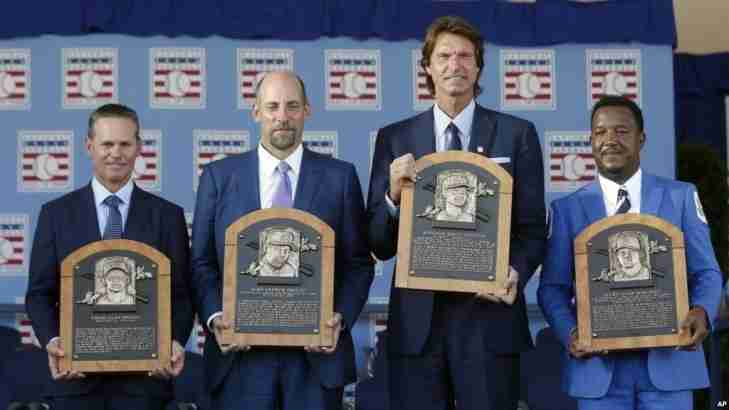
This year they have four.
On what was a beautiful summer day in front of 40,000 fans and forty-nine Hall of Famers in upstate New York, four baseball legends are now enshrined with a bronze bust that will forever be on display.
Rather than recap the accomplishments of the four (regular visitors know that we have done that often), let’s read the etchings on each of the four new inductees.
CRAIG ALLAN BIGGIO: HOUSTON, N.L. 1988-2007
GRITTY SPARK PLUG WHO IGNITED ASTROS OFFENSE FOR 20 MAJOR LEAGUE SEASONS, BECOMING FIRST PLAYER IN HISTORY WITH AT LEAST 3,000 HITS, 600 DOUBLES, 400 STOLEN BASES AND 250 HOME RUNS. TRANSITIONED FROM ALL-STAR CATCHER TO GOLD GLOVE SECOND BASEMAN TO EVERYDAY OUTFIELDER, AMASSING 3,060 HITS, INCLUDING 668 DOUBLES – MOST BY A RIGHT-HANDED BATTER – AND A MODERN-DAY RECORD 285 TIMES HIT BY A PITCH. A SEVEN-TIME ALL-STAR, WON FIVE SILVER SLUGGER AWARDS AND FOUR GOLD GLOVE AWARDS.
JOHN ANDREW SMOLTZ: ATLANTA N.L. 1988-99, 2001-08; BOSTON, A.L. 2009; ST.LOUIS, N.L. 2009
A WORKHOUSE POWER PITCHER, TRADED HIS STARTING DOMINANCE TO DEVELOP INTO PREMIER CLOSER BEFORE RETURNING TO ROTATION. BECAME THE FIRST PLAYER IN HISTORY WITH 200 WINS AND 150 SAVES. WITH A DYNAMIC FASTBALL, A DECEPTIVE SLIDER AND A DARTING SPLITTER, FANNED 3,084 BATTERS AND WAS NAMED TO EIGHT ALL-STAR TEAMS, THE 1996 N.L. CY YOUNG AWARD WINNER AND 1992 NLCS MVP. SET N.L. RECORD WITH 55 SAVES IN 2002. PITCHED BEST WHEN GAME WAS BIGGEST, RECORDING A 15-4 POST-SEASON RECORD, HELPING BRAVES TO 1995 WORLD SERIES TITLE.
PEDRO JAIME MARTINEZ: LOS ANGELES, N.L. 1992-93; MONTREAL. N.L. 1994-97; BOSTON, A.L. 1998-2004; NEW YORK, N.L. 2005-08; PHILADELPHIA, N.L. 2009
FEATURING AN ELECTRIC ARSENAL OF PITCHES THAT VANQUISHED BATTERS DURING AN ERA OF HIGH OCTANE OFFENSE, THE FIERY RIGHTY FROM THE DOMINICAN REPUBLIC OWNED THE INSIDE PART OF THE PLATE WITH AN EXPLODING FASTBALL AND CONFOUNDING CHANGE-UP. LED LEAGUE IN E.R.A. FIVE TIMES AND STRIKEOUTS THREE TIMES EN ROUTE TO THREE CY YOUNG AWARDS AND EIGHT ALL-STAR SELECTIONS. FIRST PITCHER TO RETIRE WITH 3,154 STRIKEOUTS IN FEWER THAN 3,000 INNINGS. WON 219 GAMES WITH AN ASTOUNDING .687 WINNING PERCENTAGE. POSTED 117-37 RECORD IN BOSTON HELPING TO LEAD RED SOX TO 2004 WORLD SERIES CHAMPIONSHIP.
RANDALL DAVID JOHNSON: “RANDY” “THE BIG UNIT”: MONTREAL, N.L. 1988-89; SEATTLE, A.L. 1989-98; HOUSTON, N.L. 1998; ARIZONA, N.L. 1999-2004, 2007-08; NEW YORK, A.L. 2005-06; SAN FRANCISCO, N.L. 2009
AT 6’10’, A TOWERING AND INTIMIDATING LEFTHANDER WHOSE CRACKLING FASTBALL AND DEVASTATING SLIDER PARALYZED HITTERS FOR MORE THAN TWO DECADES, FIVE-TIMES CY YOUNG AWARD WINNER, INCLUDING FOUR CONSECUTIVE, 1999-2002. LED LEAGUE IN STRIKEOUTS NINE TIMES AND POSTED SIX 300 STRIKEOUT SEASONS. TEN-TIME ALL-STAR AND THREE-TIME 20-GAME WINNER, RANKED SECONS ALL-TIME ON STRIKEOUT LIST (4,875) AND FIRST IN STRIKEOUTS PER NINE INNINGS (10.6) UPON RETIREMENT. WON 303 GAMES AND LED LEAGUE IN E.R.A. FOUR TIMES, WON THREE GAMES IN 2001 WORLD SERIES WITH CHAMPION DIAMONDBACKS EARNING CO-MVP HONORS.
Capital letters do make it more emphatic doesn’t it?
Do you want to know what makes it even better?
The fact that Randy Johnson was inducted with his mullet is far greater to us than his hat (the first for Arizona) and the hat worn by Craig Biggio (Astros, also a first.
So what do we do now?
What we always do!
We look forward to the next class of Baseball Hall of Famers and debate their merits.
Hopefully, all of you will participate and lend us your opinions as to who you want to see in the next Baseball Hall of Fame class.
Red Sox to Retire Pedro Martinez' Number
Saying that one of the most prestigious baseball teams, the Boston Red Sox have announced that they will be retiring the number of former Pitcher, Pedro Martinez, marking the ninth time in franchise history that the team has offered that accolade. His number 45, will join that of Bobby Doerr (#1), Joe Cronin (#4), Johnny Pesky (#6), Carl Yastrzemski (#8), Ted Williams (#9), Jim Rice (#14), Carlton Fisk (#27) and the mandated retired number 42 of Jackie Robinson. The ceremony will take place on July 28, two days after he is to be inducted into the Baseball Hall of Fame.
In the seven seasons that Pedro Martinez compiled with the Red Sox, Martinez collected two Cy Young Awards, won the ERA title four times, the WHIP title four times and compiled a stellar 117 and 37 won/loss record. Martinez was also a large part of the 2004 team that won the World Series.
We here at Notinhalloffame.com would like to congratulate Martinez on achieving this accolade.
