


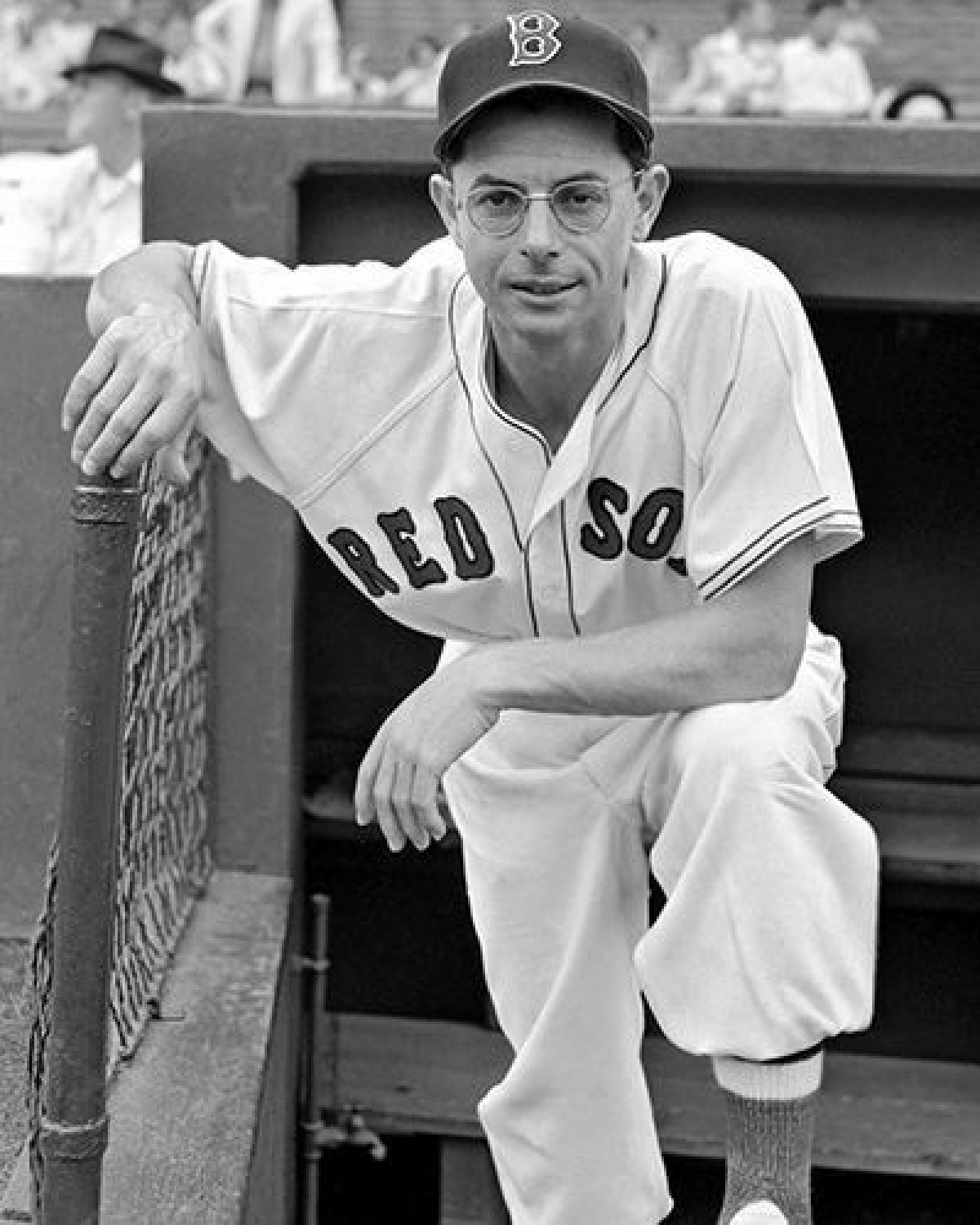


Though often introduced as the brother of Joe, Dom DiMaggio carved out a legacy in Boston that was entirely his own. Nicknamed "The Little Professor" for his spectacles and scholarly demeanor, he proved to be a clinical technician at the top of the lineup from the moment he debuted in 1940. A natural lead-off man, DiMaggio combined elite plate discipline with a high-contact bat, securing All-Star selections in each of his first two full seasons while consistently pacing the Red Sox offense with 165+ hits a year.
Like many of his teammates, DiMaggio’s career was interrupted by three years of military service during World War II. However, his return in 1946 was a masterclass in "Era Dominance" (Category 3). He batted a career-high .316 and earned his third All-Star nod, proving he hadn't missed a beat during his time away. Between 1949 and 1952, he was a perennial All-Star, showcasing a speed-and-discipline profile. His 1950 campaign was a statistical outlier; he led the American League in Runs Scored (131), Triples (11), and Stolen Bases (15), serving as the catalytic engine for the high-powered Boston offense.
Defensively, DiMaggio was considered one of the most intelligent center fielders of his era. He utilized a deep knowledge of opposing hitters to position himself with mathematical precision, often neutralizing the tricky dimensions of Fenway Park. 383 On-Base Percentage was a mark of consistency that ensured he was almost always on base for the heart of the order. He played his entire 11-season career in a Red Sox uniform, finishing with 1,680 hits and a near-.300 career average.
Though his career ended abruptly in 1953, the "Little Professor" remained one of the most beloved figures in franchise history and embodied the grit and intelligence of the post-war Red Sox. Inducted into the Red Sox Hall of Fame in 1995, his legacy is defined not by his family name but by his role as the premier table-setter for a generation of Boston greats.

Comments powered by CComment