


Site Admin
21. Don Wilson
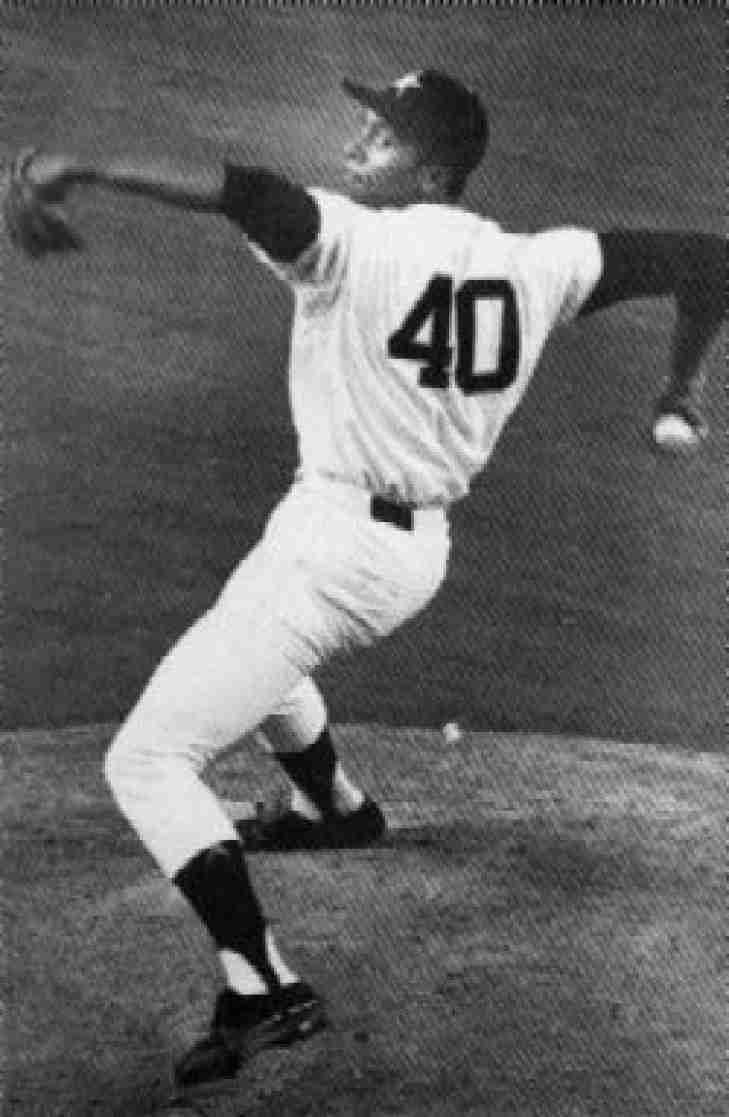
Don Wilson first made his mark in Houston as a fireballing right-hander who defined the early power-pitching identity of the franchise. After signing with the organization in 1964 and quickly climbing the minor league ladder, he joined the big league roster for good in 1967.
Wilson’s impact in a Houston uniform reached a historic peak early in his journey. In 1967, as a 22-year-old rookie, he secured a place in franchise lore by tossing the first no-hitter ever recorded in a domed stadium, striking out 15 Atlanta Braves. This performance signaled a transition from a young prospect to a premier league force who specialized in overpowering hitters. He showed the organization that he was a foundational piece of the staff, proving his consistency by repeating the feat two years later with a second no-hitter against the Reds in 1969.
Between 1968 and 1972, Wilson was a statistical force, recording double-digit wins every single year and earning an All-Star selection in 1971. He reached a career peak for workload during that span, twice surpassing 260 innings pitched and maintaining a focused intensity that led to 1,238 career strikeouts. Despite the early Astros' offensive struggles, he maintained a 104-92 record, providing steady production that anchored the rotation alongside Larry Dierker.
At just 29 years old and still in the prime of his professional life, Wilson passed away alongside his family due to carbon monoxide poisoning in their garage. The loss sent a shockwave through the city, leading the organization to retire his number 40 that spring as a final punctuation on his immense contribution. In 2019, he was inducted as part of the inaugural Astros Hall of Fame class.
20. Terry Puhl
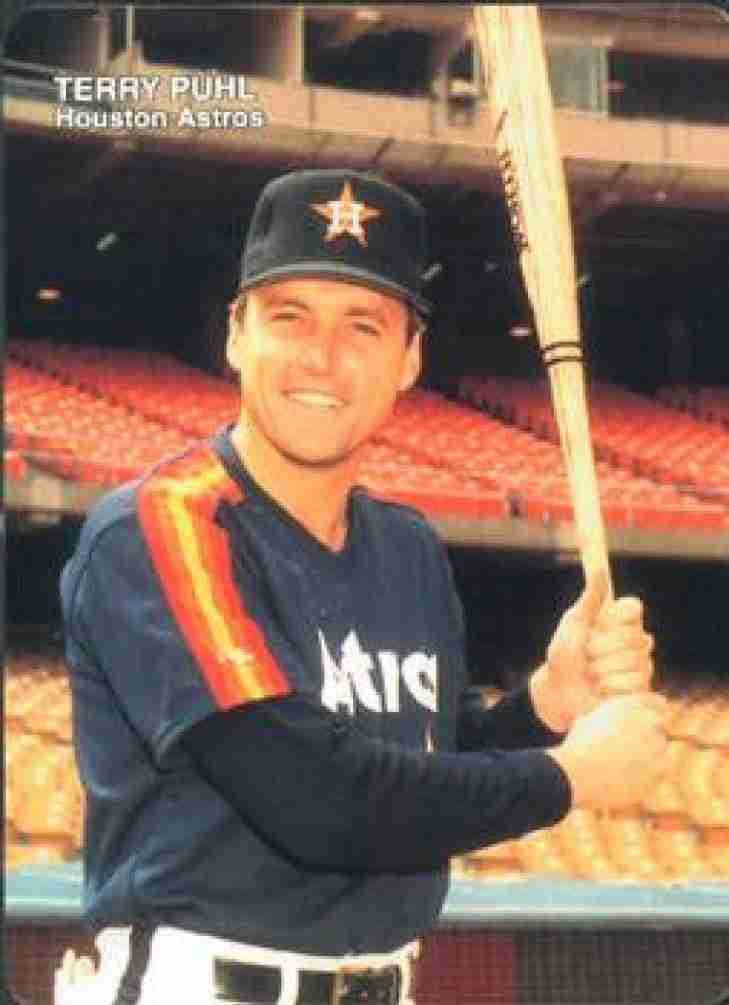
From Melville, Saskatchewan, Terry Puhl became a cornerstone of the Houston outfield for over a decade, carving out a career defined by defensive brilliance and high-speed efficiency. Signing with the Astros as an undrafted free agent, the Canadian-born standout became a fixture during the franchise’s first real era of contention.
During his first full season in 1978, at just 21 years old, he secured an All-Star selection by batting .289 and showcasing a disciplined approach that belied his age. This initial splash signaled his transition into a premier table-setter for a club that prioritized speed and contact. He swiped 32 bases that summer and proved he could be a foundational piece for a team on the verge of its first postseason appearance.
The bulk of his Houston years were characterized by consistent, all-around production during a decade of elite defensive play. Between 1979 and 1984, Puhl was a statistical force of reliability, recording six seasons with at least 20 stolen bases and twice surpassing the 150-hit plateau. He reached a career peak for high-stakes performance during the 1980 National League Championship Series, where he set a then-record with ten hits in a five-game series. Despite a lack of traditional power, he contributed with a career batting average of .280 in a Houston uniform and provided the leadership required of a veteran.
Everything culminated in a fourteen-year run that saw him amass 1,357 hits and 226 stolen bases for the organization. He eventually finished his professional journey with a brief stint in Kansas City in 1991, but his identity remained firmly rooted in the Bayou City. In 2022, the Astros inducted him into their Hall of Fame.
12. Nolan Ryan

Nolan Ryan’s arrival in Houston in 1980 was a homecoming that doubled as a massive free-agent statement. At 33, an age when most power pitchers are bracing for a decline, the Texas native returned to his roots to become the highest-paid player in the game. While he had already established himself as a strikeout king with the Angels, his nine-season run with the Astros proved he was a physical outlier whose professional resilience could defy the standard aging curve.
Ryan’s tenure in Houston began with an immediate high-leverage impact, as he helped anchor the rotation of the 1980 squad that captured the franchise's first division title. In the strike-shortened 1981 season, he led the National League with a 1.69 ERA and threw his record-breaking fifth no-hitter against the Dodgers. He possessed a specialized, high-velocity fastball that remained elite well into his late thirties, a style that allowed him to maintain a steady-state dominance over National League hitters who had never seen anything quite like his "Express."
In 1983, Ryan surpassed Walter Johnson to become the all-time strikeout leader, a moment that cemented his status as a franchise pillar. While his win-loss records were often victims of poor run support, most notably in 1987 when he led the league in ERA (2.76) and strikeouts (270) but finished with only eight wins, his focused intensity never wavered. He was a model of high-frequency strikeout production, leading the league in punchouts twice as an Astro and finishing in the top five of the Cy Young voting on two occasions.
The final chapters of his Houston story reached a frustrating plateau in 1988. Despite still being a premier draw and a productive arm, contract disputes with owner John McMullen led to Ryan’s departure for the Texas Rangers following the season. He left the organization with 106 wins and 1,866 strikeouts, having proven that a veteran-like poise and a 100-mph heater could coexist for nearly a decade. He showed the world that a player's second act can be just as legendary as the first, leaving a statistical footprint that eventually forced the club to acknowledge his permanence in their history.
The story in Houston reached its final punctuation in 1996 when the Astros retired his number 34, followed by his induction into the inaugural class of the Astros Hall of Fame in 2019. He showed the organization that when you have the heart of a competitor and the arm of a phenomenon, you don't just play for a team, you become the identity of the entire state.
In Houston, Ryan compiled 106 wins, 1,866 strikeouts, and a 3.13 ERA across nine seasons.
10. Mike Scott
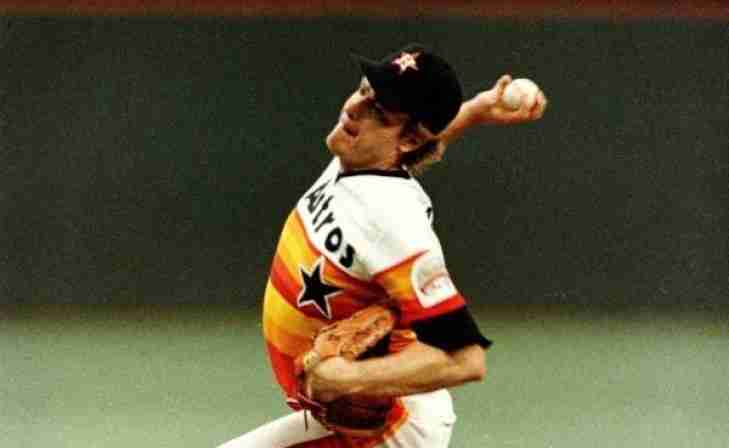
In the mid-1980s, the Houston Astros possessed a psychological weapon that reduced the best hitters in the National League to a state of visible frustration. Mike Scott, armed with a split-finger fastball that seemed to defy the laws of physics, transformed from a struggling former prospect into a high-velocity force of nature. For a five-year stretch in the heart of the "Astrodome era," he wasn't just the ace of the staff; he was a tactical anomaly who could end a game—or a division race—entirely on his own terms.
Scott’s tenure in Houston was defined by a historic metamorphosis during his legendary 1986 campaign. That summer, he authored a statistical outlier season of such profound dominance that he swept nearly every major pitching category, leading the National League in ERA (2.22), strikeouts (306), and WHIP (0.923). The hallmark of his mastery occurred on September 25, 1986, when he became the only pitcher in major league history to throw a no-hitter in a division-clinching game. He didn't just secure the NL West title; he suffocated the Giants in a 2-0 masterpiece that served as the final exclamation point on his Cy Young Award-winning season.
However, months later, he had an even bigger moment. During the 1986 NLCS against the Mets, Scott’s efficiency bordered on the supernatural, pitching two complete-game victories and allowing only a single run across 18 innings. He struck out 19 batters and walked just one, leaving the eventual world champions so demoralized that he was named the NLCS MVP, becoming the first player in history to win the honor while playing for the losing team. Had the series reached a Game 7, Scott’s presence on the mound was widely considered a foregone conclusion for a Houston victory, a testament to the high-leverage fear he instilled in his opponents.
While 1986 was his masterpiece, Scott remained a model of professional resilience as the decade closed. He surpassed the 200-strikeout plateau again in 1987 and reached a new personal high, where, in 1989, he led the league with 20 wins and finished as the Cy Young runner-up.
Scott declined rapidly after retiring two years later, but a year later, the team retired his number 33. Scott compiled 110 wins and 1,318 strikeouts, and the Astros inducted him into the inaugural class of the Astros Hall of Fame in 2019.