

48. Kevin Brown

Kevin Brown's arrival in Los Angeles in 1999 marked a historic milestone as the first player in Major League Baseball to be awarded a contract exceeding $100 million. This extensive seven-year agreement, which transitioned him from San Diego to Chavez Ravine, was predicated on the expectation that he would be the pivotal element in securing a championship. Although the period known as the "Kevin Brown Era" is often viewed through the prism of the substantial financial investment and a series of injuries, the right-hander demonstrated a high level of efficiency that, when he was healthy, rendered him one of the most formidable sinkerball pitchers in franchise history.
Back in 1999, Brown hit a peak in his workload, pitching a season with 18 wins and over 250 innings, a true testament of his mastery in the National League. He demonstrated incredible control, striking out 221 batters and finishing sixth in the Cy Young voting. The following year, in 2000, he reached new heights of efficiency, capturing the ERA Title with an impressive 2.58 and leading the league in WHIP at 0.99. Throughout this exciting period, he was a key player, surpassing the 200-strikeout mark in consecutive years and proving once again that he was a formidable force in the game.
Brown faced a tough crossroads mid-contract. Between 2001-2002, injuries like chronic back, elbow, and shoulder problems led to a decline in durability. Once a key player, he only won 10 games in 2001 and just 3 in 2002, with a 4.81 ERA. During this period, focus shifted from his sinker to his salary, and fan expectations grew frustrated as the team missed the postseason.
In 2003, Brown had his final full season with the Blue, posting a 14-9 record with a 2.39 ERA. He was a key part of the rotation, earning his second All-Star selection and finishing in the top ten in ERA. However, that winter, the organization changed direction, and Brown was traded to the Yankees for Jeff Weaver and prospects.
Brown compiled a 58-32 record, a 2.83 ERA, and 784 strikeouts as a Dodger, which, while decent, earns him a spot here, will always be associated with a contract that his body couldn’t live up to.
42. Kevin Brown
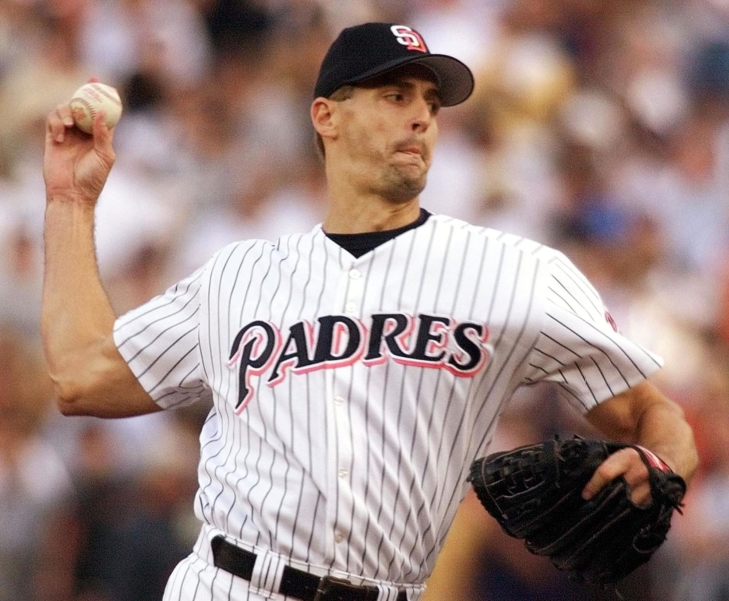
When building an objective, data-driven framework to evaluate a historical ledger, you inevitably encounter the ultimate philosophical puzzle: how do you weigh a single, volcanic season of absolute transcendence against decades of steady, standard compilation? For a franchise that has handed the ball to iconic multi-year Cy Young winners like Gaylord Perry, Jake Peavy, and Blake Snell, the concept of elevating a one-year mercenary above them feels almost sacrilegious.
Kevin Brown did not just have a good year down in Southern California; his lone summer on the grass represents the most ruthlessly dominant, high-leverage single-season pitching masterpiece in the history of the organization—and it isn't particularly close.
The scenario was driven by straightforward small-market economics. After winning the 1997 world title, the Florida Marlins conducted a major corporate fire sale, trading their formidable ace to San Diego in December. Like in Miami, Brown quickly changed the dynamics of his new rotation. Instead of relying on subtlety, he showcased a relentless display of raw power with a high-velocity 96 mph sinking fastball and a deadly slider, which often forced veteran hitters to hit ground balls into the infield dirt.
His 1998 regular-season performance showcased exceptional durability on the front line, breaking local records. Brown made consuming deep, high-stakes frames a disciplined routine, starting 35 games and finishing with an impressive 18–7 record. He systematically dominated National League lineups, leading the league with an outstanding 2.23 FIP, and set a franchise record with 257 strikeouts in 257.0 innings. Advanced analytics strongly confirm his efficiency, as he topped all Major League pitchers with an 8.6 pitching bWAR (9.1 including batting), a benchmark that remains the standard for any season in San Diego history.
While traditional BBWAA voters overlooked his difficult clubhouse demeanor, placing him third in the Cy Young voting behind Tom Glavine and Trevor Hoffman, other baseball circles recognized his excellence. The Sporting News honored him by naming Brown its Major League Pitcher of the Year.
More significantly, his fierce competitive drive was the key force behind the underdogs reaching the 1998 pennant. He delivered an outstanding performance in his first two postseason series, including an iconic 11-strikeout complete-game shutout against the strong Houston Astros in the NLDS, and then dominated the Atlanta Braves in the NLCS. However, his final performance lacked that elite consistency; he showed signs of physical exhaustion in the World Series, where the formidable New York Yankees ultimately defeated him as they swept to the championship.
Brown orchestrated a definitive, earth-shaking departure by signing a historic seven-year, $105 million contract with the regional rival Los Angeles Dodgers—becoming the first player in professional sports history to cross the elusive $100 million threshold.
8. Kevin Brown
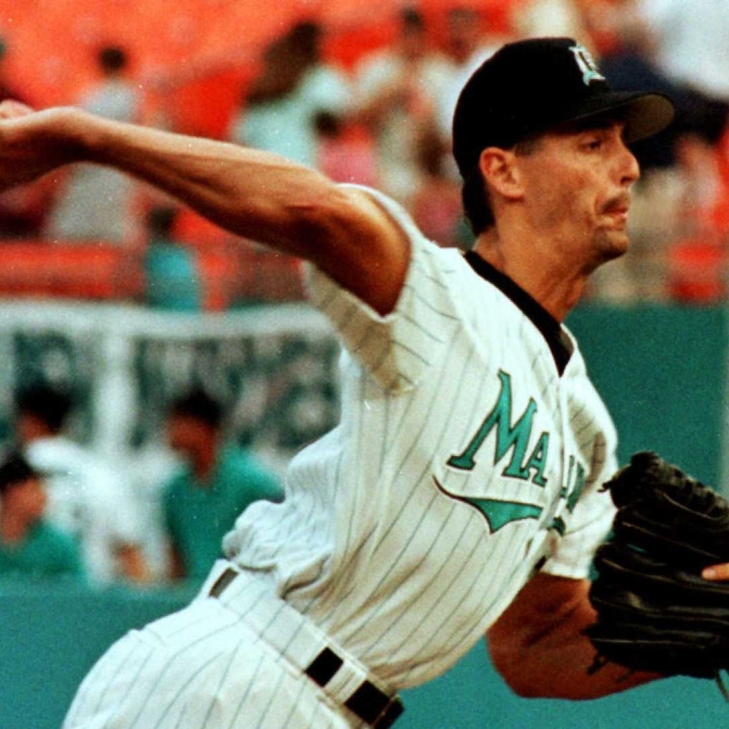
Kevin Brown arrived in South Florida in 1996 as a high-caliber free agent, a right-hander with a sinking fastball that induced broken bats and ground-ball outs with surgical precision. While his tenure in a Marlins uniform was a brief two-season residency, he provided a brand of top-tier pitching that stands as the most dominant individual peak in the organization's history, and you can easily argue that the franchise’s first World Series win does not happen without him.
In his first season with the Fish, Brown was electric, recording a staggering 1.89 ERA and a 0.944 WHIP. He showcased technical efficiency that produced an ERA+ of 215, meaning he was more than twice as effective as the average pitcher in an era defined by explosive offense. While he finished as the runner-up for the Cy Young Award to John Smoltz, his performance established a high-quality baseline that transformed the Marlins into a legitimate postseason threat.
The season after Brown tossed the second no-hitter in team history against the Giants and earned his second consecutive All-Star selection. He proved to be a high-caliber winner by recording 16 victories and eclipsing 200 strikeouts, anchoring a staff that secured a Wild Card berth. His impact was never more apparent than in the NLCS against the Braves, where he famously pitched a complete-game masterpiece while battling the flu to clinch the Marlins' first pennant. While his efficiency dipped in the 1997 World Series, where he struggled in two starts against the Indians, his value to the championship run remained unquestioned; without his earlier dominance during the regular season and the early playoff rounds, the team never reached the Fall Classic.
In the winter of 1997, when, as part of the franchise's total roster dismantling, he was traded to the San Diego Padres for Derrek Lee and prospects. He walked away with a championship ring and the status of having authored the greatest two-year pitching run the team has ever seen. Stat-wise, Brown had a 33-19 record and a 2.83 ERA.
27. Kevin Brown

Long before Kevin Brown became baseball’s first $100 million player, threw a no-hitter, or led different teams to the World Series, he was a key draft prospect for the Texas Rangers. Picked fourth overall in 1986 from Georgia Tech, this intense right-hander featured a powerful sinking fastball that defined his pitching style. Although his peak, close to Cooperstown, came after leaving Texas, his seven full seasons in Arlington set the stage for a highly successful major league career.
By 1989, Brown had become a regular in the Texas rotation, just behind legendary Nolan Ryan. He used a distinctive high-velocity sinker that generated numerous ground balls, showcasing efficiency often overlooked at Arlington Stadium, known for favoring hitters in the pre-humidor era. While early '90s fans and media admired strikeout kings, Brown emphasized solid contact, playing with a relentless, bulldog-like approach.
That unyielding approach culminated in a spectacular individual breakthrough in 1992. Completely dominating American League lineups, Brown authored a masterpiece of a season, leading the major leagues with 21 victories against just 11 defeats. Pacing the circuit with 265.2 grueling innings over 35 starts, he earned his first career All-Star selection and finished sixth in the AL Cy Young Award voting, becoming the first Ranger pitcher to reach 20 wins since Fergie Jenkins in 1974. He sustained that workhorse pace the following summer, logging another 233 frames to post 15 wins.
However, his time in Texas concluded amidst the structural chaos that gripped the sport in the mid-1990s. Brown took the ball for 26 starts during the strike-shortened 1994 campaign, but his relationship with the front office grew increasingly stagnant. Once the devastating player strike wiped out the World Series and spilled into the following spring, the business of the game shifted dramatically. When the strike finally settled in April 1995, Brown hit the open market as a free agent. The small-market Rangers, unwilling to commit to escalating long-term financial obligations, elected to let their former ace walk, clearing the path for him to sign a one-year deal with the Baltimore Orioles.
Across parts of eight seasons in Texas (1986, 1988–1994), Brown made 188 appearances (185 starts). He compiled a highly respectable 78–64 record with a 3.81 ERA and a 1.33 WHIP. He swallowed up 1,234 innings of work, recording 36 complete games, three shutouts, and 742 strikeouts.
37. Kevin Brown
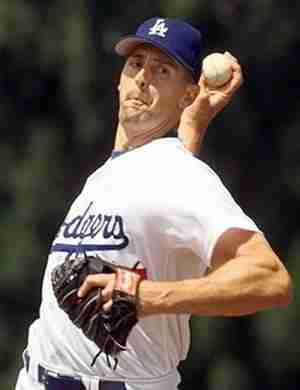
A lot of baseball players take flak for their high salaries. One of those who did was Kevin Brown, who was the first man in professional baseball to sign a contract worth $100 Million. Sadly for Brown, his deterioration made that one of the worst contracts, as in the final years of his career, he was not a player who should have been among the game’s highest-paid.
This isn’t to say that Kevin Brown didn’t have flashes of brilliance because he certainly had enough of them to warrant such a huge contract in the first place. He was regarded as one of the most intense pitchers, and as much as his temper served to fuel his unparalleled competitiveness, it also would cause his unraveling on occasion. Nevertheless, Kevin Brown was a major reason that the Florida Marlins won their surprise World Series in 1997 and the Padres’ 1998 World Series appearance. He had a brilliant fastball and forkball and rarely gave up the longball.
Unfortunately, Kevin Brown was unable to maintain his skill set, and his production dropped off during his final years with the Dodgers and during his American League return to the Yankees. Had Kevin Brown lived up to the years leading up to his nine-digit contract, he would be a serious contender for induction. As it stands now, it doesn’t look good.
