


Site Admin
37. Erik Williams
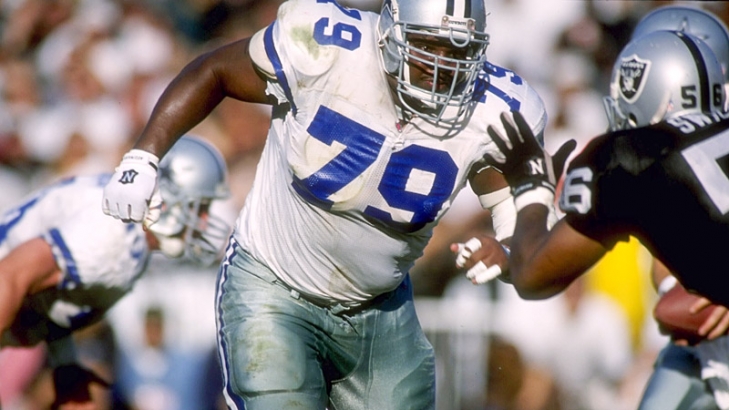
Overcoming poor academic marks in high school, Erik Williams took a unconventional path to gridiron stardom, landing at Division II powerhouse Central State University in Ohio. There, the massive Philadelphia native helped lead the Marauders to an NAIA national title, displaying a terrifying blend of size, power, and athletic movement. When the Dallas Cowboys selected him in the third round (70th overall) of the 1991 draft, they weren't just picking an interior depth piece—they were adding the final, mean-spirited cornerstone of a dominant offensive dynasty.
Williams logged time as a backup during his rookie campaign, but his ferocious performance during 1992 training camp forced Jimmy Johnson to shuffle the starting lineup. The Cowboys shifted veteran Nate Newton inside to guard, clearing space for Williams to take over at right tackle. Standing 6-foot-6 and 320 pounds, "Big E" brought a mean, physically imposing edge to the perimeter, locking down elite pass rushers and clearing lanes for Emmitt Smith. His signature moment arrived in 1992, when he single-handedly neutralized Reggie White without tight end help, signaling his ascension as the most feared edge-blocker in the sport.
As a vital pillar of "The Great Wall of Dallas" alongside Newton, Mark Tuinei, Mark Stepnoski, and Kevin Gogan, Williams anchored the front line during Dallas's back-to-back title runs in Super Bowl XXVII and XXVIII. He earned First-Team All-Pro honors and a Pro Bowl nod in 1993, establishing a reputation so dominant that many analysts regarded him as a future first-ballot Hall of Famer.
Tragedy struck in October 1994 when Williams suffered severe, multi-ligament knee damage in a near-fatal automobile crash in Dallas, forcing him to miss the rest of the season. Though the injury permanently sapped some of his elite lateral quickness, Williams fought through agonizing rehabilitation to reclaim his starting job in 1995. Relying on sheer power, mental toughness, and a veteran edge, he helped lead Dallas to a third title in Super Bowl XXX, earning two more First-Team All-Pro selections (1995, 1996) and three additional Pro Bowl honors (1996, 1997, 1999).
Williams spent a decade in America's Team uniform before concluding his career with a brief stint in Baltimore in 2001. While the 1994 accident altered his trajectory, his peak play at right tackle remains among the highest levels of offensive line execution in Cowboys history.
Williams played in 141 regular-season games with 128 starts for the franchise, and in 2024, he was inducted into the Black College Football Hall of Fame.
35. George Andrie
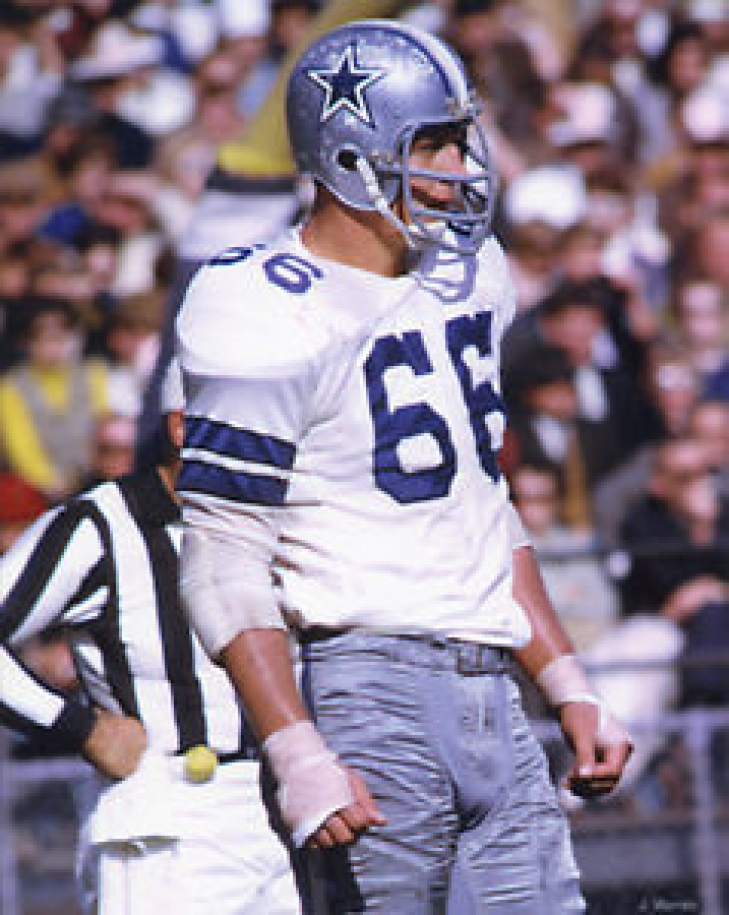
When you think of Marquette, you don’t come up with visions of football. Perhaps that is because the program shut down in 1960, the year George Andrie was a junior. This meant that during his senior year, he wasn’t playing football, and as such, slipped under the radar of many teams, but the Dallas Cowboys and especially, legendary Gil Brandt were not among them. He was chosen by Dallas in the 6th Round in 1962, and he was set to begin his pro career.
Andrie made a strong debut as a rookie, securing the right defensive end position and partnering with Bob Lilly on Tom Landry's front line. This pair quickly became a key part of the original "Doomsday Defense." With quick lateral moves and long reach, Andrie disrupted passing lanes and played at a high level from 1965 to 1969, earning five straight Pro Bowl selections and a First-Team All-Pro honor in 1969. In his peak 1966 season, he caused significant problems for opposing backfields, recording 18.5 sacks in 14 games and intercepting a 6-yard touchdown return.
Beyond his skill in pass rushing, Andrie was also known for performing under pressure in crucial games. He made a key play in the historic 1967 "Ice Bowl" by recovering a fumble from Bart Starr in the end zone for a touchdown. Four years later, he played a vital role on the defense in Super Bowl VI, recording a sack and putting pressure on Miami’s Bob Griese, as Dallas limited the Dolphins to only three points and secured their first Lombardi Trophy.
An ironman for over a decade, Andrie made 112 consecutive regular-season starts, missing only two games in his career. He retired after the 1972 season as a lifelong Cowboy, leaving a legacy of defensive dominance that set the standard for generations of Dallas edge rushers.
Andrie played in 141 regular-season games with 136 starts. He had 98.5 career sacks (unofficial) with 13 fumble recoveries and two defensive touchdowns.
34. Danny White
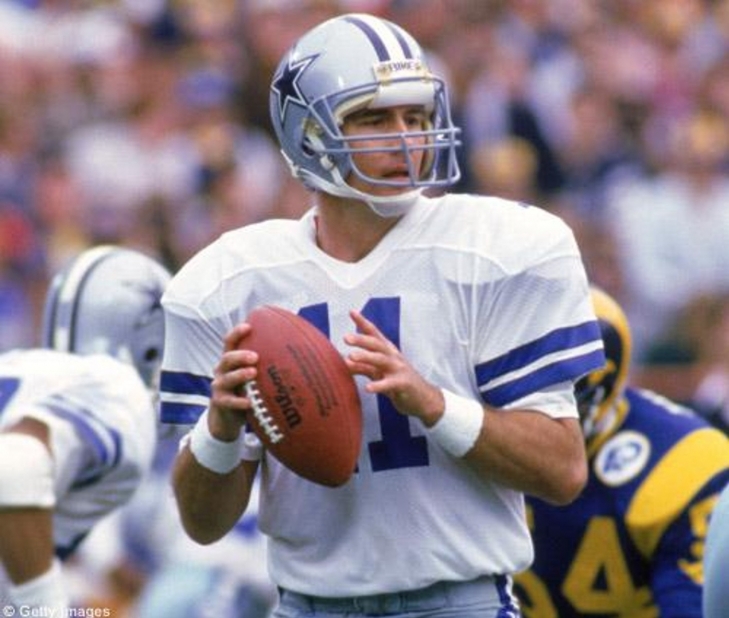
Drafted in the third round of the 1974 NFL Draft out of Arizona State, Danny White found himself in a unique logjam. With Roger Staubach firmly entrenched under center in Dallas, White chose to start his professional career in the upstart World Football League, taking snaps for the Memphis Southmen to gain valuable quarterback reps. Following the WFL's collapse, White signed with the Cowboys in 1976. For four years, he embraced a grueling dual role: serving as Tom Landry's trusted holding specialist and primary punter while operating as Staubach's designated heir apparent.
When Staubach hung up his cleats after the 1979 season, White stepped out of the shadow of a franchise icon and immediately validated Landry's trust. Taking over under center in 1980, White delivered a sterling debut campaign, throwing for 3,287 yards and 28 touchdowns to lead Dallas to a 12–4 record. What followed was one of the most remarkable individual runs in modern NFL history: White continued to pull double duty as both starting quarterback and starting punter through the 1984 season, famously becoming the only player in league history to pass for over 3,000 yards and punt for over 3,000 yards in the same season (1981).
White's tenure as a QB1 was characterized by notable statistical efficiency and an unwavering record of victories. He led the Dallas Cowboys to three consecutive NFC Championship Games from 1980 to 1982, securing his sole career Pro Bowl selection during the strike-shortened 1982 season when he led the NFC with 16 touchdown passes. Equipped with a rapid release and precision in long throws, White consistently ranked among the league leaders in passer rating and yards per attempt, demonstrating his arm talent to compete effectively with any quarterback in the conference.
Despite holding a commanding 62–30 regular-season record as a starting quarterback, White faced brutal scrutiny from a fanbase spoiled by Staubach's Super Bowl rings. That pressure peaked in 1984 when Landry briefly benched him in favor of Gary Hogeboom. White quietly reclaimed the starting job through superior preparation, bouncing back in 1985 to lead Dallas to another division title. Injuries—most notably a broken wrist suffered in 1986—eventually slowed his career before his retirement following the 1988 season.
In his thirteen seasons, White amassed 21,959 passing yards, 155 touchdown passes, and 132 interceptions alongside a 62–30 record as a starter. As a punter, he added 610 career punts for 24,509 yards (40.2 average).
32. John Niland
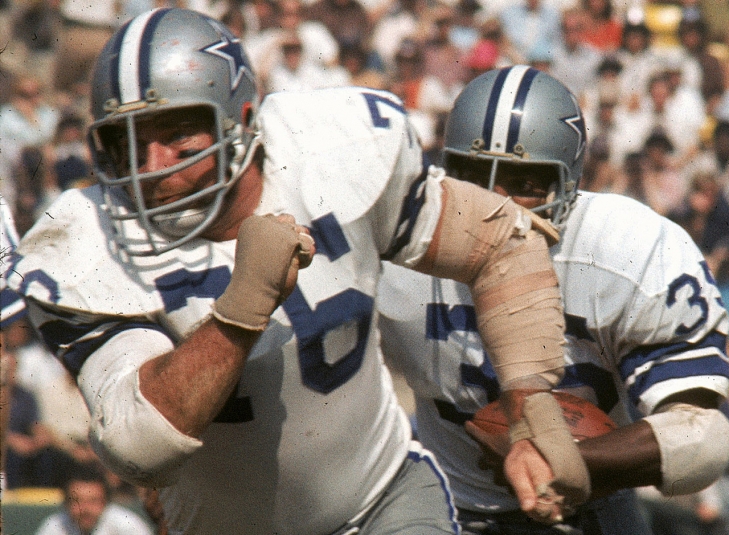
When the Dallas Cowboys selected University of Iowa consensus All-American John Niland fifth overall in the 1966 NFL Draft, they made franchise history before he ever put on a helmet. Niland became the first offensive lineman Dallas selected in the first round, establishing a blueprint for heavy-investment blocking units that would define the organization across multiple generations.
Niland spent his rookie year being baptized in fire, starting four games and squaring off daily in practice against legendary defensive tackle Bob Lilly. Iron sharpened iron; refining his technique against Lilly transformed Niland into a dominant interior force. By 1967, he had taken full ownership of the starting left guard spot, using his low-pad balance and athletic, pulling-guard agility to spearhead Tom Landry's "Multiple Offense."
Between 1968 and 1973, Niland put together a stretch of interior line play matched by few guards of his era. He earned six consecutive Pro Bowl nods and three First-Team All-Pro honors (1969, 1971, and 1972). Niland was the relentless motor on an offensive line that annually led the league in total offense and rushing yards, paving lanes for Duane Thomas, Walt Garrison, and Calvin Hill.
His finest hour arrived during the 1971 postseason, culminating in Super Bowl VI. Niland and the Dallas front wall completely neutralized the Miami Dolphins' front seven, paving the way for a then-record 252 rushing yards in a 24–3 victory that delivered the franchise's first Lombardi Trophy.
Niland's nine-year tenure in Dallas was marked by remarkable durability, missing just two games across 124 regular-season contests. After a final full season in Big D in 1974, he was traded to the division-rival Philadelphia Eagles, playing one final season before retiring after the 1975 campaign.
With Dallas, Niland played 124 regular-season games (111 starts), 15 postseason contests, and two Super Bowls. A six-time Pro Bowler, three-time First-Team All-Pro, Super Bowl VI champion, and Cowboys' All-Time Team member, he is one of six offensive linemen in franchise history with at least six Pro Bowls.
