


Site Admin
39. Michael Oher
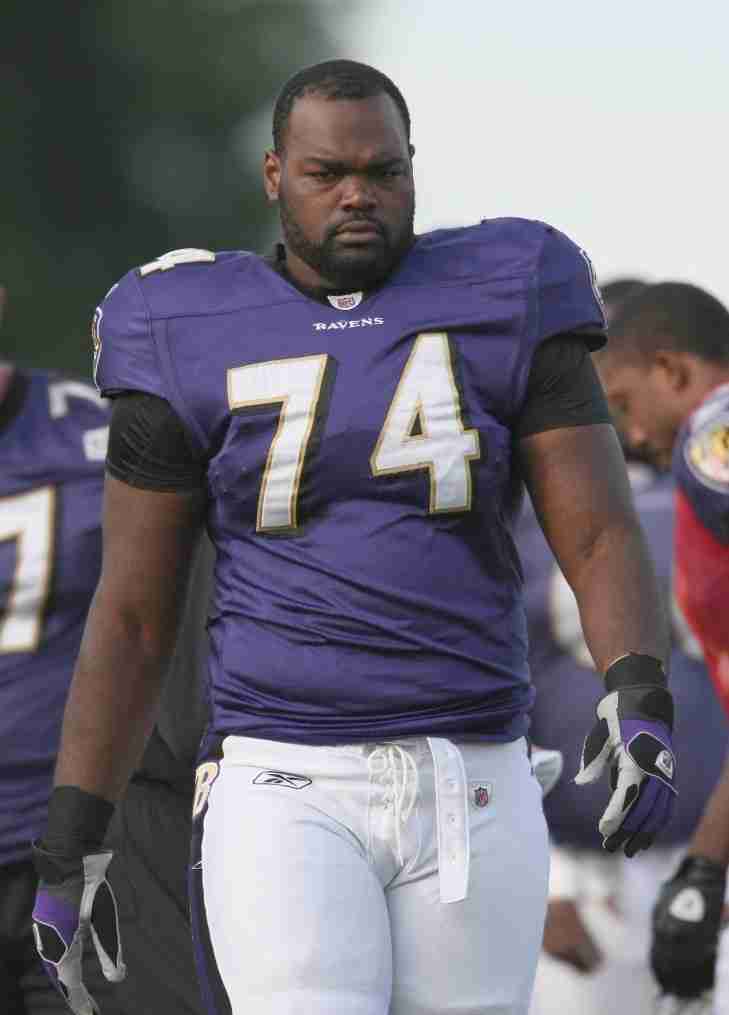
Chosen 23rd overall in the first round of the 2009 NFL Draft out of Ole Miss, Michael Oher entered the league surrounded by immense public attention as the subject of the best-selling book and eventual Oscar-winning film The Blind Side. On the field, Oher quickly proved his worth as a durable starter, establishing himself as a reliable anchor along Baltimore’s offensive line.
Standing tall at 6 feet 4 inches and weighing 315 pounds, Oher brought impressive size, footwork, and core strength that made him a formidable opponent against top-tier edge rushers. Flexible in his role, he could switch between left and right tackle based on team needs. He was excellent at creating a solid, deep pocket for pass protection and used his lower-body strength to push defenders back in Baltimore's power-running game. His quick-kick slides combined with his strong hands made him a challenging matchup for defensive ends on either side.
Oher made his debut in the starting lineup as a rookie in 2009, showcasing impressive adaptability by starting 11 games at right tackle and five at left tackle because of injury-related changes. He maintained consistency, providing pass protection for Joe Flacco and creating running lanes for Ray Rice, which earned him PFWA All-Rookie Team recognition and a second-place finish for NFL Offensive Rookie of the Year. That rookie effort set the tone for an iron-man stretch in Charm City. Over his five seasons with the Ravens (2009–2013), Oher was a fixture on the field, starting all 80 regular-season games and 10 postseason games without missing a single contest.
Oher’s standout moment as a Raven came during the 2012 postseason. After playing all 16 regular-season games at left tackle, Oher moved to right tackle for the playoffs—a strategic reshuffling of the front line that helped unlock Baltimore's offense. Throughout the four postseason games, Oher offered solid pass protection, leading to a thrilling 34–31 victory over the San Francisco 49ers in Super Bowl XLVII.
After five seasons in Baltimore (2009–2013), Oher played three more NFL seasons—one with the Titans (2014) and two with the Panthers (2015–2016), starting in Super Bowl 50. Over his eight-year NFL career, he started all 110 games he played.
34. Jamie Sharper
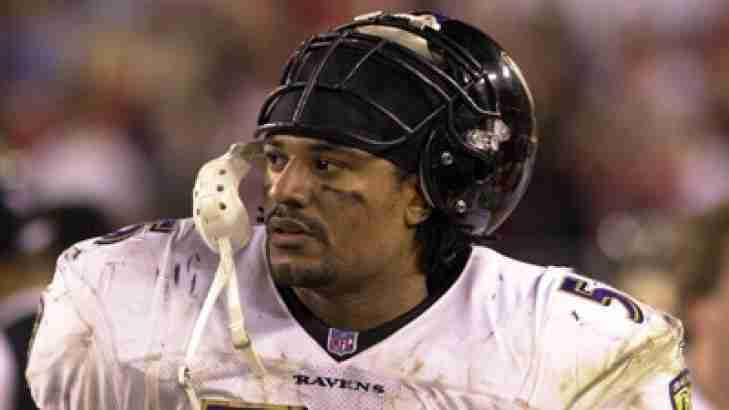
Drafted in the second round (34th overall) of the 1997 NFL Draft out of Virginia, Jamie Sharper arrived in Baltimore as a long, athletic linebacker built for modern defensive schemes. Operating alongside Ray Lewis and Peter Boulware, Sharper formed one of the most formidable linebacking corps in NFL history, serving as a versatile, playmaking anchor during the franchise's initial rise to championship glory.
Sharper provided a lively and reliable presence on the field, with great pursuit and instinctive coverage. He comfortably lined up as a strongside linebacker, ready to engage tight ends at the line, blitz on passing downs, or drop back into zone coverage with ease. His speed helped him quickly close the gap on runners, and his reach gave him a special advantage when intercepting passes over the middle.
Sharper's versatility peaked during the historic 2000 Ravens defense, which set the NFL record for the fewest points allowed in a 16-game regular season with 165. While Lewis covered the middle, Sharper discreetly recorded 76 combined tackles, five forced fumbles, and two fumble recoveries throughout the regular season.
His pivotal moment came during the postseason journey to Super Bowl XXXV. In the AFC Championship Game versus Oakland, Sharper made a vital interception of Rich Gannon, returning it 45 yards to help secure a key touchdown. Two weeks afterward in Super Bowl XXXV, Sharper achieved two sacks and four tackles as Baltimore overwhelmed the New York Giants 34–7 to win the Lombardi Trophy.
In 2001, Sharper achieved his best statistical season in Charm City, recording a career-high 6.0 sacks, 108 combined tackles, and a defensive touchdown. After that season, the Houston Texans picked him in the 2002 NFL Expansion Draft, making him a key part of their defense from the start. In 2003, Sharper led the NFL with an impressive 166 combined tackles.
In his five years in Baltimore, Sharper played in 80 regular-season games (79 starts) without missing a single contest, recording 328 tackles, 14.0 sacks, 2 interceptions, and 7 forced fumbles.
42. Edwin Mulitalo
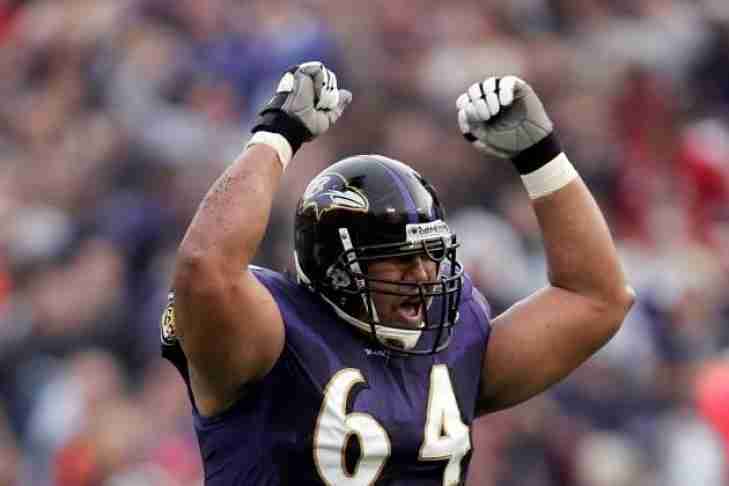
Taken in the fourth round (133rd overall) of the 1999 NFL Draft out of Arizona, Edwin Mulitalo gave Baltimore a raw, massive prospect who stepped directly into the fire as a rookie. He quickly claimed the starting left guard spot alongside Hall of Fame tackle Jonathan Ogden, forming a wall on the left side of the offensive line that powered Baltimore through its most iconic run in franchise history.
Mulitalo brought rare mass and raw power to Baltimore's offensive line. Positioned next to Jonathan Ogden, his main role in Brian Billick's power scheme was to reset the line of scrimmage by engaging 3-techniques and nose tackles. His hallmark was a fierce initial punch combined with powerful leg drive; once he clasped his hands around a defensive tackle's chest, he often pushed defenders aside, creating large "B-gap" openings for Jamal Lewis and Priest Holmes.
Mulitalo's physical presence was central to the identity of the 2000 Super Bowl XXXV championship team. He played all four playoff games at left guard, anchoring a rushing attack that averaged 148 rushing yards per game in the postseason and culminating in a dominant 34–7 victory over the New York Giants.
His peak performance as a run blocker came in 2003, when he started all 16 games for an offense that averaged 4.8 yards per carry and generated +62.4 Adjusted Rushing Runs (per Football Outsiders metrics). Mulitalo cleared the way for Jamal Lewis's historic 2,066-yard rushing season, including Lewis's then-NFL-record 295-yard performance against Cleveland on September 14, 2003, in which most of the internal power plays were directed right behind Mulitalo and Ogden.
After departing Baltimore following the 2006 season, Mulitalo spent two years with the Detroit Lions before transitioning into coaching and humanitarian work. With the Ravens, he started 102 of his 106 games.
41. Mike Flynn
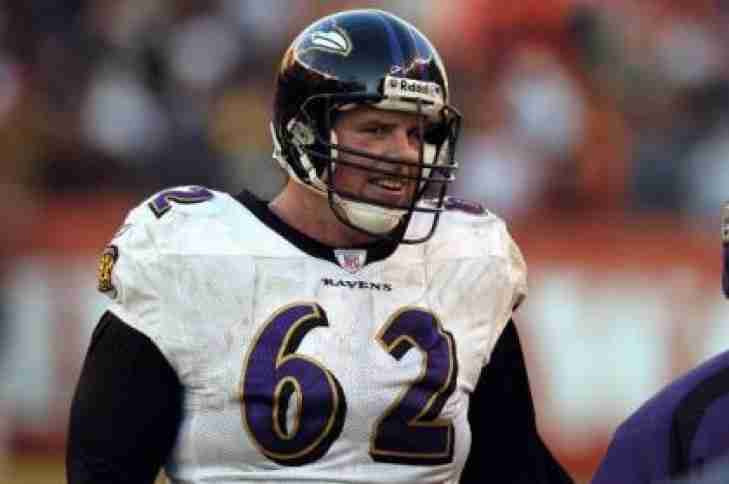
Signed as an undrafted free agent in 1997 out of Maine, Mike Flynn faced long odds just to make an NFL roster. Through sheer grit, intelligence, and versatility, he worked his way up from the practice squad into a central pillar of Baltimore's offensive line. Over a decade in Charm City, Flynn transformed from a roster-bubble longshot into an indispensable starter on the frontline of the most physical offense in franchise history.
Flynn contributed exceptional interior leverage, short-area power, and pre-snap intelligence to the offensive line. Whether positioned at right guard or executing line calls from the center position, he specialized in initiating movement on down blocks and maintaining blocks at the second level to facilitate power-running plays.
Flynn secured a position in the starting lineup as right guard during Baltimore's notable 2000 season. He commenced all four postseason games, facilitating running lanes for Jamal Lewis and Priest Holmes, while ensuring robust interior protection during the 34–7 triumph over the New York Giants in Super Bowl XXXV.
After his impressive championship run, Flynn showcased his flexibility by moving to center in 2002. Over the next six seasons, he became the main thinker of the offensive line, skillfully calling out blitz fronts and making important pre-snap protection adjustments. In 2003, Flynn played a key role as an interior force on an offensive line that helped Jamal Lewis achieve his famous 2,066-yard rushing season.
Flynn spent his entire 10-year NFL career exclusively in Baltimore (1998–2007). Known for his durability and steady work ethic, he played in 134 regular-season games, making 115 starts for the franchise.
