


Site Admin
15. Tom Sestak
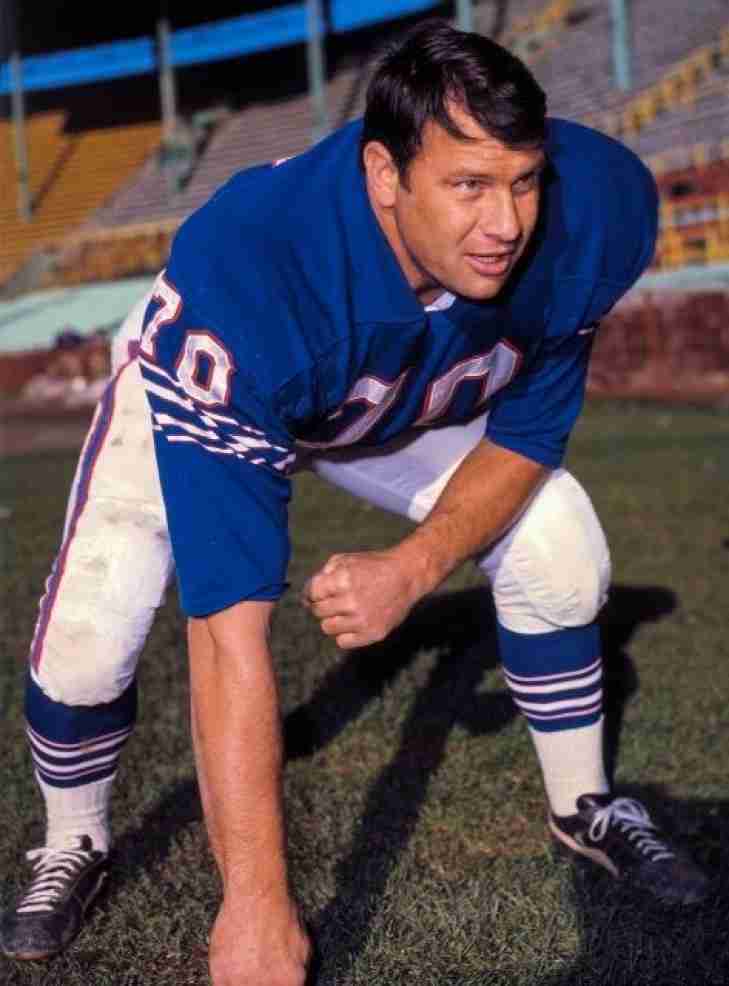
Tom Sestak joined Western New York as a 17th-round pick (132nd overall) in the 1962 AFL Draft from McNeese State. He quickly established himself as one of the most dominant defensive players in professional football. Throughout his seven-year career, he remained with the Bills, anchoring the interior of a formidable defensive line that led Buffalo to two consecutive league championships.
Sestak brought a unique blend of impressive size, lightning-fast quickness, and formidable upper-body strength to the 1960s AFL. Playing as a defensive tackle, he often darted through double-teams with a powerful swim move or disrupted rushing plays directly by driving guards straight into their quarterbacks. When it came to stopping the run, he had the agility to quickly move across gaps and tackle ball carriers before they could get past the line of scrimmage.
Sestak made a notable impact during his inaugural 1962 season, receiving First-Team All-AFL recognition and his initial AFL All-Star selection. His peak performance occurred in 1964, where he played a pivotal role as the driving force behind a defense that secured Buffalo’s first AFL Championship. During this period, Sestak achieved one of the most remarkable individual performances by an interior lineman in history. He led the AFL with an unofficial total of 15.5 sacks over just 14 regular-season games, which earned him First-Team All-AFL honors and his third consecutive AFL All-Star nomination.
Sestak backed that up during the 1965 championship defense, earning his fourth AFL All-Star trip and third First-Team All-AFL nod while leading a unit that set an AFL record by going 17 straight games without allowing a rushing touchdown.
Despite facing tough knee injuries that paused his career after the 1968 season, Sestak continued to be a strong presence during his seven years in Buffalo. He recorded an impressive 52.0 unofficial career sacks in just 85 regular-season games. His remarkable performance earned him a unanimous spot on the AFL All-Time Team, and Pro Football Weekly also recognized him by naming him to its All-1960s All-Pro team alongside Bob Lilly. In 1987, Buffalo proudly inducted Sestak into their Wall of Fame.
21. Joe Ferguson
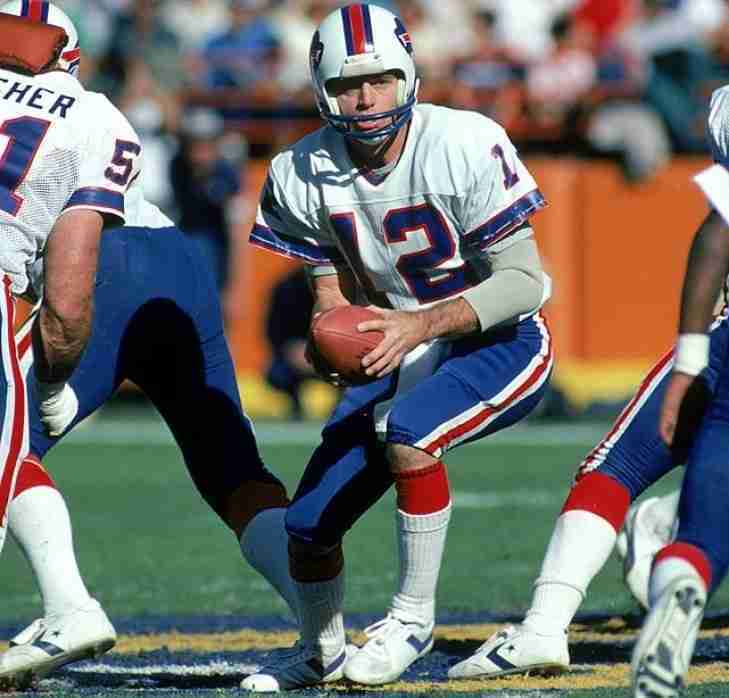
Drafted in the third round (57th overall) of the 1973 NFL Draft out of Arkansas, Joe Ferguson stepped into Western New York as a rookie and immediately took over the starting quarterback role. Over the next 12 seasons, "Fergie" served as the steady, tough-as-nails commander under center, directing the offense through major stylistic shifts—from handoffs to O.J. Simpson to air-it-out aerial assaults.
Ferguson was known for his quick release, deep-ball accuracy, and impressive toughness. Early in his career, he served as a control-oriented game manager, often executing play-action plays based on Simpson’s renowned running ability. When the team shifted into Chuck Knox’s era in the late 1970s, Ferguson demonstrated greater versatility by dropping into frequent passing formations and staying composed in collapsing pockets to throw accurate intermediate passes even under heavy coverage.
Ferguson’s early career was defined by his complementary play during O.J. Simpson's historic 2,000-yard season in 1973. He managed the offense with poise, taking the Bills to the playoffs in 1974.
His statistical peaks came as the offense opened up. In 1975, Ferguson tied Fran Tarkenton for the NFL lead with 25 passing touchdowns, throwing for 2,426 yards while driving the league's highest-scoring offense. Two years later, in 1977, he led the NFL in passing yards with 2,803, proving he could handle heavy volume.
After a 12-year streak of starting every healthy game, an ankle injury and a 1–10 record in 1984 marked the end of his era. In spring 1985, Buffalo traded the veteran quarterback to the Detroit Lions. He then spent six more seasons as a key backup and occasional starter with Detroit, Tampa Bay, and Indianapolis before retiring in 1990.
In Buffalo, Ferguson played in 164 regular-season games, leaving as the franchise’s all-time leader in passing yards (27,590) and passing touchdowns (181). Buffalo inducted Ferguson into their Wall of Fame in 1995.
23. Steve Tasker
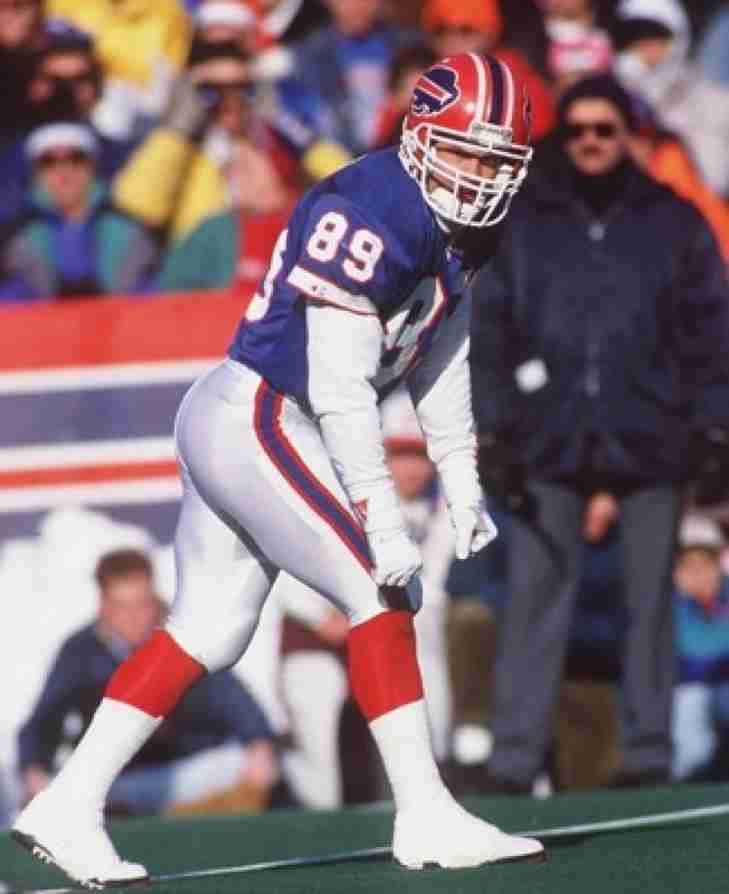
Claimed off waivers from Houston midway through the 1986 season, Steve Tasker came to Western New York as an unassuming 5-foot-9, 185-pound receiver. Over the following 12 years, he dramatically changed the NFL's perspective on the gunner role, transforming kick and punt coverage into a craft and cementing his reputation as the most outstanding pure special teams player in football history.
Tasker was not especially large but made up for it with keen instincts, an relentless engine, and explosive pad level at contact. As Buffalo's main gunner on punts and the kickoff containment leader, he excelled at shedding double blocks quickly, fighting jam attempts, and meeting returners precisely when the ball arrived. Besides coverage, Tasker had an unusual ability to time his pre-snap movement, often bursting through interior gaps to block or deflect kicks.
Tasker quickly transformed Marv Levy's special teams unit into a game-changing phase during Buffalo's ascent in the late 1980s. By 1987, he earned his first career Pro Bowl selection, setting the template for how teams evaluated gunners.
As the Bills embarked on their historic run of four consecutive AFC Championships (1990–1993), Tasker served as the heart and soul of the roster alongside stars like Jim Kelly and Bruce Smith.
His standout moment came at the 1993 Pro Bowl, where in an all-star game filled with future Hall of Famers, Tasker stood out by forcing a fumble, blocking a field goal, and making four special teams tackles. These impressive plays earned him the Pro Bowl MVP award—marking him as the first and only pure special teams player in NFL history to win this honor.
In total, Tasker earned seven Pro Bowl selections (1987, 1990–1995) and five First-Team All-Pro honors, redefining a position that had previously been viewed as an afterthought. Though primarily a coverage ace, he remained an effective spot receiver in the offense when called upon, hauling in 51 passes for 779 yards and nine touchdowns as a Bill. He also played in 168 regular-season games, racking up 204 special teams tackles, seven blocked punts, and 1,019 kickoff return yards for the team. Although Canton eluded Tasker, he was inducted into the Bills Wall of Fame in 2007.
24. Eric Moulds
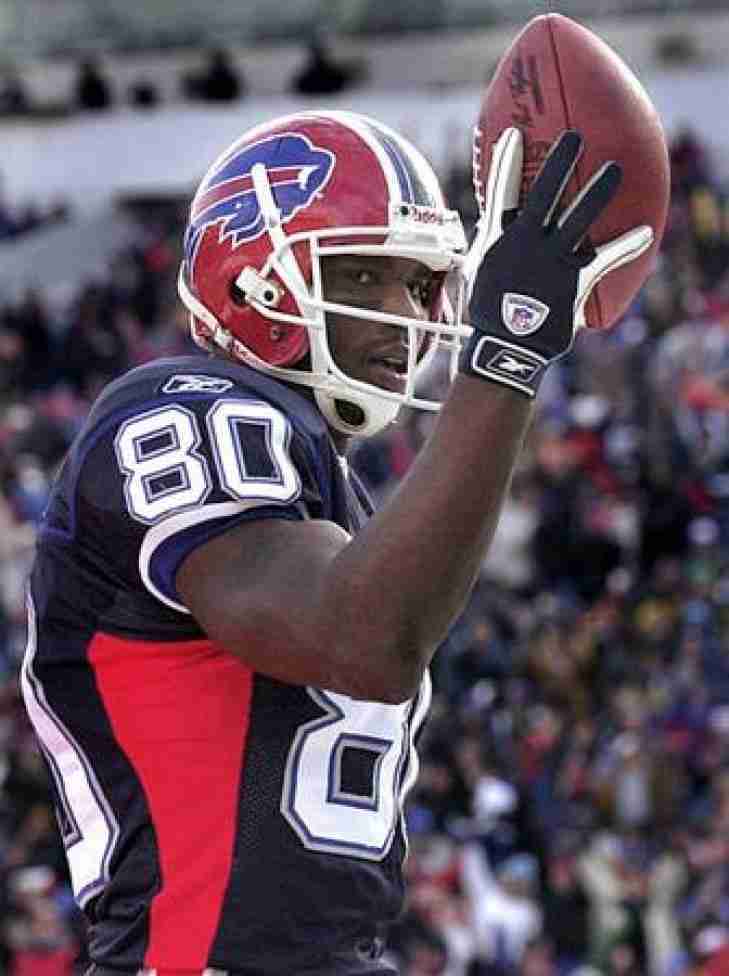
With the 24th overall pick in the first round of the 1996 NFL Draft, the Bills selected Eric Moulds, a dynamic wide receiver from Mississippi State. Biding his time on the depth chart behind legends like Andre Reed, Moulds exploded in his third season, establishing himself as one of the most dominant perimeter targets of the late 1990s and early 2000s.
Moulds had a rare physique, combining the robustness of a modern alpha receiver with the speed of a track athlete. He excelled at body-positioning defensive backs at the catch point, leveraging his formidable strength to dominate press coverage at the line. Once he secured the ball in the air, he demonstrated exceptional late-hands control, and his ability to break tackles after the catch made him a formidable threat in open space.
After spending his first two years as a rotational threat and return specialist, Moulds emerged in 1998 as a top offensive player. Dominating secondary after secondary, he broke the franchise record with 1,368 receiving yards—a record that lasted over twenty years—and averaged an impressive 20.4 yards per catch. He led the AFC in receiving yards, ranked second in the NFL, made his first Pro Bowl, and was named a Second-Team All-Pro. His standout 1998 season culminated in a memorable postseason game against the Miami Dolphins in January 1999, where Moulds caught nine passes for an astonishing 240 yards, setting an NFL playoff single-game record that still remains unbroken.
Despite catching passes from various quarterbacks after Jim Kelly's era, Moulds consistently demonstrated dominance. He earned his second Pro Bowl in 2000 with 1,326 receiving yards. In 2002, he made history as the first Bills player to reach 100 receptions in a season, finishing with 1,292 yards and 10 touchdowns, leading to a third Pro Bowl and his second Second-Team All-Pro selection.
After ten seasons with Buffalo, a salary-cap restructuring prompted a trade to the Houston Texans in 2006, a pick Buffalo used to select Kyle Williams. He ended his career with a final season in Tennessee in 2007. During his time with Buffalo, Moulds appeared in 154 regular-season games, recording 675 receptions, 9,096 receiving yards, and 48 receiving touchdowns. He also scored 10 total touchdowns on returns and rushing.
