


Site Admin
28. Cal Hubbard
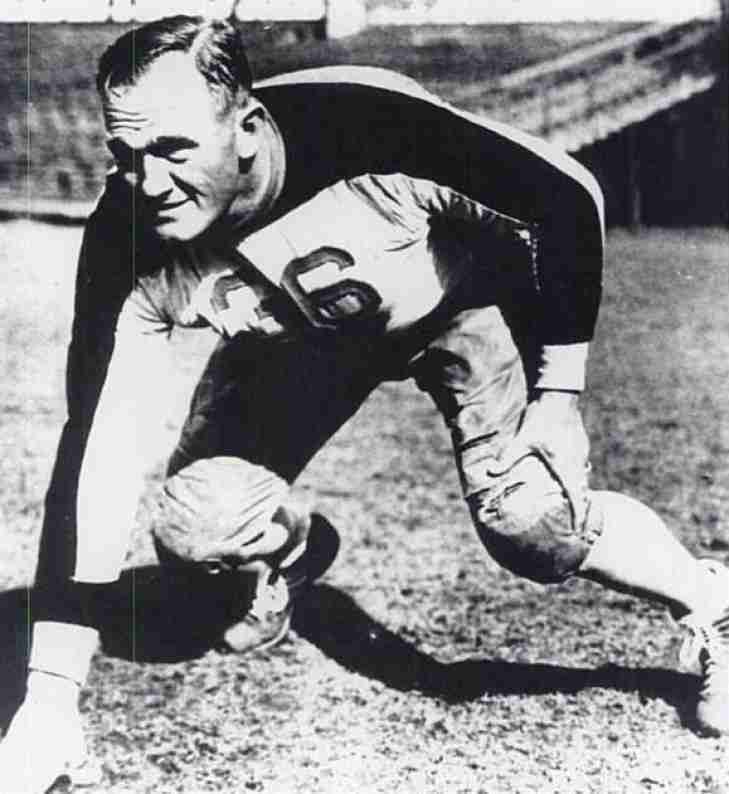
Standing 6-foot-2 and tipping the scales at over 250 pounds, Robert "Cal" Hubbard was a terrifying apparition on the gridiron during an era when most players resembled ordinary men. A multi-sport standout who played college ball at Centenary College and Geneva College, Hubbard entered the professional ranks with the New York Giants in 1927, immediately establishing himself as a ferocious, immovable object along the line of scrimmage.
The course of football history shifted permanently during a late-1928 road trip to Wisconsin. Playing against the Green Bay Packers at Bellevue Park, Hubbard fell completely under the spell of the small-town, blue-collar atmosphere and rabid fan base. As the legend goes, he grew so enamored with the environment that he flatly demanded a trade to Titletown, threatening to retire from professional football entirely if management refused. Packers founder and coach Curly Lambeau worked out the transaction, bringing Hubbard to Green Bay ahead of the 1929 campaign.
Hubbard's arrival transformed the Packers from a competitive contender into an absolute dynasty. Anchoring both offensive and defensive tackle positions with rare athleticism and brutal physical leverage, he spearheaded Green Bay's historic three-peat, capturing three consecutive NFL Championships in 1929, 1930, and 1931. Operating in an era of iron-man football, Hubbard's ability to clear massive running lanes while collapsing opposing backfields single-handedly dictated the physical terms of every game.
Honored as a three-time First-Team All-Pro during his tenure in green and gold, Hubbard earned universal respect from opponents and referees alike—though his fiery competitiveness occasionally tested umpires. Ironically, after hanging up his football cleats, Hubbard embarked on an extraordinary second career as a legendary Major League Baseball umpire, patrolling the diamond for 35 years and becoming the only person in sports history to achieve elite, Hall of Fame-level prominence in both professional football and Major League Baseball.
Hubbard's national validation for his gridiron dominance came when he was inducted into the Pro Football Hall of Fame in 1963, alongside legends like Red Grange and Jim Thorpe. The Packers also honored him in 1970 as an inaugural Hall of Fame member.
36. Max McGee
22. Mike Michalske
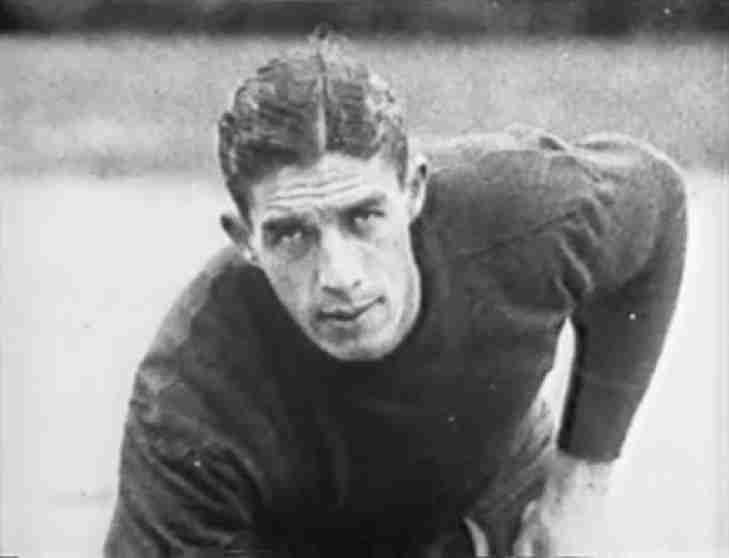
Before interior linemen were recognized as fundamental building blocks of championship offenses, August "Iron Mike" Michalske set the golden standard for guard play in professional football. Following a dominant three-year stint with the AFL and NFL iterations of the New York Yankees, Michalske arrived in Green Bay in 1929, giving Curly Lambeau an unusually fast 210-pound pulling guard whose quickness out of his stance redefined trench warfare.
Michalske made an immediate, transformative impact on the franchise, capturing consensus First-Team All-Pro honors in each of his first three seasons in Wisconsin (1929, 1930, 1931). Playing both ways on the line, his rare combination of lateral agility and durability allowed him to spearhead Lambeau’s sweep blocking schemes on offense while tearing through opposing backfields on defense. His arrival sparked the NFL's first true dynasty, powering Green Bay to three consecutive NFL Championships from 1929 through 1931—an unprecedented three-peat in league lore.
In an era when line play was brutal, and substitutions were sparse, Michalske earned his "Iron Mike" moniker by routinely playing 60 minutes without coming off the field. Despite his modest weight, he used low pad level and exceptional leverage to overpower bulkier defenders, famously serving as the lead blocker for backfield stars like Johnny "Blood" McNally and Clarke Hinkle. Offensively, he was the prototype for the modern pulling guard; on defense, his rapid penetration disrupted ground games before they reached the line of scrimmage.
He cemented those achievements with two landmark honors. In 1964, Michalske became the very first offensive guard selected for enshrinement into the Pro Football Hall of Fame as part of its second induction class. Six years later, the franchise cemented his place in Wisconsin gridiron lore by choosing him for the inaugural Green Bay Packers Hall of Fame class of 1970.
41. Josh Sitton

A Fourth Round Pick from Central Florida, Sitton was named the starting Right Guard in his second season (2009) until he switched to Left Guard in 2013. Sitton went to three Pro Bowls with Green Bay, one at Left and two at Right, and he was part of Green Bay's Super Bowl XLV Championship Team. Sitton was surprisingly released before the 2016 season, and he signed with the division rival, Chicago, where he went to two more Pro Bowls.
