


Site Admin
12. Yadier Molina
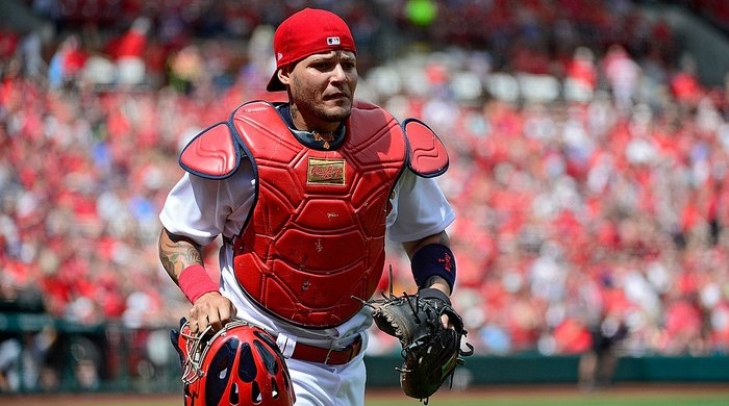
There is so much to love about Yadier Molina.
A ferocious player when needed, Yadier Molina has been a clubhouse leader since he arrived to the St. Louis Cardinals, the only team he has played for in the Majors. Early in his career, the Puerto Rican was universally regarded as being a really good defensive Catcher and a light hitter but in 2008 he improved his Batting Average to .308 and was locked in as the team’s starting Catcher.
15. Harry Brecheen
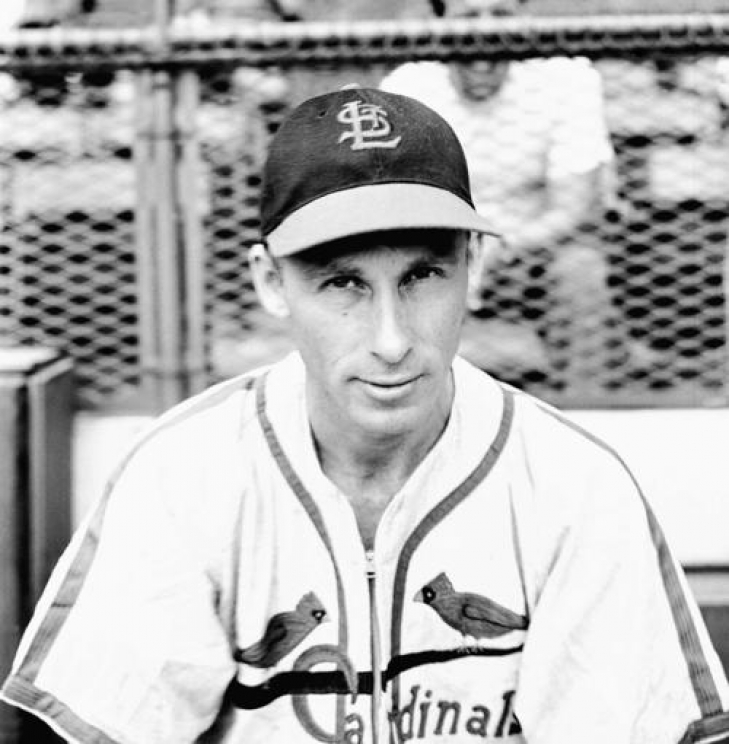
Harry David Brecheen spent his early twenties climbing through the minor leagues with careful deliberate steps, but he joined the major league roster permanently in 1943 and immediately made a significant impact on the pitching staff. He was just 5'10" and 160 pounds, earning the long-lasting nickname "The Cat" for his quick, feline-like reflexes when fielding bunts off the mound. With a perfect combination of a screwball and curveball, the southpaw built a ten-year career of excellence, excelling as a consistent regular-season performer and becoming an immortal legend in the postseason.
His early role as a key part of the rotation came during an exciting period for the team in the mid-to-late 1940s. Brecheen made a consistent effort to keep National League lineups in check by encouraging weak contact and focusing on control. He was impressively dependable, winning 14 or more games across six consecutive summers, offering valuable stability along with Mort Cooper and Red Schoendienst, and helping lead the team to two world championships.
The individual's peak performance during the regular season was exemplified by a remarkable 1948 achievement that received commendation. During that summer, “The Cat” demonstrated an outstanding ability in preventing runs, leading the Senior Circuit with an impressive 20–7 record and a league-leading 2.24 ERA. He impeded hitters throughout the season, leading the National League in strikeouts (149), shutouts (7), FIP (2.49), WHIP (1.037), and achieving an exceptional 3.04 strikeout-to-walk ratio, resulting in a fifth-place finish in the National League MVP voting.
While his strong regular-season performance established his important role in the front line, it’s his incredible achievements in October that truly secured his legendary status in baseball history. Brceheen saved his best performances for the brightest stages. He proved to be an essential player during the 1944 Fall Classic against the nearby St. Louis Browns, delivering an outstanding game in Game 4 where he gave up only one run, helping secure a key victory. Two years later, he delivered an amazing and historic performance against the powerful Boston Red Sox in the famous 1946 World Series. He took control of the game and became the first left-handed pitcher in baseball history to win three games in a single Fall Classic. During 20 intense innings in the postseason that October, he outperformed Boston's top hitters with an incredible 0.45 ERA and a 0.950 WHIP—winning Game 2, pitching a complete-game masterpiece in Game 6, and famously stepping out of the bullpen on zero days' rest to throw two scoreless innings during Game 7, helping to secure the championship with Enos Slaughter’s famous "Mad Dash’.
Brecheen departed from the Sportsman's Park rubber, leaving an impressive statistical record that garners considerable respect among analytical purists. During his eleven active seasons solely representing the Cardinals, he achieved exactly 128 wins against 79 losses, complemented by an outstanding 2.91 ERA, 122 complete games, and 25 career shutouts—still the franchise record for left-handed pitchers. The organization beautifully added the final, definitive punctuation to his legacy in 2018; the Red Ribbon Committee officially righted the historical record by triumphantly enshrining Harry Brecheen into the St. Louis Cardinals Hall of Fame.
11. Adam Wainwright

The modern history of the St. Louis Cardinals is closely linked to a highly loyal and dominant right-handed pitcher from Georgia. Originally drafted in the first round by the Atlanta Braves, Adam Wainwright was traded to Missouri in December 2003. This trade became one of the most significant and franchise-changing deals in baseball history. Known for his powerful sinker and a legendary 12-to-6 curveball called "Uncle Charlie," Wainwright spent over twenty years becoming a cornerstone of the team. He not only posted impressive stats but also demonstrated relentless competitive spirit and loyalty to the organization. Over time, he transformed from a postseason hero to the standout ace of his era.
After two games with the parent club in 2005, Wainwright became a permanent fixture in 2006, emerging in high-leverage bullpen roles. When veteran closer Jason Isringhausen was injured late in 2006, manager Tony La Russa played the rookie, who responded flawlessly, allowing zero runs over nine postseason appearances. Most famously, he froze Carlos Beltrán with a legendary, physics-defying curveball to capture the National League pennant, before striking out Brandon Inge to secure the 2006 World Series title.
Once he returned to his natural starting role ahead of the 2007 season, Wainwright transformed into a metronomic force at the top of the rotation. His absolute individual peak of regular-season execution erupted during a phenomenal multi-year run surrounding the turn of the decade. He led the National League with a career-high 19 victories in 2009 to claim a close third-place finish in the Cy Young voting.
He truly shined during an incredible 2010 season, earning his first 20-win game with a dazzling 2.42 ERA and 213 strikeouts over 230.1 innings. It was a season that earned him his first career All-Star selection and a close second place in the Cy Young voting behind Roy Halladay.
However, his extensive career must be viewed in light of the serious physical challenges that nearly ended his prime. A torn elbow ligament led to Tommy John surgery, causing him to miss the entire 2011 season—yet he was richly rewarded later with his second World Series ring when his team won the championship that fall.
Proving any doubts about his physical leverage entirely wrong, he engineered a spectacular second act of frontline dominance upon his return.
He dominated the Senior Circuit in 2013 with 19 wins and a league-high 241.2 innings, then obliterated National League lineups in 2014 with 20 wins and a remarkable 2.38 ERA, finishing second and third in consecutive Cy Young races. Wainwright’s legacy was built on exceptional, multi-faceted contributions that set him apart from typical pitchers. He was also a top defender, earning two Gold Glove Awards for his perfect positioning and exceptional internal clock. He was equally dangerous with a bat in his hands, famously launching a home run on the very first pitch he ever saw in the major leagues and capturing a Silver Slugger Award in 2017.
While his final 2023 victory lap was highly suspect due to a severe performance leak—navigating his age-41 season with an ERA near 8.00 and a negative 2.0 bWAR—he displayed incredible baseline resilience to secure his historic, milestone 200th career victory in his final home start against the Milwaukee Brewers.
Across his 18 seasons strictly representing the Cardinals as a true "Lifer," he compiled an even 200–128 record, 2,202 strikeouts, and a stellar 3.38 career ERA over 2,668.1 innings of work.
9. Lou Brock
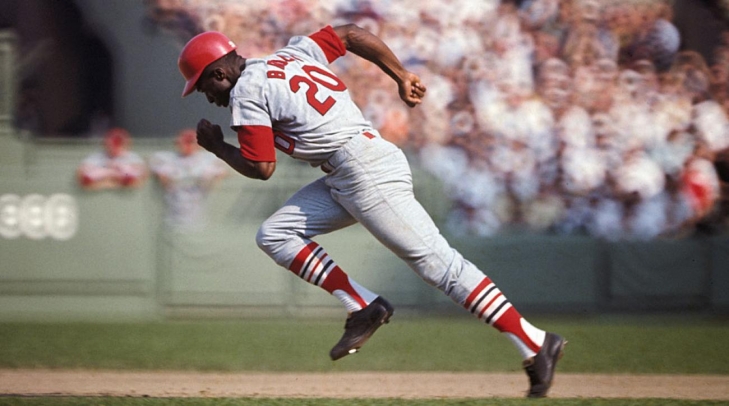
When a franchise executes a trade that is profoundly imbalanced, altering the entire course of its modern history, the transaction swiftly becomes a quintessential example of executive ill-gotten gains. In June 1964, the St. Louis Cardinals obtained an underperforming and structurally mismanaged outfielder from their longstanding adversaries, the Chicago Cubs, in a notorious multi-player deal centered on pitcher Ernie Broglio. Lou Brock did not merely experience a change of scenery in Missouri; he became an unstoppable force of high-velocity offense. By infusing the roster with a formidable combination of exceptional speed and aggressive contact hitting, the exceptionally swift left fielder embarked on a legendary 16-season tenure that revolutionized the batting order for an entire generation.
His mid-season arrival in 1964 served as an immediate catalyst, resulting in a significant increase in his performance virtually overnight. Brock transformed getting on base into a nightly demonstration, batting an impressive .348 over 103 games during the latter part of the season, thereby contributing to the Redbirds' historic National League pennant victory and ultimately securing the world championship title against the New York Yankees.
Once fully integrated into the local culture, he methodically redefined the art of base running. He achieved his first career stolen base title during an impressive 1966 season, an accomplishment that sparked a remarkable sequence of dominance, whereby he led the National League in stolen bases in eight of nine summers from 1966 through 1974. The pinnacle of his individual base-stealing mastery was exemplified during the exceptional 1974 regular season. At the age of 35, Brock demonstrated an exemplary display of timing and tactical foresight, breaking the modern single-season record by stealing an extraordinary 118 bases and securing a distinguished runner-up position for the National League Most Valuable Player award.
Nevertheless, characterizing Brock exclusively as a baserunning specialist significantly understates the extensive nature of his offensive contributions. He was a distinguished high-volume hitter during his tenure under the Arch, achieving four seasons with 200 hits, in addition to seven seasons in which he exceeded 180 hits.
His big-game DNA was entirely unrivaled when the ultimate prize was on the line. Across three separate World Series appearances (1964, 1967, and 1968), Brock systematically dismantled opposing pitching to forge a mind-bending .391/.424/.655 postseason slash line with 14 doubles, seven triples, four home runs, and a modern Fall Classic-record 14 stolen bases across 21 games.
Where Brock experiences substantial decline under contemporary analytical scrutiny is in his markedly volatile and unidimensional profile. He was widely recognized as a notably aggressive hitter who consistently ranked high on league strikeout leaderboards, recording at least 100 strikeouts in nine separate summers with St. Louis.
Defensively, his metrics were even more problematic; he possessed a highly erratic glove and a limited throwing arm, posting eight separate seasons with a negative defensive bWAR of -1.0 or worse while retiring with the third-most errors recorded by any left fielder in the history of the sport. These massive defensive leaks heavily drag down his advanced efficiency metrics, explaining why his localized value anchors lower in a comprehensive algorithmic review than his traditional status might indicate.
Nevertheless, his historic longevity ultimately earned him inner-circle baseball immortality. During his final 1979 swan song in a Cardinals uniform, the veteran icon joined the sport's most exclusive fraternity, collecting his 3,000th career hit to draw a definitive, storybook curtain on his playing days.
In St. Louis, Brock accumulated 2,713 hits, 434 doubles, 121 triples, and 888 stolen bases, which formed the bulk of his 938 career swiped bags—a historical record that stood until Rickey Henderson eventually redefined the category. He would be inducted into the Baseball Hall of Fame in 1985 on the first ballot, and was also part of the first class inducted into the Cardinals Hall of Fame in 2014. His number 20 was also retired by the team after he retired in 1979.
