


Site Admin
10. Isaac Bruce
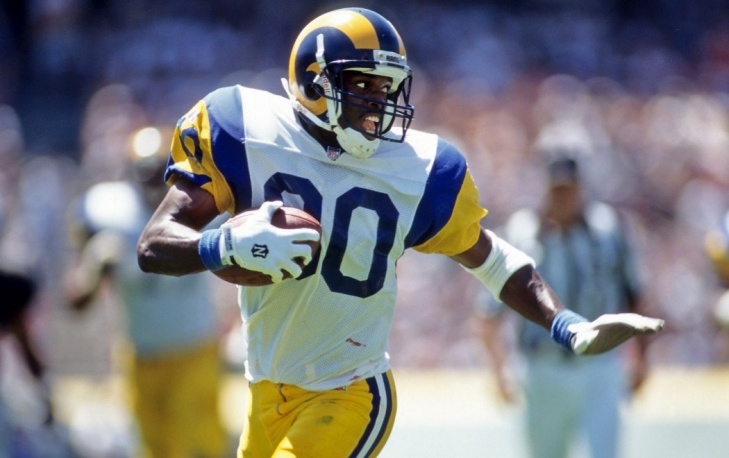
Isaac Bruce starred as the top Wide Receiver for the "Greatest Show on Turf," which is no small statement. A Second Round pick from the University of Memphis, Bruce exploded with a 1,781 Yard season with 13 Touchdowns. Amazingly, he was not a Pro Bowl selection that year but would be the next season when his 1,338 Yards led the NFL. In 1999, Bruce would catch the game-winning Touchdown in Super Bowl XXXIV, and his play was an integral part of the Rams return to Super Bowl the next season, although they would lose to the New England Patriots.
8. Bob Waterfield
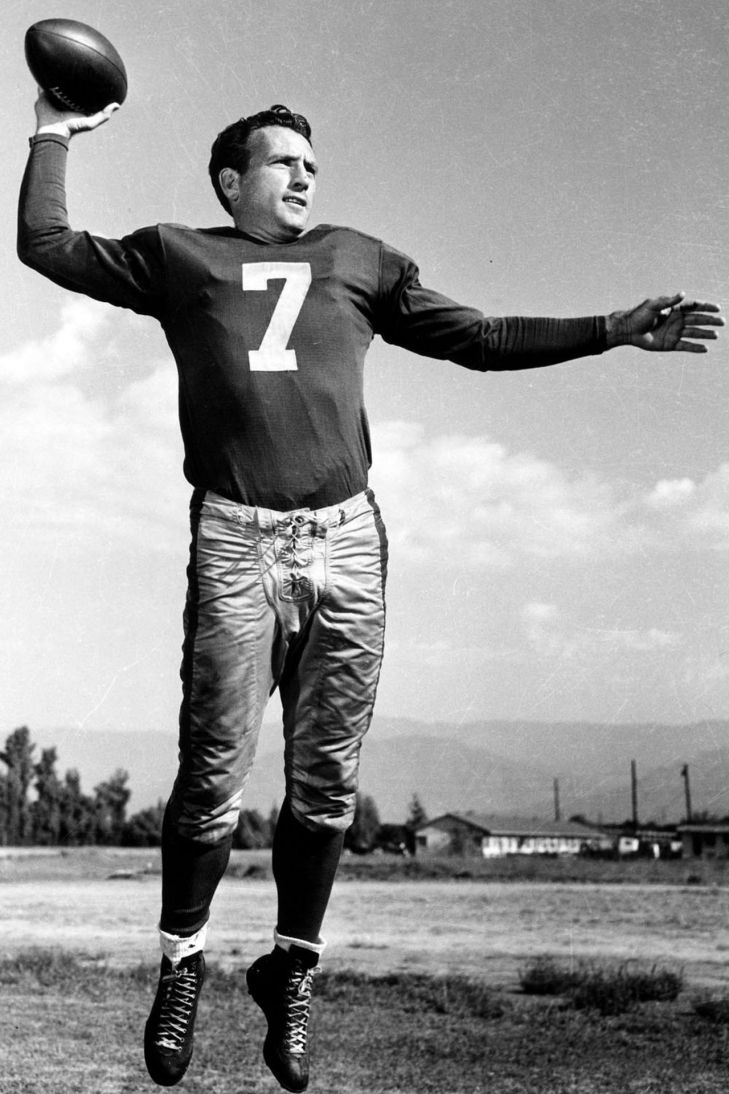
Selected in the fifth round (42nd overall) of the 1944 NFL Draft out of UCLA—where he led the Bruins to their first Rose Bowl appearance—Bob Waterfield stepped into professional football and delivered one of the most remarkable rookie campaigns in gridiron history. Debuting for the Cleveland Rams in 1945, the multi-talented phenom led the league with 14 touchdown passes while guiding the franchise to a 9–1 record and a 15–14 victory over the Washington Redskins in the NFL Championship Game. For his extraordinary debut, Waterfield was named NFL Most Valuable Player, becoming the first rookie in league history to capture the award.
Waterfield was the quintessential triple-threat star of pro football's single-wing transition era, influencing games on offense, defense, and special teams. Beyond his aerial distribution at quarterback, he served as the team's primary placekicker and punter, leading the league in field goals twice and average punting yards in 1948. On defense, his ball-hawking instincts at defensive back produced 20 career interceptions across eight seasons, showcasing an all-around athletic versatility modern football rarely sees.
After their 1945 title, the Rams relocated west to become the Los Angeles Rams in 1946, and Waterfield quickly became a Southern California sports icon. He picked up right where he left off in his new home, finishing second in passing yards (1,747) and throwing a league-high 17 touchdown passes while earning his second consecutive First-Team AP All-Pro selection. Off the field, his star power burned just as brightly when he married Hollywood superstar Jane Russell, turning the couple into one of Los Angeles's original glamour pairings.
While his statistical efficiency fluctuated in subsequent campaigns, Waterfield regained top form in 1949 to earn his third First-Team AP All-Pro selection after leading the NFL with 1,608 passing yards and 23 touchdown passes. He remained at the top of his game as the league entered the 1950s, earning selections to the first two Pro Bowls in 1950 and 1951. His steady leadership in the pocket helped propel Los Angeles to three straight NFL Championship Game appearances from 1949 through 1951.
The peak of the Rams' Southern California revival arrived in 1951, when Waterfield anchored a high-powered offense that captured the NFL Championship with a 24–17 victory over the Cleveland Browns. Managing the offense alongside head coach Joe Stydahar, Waterfield shared signal-calling duties with fellow future Hall of Famer Norm Van Brocklin, creating a lethal two-quarterback system that confounded opposing defensive coordinators and produced one of the most prolific passing attacks of the mid-century era.
Waterfield played one final season in 1952, splitting snaps with Van Brocklin before retiring at age 32 to transition into film production and coaching. He later returned to the franchise as head coach of the Los Angeles Rams from 1960 to 1962. In 1952, the Rams honored his foundational contributions by officially retiring his #7 jersey, ensuring no future Ram would wear his iconic number.
His legacy as one of football's greatest pioneers was permanently sealed in 1965 when he was enshrined in the Pro Football Hall of Fame in Canton, Ohio.
With the Rams, he threw for 814 completions on 1,617 attempts, 11,849 passing yards, and 97 touchdown passes, plus 60 field goals, 315 extra points, and 20 defensive interceptions.
7. Jackie Slater
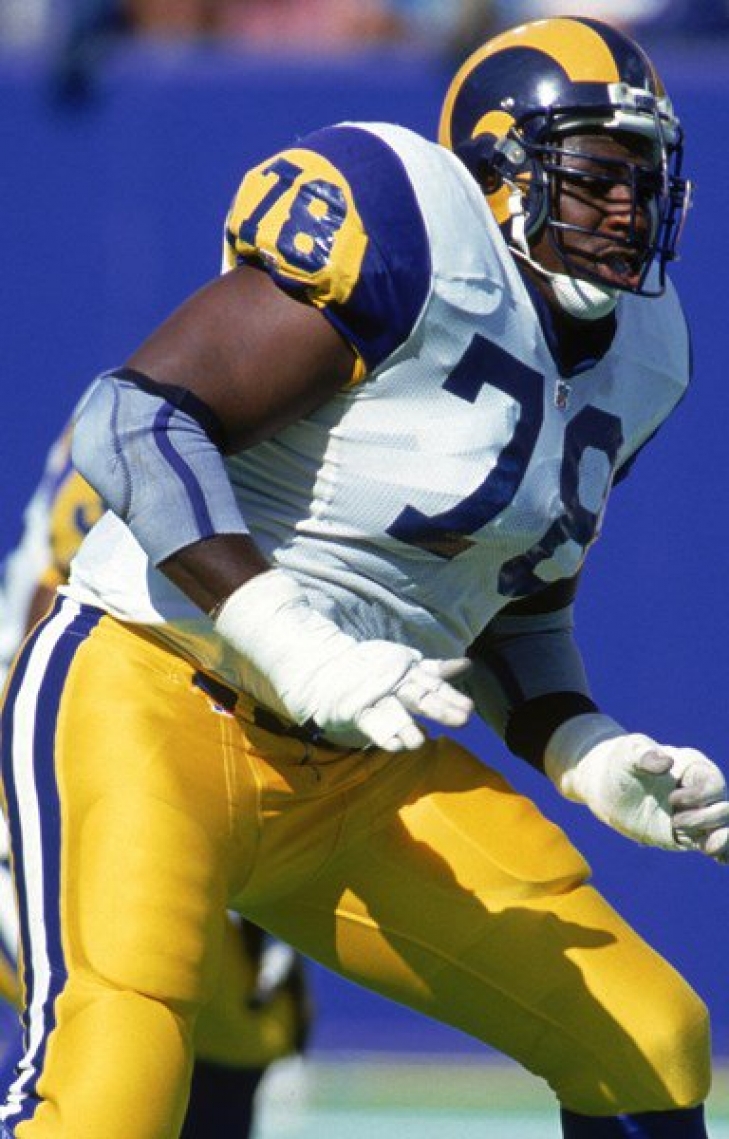
Selected in the third round (86th overall) of the 1976 NFL Draft out of Jackson State—where he played alongside Walter Payton—Jackie Slater arrived in Los Angeles as a backup before becoming the standard for offensive-line longevity. Spending his first three seasons primarily on special teams and as a reserve, Slater absorbed the professional game until taking over as the full-time starting right tackle in 1979. That year, he helped anchor an offensive line that led the Rams to an NFC Championship and a berth in Super Bowl XIV against the Pittsburgh Steelers.
Once entrenched at right tackle, Slater launched a reign of relentless durability that defined two decades in Southern California. From 1979 onward, he was a steady fixture on the edge, starting 211 regular-season games for the franchise. Opposing edge rushers struggled to solve his technique, as his combination of lateral footwork and brute strength neutralized the league's most fearsome pass rushers throughout the 1980s.
Slater earned seven Pro Bowl selections (1983, 1985, 1986, 1987, 1988, 1989, and 1990) and four Second-Team AP All-Pro honors. Whether blocking for Eric Dickerson during his record-breaking 2,105-yard rushing campaign in 1984 or protecting signal-callers like Vince Ferragamo and Jim Everett, Slater consistently anchored one of the league's most dominant front fives.
His 20-season career with a single franchise set an NFL record for offensive linemen, spanning 19 years in Los Angeles (1976–1994) and concluding with a single final game after the team relocated to St. Louis in 1995. By the time he retired, Slater had blocked for 24 different quarterbacks and 37 different running backs, leaving behind an unmatched standard of consistency and professional dedication.
In 1996, the franchise permanently honored his legendary service by retiring his #78 jersey. His transcendent career achieved ultimate gridiron immortality in 2001, when he was enshrined in the Pro Football Hall of Fame in Canton, Ohio.
6. Marshall Faulk
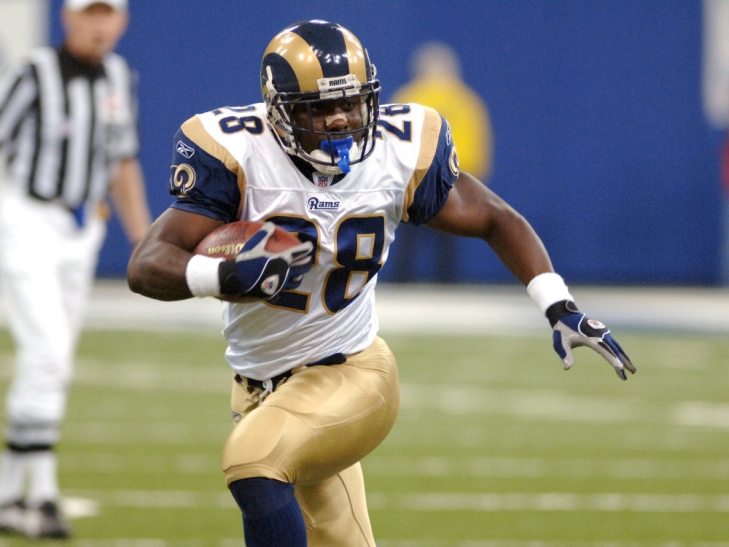
Traded from the Indianapolis Colts in the spring of 1999, Marshall Faulk arrived in St. Louis and immediately revolutionized the running back position. Already an elite dual-threat weapon during his five seasons with the Colts, Faulk elevated his skill set to unheard-of heights under head coach Dick Vermeil and offensive coordinator Mike Martz. His arrival helped transform a struggling franchise into "The Greatest Show on Turf"—the most explosive offensive machine in NFL history.
In his legendary 1999 debut season with the Rams, Faulk put together one of the most remarkable individual campaigns in gridiron history. Playing as both a traditional tailback and an unmatched slot receiver, he rushed for 1,381 yards and caught 87 passes for 1,048 receiving yards. By doing so, he became only the second player in NFL history (joining Roger Craig) to eclipse 1,000 rushing and 1,000 receiving yards in the same season, setting a then-NFL record with 2,429 yards from scrimmage.
Faulk’s versatility and processing speed made him the undisputed engine of the Rams' high-flying attack. Defenses couldn't match up against him, as he could slice through defensive lines between the tackles or split out wide to obliterate linebackers in single coverage. His relentless execution in both phases of the offense gave quarterback Kurt Warner the ultimate escape hatch, propelling St. Louis to a 13–3 record and the franchise's first Super Bowl title in Super Bowl XXXIV.
The dynamic back somehow raised the bar even higher over the next two seasons, producing an unprecedented three-year run of individual brilliance. Faulk captured the AP NFL Most Valuable Player award in 2000 after scoring a staggering 26 touchdowns in just 14 games, followed by winning three consecutive AP NFL Offensive Player of the Year awards from 1999 through 2001. During this historic peak, he earned three consecutive First-Team AP All-Pro selections and guided the Rams back to Super Bowl XXXVI.
Beyond his eye-popping statistical output, Faulk served as an extension of the coaching staff on the field. His elite football IQ allowed him to call out defensive coverages, adjust pass protection schemes at the line of scrimmage, and exploit subtle mechanical flaws in opposing front sevens. His rare vision, combined with pristine route-running precision out of the backfield, redefined expectations for modern all-purpose running backs for generations.
Faulk retired after the 2006 season with over 19,000 all-purpose yards and 136 touchdowns. The Rams retired his No. 28 jersey in 2007. In 2011, he entered the Pro Football Hall of Fame in his first year of eligibility. With the Rams, he compiled 6,959 rushing yards with 58 rushing touchdowns, 470 receptions for 4,071 receiving yards with 27 receiving touchdowns, and 11,030 yards from scrimmage.
