


Site Admin
15. Peyton Manning

For over a decade, John Elway’s shadow hung over Mile High, fueling a long search for a worthy successor under center. In a twist fit for a movie script, it took Elway himself—serving as executive vice president and general manager—to finally solve the puzzle. After four neck surgeries forced Peyton Manning to miss the entire 2011 season, Indianapolis released their franchise icon and drafted Andrew Luck first overall. Elway pounced, luring the future Hall of Famer to Denver in 2012 amid a sea of eager suitors. Questions lingered about whether Manning’s arm strength and nerve function would hold up, but what followed was one of the most prolific second acts in sports history.
In 2012, Manning silenced critics by leading the NFL in completion percentage at 68.6%, throwing for 4,659 yards and 37 touchdowns. He received the AP Comeback Player of the Year award, was named a First-Team All-Pro, and helped Denver achieve a 13–3 record. The following year, he surpassed his own standards with what is considered the greatest statistical season by a passer in NFL history. Manning led the league's highest-scoring offense ever (606 points), setting single-season records with 5,477 passing yards and 55 touchdown passes. This outstanding performance earned him his fifth MVP award, another First-Team All-Pro honor, and an AFC Championship win.
Following another Pro Bowl and a 4,700-yard season in 2014, the physical toll of father time and accumulated injuries caught up to Manning in 2015. Plagued by a torn plantar fascia, he struggled through a nine-touchdown, 17-interception stretch and surrendered the starting job to Brock Osweiler. Yet true to his legendary intellect, Manning reclaimed the job in Week 17, serving as the ultimate game manager for Wade Phillips' historic "No Fly Zone" defense. In the postseason, Manning used his elite pre-snap command to pilot Denver through the AFC bracket, capping his career with a 24–10 victory over Carolina in Super Bowl 50. That would be the last game Peyton Manning ever played. Having become the first starting quarterback to win Super Bowls with two different franchises, Manning rode off into the sunset, announcing his retirement weeks after lifting the Lombardi Trophy.
As a Bronco, compiling 17,112 passing yards, 140 touchdown passes, and a 45–12 record as a starter. Manning was inducted into the Denver Broncos Ring of Fame in 2021, the same year he was enshrined into the Pro Football Hall of Fame in his first year of eligibility.
16. Tom Jackson
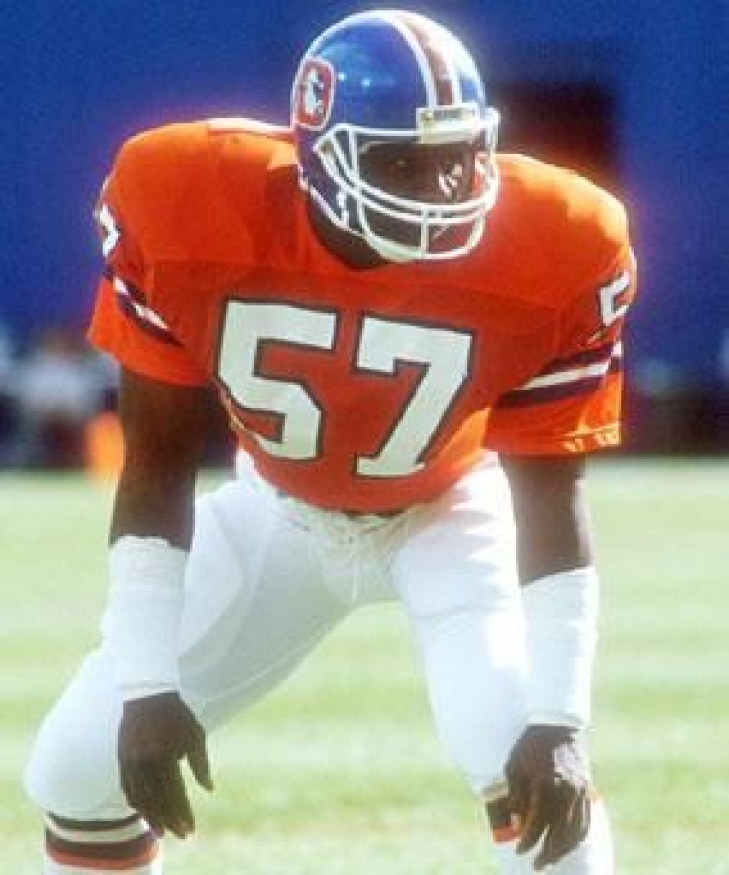
Drafted in the fourth round of the 1973 NFL Draft out of Louisville, Tom Jackson arrived in Denver as an undersized, fast-flowing weakside linebacker. He quickly claimed a starting job in Joe Collier's 3-4 front and became the emotional heartbeat and outspoken leader of the iconic "Orange Crush" defense. Jackson's range, high football IQ, and sideline-to-sideline pursuit helped transform the Broncos from a historically struggling franchise into an AFC powerhouse.
Jackson's career trajectory reached elite standing during the storybook 1977 season. Spearheading a defensive unit that carried Denver to its first AFC Championship and Super Bowl XII appearance, Jackson earned First-Team All-Pro honors and his first Pro Bowl selection. He followed that up with two more consecutive Pro Bowl trips in 1978 and 1979. Operating as an effective blitzer and intermediate coverage defender, he routinely turned opponent mistakes into points, returning three of his 20 career interceptions for touchdowns.
Remarkable longevity defined Jackson's 14-year run in Mile High. He missed minimal action across his career, starting 177 of his 191 games—a durable total that trails only John Elway and Jason Elam on the franchise's all-time games played list. Near the tail end of his playing days, Jackson provided crucial veteran leadership for the 1986 squad that captured another AFC crown, making him one of just four players to appear in both Super Bowl XII and Super Bowl XXI for the franchise.
After retiring following the 1986 season, Jackson smoothly transitioned into a second iconic career as a broadcaster. Joining ESPN in 1987, he spent nearly three decades alongside Chris Berman on NFL Primetime and Sunday NFL Countdown, becoming one of the most recognizable and revered studio analysts in sports media history until he retired from broadcasting in 2016.
Jackson spent 14 seasons with the Denver Broncos (1973–1986), playing 191 games with 177 starts. He recorded 20 interceptions for 340 yards, 3 defensive touchdowns, 40 sacks, and 8 fumble recoveries. A three-time Pro Bowler, All-Pro, two-time AFC champion, and six-time team MVP, Jackson was inducted into the Denver Broncos Ring of Fame in 1992.
13. Dennis Smith
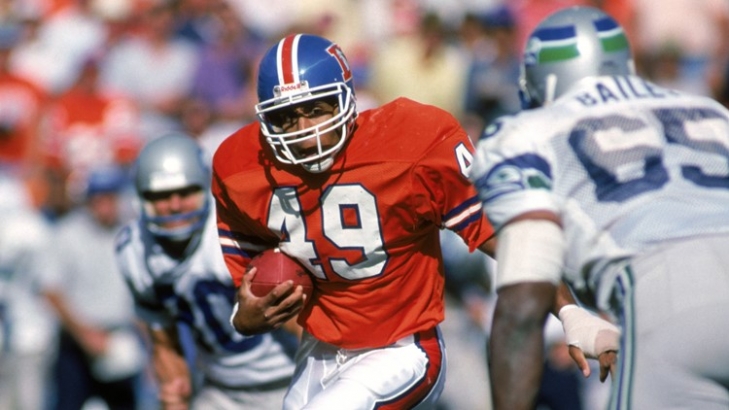
From USC, Dennis Smith was drafted 15th overall in the 1981 NFL Draft and was a decorated consensus All-American who immediately injected raw physicality into the secondary. Transitioning into the starting strong safety spot early in his career, Smith established himself as an intimidating secondary enforcer—setting the blueprint for a generation of box safeties who could crush ball-carriers in run support while holding their own in pass coverage.
Smith’s breakout arrival occurred during his third season in 1983, when he achieved a career-best total of 114 tackles, along with five sacks and four interceptions. This remarkable performance initiated a decade-long period of leadership in the secondary. Acting as the formidable enforcer of Denver’s defense, Smith exceeded 100 tackles in five distinct seasons—culminating with a career-high of 120 tackles in 1992—while consistently leading the team's defensive backs in tackles and forced fumbles.
During the late 1980s and early 1990s, his play reached elite level. Smith earned six Pro Bowl selections (1985, 1986, 1989–1991, 1993) and two All-Pro honors. As the veteran starter alongside a young Steve Atwater from 1989, they created one of the most formidable safety duos in NFL history. That defensive backfield was crucial for Dan Reeves' teams, driving Denver to the AFC playoffs and securing three Super Bowl appearances in XXI, XXII, and XXIV.
Smith was not only known for his punishing hits but also for his exceptional ball skills and field awareness. Over his 14-year career with Denver, he amassed 30 interceptions—one of which he returned for a touchdown—along with 17 fumble recoveries and 15 sacks. His versatile skill set consistently disrupted opposing offenses, and he was regarded as a revered team leader until he retired after the 1994 season.
In his 14-year career, Smith had 1,171 total tackles, 30 interceptions, 15 sacks, and 17 fumble recoveries. In 2001, he was enshrined in the Broncos Ring of Fame.
9. Louis Wright
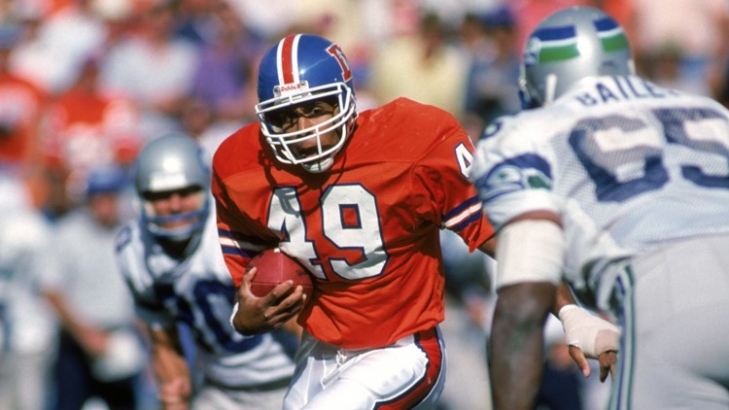
Louis Wright was taken 17th overall in the 1975 NFL Draft out of San Jose State, and the gifted cornerback stepped straight into Denver's starting lineup and instantly elevated the standard for perimeter defense. Standing 6-foot-1 with track-star speed, Wright brought a rare combination of length, fluidity, and physical press coverage that allowed defensive coordinator Joe Collier to unleash the legendary "Orange Crush" defense.
