


Site Admin
8. Jordan Gross
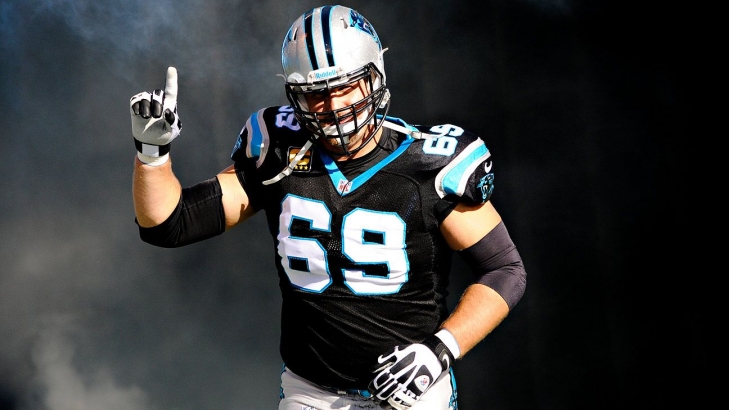
Jordan Gross was selected eighth overall in the first round of the 2003 NFL Draft from Utah. He joined the Charlotte team as an immediate solution for the offensive line. Throughout 11 seasons, Gross proved to be the epitome of durability at tackle, maintaining consistent performance and establishing the franchise's standard for resilience.
Gross combined excellent footwork with strong technical skills. While his core strength was ideal for driving defenders in the running game, his real expertise was in pass protection. Using balanced movements and patient hand placement, he effectively neutralized pass rushers without losing deep pocket leverage, executing textbook sets that enabled quarterbacks like Jake Delhomme and Cam Newton to operate smoothly.
Gross made a strong start as a rookie in 2003, taking his place as the starting right tackle from day one. He played every offensive snap during the season, permitting only three sacks and leading a line that propelled Carolina to Super Bowl XXXVIII.
After a standout rookie year, Gross transitioned to left tackle, securing the quarterback's blind side for the rest of his career. His best season was in 2008, when he played exceptionally well, allowing minimal pressure and creating running lanes for DeAngelo Williams and Jonathan Stewart. That year, he was chosen for his first Pro Bowl and received First-Team All-Pro honors, helping Carolina achieve a 12–4 record and win the NFC South division.
Gross earned two more Pro Bowl selections in 2010 and 2013. In his last season in 2013, he was the team captain for an NFC South-winning team, leading a front five that protected Cam Newton and contributed to a 12–4 record.
After the 2013 season, Gross retired, having spent all 11 of his professional seasons with Carolina. His durability sets a team benchmark: he played and started in all 167 games of his career, marking the franchise record for the most career starts by any player. The organization honored his contributions by inducting Gross into the Carolina Panthers Hall of Honor in 2019, alongside longtime teammates Steve Smith Sr. and Jake Delhomme.
6. Thomas Davis
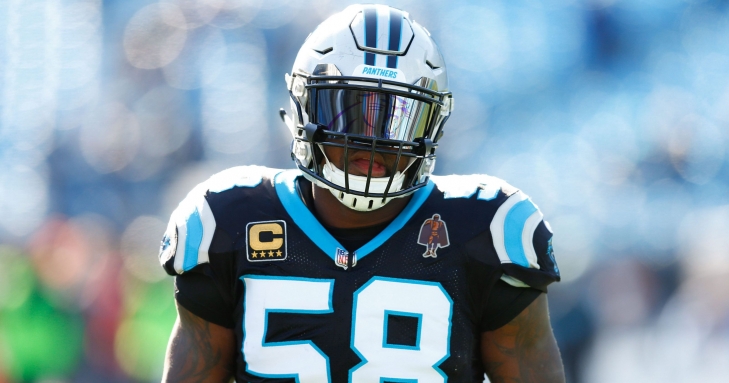
Thomas Davis was selected 14th overall in the first round of the 2005 NFL Draft and entered the league as a hybrid safety/linebacker. While he began his career in the secondary, the Panthers quickly shifted him to weakside linebacker full-time, unlocking one of the most remarkable stories of resilience and longevity in modern NFL history.
Davis maintained his safety speed while building the lower-body strength needed to play in the front seven. A sideline-to-sideline tackler, he had fluid hips in zone coverage, making him an ideal weakside linebacker capable of carrying tight ends up the seam or firing through gap blitzes. Above all, what defined Davis was his relentless motor and physical toughness, paired with a rare ability to overcome severe knee injuries.
Davis swiftly transitioned to linebacker, starting 14 games in 2006 and then achieving consecutive 100-tackle seasons in 2008 (114 tackles) and 2009. Unfortunately, he tore his right ACL late in 2009, and over the following two years, he experienced two more ACL tears on the same knee—one in June 2010 and another in September 2011—losing nearly two entire seasons.
While most careers would have ended after three ACL reconstructions, the Panthers supported Davis, who then delivered an extraordinary second chapter. In 2012, he came back full-time and achieved 105 tackles, making NFL history as the first to return and perform at an elite level after three ACL surgeries on the same knee.
Paired with middle linebacker Luke Kuechly, Davis formed one of the era's premier linebacker duos. In 2013, he recorded 123 tackles and 4.0 sacks. Off the field, his extraordinary charitable work earned him the prestigious 2014 Walter Payton NFL Man of the Year award.
In his 30s, Davis reached a top-tier individual peak. In 2015, he led Carolina's defense, which went 15–1, with 105 tackles, 5.5 sacks, and four interceptions, earning First-Team All-Pro and his first Pro Bowl. Notably, he broke his arm in the NFC Championship Game, had 12 screws and a plate inserted, and still played through the pain two weeks later in Super Bowl 50.
Davis picked up two additional Pro Bowl nods in 2016 and 2017, anchoring Carolina's defense through 2018 before playing his final seasons with the Chargers and Washington. Davis played 176 regular-season games (158 starts), racking up 1,098 tackles, 28.0 sacks, 13 interceptions, and 18 forced fumbles in a Panthers uniform. The organization inducted Davis into the Carolina Panthers Hall of Honor in 2023 alongside his long-time linebacking partner Luke Kuechly.
5. Ryan Kalil
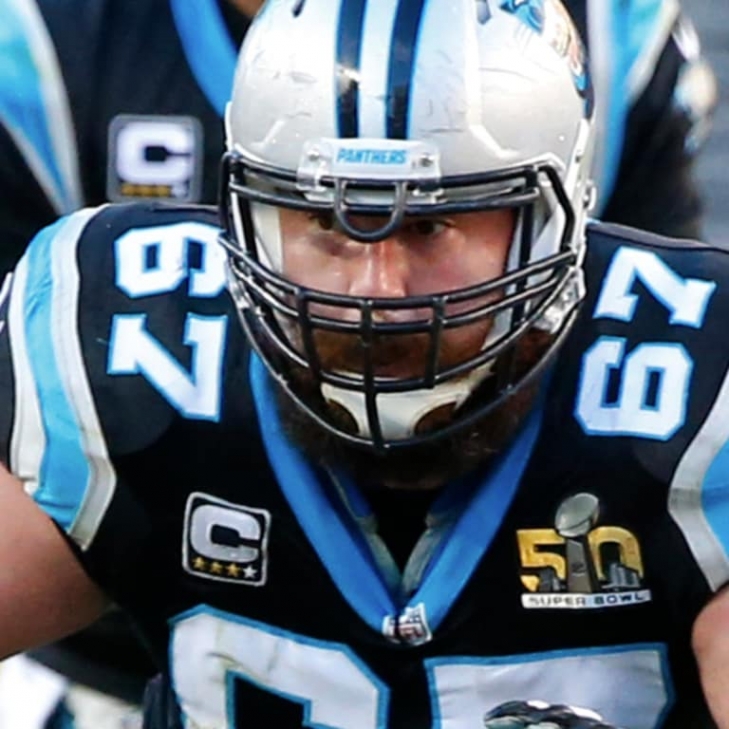
Chosen in the second round (59th overall) of the 2007 NFL Draft from USC, Ryan Kalil came to Charlotte as a highly regarded college center. Over 12 seasons, he became the key figure on Carolina's offensive line, blending exceptional athleticism with sharp pre-snap awareness to lead the franchise through its most successful period.
Kalil transformed interior offensive line play in Carolina. With exceptional quickness for a center, he excelled at pulling blocks in power-running schemes, easily reaching the second level to block linebackers. More than his physical skills, Kalil served as the brain of the offensive front, analyzing defensive fronts, communicating blitz calls, and delivering swift, accurate snaps in Cam Newton's zone-read and power-option schemes.
After serving a rotational role as a rookie in 2007, Kalil became the full-time starting center in 2008, quickly improving the team's performance. By 2009, he was selected for his first Pro Bowl, beginning a period during which he was regarded as one of the top centers in the league.
Kalil kept his high level of performance around the decade's start, earning back-to-back Pro Bowl selections in 2010 and 2011, as well as a Second-Team All-Pro accolade in 2011. That achievement led to a significant contract extension in August 2011, making him briefly the highest-paid center in NFL history.
His career peak came during Carolina's strong performances in the mid-2010s. Kalil earned First-Team All-Pro and a Pro Bowl spot in 2013 when Carolina won the NFC South. He maintained that high level during the remarkable 2015 season, earning his second First-Team All-Pro honor and fifth Pro Bowl. As a team captain, he led the offensive line that helped Carolina reach a 15–1 record, win the NFC Championship, and make it to Super Bowl 50.
Navigating injuries late in his career, Kalil provided steady veteran leadership through his final year in Charlotte in 2018, before spending a brief 2019 farewell season with the New York Jets.
A six-time team captain, Kalil started 145 of his 148 regular-season games in a Panthers uniform, establishing himself as one of the most durable and decorated offensive linemen in team history.
4. Julius Peppers
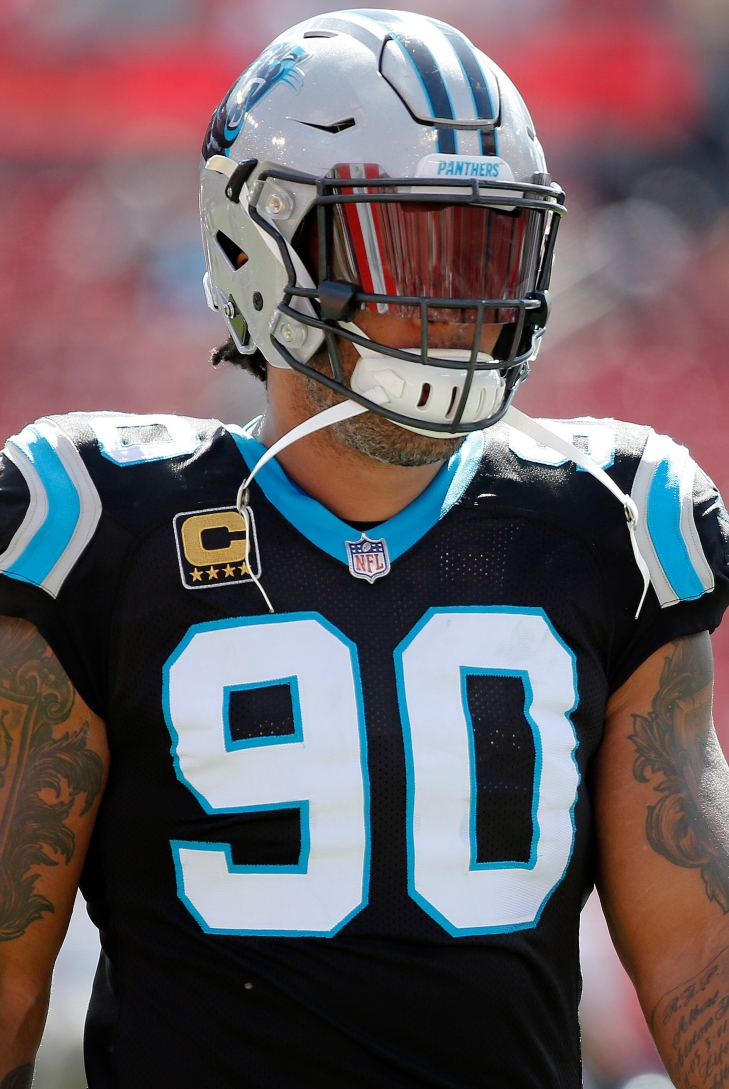
Julius Peppers, chosen second overall in the 2002 NFL Draft from North Carolina—after earning both the Lombardi and Chuck Bednarik Awards during his college career—was the quintessential local star. Retaining this multi-talented athlete in his home state turned out to be a brilliant move, as Peppers developed into an extraordinarily athletic pass rusher who set the standard for defense in Carolina during two separate periods.
Standing 6 feet 7 inches tall and weighing 283 pounds, Peppers redefined the physical profile that offensive coordinators fear on the edge. With a 4.7-second 40-yard dash and basketball-learned vertical leap, he easily countered edge angles through his long stride. He used a long-arm extension to keep offensive tackles at bay, combining it with a swift speed-to-power rush that often collapsed the pocket. His great length also enabled him to swat passes at the line of scrimmage, defend boundary sweeps, and drop into passing lanes to make surprising interceptions for a defensive lineman.
Peppers made a strong start with a breakout 2002 rookie season, achieving 12.0 sacks and five forced fumbles in only 12 games, earning the AP NFL Defensive Rookie of the Year award. In 2003, he was a key pass-rusher, contributing significantly to Carolina's first division title in seven years and their run to Super Bowl XXXVIII.
His first First-Team All-Pro and Pro Bowl honors came in 2004, a standout year in which he recorded 11.0 sacks, led the NFL with 18 tackles for loss, and returned an interception 97 yards for a touchdown against Denver. Peppers remained nearly unblockable during the following two seasons, earning Pro Bowl selections in 2005 and 2006, with the 2006 season earning him First-Team All-Pro recognition after posting 13.0 sacks and two forced fumbles.
Named defensive captain in 2007, Peppers reached his career peak in 2008, disrupting opponents’ backfields with 14.5 sacks, 17 tackles for loss, and five forced fumbles, earning Second-Team All-Pro honors. He made his fifth Pro Bowl in 2009 in Carolina after recording 10.5 sacks.
After seven productive seasons away—four with the Chicago Bears and three with the Green Bay Packers—Peppers returned to Charlotte in 2017. At 37, he delivered an impressive 11.0-sack season, contributing to the Panthers making the postseason again, before finishing his career with one last year in 2018.
Peppers appeared in 140 regular-season games, setting franchise records with 97.0 sacks, 34 forced fumbles, and eight blocked field goals. His total of 159.5 career sacks ranks fourth in NFL history. Recognized on both the NFL 2000s All-Decade Team and NFL 2010s All-Decade Team, Peppers was inducted into the Carolina Panthers Hall of Honor in 2019. His legendary career was finally confirmed when he was elected to the Pro Football Hall of Fame in 2024 on his first ballot, making him the first franchise-drafted player to be enshrined in Canton.
