


Site Admin
3. Ichiro Suzuki
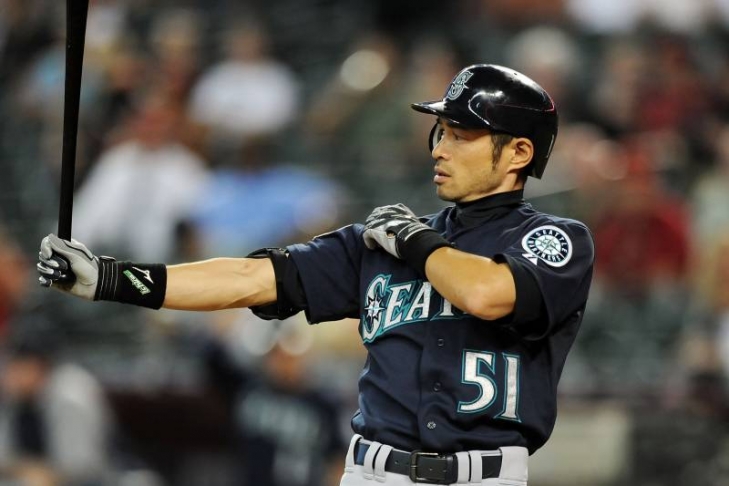
When establishing a historical hierarchy for the Seattle Mariners, the discussion at the apex of the leaderboards will invariably feature a trio of distinguished, localized deities. Whilst Ken Griffey Jr. exemplifies the utmost athletic excellence and Edgar Martinez signifies an enduring career-long presence, the right-field corner at T-Mobile Park was comprehensively dominated by a global cultural phenomenon who redefined the mechanical limits of professional hitting. Ichiro Suzuki did not merely play baseball in the Pacific Northwest; he transformed the simple act of singles into a high-velocity, highly watchable regular-season spectacle. Arriving in the United States in 2001 as a 27-year-old superstar from the Orix BlueWave, he encountered significant national skepticism from critics who openly questioned whether his slender frame and incisive style could endure Major League Baseball competition. He responded by orchestrating arguably the most explosive introductory campaign in the history of the sport.
His outstanding 2001 summer season was a remarkable demonstration of elite contact skills and exceptional speed. Ichiro systematically dismantled American League pitching staffs, leading the league with a remarkable .350 batting average, 56 stolen bases, and an impressive 242 hits. His persistent playmaking served as the primary engine driving a historic Mariners team that tied the major league record with 116 victories. Naturally, his exceptional individual performance earned him both the American League Rookie of the Year and the Most Valuable Player Award, making him only the second player in baseball history to attain both honors in the same season. Although that remained his sole MVP award, he spent the following decade amassing hits at a nearly supernatural pace.
From 2001 through 2010, Ichiro established the 200-hit milestone as a rigorous, daily routine, achieving 10 consecutive seasons with at least 200 hits and a .300 batting average, thereby setting an all-time Major League record for consecutive 200-hit seasons. In 2004, Ichiro demonstrated exceptional bat control, breaking George Sisler’s 84-year-old single-season record by accumulating an extraordinary 262 hits and securing his second career batting title with an impressive .372 average.
Opposing defenses were completely fractured by his unique, pre-swing pendulum motion and his ability to begin sprinting toward first base before the ball even left his bat. Yet, focusing entirely on his offensive volume tells only half the story. Weaponizing elite closing speed and a telepathic tracking ability, Ichiro converted the right-field grass into a strict no-fly zone, capturing 10 consecutive Gold Glove Awards from 2001 through 2010.
His throwing arm was a literal cannon, permanently frozen in Pacific Northwest lore after he unleashed a high-velocity, no-hop rocket to third base to nail Terrence Long during his rookie season—a sequence affectionately dubbed "The Throw."
A ten-time All-Star and three-time Silver Slugger in a Seattle uniform, he remained a lethal threat on the basepaths by swiping 438 bases during his first stint with the franchise; however, nothing lasts forever.
By the middle of the 2012 campaign, with his offensive metrics experiencing a natural, age-related dip and the Mariners fully committed to a youthful roster rebuild, Ichiro recognized that his presence was inadvertently blocking the development of the club's next generation. Showing immense grace, he quietly approached team executives during the All-Star break to request a trade. This was granted, and Ichiro would become a New York Yankee, but this was not the end of his story in Seattle.
He came back as a 44-year-old Free Agent in 2018, playing 15 Games while only batting .205. In May of that year, he would move to the Mariners Front Office, but made a special return in the first two games of 2019, which were held in Japan, allowing him to have the proper sendoff that a player of his stature deserved.
He left Seattle with a batting average of .321 and is the all-time franchise leader in that metric as well as hits (2,542) and stolen bases (438). In 2022, Ichiro was inducted into the Mariners Hall of Fame, and in 2025, he was chosen for the Baseball Hall of Fame.
2. Edgar Martinez
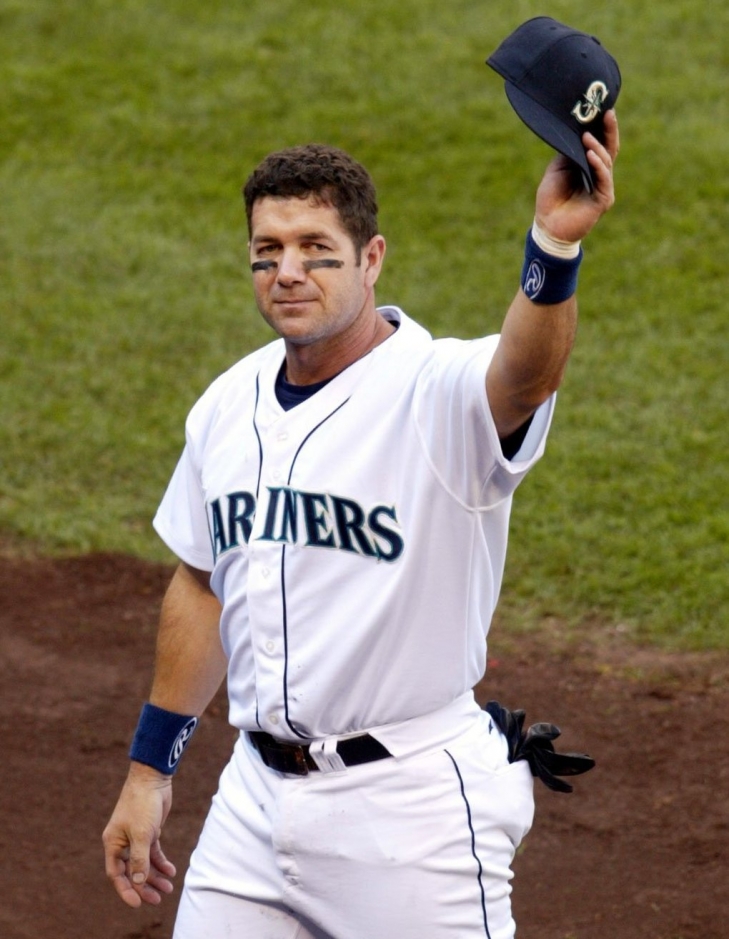
When considering the Seattle Mariners’ historical hierarchy, determining the top spot involves weighing raw physical talent against sustained career excellence. We can confidently argue that Ken Griffey Jr. had a higher athletic peak, especially since much of his prime was spent in the Pacific Northwest, making his place at number one a logical choice. However, if the focus is on the most devoted and consistently productive player, Edgar Martinez stands alone. He didn’t just play for the team; he became the core of Seattle's baseball identity. Over 18 seasons, this right-handed hitter turned the batter's box into a hub of hitting mastery, overcoming a late start in the organization to become a local legend.
Martinez signed as an unheralded amateur free agent from Puerto Rico in 1982. His early progress through the farm system gave little hint of the exceptional outlier he would become. He moved between Triple-A Calgary and the majors for several summers, lacking a consistent routine until finally becoming the regular starting third baseman in 1990 at age 27. He proved his elite contact ability immediately, batting .302, followed by a strong .307 in 1991. His outstanding hitting skills were fully showcased in 1992, when he dominated American League pitchers, winning his first batting title with a.343 average and leading the majors with 46 doubles, earning his first Silver Slugger Award.
Tragically, his availability was drastically limited by severe hamstring and knee injuries, reducing him to only 131 games in 1993 and 1994 and risking his career. Confronted with this major physical setback, the organization made a strategic decision before the 1995 season to convert Martinez permanently into a full-time Designated Hitter. This move resulted in an outstanding display of professional hitting that solidified the legitimacy of the role.
Returning with immense competitive authority, his spectacular 1995 regular-season masterpiece remains the stuff of Pacific Northwest legend. Martinez captured his second batting title with a career-high .356 average, paced the AL with 52 doubles, 121 runs scored, and a towering 1.107 OPS, drawing 116 walks to fuel a league-leading .479 on-base percentage. He put an absolute exclamation point on that magical summer in October, launching "The Double" down the left-field line in the 11th inning of Game 5 of the ALDS to score Ken Griffey Jr.—a legendary, high-leverage moment that single-handedly saved the franchise from relocation.
Martinez maintained his hardware-certified authority throughout his long career, making daily run production a routine. As the Mariners' dedicated DH, he achieved six All-Star selections, won four more Silver Slugger Awards, and excelled in the league's advanced metrics by securing back-to-back on-base percentage titles in 1998 and 1999. He was also a central catalyst for the historic 2001 squad that tied the major league record with 116 regular-season victories, pacing the American League with a career-high 145 RBIs the previous summer in 2000.
Martinez retired after the 2004 season, and he was widely regarded as the greatest Designated Hitter in the history of the game. We don’t say this flippantly. The award for the Designated Hitter of the Year was renamed the Edgar Martinez Award in his honor. Ironically (we think it is ironic), this award would take his namesake before the Baseball Hall of Fame would induct him. He would finally enter Cooperstown in 2019, his final year of eligibility. The team had already retired his number 11 in 2017, and ten years previously, he was inducted into the Mariners Hall of Fame.
Martinez is the Mariners’ all-time leader in Games Played (2,055), Total Bases (3,718), Doubles (514), Runs Batted In (1,261), Walks (1,283), and Win Probability Added (44.3). He would also have 309 Home Runs with a Slash Line of .312/.418/.515, making a member of the elusive career 3/4/5 club.
1. Ken Griffey Jr.
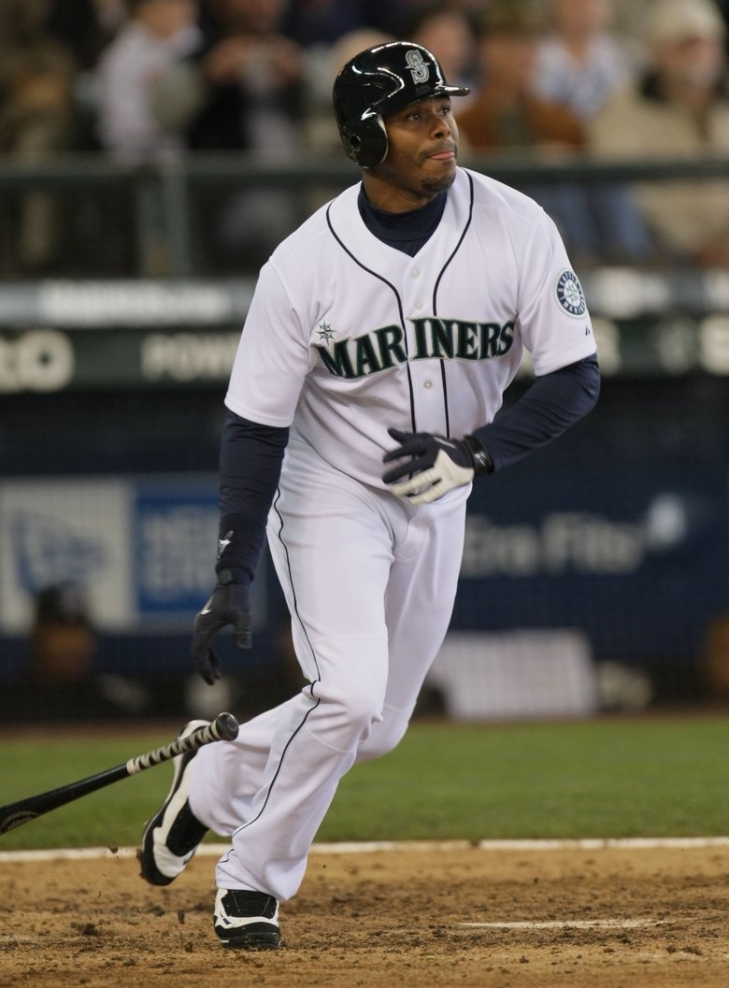
Examining the history of the Seattle Mariners often sparks debate around a trio of legendary figures who shaped different baseball eras in the Pacific Northwest. While Edgar Martinez's consistent drive and Ichiro Suzuki's groundbreaking global influence are notable, the ultimate pinnacle of individual achievement points to one undisputed leader. Ken Griffey Jr. was more than just a Mariners player; he was instrumental in revitalizing baseball in Seattle. As the son of three-time All-Star Ken Griffey Sr., "The Kid" was naturally groomed for greatness, blending a natural talent with a charismatic, backward-cap flair that made the Pacific Northwest a hub of youth culture. With what is arguably the most elegant and fluid left-handed swing in the sport, Griffey was selected first overall in 1987 and made his MLB debut at 19 in 1989. His initial season saw a promising 16 home runs, but it was only the beginning of a decade of nationwide dominance.
The 1990s were dominated by Ken Griffey Jr. During that decade, he transformed the expansive Kingdome into his own stage, earning an All-Star selection each summer. He exemplified the five-tool player.
As a pure hitter, his bat control and spatial awareness led him to surpass the coveted .300 batting average seven times during his time with Seattle. As a power hitter, he consistently overwhelmed American League pitching staffs, winning four home run titles and recording six seasons with at least 40 home runs.
His exceptional run production was extraordinary; he achieved seven 100-RBI seasons, including a renowned four-year period from 1996 to 1999 where he never had fewer than 134 RBIs each season. This consistent offensive performance earned him seven Silver Slugger Awards and made him the most recognizable and universally loved athlete worldwide.
His ultimate evolutionary peak occurred during a stunning 1997 regular season. Griffey showcased pure dominance, leading the majors with 125 runs, 56 home runs, and 147 RBIs, while hitting an impressive .646 slugging percentage, earning him the American League Most Valuable Player Award unanimously. His relentless, high-velocity playmaking carried the Mariners to a division title, and his internal excellence was so consistent that he secured six additional top-ten finishes in the AL MVP balloting over his residency.
However, concentrating solely on his offensive output only tells part of the story. In center field, Griffey transformed defensive play with his exceptional closing speed and a fearless approach to his safety, often leaping over concrete walls to prevent home runs. His defensive skill earned him 10 straight Gold Glove Awards from 1990 to 1999, solidifying his reputation as a versatile and outstanding player.
Furthermore, his high-velocity instincts made him a formidable threat on the basepaths, swiping 167 bases in a Mariners uniform and executing the single most meaningful run in franchise history, sliding across home plate to score from first on Edgar Martinez's "The Double" in Game 5 of the 1995 ALDS.
However, all historical eras eventually reach a definitive career end. Prior to the 2000 campaign, desiring to play closer to his family's hometown, Griffey requested a change of scenery. The front office engineered a landscape-shifting trade to the Cincinnati Reds, and while the Mariners received a package that lacked a superstar of his singular magnitude, Griffey’s physical tools began to undergo an accelerated, injury-hampered decline away from the evergreen state.
He ultimately returned to his true baseball home in 2009, logging two sentimental final seasons in Seattle before executing a quiet walk away from the game in the summer of 2010
You can look at others like Ichiro Suzuki or Edgar Martinez for this top spot, and we did. However, when it was all said and done, nobody on this team was this great for this long. As of this writing, Ken Griffey Jr. is the all-time franchise leader in bWAR (70.6) and Home Runs (417), and he owns a Slash Line of .292/.374/.553.
The Mariners inducted Griffey Jr. into their franchise Hall of Fame in 2013, and three years later, the team retired his number 24. He was also inducted into the Baseball Hall of Fame on his first try that same year.
50. Mark Mulder

Mark Mulder entered the league with massive expectations as the second overall pick in 1998 out of Michigan State. The smooth-throwing lefty didn't waste time, fast-tracking his way to the Coliseum by 2000.
That rookie campaign was rough around the edges, yielding a 5.44 ERA over 27 starts, but it served as the necessary baseline for what would become a rapid transformation.
Everything clicked in 2001. Mulder anchored the rotation with a league-leading 21 wins, commanding the strike zone with an aggressive sinker-splitter combination that kept hitters completely off-balance. He finished as the American League Cy Young runner-up to Roger Clemens—the highest point of award recognition he would reach, but far from his only productive summer in the green and gold.
As the southpaw component of Oakland’s famed "Big Three" alongside Tim Hudson and Barry Zito, Mulder became a model of efficiency. He rattled off three consecutive seasons of at least 15 wins following his breakout year, earning back-to-back All-Star selections in 2003 and 2004.
During his five-year peak with the Athletics, Mulder was an absolute workhorse, pitching to an 81-42 record with 668 strikeouts and leading the league in complete games twice.
Because the front office operated under strict small-market financial constraints, the roster churn was inevitable. Before his arbitration costs could skyrocket, Oakland traded Mulder to the St. Louis Cardinals prior to the 2005 season. He delivered one final, stellar 16-win campaign in the National League, helping push the Cardinals into the postseason.
