


Site Admin
47. Rolando Arrojo
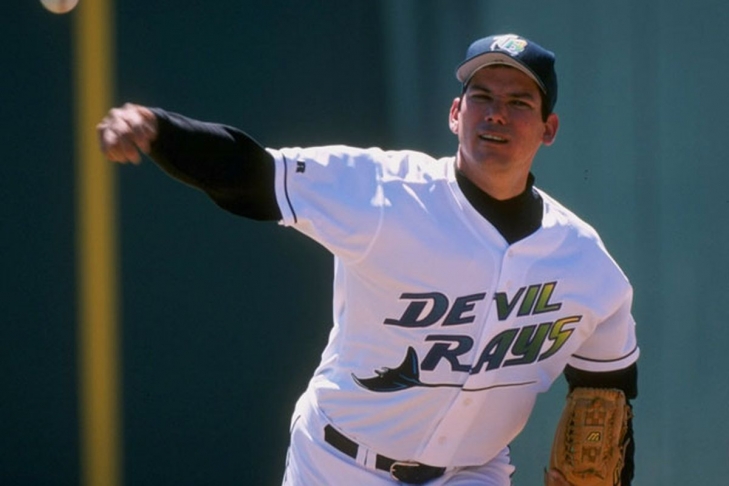
If you look strictly at the back of a baseball card, Rolando Arrojo's major-league trajectory reads like a classic one-year wonder. While that assessment is mathematically accurate, it glosses over a fascinating, high-stakes international backstory. The Cuban right-hander brought a lifetime of elite international experience with him before he ever threw a single official pitch on a big-league mound in the United States.
Arrojo famously defected from the Cuban national team in Georgia just before the 1996 Atlanta Olympics, where he had been slated to be a core pillar of their powerhouse rotation. Seeking a direct path to the major leagues, he signed with the Tampa Bay Devil Rays in early 1997—nearly a full calendar year before the expansion franchise was scheduled to play its historic first game. When the team finally took the field for its inaugural 1998 season, the polished right-hander instantly emerged as the team's chief drawing card and competitive heartbeat on an otherwise struggling roster.
That 1998 rookie campaign was nothing short of sensational. Despite his rookie status, Arrojo displayed seasoned maturity, outdueling elite American League lineups to post a 14–12 record and a crisp 3.56 ERA. He secured the franchise's first regular-season victory, shouldered a heavy 202-innings workload, and became the first All-Star representative in Tampa Bay history. He capped off that magical summer by finishing as the runner-up for the AL Jackie Robinson Rookie of the Year Award to Oakland's Ben Grieve.
Sadly, that brilliant introduction proved both his apex and his practical conclusion in Florida. Already in his early 30s when he debuted, he saw the combination of advanced baseball age, minor hip issues, and heavy usage quickly erode his physical baseline. His command fractured during the 1999 campaign, pushing his ERA to 5.18 over 140.2 innings as the league adjusted to his fading movement. Recognizing the steep decline in his physical tools, the front office pivoted that winter, trading the veteran right-hander to the Colorado Rockies in a multi-player transaction that brought in Vinny Castilla.
With the Rays, Arrojo made 66 appearances (all starts). He compiled a 21–24 record with a 4.23 ERA and a 1.34 WHIP, registering 22 complete games, two shutouts, and 259 strikeouts over 342.2 innings.
39. Matt Moore
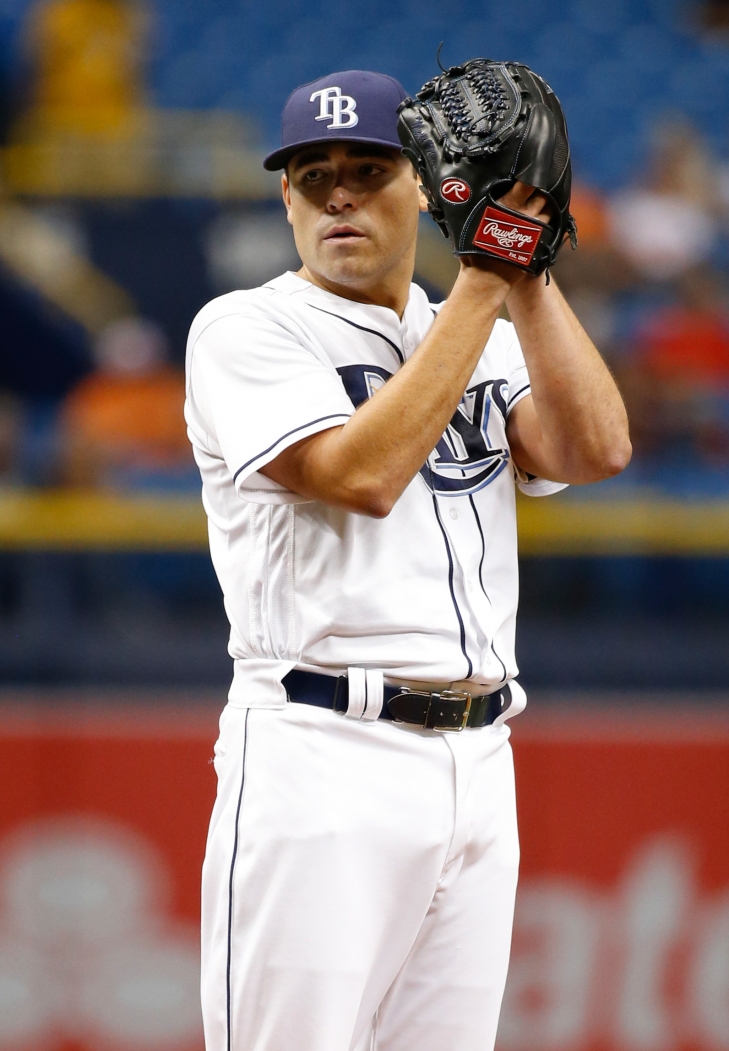
Few young pitchers in Tampa Bay history generated as much anticipation as Matt Moore. Drafted out of a New Mexico high school in the eighth round of the 2007 amateur draft, he spent years in the minors before becoming baseball’s top pitching prospect.
When the front office finally called him up in September 2011, his regular-season debut was limited to a quick, three-game stint. Nonetheless, his dynamic, high-velocity pitching made such a strong impression that manager Joe Maddon boldly included the rookie on the postseason roster. This pivotal decision made Moore a lasting part of October history, as he was entrusted with Game 1 of the American League Division Series against the formidable Texas Rangers. Moore appeared completely unfazed by the spotlight, tossing seven scoreless, two-hit innings to secure a historic playoff win and bolster the belief that a future multiple Cy Young winner had arrived.
With considerable hype trailing him, Moore entered the regular starting rotation in 2012. He adjusted to a full season’s workload, finishing with an 11–11 record in 31 starts. This solid foundation paved the way for a spectacular breakout season in 2013. Everything aligned for the young left-hander as he dominated the American League, going 17–4 with a 3.29 ERA. His impressive performance, aided by a fiery four-seamer and a lethal changeup, earned him his only career All-Star selection and a ninth-place finish in AL Cy Young voting.
Just as he appeared ready to secure a steady spot in the rotation, his progress was halted by the demands of modern power pitching. After only two starts in 2014, a severe elbow injury necessitated Tommy John surgery. His difficult recovery kept him out for over a year, effectively ending that season and much of 2015. When he returned, his usual velocity and pinpoint control were noticeably diminished, as he struggled to regain the consistency that once made him unhittable.
Recognizing the need to restock the roster and maximize Moore’s remaining market value, the front office traded him to the San Francisco Giants before the August 2016 deadline for Matt Duffy and prospects. Moore made 96 appearances, with a 39–28 record, 3.88 ERA, 1.32 WHIP, 540 innings, and 494 strikeouts.
37. Jake McGee
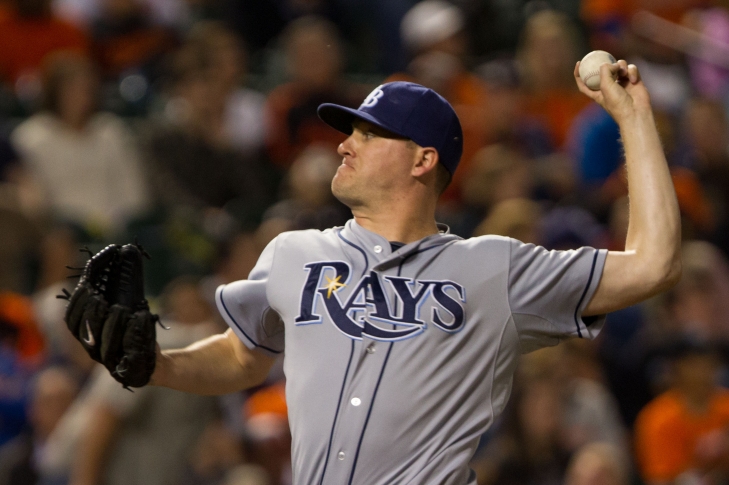
Drafted by the Devil Rays in 2004, southpaw Jake McGee spent a staggering 12 years evolving within the organizational pipeline, transitioning from a highly touted starting prospect into an indispensable late-inning weapon.
When he finally made it onto the major league roster for a brief, eight-game appearance in September 2010, his raw, electrifying talent was immediately evident. Although McGee took on a bigger role in 2011, it wasn’t until 2012 that he secured his spot permanently at the back end of the bullpen. Over the following three seasons, he became an indispensable workhorse for managers Kevin Cash and Joe Maddon, appearing in at least 69 games each summer. His lethal four-seam fastball, which regularly overwhelmed even the top hitters in the American League, propelled him to his peak performance during a remarkable 2014 season. That summer, he assumed the closer role for the final three months, recording 19 saves, a minuscule 1.89 ERA, and striking out 90 batters in just 71.1 innings.
He followed that outstanding stretch with another impressive season in 2015, posting a sub-3.00 ERA and using his deceptive fastball to hold opponents to a.197 batting average. Sensing that his trade value was at its peak ahead of free agency, the front office took advantage of his market desirability that winter, trading McGee to the Colorado Rockies in a major deal that brought outfielder Corey Dickerson to the team.
McGee made 297 appearances (all in relief). He compiled a stellar 21–11 record with 26 saves, a 2.77 ERA, and a premium 1.02 WHIP, striking out 319 batters over 259.2 innings pitched.
45. Fernando Rodney
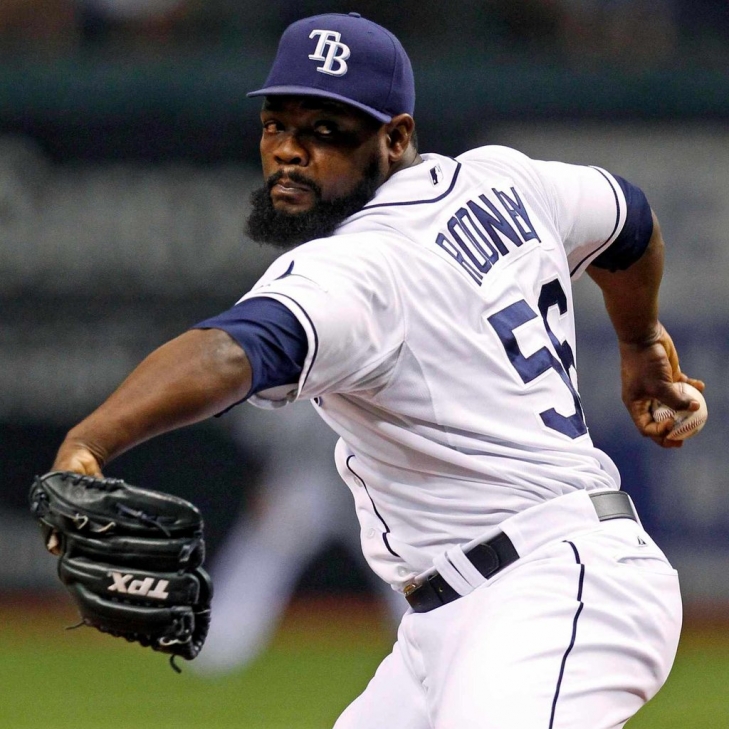
In the wildly unpredictable career of Fernando Rodney, the two-season chapter he spent in St. Petersburg stands as an absolute mountain peak. Signed as an unheralded free agent ahead of the 2012 season after nine years of varying success with Detroit and the Los Angeles Angels, the Dominican right-hander was handed the ninth-inning keys by Joe Maddon. What followed wasn't just a career resurgence—it was one of the most historically dominant relief seasons in baseball history.
Weaponizing a generational, fading changeup that completely locked up opposing hitters, Rodney turned the 2012 campaign into a personal masterpiece. He slammed the door for a franchise-record 48 saves, but it was his pristine efficiency that rewrote the record books: Rodney yielded a microscopic 0.60 ERA over a career-high 74.2 innings, setting a major league record for the lowest single-season ERA by any pitcher with at least 50 innings thrown. The baseball world took notice of the performance—and his signature, tilted-cap style—rewarding him with an All-Star selection, a fifth-place finish in the AL Cy Young voting, and a 13th-place finish in the MVP race. Every time he pulled back his invisible bow and arrow to celebrate a final out, the Rays were securing a win on the back of historically elite run prevention.
While maintaining that mythical level of perfection was impossible, Rodney returned in 2013 to provide the club with another highly productive baseline. He locked down 37 saves across 68 appearances, anchoring a steady bullpen that propelled the Rays right back into the postseason picture.
With his market value thoroughly restored, Rodney hit the open market that winter and signed a lucrative free-agent deal with the Seattle Mariners. Rodney made 144 appearances (all in relief). He compiled a 7–6 record with 85 saves, a spectacular 1.91 ERA, and a 1.03 WHIP, striking out 158 batters over 141.1 innings pitched as a Ray.
