

The Pro Football Hall of Fame Revisited Project: 1985 Final VOTE

1985 Pro Football Hall of Fame Revisited Project Class.
Here we are! Again!!
If you have been following our Pro Football Hall of Fame Revisited Project, you know we have asked the rhetorical question: What if the PFHOF began in January 1946?
After soliciting and obtaining a passionate group of football fans and historians, we sent out a ballot for a Preliminary Vote, in which we asked each voter to select 25 names as their semi-finalists and 5 names for the Senior Pool. We then asked the group to vote for their 15 Finalists in the Modern Era and 3 in the Senior Category. The final stage was to vote for their five Modern Era inductee and one Senior inductee.
This is the result of the 40th official class.
Below are the final results of this project based on 32 votes.
Remember that we have reverted back to the top five candidates entering the Hall in the Modern Era
This is for the “Modern Era”
*Bold indicates they have been elected to the Pro Football Hall of Fame Revisited Class of 1985:
|
Player |
Year of Eligibility |
Vote Total |
|
Roger Staubach QB |
1 |
26 |
|
O.J. Simpson RB |
1 |
18 |
|
Jim Tyrer T |
6 |
11 |
|
Buck Buchanan DT |
5 |
11 |
|
Joe Namath |
3 |
11 |
|
Gene Hickerson G |
7 |
10 |
|
Larry Czonka FB |
1 |
9 |
|
Carl Eller DE |
1 |
9 |
|
Mick Tingelhoff C |
2 |
8 |
|
Paul Krause DB |
1 |
8 |
|
Charley Taylor WR-SE-RB |
3 |
7 |
|
Bob Hayes SE-WR |
5 |
6 |
|
Tommy Nobis LB |
4 |
6 |
|
Rayfield Wright T-TE |
1 |
6 |
|
Emmitt Thomas DB |
2 |
5 |
|
Charlie Sanders TE |
3 |
3 |
|
Jackie Smith TE |
2 |
3 |
|
Tom Mack G |
2 |
1 |
This is for the “Senior Era”,
*Bold indicates they have been elected to the Pro Football Hall of Fame Revisited Class of 1985.
|
Buckets Goldenberg G-BB |
15 |
12 |
|
Pat Harder FB |
13 |
7 |
|
Ward Cuff WB-QB-HB |
13 |
6 |
|
None of the Above |
N/A |
6 |
This is for the “Coaches/Contributors”,
*Bold indicates they have been elected to the Pro Football Hall of Fame Revisited Class of 1985.
|
Sid Gillman (Coach) |
1 |
13 |
|
George Allen (Coach) |
6 |
10 |
|
Hank Stram (Coach) |
6 |
8 |
About the 1985 Inductees:
Roger Staubach, QB, DAL 1969-79: Inducted in the Pro Football Hall of Fame Revisited Project in 1985 on his 1st Ballot. Inducted into the actual Pro Football Hall of Fame in 1985.
Roger Staubach was the 1963 Heisman Trophy winner, but as he was enrolled at the Naval Academy, he had to fulfill a military obligation before he would play football. As such, he was a 27-year-old rookie in 1969, but despite the late start, Staubach would go on to have a Hall of Fame career.
Arguably, it was an even later start, as he did not take over as the team’s starting Quarterback in 1971, succeeding a slumping Craig Morton. He won all 10 of his starts that year, and would finish first in Passer Rating (104.8), go to his first Pro Bowl, and take Dallas to their first Super Bowl Championship.
A separated shoulder kept him on the shelf for most of 1972, and after two above-average years, Staubach went on a five-year streak of Pro Bowl Selections (1975-79). This run saw Staubach lead the NFL twice in Passer Rating and win another Super Bowl Championship in the 1977 season. In his last season, Staubach would have career-highs in Passing Yards (3,586) and Touchdown Passes (27), and he clearly could have kept playing had he so desired.
The QB retired with 22,700 Passing Yards and 153 Touchdown Passes, and was a first ballot inductee.
O.J. Simpson, RB, BUF 1969-77 & SFO 1978-79: Inducted in the Pro Football Hall of Fame Revisited Project in 1985 on his 1st Ballot. Inducted into the actual Pro Football Hall of Fame in 1985.
While the first three years of O.J. Simpson’s professional career were basically average, he would explode the next five seasons, where he would explode for five consecutive First Team All-Pro nods as well as four Rushing Titles. One of those titles included becoming the first Running Back in NFL history to rush for over 2,000 yards in a season.
The Buffalo Bills may not have had that much to cheer about during the 1970s, but Bills fans always had a reason to pack the stadium, knowing that they would likely see the “Juice” rush for over 100 Yards a game. Simpson no longer holds the Bills' rushing record, but in his prime, he was one of the most explosive Running Backs in NFL history. Simpson entered the Pro Football Hall of Fame in his first year of eligibility.
Jim Tyrer, T, DTX 1961-62, KAN 1963-73 & WAS 1974. Inducted in the Pro Football Hall of Fame Revisited Project in 1985 on his 6th Ballot. Was never inducted into the actual Pro Football Hall of Fame.
Jim Tyrer was definitely the top Offensive Lineman for the Kansas City Chiefs throughout the 1960s, and there is a case to be made that he was among the top tier in the AFL. Tyrer was a First Team AFL All-Pro five times (and also a First Team All-Pro twice) and a vital part of the O-Line that protected Len Dawson for years. Notably, he was a seven-time AFL All-Star, a two-time Pro Bowl winner, and part of three AFL Championship teams and the Super Bowl IV win.
We do have to mention, however, when discussing Tyrer, that while he could be considered an (actual) Hall of Fame snub, he killed his wife and himself after a bout of depression, which is now largely considered to be CTE. He is a member of the Kansas City Chiefs Hall of Fame, inducted in 1977.
Buck Buchanan, WR, OAK, 1963-75. Inducted in the Pro Football Hall of Fame Revisited Project in 1985 on his 5th Ballot. Inducted into the actual Pro Football Hall of Fame in 1990.
Buck Buchanan was a proven force at Grambling; so much so that the Kansas City Chiefs made him the first overall draft pick in the 1963 AFL Draft, the first time a black player was chosen at that spot.
It was definitely the right call, as Buchanan would blossom into the leader of the Chiefs' front four. Blessed with incredible speed, Buchanan seemed to improve annually throughout the 1960s. Buchanan was named an AFL All-Star in 1964 and continued collecting that honor until 1969, when it was no longer offered and replaced by the Pro Bowl following the merger. Not surprisingly, Buchanan went to the first two Pro Bowls that he was eligible for.
Where Buchanan excelled was breaking up plays before they even started. The star Defensive Tackle had a breathtaking 16 batted balls in the 1967 season, and his overall ability helped the Chiefs win two AFL Titles and Super Bowl IV.
Joe Namath, QB, NYJ 1965-76 & RAM 1977. Inducted in the Pro Football Hall of Fame Revisited Project in 1985 on his 3rd Ballot. Inducted into the actual Pro Football Hall of Fame in 1985.
When you talk about any Hall of Fame, often the word that gets forgotten is the most important one: “Fame”. There are few football players or athletes, for that matter, who achieved more fame than Joe Namath.
Namath was the first overall pick in the AFL Draft, joining the New York Jets in 1965. He became the face of the franchise and then the league, and he would lead the AFL in Passing Yards in 1966 and 1967. In the first two Super Bowls, the AFL representatives were handily defeated by the Green Bay Packers, and with the Jets winning the AFL Title going into Super Bowl III, few thought they would beat the Baltimore Colts. Namath disagreed and guaranteed that New York would prevail. He was right, and Namath became the most popular player in football.
Namath played with the Jets until 1976, with a final year with the Los Angeles Rams. The Quarterback’s stats look tame compared to the modern era and even against some of his peers, but Namath had no equals in terms of recognition.
Sid Gillman, Coach, RAM 1955-59, LAC 1960, SDG 1961-71 & HOU 1973-74. Inducted in the Pro Football Hall of Fame Revisited Project in 1985 on his 1st Coach/Contributor Ballot. Inducted into the actual Pro Football Hall of Fame in 1983.
Sid Gillman was one of the first coaches to understand the value of the passing game, and his peers considered him one of the quickest thinkers in Football.
Gillman first coached on the pro level with the Los Angeles Rams in 1955, but his merit was proven far greater with the Los Angeles/San Diego Chargers of the AFL, the team he ran from 1960 to 1971. Taking the Chargers to the playoffs five times, Gillman’s squad won the AFL Title in 1963, primarily due to Gillman’s innovation. It is no stretch to say that Gillman’s work with the Chargers helped keep the league afloat.
He retired with a record of 122-99-7.
8. Buck Buchanan
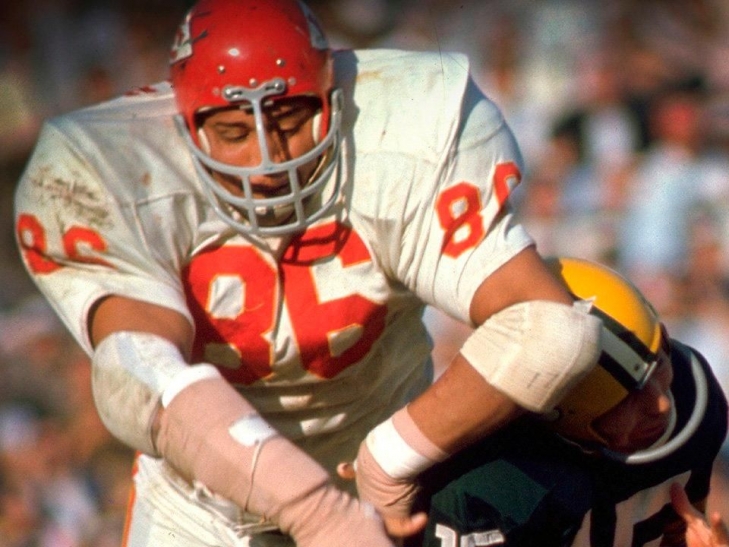
Chosen first overall by the Kansas City Chiefs in the 1963 AFL Draft, Grambling State icon Junious "Buck" Buchanan made history as the first Black player selected with the top overall pick in professional football. While head coach Hank Stram and legendary scout Lloyd Wells recognized Buchanan's exceptional talent, he surpassed all expectations, revolutionizing line play and becoming the formidable force driving Kansas City's defense for more than ten years.
Standing 6-foot-7 and weighing 287 pounds, Buchanan possessed a terrifying blend of size, power, and sprinter-like speed that was unprecedented for a defensive tackle in the 1960s. He used his explosive first step to overwhelm opposing guards and centers, routinely firing into the backfield to blow up plays before they developed. Beyond collapsing pockets, Buchanan used his massive wingspan and leaping ability to swat down passes at the line of scrimmage, highlighted by a staggering 16 batted balls in the 1967 campaign.
Buchanan served as the emotional and physical anchor of Kansas City's famous "Triple-Stack" defense, lining up alongside fellow Hall of Famers Willie Lanier, Bobby Bell, and Emmitt Thomas. His peak performance elevated the franchise onto the game's biggest stages, leading the Chiefs to two AFL Championships and appearances in Super Bowls I and IV. In Super Bowl IV against the heavily favored Minnesota Vikings, Buchanan and the Chiefs’ defense suffocated Minnesota's offense, limiting it to just 67 rushing yards in a decisive 23–7 victory.
His dominance was recognized year in and year out across both leagues. Buchanan was named an AFL All-Star six consecutive times from 1964 through 1969, and following the AFL-NFL merger, he seamlessly continued his elite play by earning Pro Bowl selections in 1970 and 1971. A four-time First-Team All-AFL selection, he was an undeniable selection for the AFL All-Time Team.
In total, Buchanan played 182 regular-season games in red and gold—including a streak of 166 consecutive games—before retiring following the 1975 season. Statistically, Buchanan had 70.5 sacks in his career. His legacy in professional football includes induction into the Kansas City Chiefs Hall of Fame in 1981, the retirement of his No. 86 jersey, enshrinement in the Pro Football Hall of Fame in 1990, and selection to the NFL 100th Anniversary All-Time Team in 2019.
