

23. Bert Jones
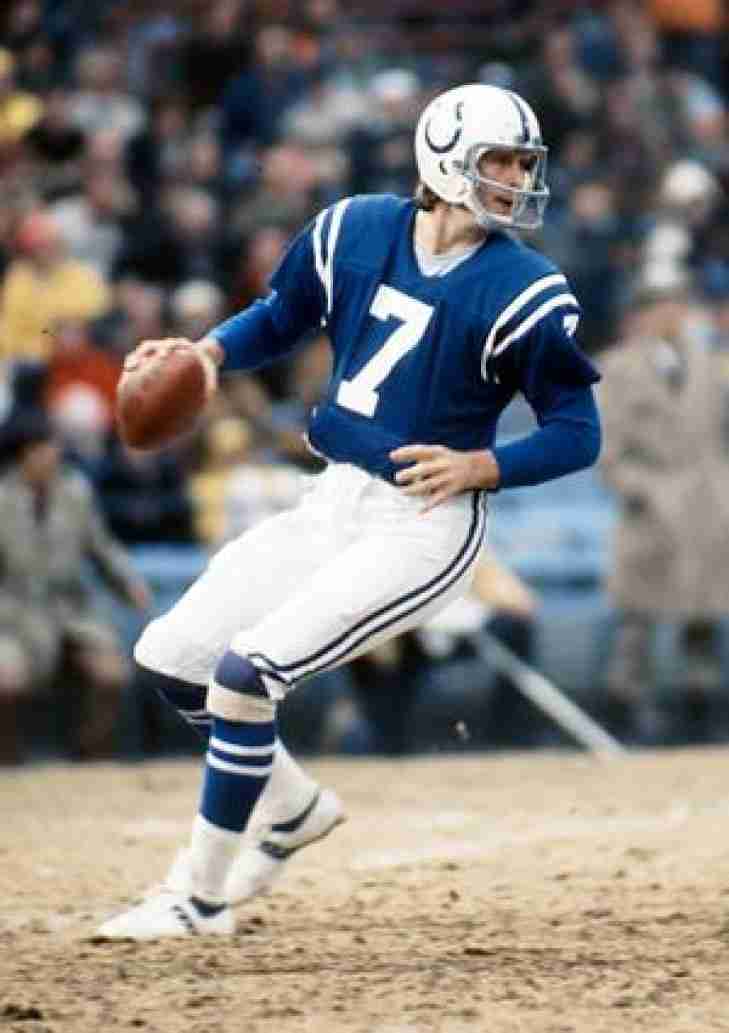
Taking over the reins of a franchise directly following a legend like Johnny Unitas is one of the most daunting assignments in football history. Selected second overall out of LSU in the 1973 NFL Draft, Bert Jones met that challenge head-on, earning the nickname "The Ruston Rifle" for a bullet pass and fearless pocket presence that quickly won over the fan base.
Without the deep championship cast that surrounded Unitas in the late 1950s, Jones willed the Colts back into national prominence through sheer individual excellence. Orchestrating head coach Ted Marchibroda's offense, he led Baltimore to three consecutive AFC East division crowns from 1975 to 1977. The crown jewel of his tenure came in 1976—a dominant season where he led the NFL with 3,104 passing yards, threw 24 touchdowns against nine interceptions, and compiled a league-leading 102.5 passer rating. That brilliant run swept the league's top honors, earning him the 1976 AP NFL Most Valuable Player award, AP Offensive Player of the Year, and First-Team All-Pro honors.
Known as one of the toughest and purest arm talents of his era, Jones routinely earned the admiration of opposing coaches and players. Regrettably, persistent shoulder injuries beginning in 1978 siphoned away his prime years and limited his availability. After nine seasons anchoring the offense in Maryland, Jones played a single final campaign with the Los Angeles Rams in 1982 before a neck injury brought his career to an early close.
With the Colts, Jones had a 56.1% completion percentage for 17,663 passing yards, a 122-97 TD-INT ratio, alongside 1,350 rushing yards and 14 rushing touchdowns.
The 2016 College Football Hall of Fame Class is Announced!
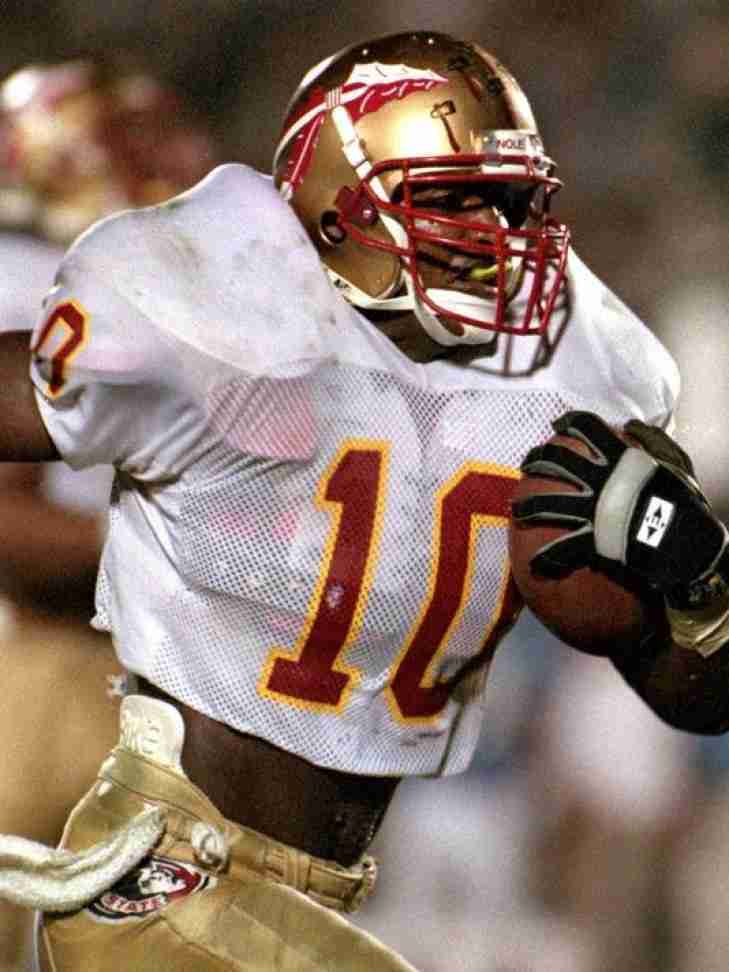
Days before the National Championship Game between Clemson and Alabama, the College Football Hall of Fame has announced their Class of 2016 an while we do not rank those who are not in the College Hall, we here at Notinhalloffame.com always are interested to see who gets in!
Here they are!
Marlin Briscoe, Nebraska, Quarterback
Derrick Brooks, Florida State, Linebacker
Tom Cousineau, Ohio State, Linebacker
Randall Cunningham, UNLV, Quarterback/Punter
Troy Davis, Iowa State, Running Back
William Fuller, North Carolina, Defensive Tackler
Bert Jones, LSU, Quarterback
Tim Krumrie, Wisconsin, Defensive Tackle
Pat McInally, Tight End, Harvard
Herb Orvis, Defensive End, Colorado
Bill Royce, Linebacker, Ashland
Mike Utley, Offensive Guard, Washington State
Scott Woerner, Defensive Back, Georgia
Rod Woodson, Defensive Back, Purdue
Bill Bowes, Coach, New Hampshire
Frank Girardi, Coach, Lycoming
We here would like to congratulate this stellar group to the College Football Hall of Fame!
