


Committee Chairman
How Data Protection Shapes Player Confidence in Betting

Online betting platforms handle more than wagers and game results. They may also process names, contact details, payment information, identity documents, account histories, and login records. Players therefore need confidence that their personal information is being collected responsibly and protected from unauthorised access.
Strong data protection supports that confidence. When a platform explains what information it collects, limits access, secures transactions, and gives users control over their accounts, players are more likely to view the service as organised and dependable.
Clear Privacy Information Builds Understanding
Players should not need legal knowledge to understand how their information is used. A clear privacy policy can explain what data is collected, why it is required, how long it may be stored, and whether trusted service providers are involved.
Simple explanations are especially important during registration and identity verification. Players are more comfortable sharing information when the platform explains why each detail is needed.
For example, identity documents may be requested to confirm age, meet regulatory requirements, protect accounts, or support secure withdrawals. Explaining these reasons reduces uncertainty and helps users make informed decisions.
Secure Registration Creates a Strong First Impression
The vegas338 registration process is often the first moment when a player shares personal data. A secure and well-organised form can immediately influence how trustworthy the platform feels.
Betting sites should use encrypted connections, clear password requirements, and protected data-entry fields. Forms should request only the information required for account creation or legal compliance.
Asking for unnecessary details can make players uncomfortable. Collecting less data also reduces the amount of information the platform must protect.
A smooth registration process should balance convenience with careful verification. Players want to open accounts efficiently, but they also expect meaningful protection against fake identities and unauthorised access.
Account Security Protects Personal Information
Data protection continues after registration. Player accounts may contain contact details, financial records, betting histories, and saved payment preferences.
Strong passwords provide a basic layer of protection, while multi-factor authentication adds an additional verification step. This may involve a temporary code, authentication application, approved device, or biometric check.
Platforms can also monitor unusual account behaviour. Repeated failed login attempts, unexpected password changes, or access from unfamiliar devices may trigger alerts or additional checks.
Secure account recovery is equally important. A weak recovery process can allow someone to bypass strong login controls. Verification should therefore be careful without becoming unnecessarily complicated for the legitimate account holder.
Payment Protection Strengthens Financial Confidence
Deposits and withdrawals involve some of the most sensitive information handled by betting platforms. Players need to know that payment details are processed securely and that transactions can be reviewed easily.
Trusted payment processors, encrypted transactions, and limited storage of financial data can reduce exposure. Platforms should avoid displaying complete card or bank details inside account areas.
Clear transaction records also support confidence. Players should be able to review deposits, withdrawals, refunds, and adjustments in a straightforward account history.
Additional checks may be necessary when payment information changes or a withdrawal request appears unusual. Explaining these checks helps players understand that verification protects their funds rather than simply delaying access.
Data Access Should Be Carefully Controlled
Not every employee or third-party provider needs access to all player information. Strong platforms use role-based access, meaning staff members can only view the data required for their responsibilities.
A customer-support agent may need access to account details but not complete payment information. A technical provider may require system access without seeing identity documents.
Platforms should also record when sensitive information is viewed or changed. These activity logs support accountability and help security teams investigate unusual actions.
Third-party services must be reviewed carefully because payment processors, identity-verification providers, analytics tools, and support systems can all become part of the wider data-protection structure.
Player Control Supports Long-Term Trust
Confidence grows when players can manage their own information. Account settings should make it easy to update contact details, change passwords, review active devices, and adjust communication preferences.
Players should also know how to request access to their data or ask questions about its use. Support channels need to provide clear answers rather than vague technical language.
Data should not be stored indefinitely without a reason. Retention policies help platforms remove information that is no longer required while preserving records needed for regulatory, security, or financial purposes.
Responsible Data Use Creates a Better Relationship
Data protection is not only about preventing technical incidents. It also concerns how responsibly information is used.
Platforms may analyse player activity to improve interfaces, detect suspicious behaviour, or support responsible-betting tools. These uses should be transparent and limited to clear purposes.
Players are more likely to trust a platform when data is used to improve security and account management rather than collected without explanation.
Confidence Begins With Consistent Protection
Data protection shapes player confidence because betting platforms ask users to share sensitive personal and financial information. Players need evidence that this information is handled carefully throughout the entire account relationship.
Clear policies, secure logins, protected payments, controlled access, and useful account settings all contribute to trust. When these protections work together, players can focus on using the platform without constantly questioning what is happening to their data.
Strong data protection is therefore more than a technical requirement. It is a visible part of the player experience and a foundation for lasting confidence.
The University of Utah names its 2026 Athletic Hall of Fame

Regular visitors of notinhalloffame.com know that we are slowly working on the top 50 of every major team in the NHL, NBA, NFL, and MLB. Once that is done, we will examine how each team honors its past players, coaches, and executives. Eventually, we will do the same with major college programs. As such, it is important to us that the University of Utah has announced the four players, one coach, and one team that will be inducted into its Athletic Hall of Fame Class of 2026.
The event will take place on September 18, with the inductees being honored the following day during the football game against Utah State.
The Class of 2026 members are:
Zan Beadles, Football, 2006-09. In Beadles’ 2009 season, he was a First Team All-Mountain West Selection, playing Left Tackle on the squad that won the Sugar Bowl and finished the season ranked #2. He went on to play nine seasons in the NFL for the Denver Broncos, Jacksonville Jaguars, San Francisco 49ers, and Atlanta Falcons and boasts a Super Bowl Ring with the Broncos (2015).
Daria Bijak, Women’s Gymnastics, 2007-10. An eight-time All-American, Bijak won the 2008 Dahl Award, which is awarded to the Red Rocks’ top scholar-athlete. She competed for Germany in the 2008 Olympics in Beijing.
Jerry Pimm, Men’s Basketball Head Coach, 1974-83. Pimm was an Assistant Coach for 13 years before he took over the reins in 1974, and as a Head Coach, he had a record of 173-86. He led the Utes to five NCAA Tournaments, four Sweet Sixteens and three WAC Championships.
Katrin Smigun, Women’s Skiing, 2003. A two-time Winter Olympian (1998 & 2002) while representing Estonia, Smigun competed only one season for Utah but went undefeated in 12 straight races and was a dual winner at the 2003 NCAA Championships.
Delon Wright, Men’s Basketball, 2013-15. A two-time First Team All-Pac-12 Selection and two-time Pac-12 Defensive Team Selection, Wright led the Utes to the 2015 Sweet Sixteen. He had 1,022 Points over his NCAA career and went on to play 10 seasons in the NBA for the Toronto Raptors, Memphis Grizzlies, Dallas Mavericks, Detroit Pistons, Sacramento Kings, Atlanta Hawks, Washington Wizards, Milwaukee Bucks, and New York Knicks.
The 1991 Women’s Softball Team. The team won the Regular Season and Tournament WAC Championships, and qualified for the College World Series.
We here at Notinhalloffame.com would like to congratulate the impending members of the Michigan State University Athletic Hall of Fame.
29. Kyle Hamilton
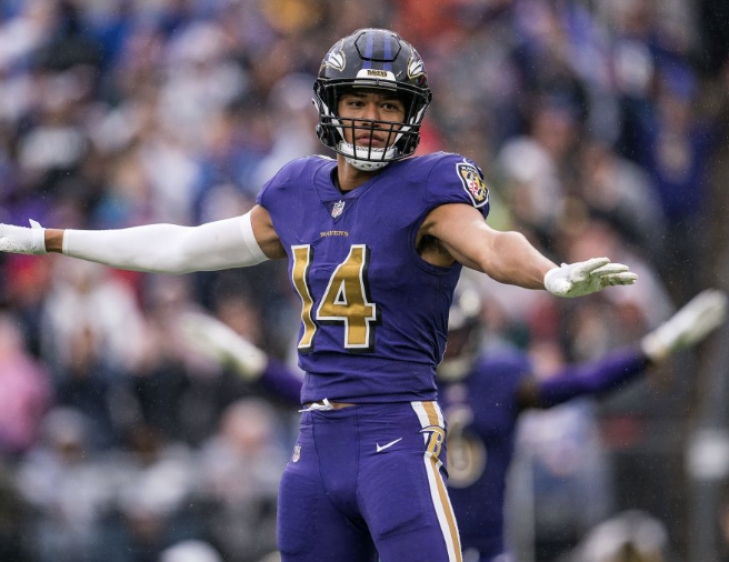
Drafted 14th overall in the first round of the 2022 NFL Draft out of Notre Dame—where he was a Consensus All-American—Kyle Hamilton brought rare unicorn traits to Baltimore's secondary. Standing 6 feet 4 inches and weighing 224 pounds, he disrupted traditional positional labels, quickly establishing himself as a foundational piece of the Ravens' modern defensive framework.
Hamilton blends the size of a linebacker with the coverage ability of a safety and the agility of a slot corner. He acts as a versatile hybrid, lining up in various positions such as deep half, stacking the box to defend the run, moving into the slot to cover pass-catchers, or rushing through gaps as a pass-rushing threat from the edge. His quick processing and burst of speed enable him to disrupt perimeter screens and interrupt seam routes early, preventing throws before they develop.
In his 2022 rookie season, Hamilton established a significant role as a slot defender and box safety, earning PFWA All-Rookie Team honors with 62 tackles, 2.0 sacks, and five pass deflections. His true breakthrough came in 2023 when Mike Macdonald fully unlocked his potential within the defense. Playing 15 games as a starter, Hamilton recorded 81 tackles, 3.0 sacks, 10 tackles for loss, 13 pass deflections, and four interceptions, including a pick-six. His impactful performance led to his first Pro Bowl selection and First-Team All-Pro honors.
In 2024, he maintained a world-class level, finishing with a career-high 107 combined tackles, 2.0 sacks, two forced fumbles, and an interception, earning his second Pro Bowl and Second-Team All-Pro honors. In 2025, Hamilton continued to be the driving force of Baltimore's secondary. Playing all 16 games, he recorded another outstanding season with 105 combined tackles, 7.0 tackles for loss, nine pass deflections, and two forced fumbles. His exceptional play earned him his second First-Team All-Pro selection and his third straight Pro Bowl appearance.
Entering the 2026 season, Hamilton stands as one of the most dominant and complete defensive weapons in football. Across his first four seasons in Baltimore, he has played in 64 regular-season games, accumulating 355 total tackles, 8.0 sacks, 25 tackles for loss, 36 pass deflections, and five interceptions.
Michigan State names it 2026 Hall of Fame Class
Regular visitors of notinhalloffame.com know that we are slowly working on the top 50 of every major team in the NHL, NBA, NFL, and MLB. Once that is done, we will examine how each team honors its past players, coaches, and executives. Eventually, we will do the same with major college programs. As such, it is important to us that Michigan State has announced the six players and a coach that will be inducted into its Athletic Hall of Fame Class of 2026.
The event will take place on September 11, with the inductees being honored the following day during the football game against Eastern Michigan.
The Class of 2026 members are:
Lindsay Bowen, Women’s Basketball, 2002-06. Bowen was a four-time Big Ten Selection and the 2003 Big Ten Freshman of the Year. She recorded 1,739 Points as a Spartan.
Dan Currie, Football, 1955-57. Currie helped take Michigan State to National Championships in 1955 and 1957 and in ’57 was a Consensus All-American. He also helped take MSU to a Rose Bowl win in 1956. He played nine seasons in the NFL, seven of which were in Green Bay, where he helped the team win two NFL Championships.
Walt Drenth, Track & Field Coach, 2000-20. Drenth led the women’s track team to five cross country conference titles and the 2014 National Championship. He was also a six-time Big Ten Coach of the Year, and his athletes won two individual NCAA Titles and 37 Big Ten Titles.
Tico Duckett, Football & Men’s Track & Field, 1989-92. Playing at Running Back, Duckett rushed for 4,176 Yards and 26 TDs, his best season coming in 1990, when he rushed for a conference-leading 1,394 Yards. For his efforts, he was named the Big Ten Offensive Player of the Year. Duckett also competed for the Spartans in the 55-m and 100-m dash.
Sue Latter-Addison, Women’s Track & Field, 1975-78. A pioneer in school history, Latter-Addison was part of the inaugural women’s track team and later would win the 44-yard and 88-yard Big Ten Titles, while also helping the Spartans win the conference title. She later won the National Title in the 800.
Kalin Lucas, Men’s Basketball, 2007-11. Playing at Point Guard, Lucas was the 2009 Big Ten Player of the Year and guided the Spartans to the National Championship Game against North Carolina and back to the Final Four a year later. The two-time First Team All-Big Ten Selection had 1,996 Points, which is enough for fifth all-time in program history. Lucas went on to play professionally for 14 years in countries such as Greece, Turkey, Israel, Serbia, Italy, Kuwait, and the UAE. He also played one game each for the Memphis Grizzlies and the Detroit Pistons in the NBA.
Leah O’Connor-Falland, Women’s Cross Country & Track Field, 2011-15. O’Connor-Falland won two National Championships, the 2014 Outdoor Steeplechase and 2015 Indoor Mile. She also helped Michigan State win the 2014 National Championship.
We here at Notinhalloffame.com would like to congratulate the impending members of the Michigan State University Athletic Hall of Fame.
