

35. Ricky Williams
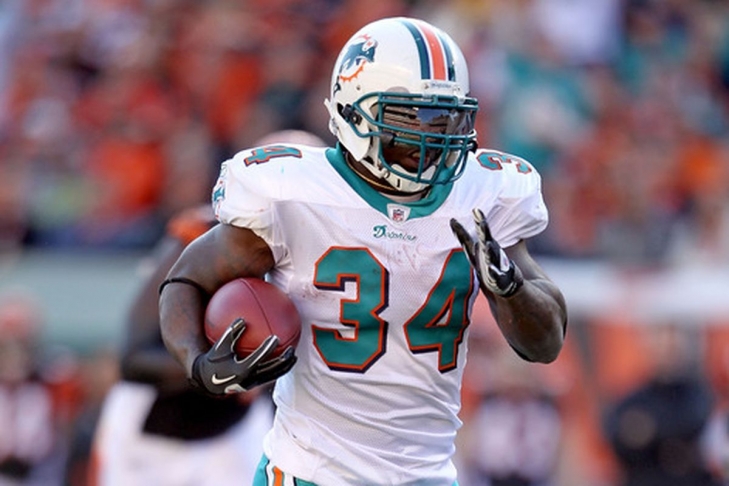
Ricky Williams arrived in Miami via trade before the 2002 season after three productive but uneven years with the New Orleans Saints. The Saints had mortgaged their entire 1999 draft (and more) to select the Heisman Trophy winner fifth overall; when results and off-field issues didn’t match the price, both sides benefited from a change. Miami sent a 2002 first-round pick and a conditional 2003 pick (which became another first after Williams hit 1,500 yards) the other way and installed him as the clear lead back.
His first season in aqua and orange finally matched the hype. Williams led the NFL with 1,853 rushing yards and 16 touchdowns on a league-high 383 carries, averaging 4.8 yards per carry and 115.8 yards per game. He earned first-team All-Pro and Pro Bowl honors, set the Dolphins’ single-season rushing record (still standing), and racked up more than 2,200 yards from scrimmage. Multiple 200-yard games and ten 100-yard performances made him the franchise’s most dominant offensive weapon in years. The team finished 9-7 and missed the playoffs, but the individual season remains one of the best by any Dolphins running back.
The rest of his Miami tenure was more stop-and-start. He followed with 1,372 yards and nine touchdowns in 2003, then abruptly retired before the 2004 season amid marijuana-related issues that also cost him the entire 2006 campaign (he spent that year in the CFL with the Toronto Argonauts). He returned in 2005 in a limited role (743 yards, six touchdowns in 12 games), dealt with further suspensions and injuries, and settled into a complementary role alongside Ronnie Brown.
Even so, he delivered another strong year in 2009: 1,121 yards and 11 touchdowns on 4.7 yards per carry after Brown was injured, setting an NFL record for the longest span between 1,000-yard seasons. He contributed to the 2008 AFC East title and playoff run in the Wildcat offense, then closed his Dolphins chapter in 2010 before one final season with Baltimore.
Across 93 games with Miami, Williams finished with 6,436 rushing yards and 48 touchdowns on 1,509 carries (plus 197 receptions for 1,431 yards and six more scores). Those numbers rank him second in franchise history behind only Larry Csonka in rushing yards. When he was on the field and focused, he was a punishing, high-volume force who gave the Dolphins the ground game they had long lacked; the suspensions and absences simply kept the full version of that career from unfolding.
