

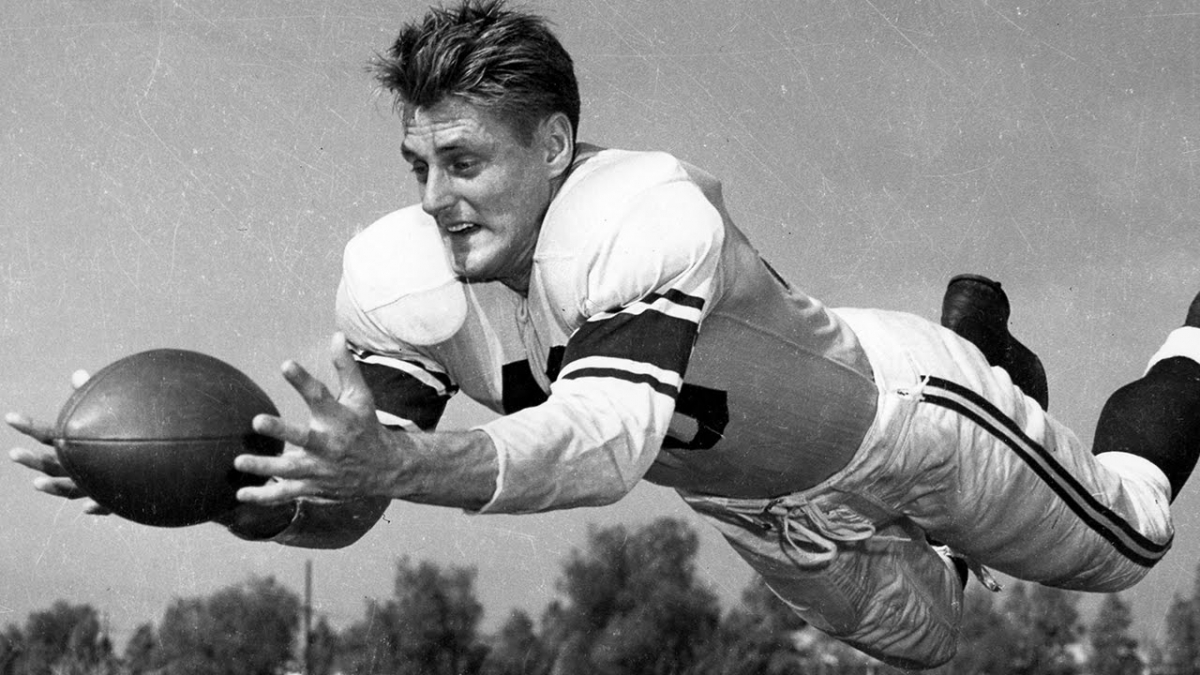
Elroy Hirsch earned the nickname “Crazy Legs” for the distinctive way he ran, legs gyrating in different directions as he shifted into top speed. He was already a known athlete by the time he reached the Rams, having starred at Michigan, served in the Marines, and then led a College All-Star team to a shutout win over the defending champion Rams in an exhibition. Drafted fifth overall by Los Angeles, he instead signed with the Chicago Rockets of the All-America Football Conference and played three seasons there before securing his release and joining the Rams in 1949.
His first two seasons in Los Angeles were solid but not spectacular. He worked mostly as a halfback before the Rams moved him to end, and he gradually settled into the role of a deep threat in an offense that was already throwing the ball more than most teams of the era. The breakthrough came in 1951. Hirsch caught 66 passes for 1,495 yards and 17 touchdowns in only 12 games. That yardage total nearly doubled the next-closest receiver in the league, and ten of his scores came on long bombs. He averaged 124.6 yards per game, a mark that stood for decades and still ranks among the highest single-season averages ever recorded.
The production helped the Rams win the NFL championship that year. Hirsch’s ability to stretch the field and make plays after the catch forced defenses to respect the deep ball, which opened things up for the rest of the offense. He wasn’t just a straight-line speed guy; the “Crazy Legs” gait made him hard to tackle once he got the ball in space, and he had a knack for tracking deep passes over his shoulder.
He never matched that 1951 season again, but he remained a productive receiver for the Rams through 1957. He posted solid numbers in several of those later years, including a 941-yard season in 1953, and he stayed a reliable part of the attack even as the roster changed. Hirsch retired after that 1957 campaign.
With the Rams he finished with 343 receptions for 6,299 yards and 53 touchdowns. Those numbers were outstanding for the era, especially the yardage total in a 12-game schedule. He also appeared in films during the 1950s, playing himself in a biopic that leaned into the nickname.
After his playing days he worked as a Rams executive and later served as athletic director at the University of Wisconsin. The Pro Football Hall of Fame inducted him in 1968, and he was later named to the NFL’s 100th Anniversary Team, recognition for the receiver whose unique running style and 1951 explosion helped define the early years of the modern passing game in Los Angeles.


Comments powered by CComment