

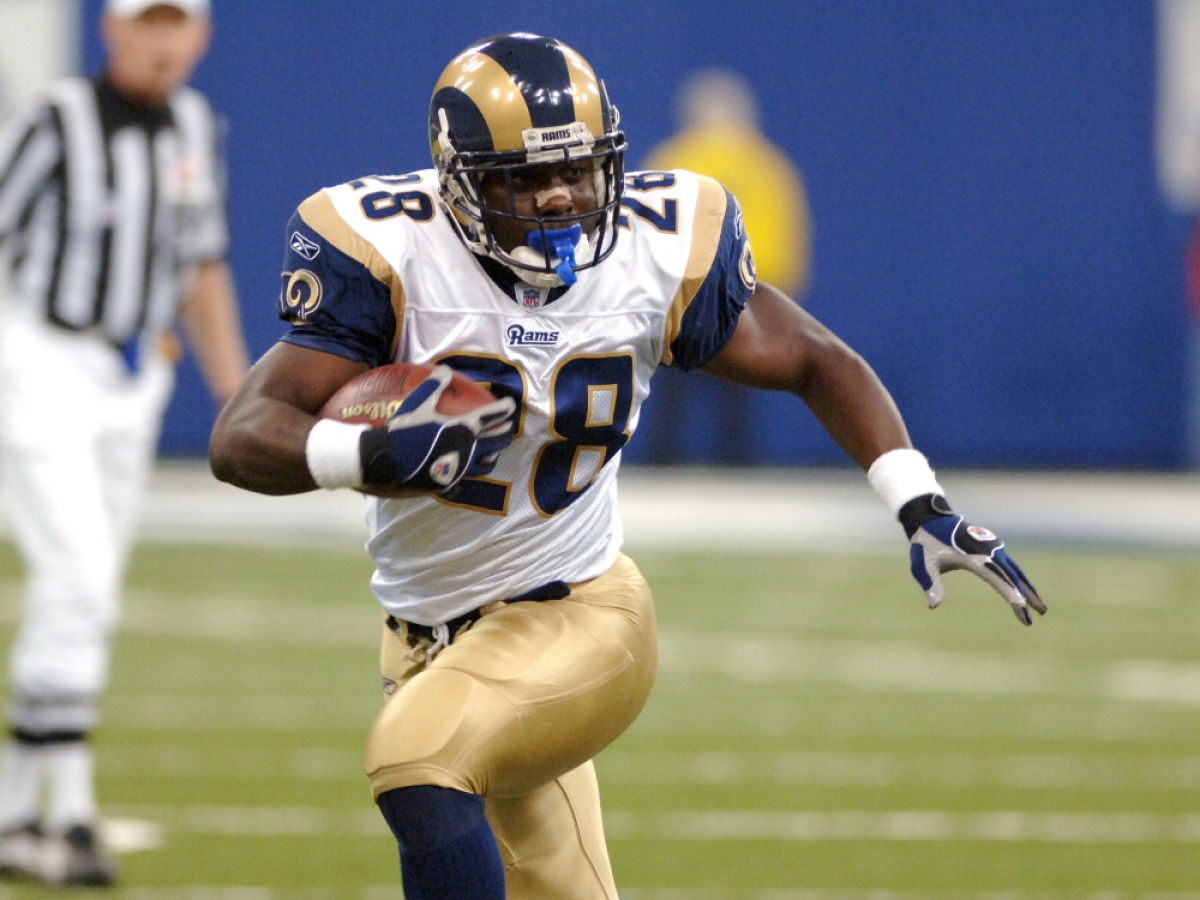
Traded from the Indianapolis Colts in the spring of 1999, Marshall Faulk arrived in St. Louis and immediately revolutionized the running back position. Already an elite dual-threat weapon during his five seasons with the Colts, Faulk elevated his skill set to unheard-of heights under head coach Dick Vermeil and offensive coordinator Mike Martz. His arrival helped transform a struggling franchise into "The Greatest Show on Turf"—the most explosive offensive machine in NFL history.
In his legendary 1999 debut season with the Rams, Faulk put together one of the most remarkable individual campaigns in gridiron history. Playing as both a traditional tailback and an unmatched slot receiver, he rushed for 1,381 yards and caught 87 passes for 1,048 receiving yards. By doing so, he became only the second player in NFL history (joining Roger Craig) to eclipse 1,000 rushing and 1,000 receiving yards in the same season, setting a then-NFL record with 2,429 yards from scrimmage.
Faulk’s versatility and processing speed made him the undisputed engine of the Rams' high-flying attack. Defenses couldn't match up against him, as he could slice through defensive lines between the tackles or split out wide to obliterate linebackers in single coverage. His relentless execution in both phases of the offense gave quarterback Kurt Warner the ultimate escape hatch, propelling St. Louis to a 13–3 record and the franchise's first Super Bowl title in Super Bowl XXXIV.
The dynamic back somehow raised the bar even higher over the next two seasons, producing an unprecedented three-year run of individual brilliance. Faulk captured the AP NFL Most Valuable Player award in 2000 after scoring a staggering 26 touchdowns in just 14 games, followed by winning three consecutive AP NFL Offensive Player of the Year awards from 1999 through 2001. During this historic peak, he earned three consecutive First-Team AP All-Pro selections and guided the Rams back to Super Bowl XXXVI.
Beyond his eye-popping statistical output, Faulk served as an extension of the coaching staff on the field. His elite football IQ allowed him to call out defensive coverages, adjust pass protection schemes at the line of scrimmage, and exploit subtle mechanical flaws in opposing front sevens. His rare vision, combined with pristine route-running precision out of the backfield, redefined expectations for modern all-purpose running backs for generations.
Faulk retired after the 2006 season with over 19,000 all-purpose yards and 136 touchdowns. The Rams retired his No. 28 jersey in 2007. In 2011, he entered the Pro Football Hall of Fame in his first year of eligibility. With the Rams, he compiled 6,959 rushing yards with 58 rushing touchdowns, 470 receptions for 4,071 receiving yards with 27 receiving touchdowns, and 11,030 yards from scrimmage.


Comments powered by CComment