

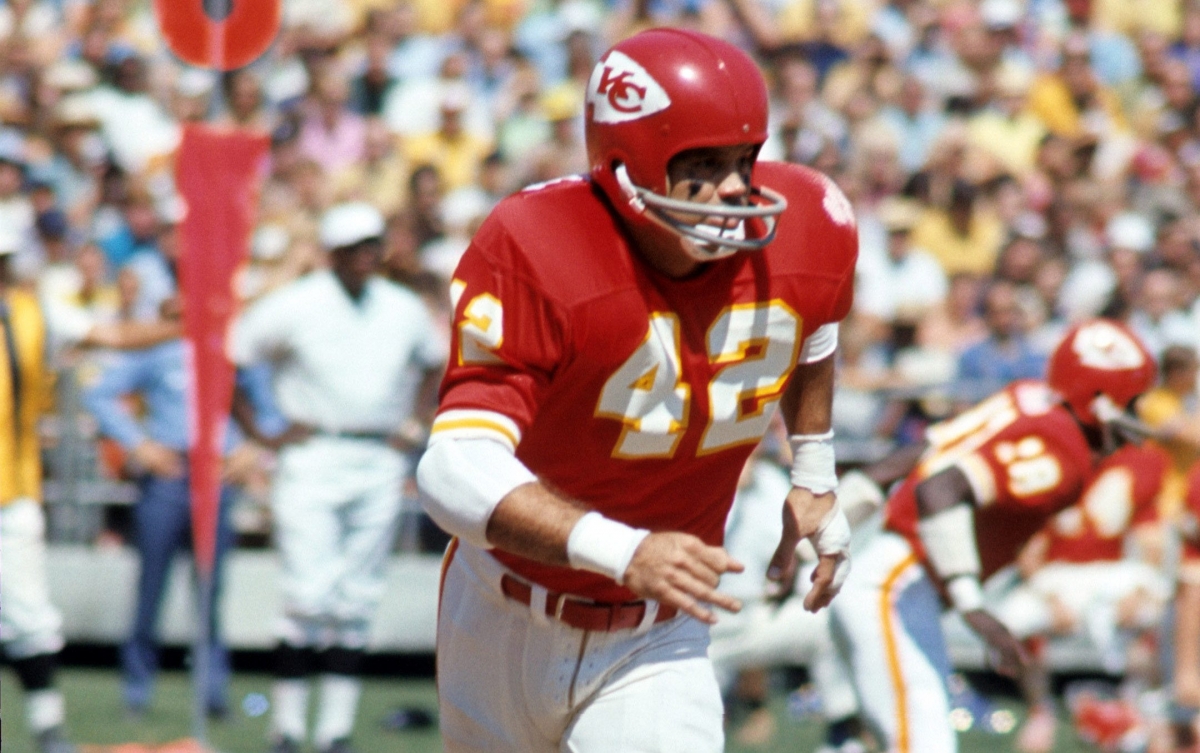
Drafted in the first round (3rd overall) of the 1960 AFL Draft out of LSU, Johnny Robinson arrived in the professional ranks as an offensive weapon. Playing halfback and flanker for the Dallas Texans in his first two seasons, he showcased impressive open-field speed, amassing over 1,800 yards from scrimmage and 15 total touchdowns. But prior to the 1962 season, legendary head coach Hank Stram made a move that altered franchise history, shifting Robinson to safety.
The position change paid immediate dividends. Robinson used his offensive instincts to read opposing quarterbacks, anchoring the secondary as the Texans captured the 1962 AFL Championship. When the franchise relocated to Missouri in 1963 and became the Kansas City Chiefs, Robinson evolved into the ultimate deep-third ballhawk. Between 1965 and 1970, he assembled one of the most dominant individual spans by any defensive back in pro football history, earning six consecutive First-Team All-Pro honors (five AFL, one NFL). He led the AFL with 10 interceptions in 1966 and topped the NFL with 10 more in 1970 following the merger.
Robinson's big-play reputation reached its peak when championship hardware was on the line. Uniquely clutch, he recorded an interception in all three AFL Championship Games he played in (1962, 1966, 1969). His most iconic performance arrived in Super Bowl IV despite playing with three broken ribs. Robinson completely disrupted Minnesota's passing game, recovering a crucial fumble in the first half and picking off a pass in the second to seal Kansas City’s 23–7 victory.
Robinson retired after the 1971 season, and stat-wise, he had 57 interceptions, returned 160 interception yards, scored one pick-six, recovered nine fumbles, and totaled 1,228 rushing yards, 658 receiving yards, and 15 total touchdowns. The organization quickly recognized his contributions, making him one of the earliest Kansas City Chiefs Hall of Fame members in 1974. His Canton induction was delayed for decades, but justice was finally served when the Veterans Committee enshrined him into the Pro Football Hall of Fame in 2019.


Comments powered by CComment