

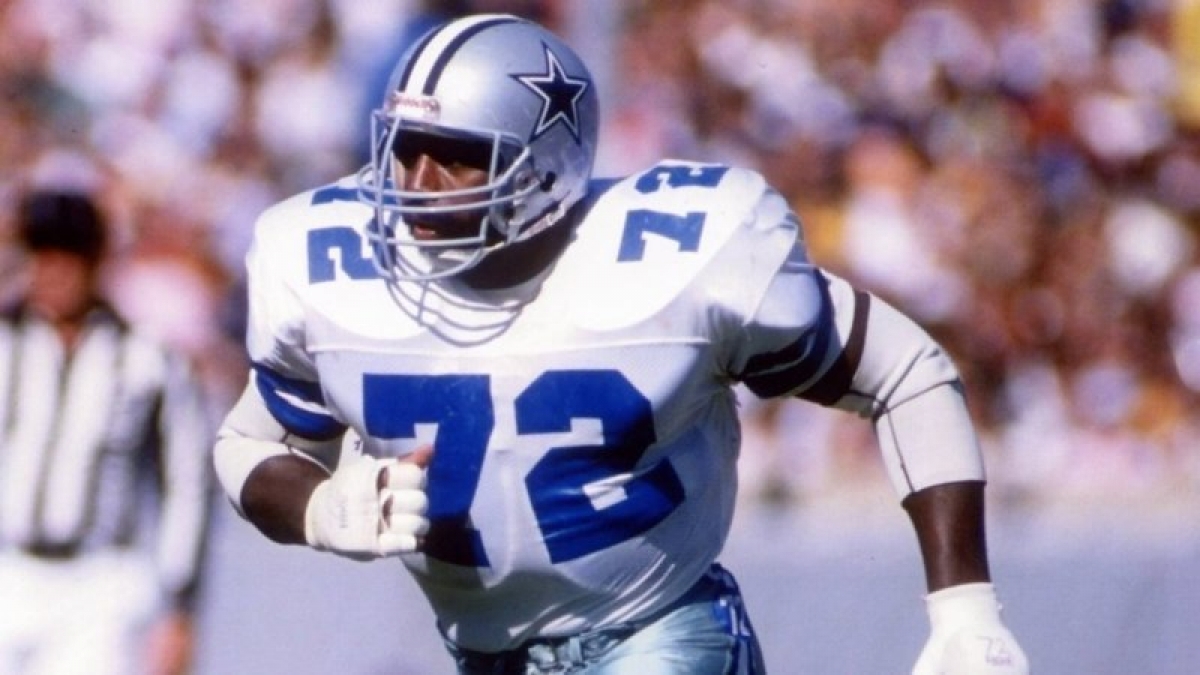
Standing at a towering six feet, nine inches, Edward Lee “Too Tall” Jones possessed one of the most distinctive and accurate monikers in sports history. Out of Tennessee State, he made history in the 1974 NFL Draft by becoming the first player from a Historically Black College or University (HBCU) to be selected number one overall, landing directly in Tom Landry’s Dallas locker room.
Jones’s early years involved adapting to the professional ranks, initially rotating through different roles before securing the left defensive end position. With a remarkable wingspan and exceptional lateral agility for his size, he became a key part of the "Doomsday II" defense. His reach enabled him to deflect passes frequently and disrupt quarterbacks, leading to a standout postseason that contributed to Dallas's 27–10 victory over the Denver Broncos in Super Bowl XII.
In a stunning career pivot following the 1978 season, Jones abruptly stepped away from the gridiron to test his mettle in professional boxing. He compiled an unblemished 6–0 record inside the ring during his one-year sabbatical. Rather than derailing his football trajectory, the grueling boxing conditioning sharpened his physical conditioning, allowing him to return to the Cowboys in 1980 even stronger and more explosive than before.
The post-boxing chapter marked the absolute peak of his dominance. Jones ripped off three consecutive Pro Bowl selections from 1981 to 1983, captured First-Team All-Pro honors in 1982, and defied age by setting a personal single-season high with 13 sacks in 1985 at 34 years old. He was a master of durability, rarely missing assignments and anchoring the front line through massive personnel transitions into the late 1980s.
Jones played 15 seasons with the Dallas Cowboys (1974–1978, 1980–1989), setting a franchise record with 224 regular-season games and 203 starts. Though sacks weren't officially recorded until 1982, Cowboys records credit him with 106.0, along with 19 fumble recoveries and three interceptions. A three-time Pro Bowler, All-Pro, and Super Bowl champion, he was inducted into the Black College Football Hall of Fame in 2013, cementing his legacy as a legendary athlete of Dallas football.


Comments powered by CComment