

Our All Time Top 50 Arizona Cardinals have been revised to reflect the 2025 Season
Yes, we know that this is taking a while!
As many of you know, we at Notinhalloffame.com are slowly generating the top 50 of each major North American sports team. That being said, we maintain and update our existing Top 50 lists annually. We are pleased to present our pre-2026 revision of our top 50 Arizona Cardinals.
As for all of our top 50 players in baseball, we look at the following:
1. Duration and Impact.
2. Traditional statistics and how they finished in the National Football League.
3. Advanced Statistics.
4. Playoff performance.
5. Their respective legacy on the team.
6. How successful the team was when he was there.
7. Respecting the era in which they played.
Criteria 1-4 will make up the lion’s share of the algorithm. Please note that we have implemented this for the first time. This has changed the rankings all throughout the board.
Last year, the Arizona Cardinals were awful, winning only three games. As this team's origins date back over a century, it takes a lot to enter this list, or even move up within it. As such, there was only one elevation in this list.
As always, we present our top five, which saw no changes.
1. Larry Fitzgerald
2. Larry Wilson
3. Charley Trippi
4. Roger Wehrli
5. Dan Dierdorf
You can find the complete list here:
Eight-time Pro Bowl Safety Budda Baker moved to #12 from #17.
Of note, now a Minnesota Viking, Quarterback Kyler Murray remained at #49.
We thank you for your continued support of our lists on Notinhalloffame.com.
The Pro Football Hall of Fame Revisited Project: 1989 Final VOTE

1989 Pro Football Hall of Fame Revisited Project Class.
Here we are! Again!!
If you have been following our Pro Football Hall of Fame Revisited Project, you know we have asked the question: What if the PFHOF had begun in January 1946?
After soliciting and obtaining a passionate group of football fans and historians, we sent out a ballot for a Preliminary Vote, in which each voter selected 25 names as their semi-finalists and five names for the Senior Pool. We then asked the group to vote for their 15 Finalists in the Modern Era and 3 in the Senior Category. The final stage was to vote for their five Modern Era inductee and one Senior inductee.
This is the result of the 44th official class.
Below are the final results of this project based on 32 votes.
Remember that we have reverted back to the top five candidates entering the Hall in the Modern Era
This is for the “Modern Era”
*Bold indicates they have been elected to the Pro Football Hall of Fame Revisited Class of 1989:
|
Player |
Year of Eligibility |
Vote Total |
|
Ted Hendricks LB |
1 |
28 |
|
Mel Blount DB |
1 |
22 |
|
Jim Langer C |
3 |
14 |
|
Terry Bradshaw QB |
1 |
14 |
|
Dan Dierdorf T-G-C |
1 |
11 |
|
Bob Hayes SE-WR |
9 |
10 |
|
Tom Mack G |
6 |
10 |
|
Ken Houston DB |
4 |
9 |
|
Jackie Smith TE |
6 |
8 |
|
Dave Wilcox LB |
10 |
6 |
|
Bob Griese QB |
4 |
6 |
|
Ron Yary T |
2 |
5 |
|
Randy Gradishar LB |
1 |
5 |
|
Roger Werhli DB |
2 |
3 |
|
Elvin Bethea DE |
1 |
3 |
This is for the “Senior Era”,
*Bold indicates they have been elected to the Pro Football Hall of Fame Revisited Class of 1989.
|
Gene Lipscomb DT |
2 |
11 |
|
Marshall Goldberg FB |
16 |
9 |
|
Les Richter LB-C |
2 |
9 |
|
None of the Above |
N/A |
3 |
This is for the “Coaches/Contributors”,
*Bold indicates they have been elected to the Pro Football Hall of Fame Revisited Class of 1989.
|
Bud Grant (Coach) |
2 |
19 |
|
Don Coryell (Coach) |
1 |
10 |
|
Wellington Mara (Owner) |
3 |
2 |
|
None of the Above |
|
1 |
About the 1989 Inductees:
Ted Hendricks, LB, BAL 1969-73, GNB 1974, OAK/RAI 1975-83: Inducted in the Pro Football Hall of Fame Revisited Project in 1989 on his 1st Ballot. Inducted into the actual Pro Football Hall of Fame in 1990.
Ted Hendricks was a two-time All-American at Miami and a fifth-place finisher for the Heisman in 1968, an incredible accomplishment for a Linebacker. The Colts stole him in the Second Round of the following draft, and he went on to have stellar performances for three teams.
Hendricks became a starter during his rookie year and was a Super Bowl Champion a year later. Using his height (6’ 7”), strength, and speed, opposing offenses had to alter their schemes around him, and also special teams, as he was also excellent in blocking kicks.
Leading the NFL in Approximate Value in 1971 (21), Hendricks began a four-year run of Pro Bowls, the last year of which was with the Green Bay Packers, whom he was traded to in 974. Hendricks was set to bolt for Jacksonville in the World Football League, but was convinced to stay in the NFL when he was dealt to Oakland, where he finished his career and became mostly synonymous with.
As a Raider, Hendricks anchored the team to three Super Bowl wins, including his final year in football. Hendricks also concluded his career with a four-year streak of Pro Bowls.
Retiring as a champion, Hendricks is unofficially a member of the 25-25 Club with 26 Interceptions and 61 Sacks. He is also a four-time First Team All-Pro.
Mel Blount, DB, PIT 1970-83: Inducted in the Pro Football Hall of Fame Revisited Project in 1989 on his 1st Ballot. Inducted into the actual Pro Football Hall of Fame in 1989.
If you got past the Steel Curtain, you were not that lucky. You had Mel Blount to contend with.
Blount played the entirety of his pro career with the Steelers (1970-83), and by the middle of the 70s, he had established himself as one of the premier Cornerbacks in the NFL. A member of all four of their 70s Super Bowl teams, Blount led the league in Interceptions in 1975 (11) and secured 57 over his career, which is tops among all Steelers.
Blount used his size and strength to overpower receivers. He did it so well that the five-yard no-bump-and-run rule was put in place for how he impeded his opponents regularly. Blount remained a dominant Cornerback regardless of the rule change, earning five Pro Bowl selections and two First-Team All-Pro honors, and notably being named the AP Defensive Player of the Year in ’75.
Jim Langer, C, MIA 1970-79 & MIN 1980-81. Inducted in the Pro Football Hall of Fame Revisited Project in 1989 on his 1st Ballot. Inducted into the actual Pro Football Hall of Fame in 1987.
Jim Langer went undrafted in 1970 after a college career at South Dakota State, and following a failed attempt to make the Cleveland Browns, he found a home with the Miami Dolphins. After a pair of non-descript seasons, Langer was about to rise to the top of the food chain of NFL Centers quickly.
Langer did not start in his first two seasons, but he would in 1972, and that was the year he never missed a snap, and the Dolphins went undefeated and won Super Bowl VII. He would help them win Super Bowl VIII, and Langer marked that season with a six-year streak of Pro Bowl Selections, four of which earned First Team All-Pro Honors. As the center of a dominant O-Line, Langer deserves a lot of credit for the offensive success that Miami had in the 1970s.
Langer played his final two seasons with the Minnesota Vikings, the team that he requested to play for so that he could be close to his home.
Terry Bradshaw, QB, PIT 1970-83. Inducted in the Pro Football Hall of Fame Revisited Project in 1989 on his 1st Ballot. Inducted into the actual Pro Football Hall of Fame in 1989.
Say what you want about how the help that Terry Bradshaw had with the Steel Curtain defense and Franco Harris in the backfield, but no Quarterback wins four Super Bowls without being an excellent player.
Bradshaw was the First Overall Pick in 1970, where the Louisiana Tech QB had an abysmal rookie year with a TD-INT ratio of 6-24. “The Blonde Bomber” had up-and-down years in the first half of his career, but he was still effective, leading Pittsburgh to its first Super Bowl (IX) for the 1974 season. Bradshaw's play improved, and he went to his first Pro Bowl and took the Steelers to their second Super Bowl.
Bradshaw’s best season was in 1978, when he won the AP MVP, the Bert Bell Award, and led the NFL in Touchdown Passes (28). Also named a First Team All-Pro and Pro Bowler, Bradshaw again led the Steelers to a Super Bowl win, and this time he was the Super Bowl MVP. Bradshaw arguably had a better 1979, with 26 TDs and a career-high 3,724 Passing Yards. The Louisiana native led the Steelers to their fourth Super Bowl win, with a second Super Bowl MVP trophy landing in his case.
The QB continued to play well, again finishing first in Touchdown Passes (17) in the strike-shortened '82 season. This was the end for Bradshaw, who only played one game in 1983 after dealing with elbow problems.
Bradshaw finished his career with 27,989 Passing Yards and 212 Touchdowns against 210 Interceptions. He became a successful television analyst.
Dan Dierdorf, T-G-C, STL 1971-83. Inducted in the Pro Football Hall of Fame Revisited Project in 1989 on his 4th Ballot. Inducted into the actual Pro Football Hall of Fame in 1996.
Playing his entire career with the St. Louis Cardinals, Dan Dierdorf played predominantly at Right Tackle, where he started 150 Games and was thought of as a “walking mountain”.
Possessing an elite combination of intelligence, strength, and agility, Dierdorf showcased equal ability in run blocking and pass protection, and helmed a line that allowed the fewest sacks for five straight years. Dierdorf earned a spot on the 1970s All-Decade Team, was a six-time Pro Bowl and three-time First Team All-Pro.
Bud Grant, Coach, MIN 1967-85. Inducted in the Pro Football Hall of Fame Revisited Project in 1989 on his 1st Coach/Contributor Ballot. Inducted into the actual Pro Football Hall of Fame in 1994.
After playing professionally in Philadelphia and Winnipeg in the CFL, Bud Grant went into coaching, first in Canada with the Blue Bombers, where he won four Grey Cups. That type of success will get you noticed, and the closest NFL team, the Minnesota Vikings, signed him as their Head Coach in 1967.
Grant is still, as of this writing, the most successful Head Coach in Vikings history, winning the Coach of the Year in 1969, and leading Minnesota to four Super Bowl appearances. The Vikings did not win any of them, but they would not have gotten there without Grant, whose innovations and vision made Minnesota one of the most recognized franchises in the NFL.
Grant, who is also in the Canadian Football Hall of Fame, had an overall NFL record of 158-96-5.
Our All-Time Top 50 Arizona Cardinals have been revised to reflect the 2025 Season
Yes, we know that this is taking a while!
As many of you know, we at Notinhalloffame.com are slowly generating the top 50 of each major North American sports team. That being said, we maintain and update our existing Top 50 lists annually. As such, we are delighted to present our post-2024 revision of our top 50 Arizona Cardinals.
As for all of our top 50 players in baseball, we look at the following:
1. Advanced Statistics.
2. Traditional statistics and how they finished in the National Football League.
3. Playoff accomplishments.
4. Their overall impact on the team and other intangibles that are not reflected in a stat sheet.
Last year, the Cardinals finished 8-9 and missed the playoffs. As the franchise is one of the oldest in the league, there was little movement and only one new entrant.
As always, we present our top five, which remain unchanged.
1. Larry Wilson
4. Roger Wehrli
5. Dan Dierdorf
You can find the entire list here.
The only new entrant is two-time Pro Bowl Quarterback Kyler Murray. He debuts at #49.
We thank you for your continued support of our lists on Notinhalloffame.com.
Our All-Time Top 50 Arizona Cardinals are now up
Yes, we know that this is taking a while!
As many of you know, we at Notinhalloffame.com are slowly generating the top 50 of each major North American sports team. We have another one ready, with our Top 50 Arizona Cardinals.
As for all of our top 50 players in football, we look at the following:
1. Advanced Statistics.
2. Traditional statistics and how they finished in the National Football League.
3. Playoff accomplishments.
4. Their overall impact on the team and other intangibles that are not reflected in a stat sheet.
The most tenured team in the National Football League, the Arizona Cardinals have taken a long road, traversed multiple cities, and seen more hard times than good.
Formed in 1898 as the Morgan Athletic Club, they would be renamed the Racine Normals for two years before becoming the Racing Cardinals. Twenty years later, they were charter members of the National Football League as the Chicago Cardinals.
In the Windy City, the franchise won two titles, the first in 1925, disputed by the Pottsville Maroons, but there was no NFL Championship Game back then. The second title is undisputed, as with their "Million Dollar Backfield," they won the Championship Game in 1947, the last title they have won.
Taking a backseat to the Bears in Chicago, the Cardinals relocated to St. Louis in 1961. They only made the playoffs thrice in St. Louis and relocated again in 1987, becoming the Phoenix Cardinals. That name would change again to the Arizona Cardinals, and with Kurt Warner as their Quarterback, they made it to their first Super Bowl in the 2008 Season. They did not win but appear to have a permanent home in the desert.
Here is the inaugural top five:
1. Larry Wilson
2. Larry Fitzgerald
3. Charley Trippi
4. Roger Wehrli
5. Dan DIerdo
You can find the entire list here.
We thank you for your continued support of our lists on Notinhalloffame.com.
5. Dan Dierdorf
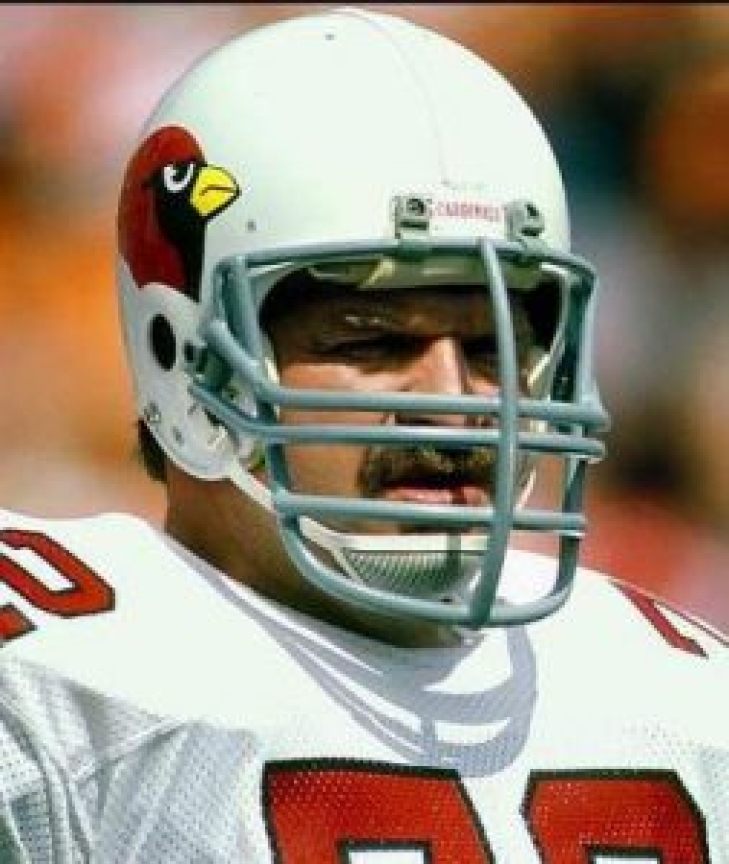
The mid-1970s revival of modern Cardinals football was built on strong offensive line play, led by a legendary technician who became the benchmark for excellence. Dan Dierdorf, a consensus All-American at Michigan under Bo Schembechler, brought exceptional size and agility to the NFL when the St. Louis Cardinals took him in the second round of the 1971 draft. He then spent an impressive thirteen seasons with the team, combining physical prowess with technical mastery to become the top offensive tackle of his era.
His game showcased expert pass protection and run-blocking leverage, resembling a masterclass. Standing 6’3" and weighing 275 pounds, Dierdorf had a strong foundation, a powerful initial punch, and excellent lateral mirroring. Although he demonstrated versatility at guard and left tackle early on, his true breakthrough came in 1974 during his fourth season. After permanently moving to right tackle, Dierdorf became nearly unstoppable, earning his first Pro Bowl and second-team All-Pro honors while contributing to Don Coryell’s dynamic "Air Coryell" offense.
That breakout campaign sparked a five-year period of unparalleled individual dominance. Between 1974 and 1978, Dierdorf was recognized as the top tackle in the league, earning five straight Pro Bowl selections and four consecutive first-team All-Pro honors. He led a legendary St. Louis offensive line—alongside Conrad Dobler and Tom Banks—that consistently shut down the most formidable pass rushes of that era. His peak performance came in the 1975 season, when the Cardinals’ offensive line set an NFL record by allowing just eight sacks in 14 regular-season games.
Over the next two years, Dierdorf's dominance became nearly legendary. During the 1976 and 1977 seasons, he completely neutralized opposing pass rushers, going two years without allowing a single sack. His perfect mirroring technique was clearly shown in internal coaching footage, which displayed a player consistently winning crucial battles against top-tier edge rushers without needing help from tight ends. Due to his exceptional performance, the NFL Players Association named Dierdorf the NFL Offensive Lineman of the Year for three straight years (1976–1978). Dierdorf's legendary streak of allowing no sacks over the 1976 and 1977 seasons remains the gold standard for pass-blocking efficiency in franchise history.
Even when a severe knee injury sidelined him for most of the 1979 season, the veteran anchor displayed immense resilience. He authored a brilliant individual bounce-back during the 1980 campaign, returning to full strength to start all 16 games at right tackle, earning his sixth career Pro Bowl invitation and his fifth first-team All-Pro nod. Ever the consummate professional, Dierdorf willingly shifted to the center position for his final two years in 1982 and 1983, stabilizing an evolving interior front with his high-level diagnostic intelligence. The historic marathon in St. Louis reached its final punctuation following the 1983 campaign, when the veteran leader hung up his cleats after 160 regular-season games.
Dierdorf was named to the prestigious NFL 1970s All-Decade Team, and his journey came full circle in 1996 when the Canton, Ohio native was fittingly enshrined into the Pro Football Hall of Fame right in his own hometown. The Cardinals also honored Dierdorf in 2006 as a member of the inaugural group in their Ring of Honor.
