
Notinhalloffame List Update: 91-100 on Football Revised

The problem with running a Hall of Fame-related website is that many of the big ones we cover all have announcements within months of each other. The backbone of what we do is list-related, so this results in a long push to revise what we already have; specifically, now with our Football and Basketball Lists.
At present, we have a minor update as we have completed the tenth ten of the 2024 Football List, which you can comment on and vote on:
The new 91 to 100:
91. Joe Fortunato
92. Nick Mangold
93. Adam Vinatieri*
94. Clay Matthews Jr.
95. Cornelius Bennett
96. Abner Haynes
97. Jim Benton
98. Albert Lewis
99. Eli Manning*
100. John Hadl
*Denotes First Year of Eligibility
Rankings are impacted annually based on your comments and votes.
Thank you all for your patience. We will soon unveil more changes to the football and basketball lists.
The Pro Football Hall of Fame Revisited Project: 1955 FINAL VOTE

1955 Pro Football Hall of Fame Revisited Project Class.
Here we are! Again!!
If you have been following our Pro Football Hall of Fame Revisited Project, you know that we have asked the rhetorical question…what if the PFHOF began in January of 1946?
After soliciting and obtaining a passionate group of football fans and historians, we sent out a ballot for a Preliminary Vote, which we asked each voter to give us 25 names as their semi-finalists, and 5 in the Senior Pool. Following that, we asked the group to vote for their 15 Finalists in the Modern Era, and 3 in the Senior Category. The final stage was to vote for their five Modern Era inductee, one Senior inductee and one Coaches/Contributor inductee.
This is the result of the tenth official class;
Below, are the final results of this project based on 30 votes, with a major change that we began “last year”: ALL FINALISTS MUST obtain 50% of the VOTE!
This is for the “Modern Era”
*Bold indicates they have been elected to the Pro Football Hall of Fame Revisited Class of 1955:
|
Player |
Year of Eligibility |
Vote Total |
|
Jim Benton E |
3 |
20 |
|
Cecil Isbell TB-HB |
8 |
16 |
|
Tony Latone B |
20 |
10 |
|
Gus Sonnenberg T-FB-TB |
20 |
9 |
|
Joey Sternaman QB-BB T-FB-TB |
20 |
9 |
|
Al Nesser G-T-E-C |
19 |
9 |
|
Beattie Feathers HB-WB |
10 |
9 |
|
Whizzer White TB-HB |
9 |
9 |
|
Bill Osmanski FB |
3 |
9 |
|
Kenny Washington B |
2 |
8 |
|
Steve Owen T-G |
17 |
6 |
|
Wayne Millner E |
5 |
6 |
|
Marshall Goldberg FB |
2 |
6 |
|
Riley Matheson G |
2 |
5 |
|
Ward Cuff WB-QB-HB |
3 |
3 |
This is for the “Senior Era”, which resulted in no entry, though Youngstrom was close!
|
Swede Youngstrom |
2 |
14 |
|
Hunk Anderson |
4 |
10 |
|
Cub Buck |
4 |
4 |
|
None of the Above |
N/A |
2 |
About the 1955 Inductees:
Jim Benton E, RAM 1938-42 & 1944-47, CHI 1943: Inducted in 1955 on his 3rd Ballot. Was never inducted into the actual Pro Football Hall of Fame.
Selected in the 2nd Round out of the University of Arkansas in 1938, Jim Benton would go onto be one of the first great receivers in the history of the Rams franchise. Benton led the NFL in Yards per Reception as a rookie and was named to the Pro Bowl in his second season. He took 1941 off and returned to the NFL in 1942, and due to a heart murmur, he was not permitted to enlist in the U.S. Military for World War II. He was loaned to the Chicago Bears in 1943 as the Rams were unable to field a team due to a depletion of talent but returned in 1944 and 1945 and 1946 but together two excellent seasons where he was the NFL leader in Receiving Yards. 1945 was a uniquely special season for Benton. Not only would it be a large part of the Rams 1945 NFL Championship, his league-leading 1,067 Receiving Yards was accomplished in only nine games. He also would become the first Wide Receiver to exceed 300 Yards in a Game, a mark that was duplicated for another 40 Years! At the time of his retirement, he was second all-time in Receiving Yards, and he was chosen for the 1940’s All-Decade Team.
Cecil Isbell TB-HB, GNB 1938-42: Inducted in 1955 on his 8th Ballot. Was never inducted into the actual Pro Football Hall of Fame.
Usually, when you speak of a five-year career in any sport, you can't be talking about a great player. Not very many people had a five-year run like Cecil Isbell. Isbell was the 7th Overall Draft Pick by Green Bay in 1938, and as a rookie, he joined Arnie Herber in the Packers backfield. Isbell was rushing more in the first two years, and back in those days, Tailbacks were often passing and rushing with similar frequency. He would subsequently the Packers win the 1939 NFL Championship. Isbell would take more of a passing role, and in 1941 and 1942, he would lead the NFL in Passing Yards and Passing Touchdowns, the last year seeing him be the first passer to throw for 2,000 Yards. He would set the since broken record with 23 straight games with a Touchdown Pass. He would retire after the 1942 season, though not due to injury but due to beginning a coaching career.
130. Jim Benton
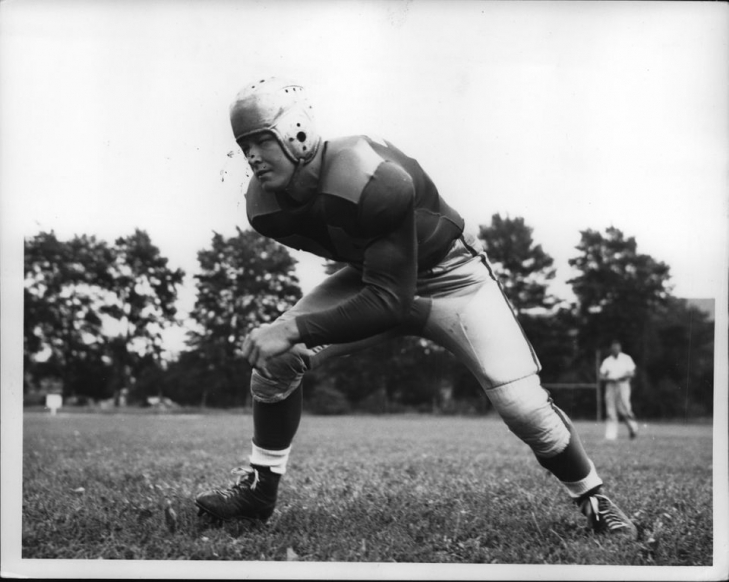
Selected in the 2nd Round out of the University of Arkansas in 1938, Jim Benton would go on to be one of the first great receivers in the history of the Rams franchise. Benton led the NFL in Yards per Reception as a rookie and was named to the Pro Bowl in his second season. He took 1941 off and returned to the NFL in 1942; because of a heart murmur, he was not permitted to enlist in the U.S. Military for World War II. He was loaned to the Chicago Bears in 1943 because the Rams couldn't field a team due to a depletion of talent, but he returned in 1944, 1945, and 1946, and together they had two excellent seasons in which he led the NFL in Receiving Yards.
1945 was a uniquely special season for Benton. Not only would it be a large part of the Rams’ 1945 NFL Championship, but his league-leading 1,067 receiving yards were also accomplished in only nine games. He also would become the first Wide Receiver to exceed 300 Yards in a Game, a mark that was duplicated for another 40 Years!
At the time of his retirement, he was second all-time in Receiving Yards, and he was chosen for the 1940’s All-Decade Team.
22. Jim Benton

Jim Benton was one of the first true stars for the Cleveland Rams after they selected him out of Arkansas in the 1938 Draft. As a rookie, he led the NFL in yards per reception, even though his 418 yards look modest by today’s standards. The game was different then, and Benton quickly showed he could stretch the field. In 1939 he led the league in touchdown receptions with seven and earned a Pro Bowl selection. After a solid 1940 season, he stepped away for a year to coach high school football, something more common in that era when salaries were low.
He returned in 1942, but World War II depleted rosters and the Rams suspended operations. Benton spent 1943 with the Chicago Bears, helping them win the NFL Championship. He came back to Cleveland when the Rams resumed play in 1944 and immediately re-established himself as a dangerous end. Benton had a long reach and reliable hands, and he specialized in big downfield plays rather than piling up short catches.
The 1945 season was the high point of his career with the Rams. He led the NFL with 1,067 receiving yards in only nine games and earned First-Team All-Pro honors. On Thanksgiving, he caught 10 passes for 303 yards against Detroit, a single-game record that stood for decades. Benton also contributed in the championship game as Cleveland beat Washington for the title. The next year the franchise moved to Los Angeles, and Benton led the league again in receiving yards with 981 while also topping the NFL in receptions with 63. He earned another All-Pro selection.
Benton played one more season in Los Angeles before retiring after 1947. As a Ram, he finished with 4,566 receiving yards. At the time of his retirement, he ranked second all-time in the NFL in receiving yards, behind only Don Hutson. Those numbers were exceptional for an era that still favored the run.
Benton was named to the NFL’s 1940s All-Decade Team. He won two championships, one with the Bears and one with the Rams, and his big-play ability helped the franchise establish itself both in Cleveland and after the move to Los Angeles.
