

43. Ben Grubbs
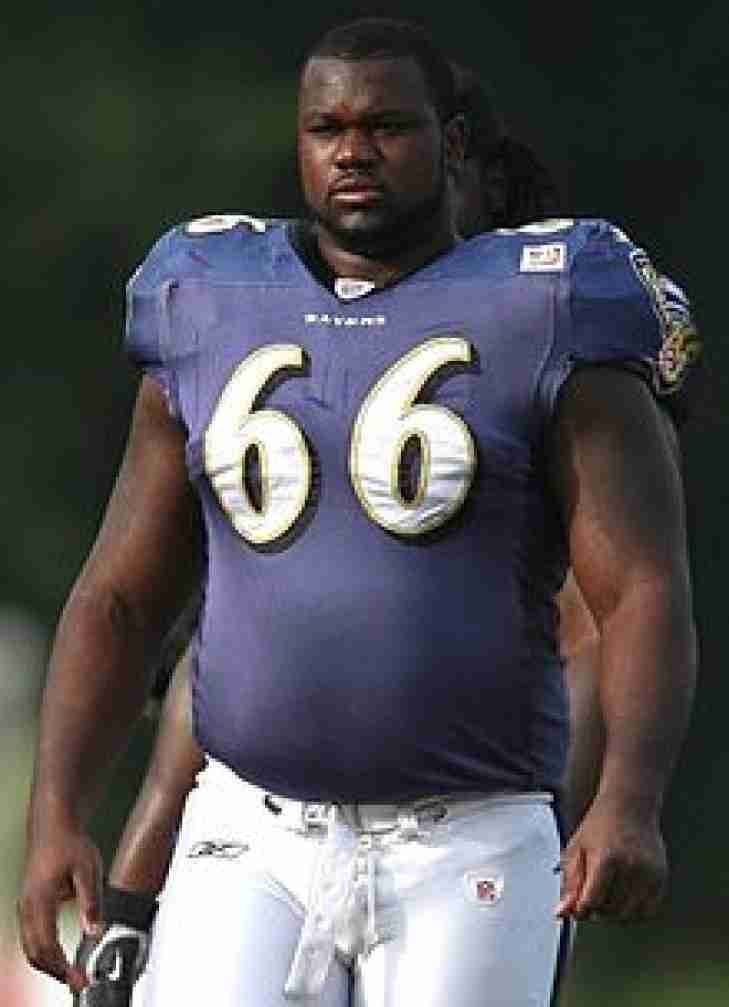
Ben Grubbs was brought to Baltimore as a first-rounder (29th overall from Auburn) as an immediate centerpiece for General Manager Ozzie Newsome’s physical offensive rebuild. Stepping onto an offensive line that prioritized ground-and-pound power, Grubbs quickly established himself as a durable, dependable anchor on the interior.
Grubbs transitioned from playing defensive line early in his college career to becoming an elite offensive guard. As a rookie in 2007, he filled in at right guard, starting 12 games and earning a spot on the PFWA All-Rookie Team. The following season, in 2008, Grubbs made a permanent shift to left guard. Opposite Marshal Yanda at right guard, Grubbs served as a primary pull-blocker in Baltimore’s man-blocking and power-running schemes.
Between 2008 and 2010, Grubbs played in all 48 regular-season games for the Ravens, consistently offering interior pass protection for rookie quarterback Joe Flacco and creating running lanes for Willis McGahee and Ray Rice. During this period, the Ravens reached the playoffs three years in a row, with Grubbs starting in every postseason game.
In 2011, Grubbs capped his Baltimore tenure with a career-best season during his contract year. Despite missing six games because of a toe injury, he rejoined as a starter for 10 regular-season games and performed at an elite level, contributing to Baltimore's rushing attack of 1,996 yards (4.3 yards per carry) with minimal interior pressure. His outstanding performance led to his first Pro Bowl selection.
After the 2011 season, Grubbs left as a free agent to join the New Orleans Saints, where he earned a second Pro Bowl selection in 2013 before finishing his career with the Kansas City Chiefs. Across five seasons in Baltimore (2007–2011), Grubbs appeared in 74 regular-season games (70 starts) and made 9 playoff starts.
47. Torrey Smith
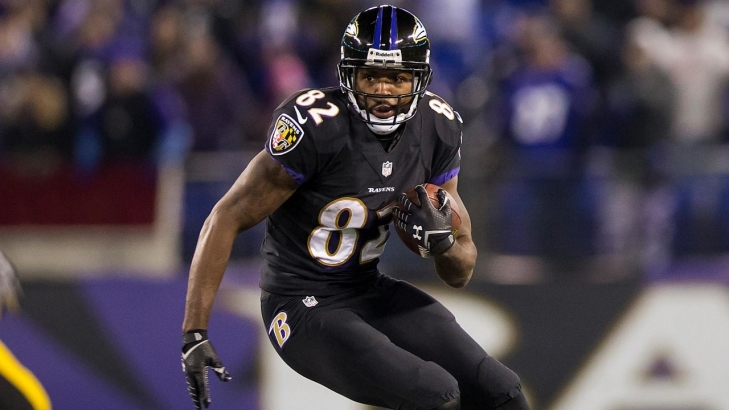
It would not take long for Torrey Smith, whom the Ravens chose 58th overall in the second round out of Maryland, to make an impact for the club. Operating as Joe Flacco's primary deep threat across four seasons, Smith possessed the raw acceleration to stretch boundary coverages and generate explosive chunk plays downfield.
Smith's primary asset was his 4.43 track speed. Used predominantly on post routes, go routes, and deep comebacks, he was lethal at taking the top off defensive coverages. His pure speed also made him one of the most prolific pass-interference drawers in the league, consistently forcing opposing cornerbacks into recovery fouls on underthrown deep balls.
Smith made a remarkable start as a rookie in 2011, making history as the first NFL player to catch three touchdown passes of over 40 yards in a single quarter during a game against St. Louis in Week 3. He wrapped up his first season with 50 catches, 841 yards, and seven touchdowns. The following year, in 2012, he enhanced his stats with 855 receiving yards and eight touchdowns. One of the season's highlights was his six-catch, 127-yard, two-touchdown game against New England, which came just hours after the heartbreaking loss of his younger brother. During the 2012 postseason, Smith recorded 11 catches for 233 yards and two touchdowns across four playoff games, including two receptions for 35 yards in Baltimore's 34–31 victory over San Francisco in Super Bowl XLVII.
Smith recorded his best overall statistical season in 2013, catching 65 passes for a career-high 1,128 receiving yards while averaging 17.4 yards per catch. In his final year in Baltimore (2014), he adapted to Gary Kubiak's offense by becoming a specialized red-zone target, hauling in a career-high 11 touchdown receptions on 49 catches.
Following the 2014 season, Smith signed with the San Francisco 49ers. As a Raven, Smith played in 64 regular-season games and 8 playoff games, recording 3,591 receiving yards, 30 receiving touchdowns, and a 16.9 yards-per-catch average.
40. Jermaine Lewis
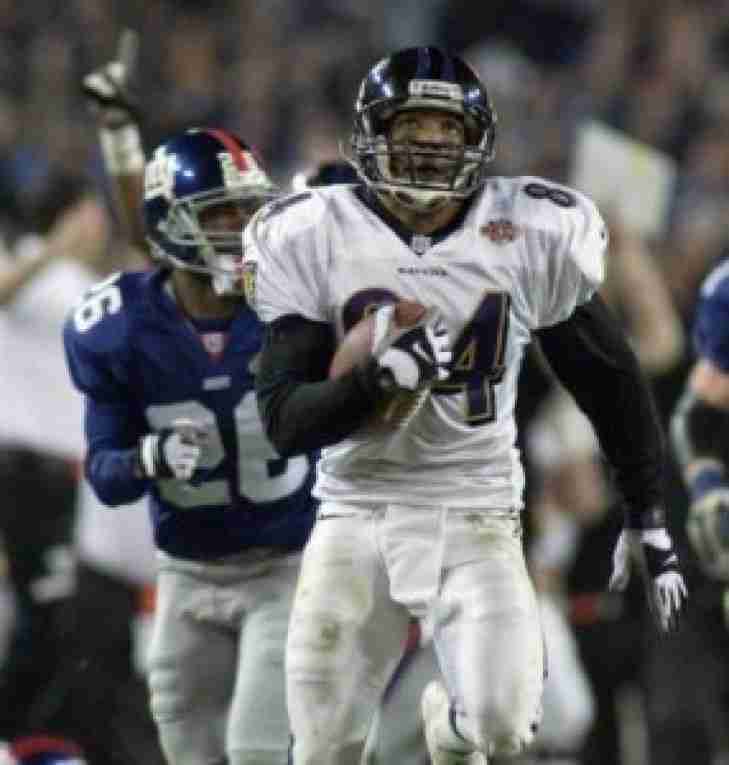
Jermaine Lewis, a local product of the University of Maryland, was chosen in the fifth round (153rd overall) and became an explosive dual-threat player for Baltimore. With exceptional speed and fearless instincts as both a wide receiver and return specialist, Lewis proved to be one of the franchise’s most versatile playmakers, offering Baltimore’s offense and special teams a burst of instant energy.
Lewis turned lack of stature (5’ 7”) into an open-field advantage. Possessing elite 4.3 speed, twitchy acceleration, and razor-sharp cutback ability, he erased angles for coverage teams the moment he caught the ball. Lined up at receiver, he blew past cornerbacks on deep post routes; on punt and kickoff returns, his patient setup behind wall blocks and decisive burst made him a constant threat to score from anywhere on the field.
Lewis became the top return specialist in professional football during the late 1990s and early 2000s. In 1997, he led the NFL in punt return average with an impressive 15.6 yards per return, also catching 42 passes for 648 yards and six touchdowns. His performance improved in 1998, earning his first Pro Bowl and First-Team All-Pro selections after posting 784 receiving yards, six receiving touchdowns, and two punt return touchdowns.
His dominance in returns persisted as he led the NFL with two punt return touchdowns in 1998 and 2000. In 2001, Lewis had an outstanding season, leading the league with 519 punt return yards and accumulating 1,039 kickoff return yards, earning his second Pro Bowl and Second-Team All-Pro distinctions.
Lewis’ iconic moment for Baltimore came during Super Bowl XXXV, the game's biggest stage. In the third quarter, after the Giants reduced Baltimore's lead to 17–7 with a kickoff return TD, Lewis responded immediately. He caught the next kickoff, dashed through a gap, and returned it 84 yards for a touchdown, instantly halting New York's comeback and sealing the game. He finished with 152 all-purpose yards and a TD, capping the franchise's first Super Bowl victory.
After a salary-cap squeeze following the 2001 season, Baltimore left Lewis unprotected in the 2002 NFL Expansion Draft, where he was picked sixth overall by the Houston Texans.
Lewis generated 8,001 all-purpose yards—a franchise record that stood for years—and scored 23 total touchdowns (17 receiving, six punt returns). His six career punt return touchdowns remain the benchmark for Baltimore special teams play.
2-7–96-7-31–396-60-10-300
49. Sam Adams
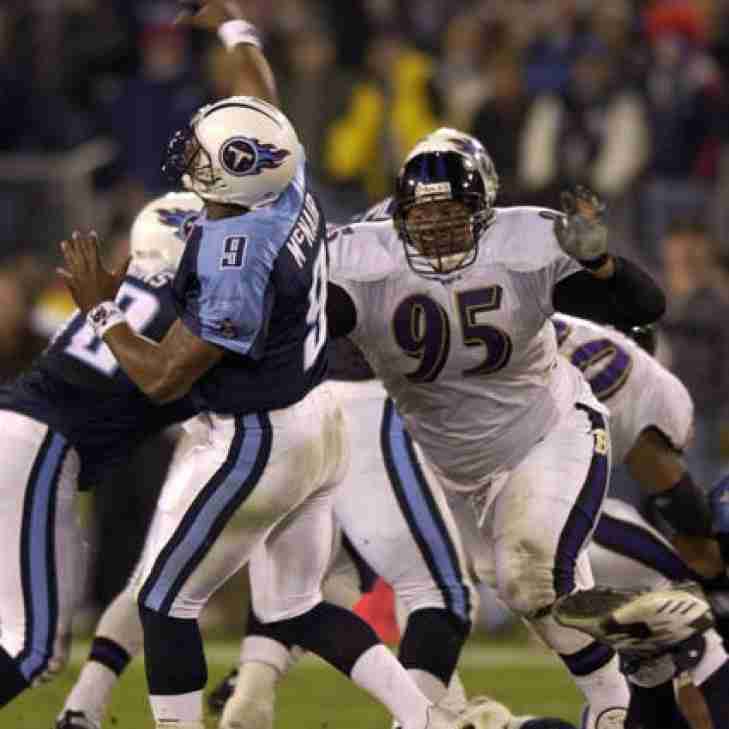
No, this isn’t the beer guy.
Signed as a marquee free agent prior to the 2000 season after six years in Seattle, Sam Adams arrived in Baltimore to give the Ravens an imposing interior defensive presence. Partnering with Tony Siragusa, Adams formed a massive interior wall that redefined defensive line play and transformed Baltimore's front seven into one of the most dominant units in NFL history.
At 6 feet 3 inches and 350 pounds, Adams possessed a rare combination of raw size and explosive initial quickness. As a defensive tackle, his primary role was to draw double-teams and occupy multiple interior blockers, keeping middle linebacker Ray Lewis clean and able to flow to the football. When left single-blocked, Adams consistently collapsed the pocket from the inside, disrupting running lanes before they could develop.
In his first year in Baltimore (2000), Adams started all 16 regular-season games for a defense that set the NFL 16-game record for fewest points allowed (165) and fewest rushing yards allowed (970). He tallied 27 tackles and 2.0 sacks in the regular season, then started all four postseason games. In Super Bowl XXXV, Adams helped neutralize the New York Giants' ground attack—holding them to just 66 rushing yards—en route to a 34–7 victory and his first career Pro Bowl selection.
Adams was even more dominant in 2001, earning his second consecutive Pro Bowl selection and receiving First-Team All-Pro honors. He recorded 23 tackles and 2.0 sacks across 14 starts, anchoring a defensive unit that allowed just 16.5 points per game and propelled Baltimore back to the postseason.
Due to salary cap constraints, Adams left after 2001, signing with the Raiders and earning a third Pro Bowl with the Bills. In two years with the Ravens (2000–2001), he started 30 games, recording 50 tackles, 4.0 sacks, 1 forced fumble, and 1 recovery.
30. Lardarius Webb
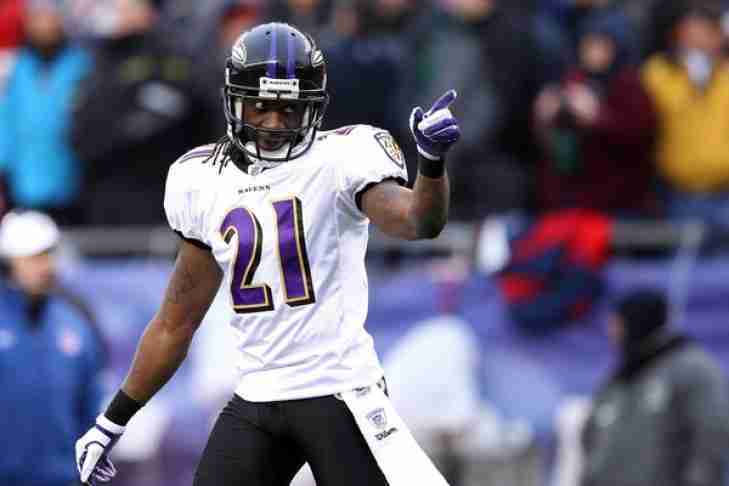
Taken in the third round (88th overall) of the 2009 NFL Draft out of Nicholls State, Lardarius Webb overcame lower-division obscurity with elite top-end speed and natural ball skills. Over nine seasons in Maryland, Webb evolved into one of the most reliable and versatile defensive backs in franchise history, transitioning from a dynamic return man and lockdown boundary corner to a dependable deep safety.
Webb was a versatile athlete known for his quick footwork and rapid recovery. Early in his career, he thrived as a press-man cornerback who could mirror the league's fastest receivers and provided a game-changing burst on kick returns. As injuries changed his physical abilities later in his career, Webb used his sharp football IQ to adapt by moving into the slot and later returning to free safety, helping him stay impactful for Baltimore's defense.
Webb first gained attention in his 2009 rookie season as a kickoff returner, notably with a 95-yard touchdown return against Denver, before a torn ACL ended his year prematurely. He recovered well in 2010, becoming an important part of Baltimore's secondary.
His standout campaign came in 2011, where he served as a key shutdown corner. Webb started all 16 games, tallying 67 tackles, five interceptions, 20 pass defenses, and scoring a punt return touchdown. In Baltimore's playoff run that winter, he added three more interceptions, ending the year with eight total takeaways and solidifying his status as one of the league's premier cover corners.
Webb started the 2012 championship season strongly, but tragedy struck in Week 6 when he tore his ACL against Dallas, ending his season. Although he couldn’t play in the postseason or the Super Bowl, Webb remained a vital part of the secondary and earned his Super Bowl XLVII ring with his teammates.
Demonstrating remarkable resolve, Webb returned in 2013 to play all 16 games, tallying 74 tackles and 22 pass deflections. Facing age and injury wear, he willingly converted to safety late in his career, giving Baltimore critical flexibility through the 2017 season.
Webb played his entire nine-year NFL career (2009–2017) exclusively as a Raven, appearing in 127 regular-season games (84 starts) while accumulating 467 total tackles, 15 interceptions, 91 pass deflections, 5.0 sacks, and two special teams touchdowns.
38. Tony Siragusa
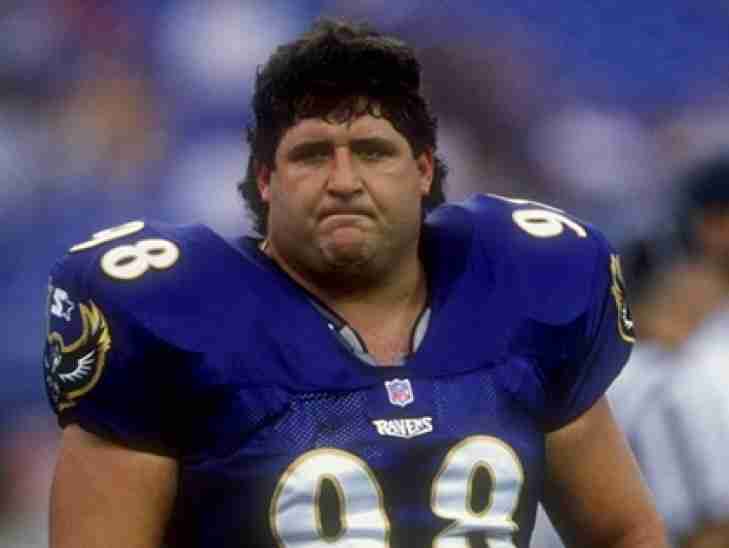
Signed by the Ravens in 1997 after seven seasons with the Indianapolis Colts, Tony "Goose" Siragusa brought a boisterous personality and a heavy physical presence to Charm City. Operating as the ultimate unsung dirty-work anchor on the interior defensive line, Siragusa spent his final five professional seasons keeping offensive line blockers off Baltimore's linebackers and helping turn the defense into a historic powerhouse.
Siragusa was constructed with the robustness of a brick wall within the defensive line. Instead of pursuing passing statistics or individual pass-rush metrics, he demonstrated excellence in absorbing double-teams, resetting the line of scrimmage, and congesting the A-gaps. His substantial mass and broad frame enabled linebackers such as Ray Lewis to operate freely behind him to execute plays, thereby establishing "Goose" as the cornerstone of Baltimore’s front line.
Siragusa’s most recognized achievement came during the legendary 2000 Ravens season. Working with nose tackle Sam Adams, he helped create a dominant 680-pound defensive line that allowed Baltimore to set NFL records for the fewest points (165) and rushing yards (970) in a single regular season. His key on-field moment came in the 2000 AFC Championship Game against Oakland, when he made a legal tackle that forced Raiders quarterback Rich Gannon to leave the game, greatly contributing to Baltimore's 16–3 win. Two weeks later, in Super Bowl XXXV, Siragusa was crucial in disrupting the New York Giants' offense, leading to a 34–7 victory.
Siragusa's charm, wit, and personality made him a fan favorite in Baltimore and a national star during HBO's Hard Knocks in 2001. In five seasons with the Ravens (1997–2001), he played 73 games (72 starts), with 159 tackles and 5.5 sacks.
Following his retirement after the 2001 season, Siragusa seamlessly parlayed his popularity into a successful career in entertainment and broadcasting. He spent over a decade as a colorful sideline analyst for FOX NFL coverage, appeared on hit television shows like The Sopranos, and remained an enduring icon in Baltimore football lore until his passing in 2022.
36. Sam Koch
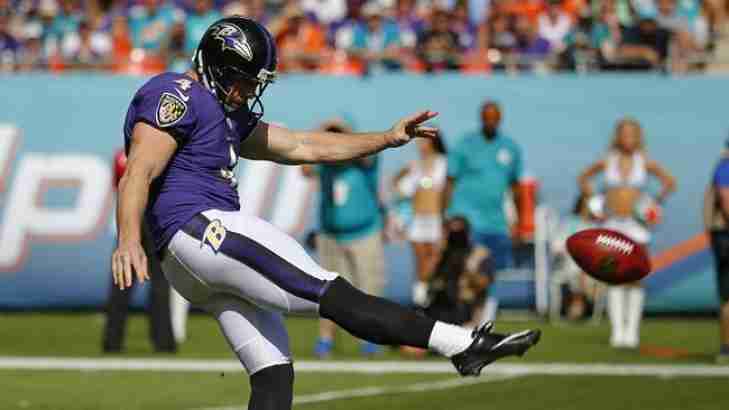
Selected in the sixth round (203rd overall) of the 2006 NFL Draft out of Nebraska, Sam Koch arrived in Baltimore as one of the rare punters taken in the draft. Over a remarkable 16-season tenure spent entirely in Charm City, Koch revolutionized special teams across the league by pioneering new directional punting techniques, solidifying his status as a foundational pillar of Baltimore's special teams.
Koch changed the punting game from just focusing on distance to using clever placement as a powerful tool. Knowing that returners found traditional spiral punts easier to track, he created a wide variety of creative kicks, like his well-known rotational "whirlybird" or "knuckleball" punts, as well as end-over-end drop-pouts and tricky corner-pins. By tweaking the spin and flight of the ball, he often caused muffed catches, closed off return options, and kept opposing teams pinned inside their own 10-yard line, making his punts both exciting and strategically effective.
Koch's technical mastery was instrumental during the Ravens' journey to Super Bowl XLVII in 2012. Throughout that championship campaign, his control of field position consistently provided Baltimore's defense with advantageous, long fields to defend. In the Super Bowl XLVII victory over the San Francisco 49ers, Koch executed a renowned late-game maneuver: with 12 seconds remaining, he deliberately scrambled through the end zone to calculate a strategic safety, thereby running down the clock and expending crucial seconds to ensure a 34–31 victory.
His standout moment came in 2015 when Koch led the NFL in net punting average at 42.9 yards and gross punting at 46.7 yards. That impressive season earned him his first Pro Bowl selection and Second-Team All-Pro honors. Throughout his career, Koch was often among the top in yards per punt, ranking in the top 10 four times, and he regularly placed high in punts downed inside the 20-yard line.
After retiring following the 2021 season, Koch ranked seventh all-time in NFL history with 52,868 punting yards on 1,168 punts, and he placed 453 of those kicks inside the 20-yard line. He immediately transitioned to coaching, staying with Baltimore as the team's special teams consultant. In 2023, the franchise honored his legendary career by inducting him into the Ravens Ring of Honor.
39. Michael Oher
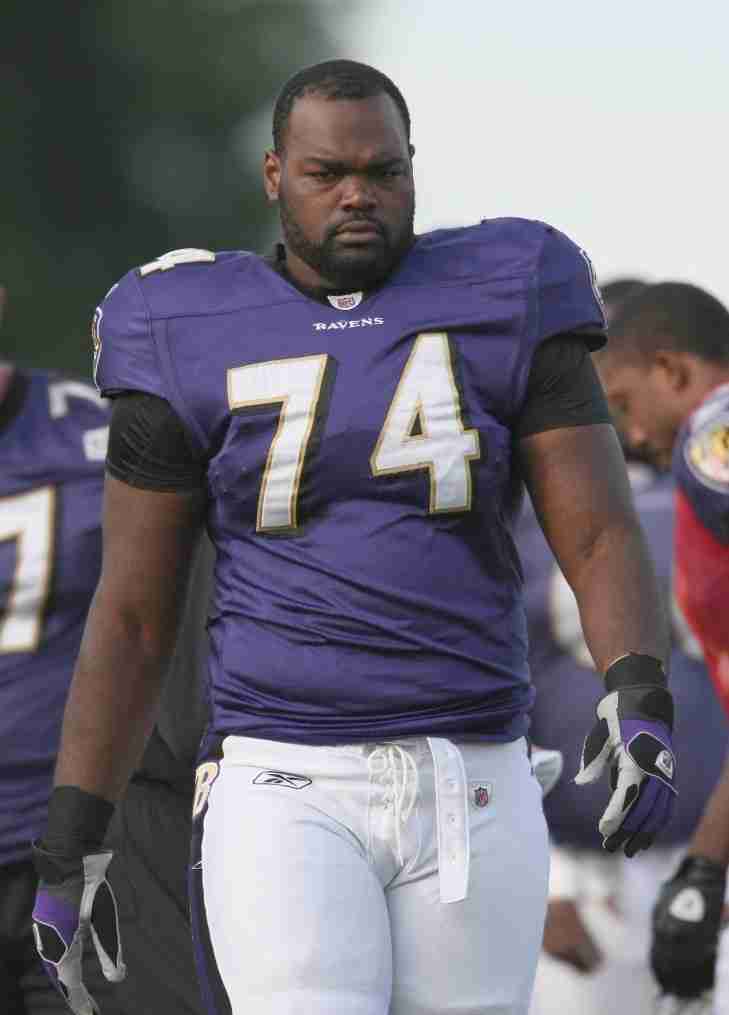
Chosen 23rd overall in the first round of the 2009 NFL Draft out of Ole Miss, Michael Oher entered the league surrounded by immense public attention as the subject of the best-selling book and eventual Oscar-winning film The Blind Side. On the field, Oher quickly proved his worth as a durable starter, establishing himself as a reliable anchor along Baltimore’s offensive line.
Standing tall at 6 feet 4 inches and weighing 315 pounds, Oher brought impressive size, footwork, and core strength that made him a formidable opponent against top-tier edge rushers. Flexible in his role, he could switch between left and right tackle based on team needs. He was excellent at creating a solid, deep pocket for pass protection and used his lower-body strength to push defenders back in Baltimore's power-running game. His quick-kick slides combined with his strong hands made him a challenging matchup for defensive ends on either side.
Oher made his debut in the starting lineup as a rookie in 2009, showcasing impressive adaptability by starting 11 games at right tackle and five at left tackle because of injury-related changes. He maintained consistency, providing pass protection for Joe Flacco and creating running lanes for Ray Rice, which earned him PFWA All-Rookie Team recognition and a second-place finish for NFL Offensive Rookie of the Year. That rookie effort set the tone for an iron-man stretch in Charm City. Over his five seasons with the Ravens (2009–2013), Oher was a fixture on the field, starting all 80 regular-season games and 10 postseason games without missing a single contest.
Oher’s standout moment as a Raven came during the 2012 postseason. After playing all 16 regular-season games at left tackle, Oher moved to right tackle for the playoffs—a strategic reshuffling of the front line that helped unlock Baltimore's offense. Throughout the four postseason games, Oher offered solid pass protection, leading to a thrilling 34–31 victory over the San Francisco 49ers in Super Bowl XLVII.
After five seasons in Baltimore (2009–2013), Oher played three more NFL seasons—one with the Titans (2014) and two with the Panthers (2015–2016), starting in Super Bowl 50. Over his eight-year NFL career, he started all 110 games he played.
34. Jamie Sharper
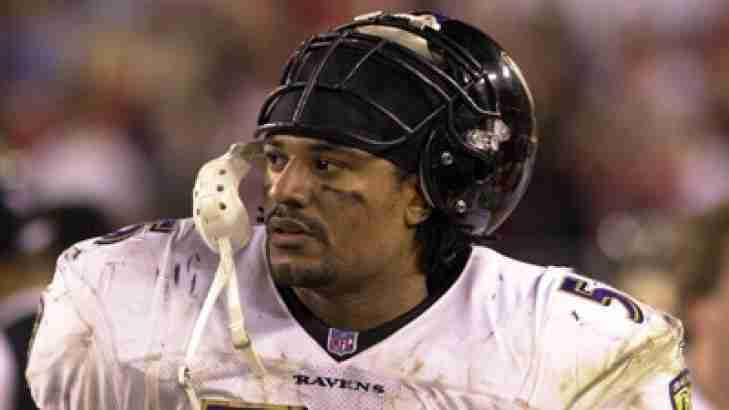
Drafted in the second round (34th overall) of the 1997 NFL Draft out of Virginia, Jamie Sharper arrived in Baltimore as a long, athletic linebacker built for modern defensive schemes. Operating alongside Ray Lewis and Peter Boulware, Sharper formed one of the most formidable linebacking corps in NFL history, serving as a versatile, playmaking anchor during the franchise's initial rise to championship glory.
Sharper provided a lively and reliable presence on the field, with great pursuit and instinctive coverage. He comfortably lined up as a strongside linebacker, ready to engage tight ends at the line, blitz on passing downs, or drop back into zone coverage with ease. His speed helped him quickly close the gap on runners, and his reach gave him a special advantage when intercepting passes over the middle.
Sharper's versatility peaked during the historic 2000 Ravens defense, which set the NFL record for the fewest points allowed in a 16-game regular season with 165. While Lewis covered the middle, Sharper discreetly recorded 76 combined tackles, five forced fumbles, and two fumble recoveries throughout the regular season.
His pivotal moment came during the postseason journey to Super Bowl XXXV. In the AFC Championship Game versus Oakland, Sharper made a vital interception of Rich Gannon, returning it 45 yards to help secure a key touchdown. Two weeks afterward in Super Bowl XXXV, Sharper achieved two sacks and four tackles as Baltimore overwhelmed the New York Giants 34–7 to win the Lombardi Trophy.
In 2001, Sharper achieved his best statistical season in Charm City, recording a career-high 6.0 sacks, 108 combined tackles, and a defensive touchdown. After that season, the Houston Texans picked him in the 2002 NFL Expansion Draft, making him a key part of their defense from the start. In 2003, Sharper led the NFL with an impressive 166 combined tackles.
In his five years in Baltimore, Sharper played in 80 regular-season games (79 starts) without missing a single contest, recording 328 tackles, 14.0 sacks, 2 interceptions, and 7 forced fumbles.
42. Edwin Mulitalo
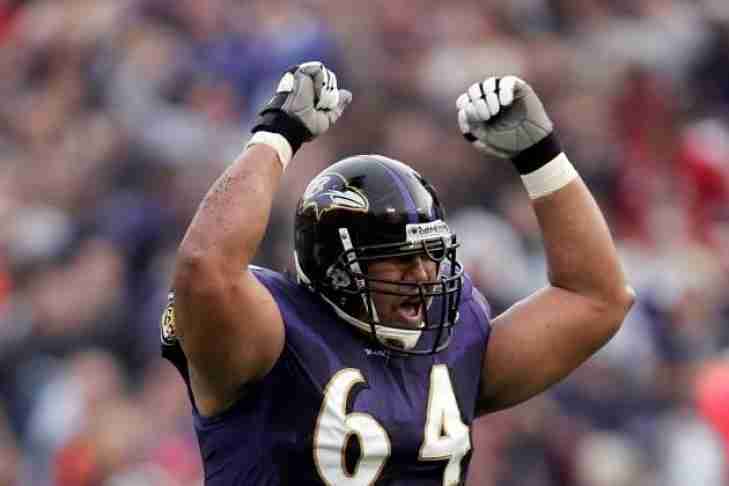
Taken in the fourth round (133rd overall) of the 1999 NFL Draft out of Arizona, Edwin Mulitalo gave Baltimore a raw, massive prospect who stepped directly into the fire as a rookie. He quickly claimed the starting left guard spot alongside Hall of Fame tackle Jonathan Ogden, forming a wall on the left side of the offensive line that powered Baltimore through its most iconic run in franchise history.
Mulitalo brought rare mass and raw power to Baltimore's offensive line. Positioned next to Jonathan Ogden, his main role in Brian Billick's power scheme was to reset the line of scrimmage by engaging 3-techniques and nose tackles. His hallmark was a fierce initial punch combined with powerful leg drive; once he clasped his hands around a defensive tackle's chest, he often pushed defenders aside, creating large "B-gap" openings for Jamal Lewis and Priest Holmes.
Mulitalo's physical presence was central to the identity of the 2000 Super Bowl XXXV championship team. He played all four playoff games at left guard, anchoring a rushing attack that averaged 148 rushing yards per game in the postseason and culminating in a dominant 34–7 victory over the New York Giants.
His peak performance as a run blocker came in 2003, when he started all 16 games for an offense that averaged 4.8 yards per carry and generated +62.4 Adjusted Rushing Runs (per Football Outsiders metrics). Mulitalo cleared the way for Jamal Lewis's historic 2,066-yard rushing season, including Lewis's then-NFL-record 295-yard performance against Cleveland on September 14, 2003, in which most of the internal power plays were directed right behind Mulitalo and Ogden.
After departing Baltimore following the 2006 season, Mulitalo spent two years with the Detroit Lions before transitioning into coaching and humanitarian work. With the Ravens, he started 102 of his 106 games.
41. Mike Flynn
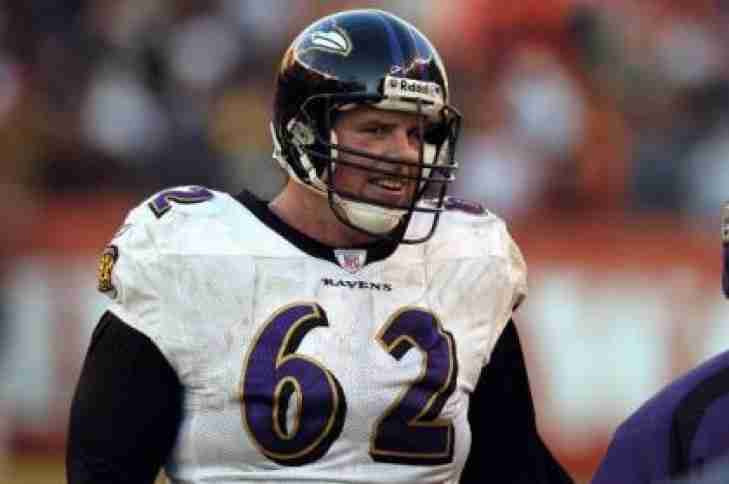
Signed as an undrafted free agent in 1997 out of Maine, Mike Flynn faced long odds just to make an NFL roster. Through sheer grit, intelligence, and versatility, he worked his way up from the practice squad into a central pillar of Baltimore's offensive line. Over a decade in Charm City, Flynn transformed from a roster-bubble longshot into an indispensable starter on the frontline of the most physical offense in franchise history.
Flynn contributed exceptional interior leverage, short-area power, and pre-snap intelligence to the offensive line. Whether positioned at right guard or executing line calls from the center position, he specialized in initiating movement on down blocks and maintaining blocks at the second level to facilitate power-running plays.
Flynn secured a position in the starting lineup as right guard during Baltimore's notable 2000 season. He commenced all four postseason games, facilitating running lanes for Jamal Lewis and Priest Holmes, while ensuring robust interior protection during the 34–7 triumph over the New York Giants in Super Bowl XXXV.
After his impressive championship run, Flynn showcased his flexibility by moving to center in 2002. Over the next six seasons, he became the main thinker of the offensive line, skillfully calling out blitz fronts and making important pre-snap protection adjustments. In 2003, Flynn played a key role as an interior force on an offensive line that helped Jamal Lewis achieve his famous 2,066-yard rushing season.
Flynn spent his entire 10-year NFL career exclusively in Baltimore (1998–2007). Known for his durability and steady work ethic, he played in 134 regular-season games, making 115 starts for the franchise.
32. Jarret Johnson
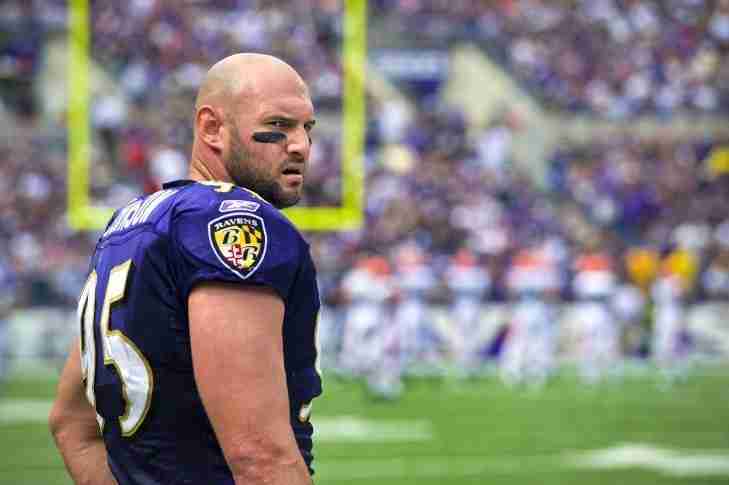
Selected in the fourth round (109th overall) of the 2003 NFL Draft out of Alabama—where he left as one of the most decorated defensive linemen in Crimson Tide history—Jarret Johnson arrived in Baltimore as a relentless, high-motor defender. Converting from defensive end to outside linebacker in Rex Ryan’s complex defensive system, Johnson became the ultimate unheralded anchor on an edge unit stacked with marquee star power, earning the enduring respect of coaches, teammates, and the Baltimore faithful.
Johnson embodied Baltimore’s tough "Play Like a Raven" spirit. While pass-rushers gained fame for chasing sacks, Johnson focused on the tough, vital job of establishing a solid edge against the run. With aggressive hand placement, strong lower-body anchoring, and relentless energy, he often took on tight ends and fullbacks, disrupting perimeter blocks and driving ball-carriers back inside towards Ray Lewis and Ed Reed.
Johnson's true distinction lay in his exceptional durability and selflessness during his nine years in Charm City. Initially, he played as a versatile rotational player across the front seven for his first four seasons. In 2007, he became a full-time starter and began a remarkable iron-man streak. From 2007 to 2011, he started 80 straight regular-season games, setting a franchise record for consecutive starts by a defensive player, showcasing his relentless preparation and mental resilience.
His best individual campaign came in 2009, when he recorded career highs of 6.0 sacks, 50 tackles, and two forced fumbles, and added a memorable interception return for a touchdown against the Kansas City Chiefs in the postseason. Whether dropping into zone coverage, rushing the passer, or setting the edge, Johnson played with selfless discipline that helped Baltimore's defense consistently rank among the NFL's elite throughout the late 2000s.
Johnson left Baltimore after 2011, ending his career with the San Diego Chargers before retiring in 2015. In nine seasons with the Ravens (2003–2011), he played 143 games (80 starts), with 20.0 sacks, 402 tackles, 30 for loss, and five forced fumbles.
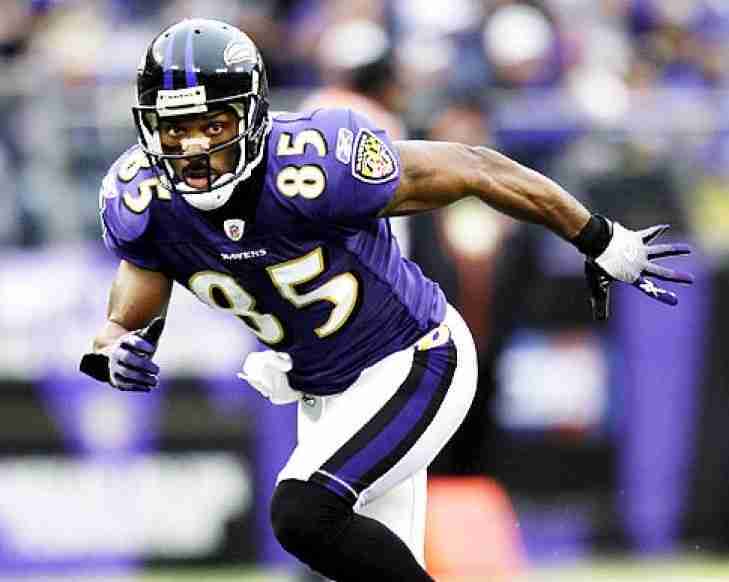
22. Derrick Mason
19. Rod Woodson
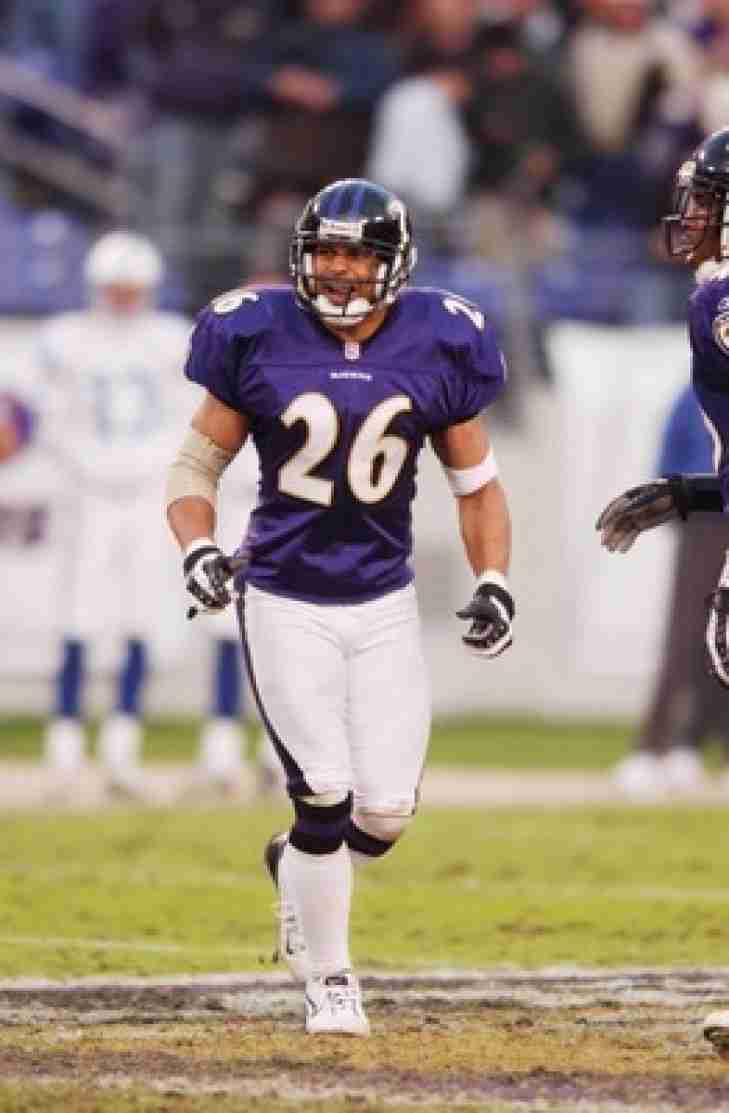
Signed by Baltimore in 1998 after a decade-defining career in Pittsburgh and San Francisco, Rod Woodson joined Maryland as a seasoned veteran transitioning into A new role. Transitioning from an elite boundary cornerback to a free safety, Woodson utilized his renowned instincts and speed to significantly enhance Baltimore's secondary, acting as the veteran leader during one of the most dominant defensive periods in NFL history.
Woodson brought rare athletic gifts to the safety valve role. Moving off the island allowed his cerebral diagnostic ability to shine. From his deep-middle perch, Woodson anticipated route concepts early, directing younger defensive backs before the snap, undercutting throwing lanes, and delivering punishing hits on receivers over the middle.
In 1999, his first season playing safety full-time in Baltimore, Woodson authored an outstanding campaign. He co-led the entire NFL with seven interceptions, returning two for touchdowns, while picking up his first Pro Bowl selection as a Raven.
Woodson achieved the peak of his career during the remarkable 2000 season. As the senior leader of a defense that set an NFL record by allowing only 165 points in a 16-game season, he recorded four interceptions and two forced fumbles during the regular season. He earned his second Pro Bowl invitation in Baltimore and maintained excellent secondary coverage throughout the postseason, which culminated in a 34–7 win in Super Bowl XXXV—the only championship ring of his Hall of Fame career.
In 2001, Woodson reinforced his performance by recording three interceptions, including one returned for a touchdown. This achievement secured his third straight Pro Bowl selection and Second-Team All-Pro honors with the franchise.
He signed with Oakland in 2002, culminating a legendary career with another All-Pro selection. During four seasons with Baltimore (1998–2001), Woodson appeared in 60 regular-season games, amassing 20 interceptions, 240 tackles, five defensive touchdowns, and 33 pass deflections. Inducted into the Pro Football Hall of Fame in 2009, his 71 career interceptions rank third in NFL history, and his 12 interception return touchdowns set an NFL record.
23. Todd Heap

Drafted 31st overall in the first round of the 2001 NFL Draft out of Arizona State, Todd Heap arrived in Baltimore as the handpicked successor to Hall of Famer Shannon Sharpe. Over the next decade, "Heap" became a household name in Maryland, serving as the primary passing target and fan-favorite focal point during an era defined by stellar defense and offensive retooling.
Heap was a matchup nightmare, excelling at exploiting seams and intermediate zones. With a wide catch radius and dependable hands, he often absorbed tough hits over the middle and secured contested catches in traffic. His soft hands and leaping ability made him a top red-zone threat, while his aggressive inline blocking supported Baltimore’s run-first approach with Jamal Lewis.
Following his rookie season in 2001, during which he learned behind Sharpe, Heap became a full-time starter in 2002. He quickly made an impact by catching 68 passes for 836 yards and six touchdowns, earning his first Pro Bowl selection.
In 2003, he improved significantly, making his second Pro Bowl and earning Second-Team All-Pro honors. Even though he played in a run-focused offense with Jamal Lewis rushing for 2,066 yards, Heap caught 57 passes for 693 yards and scored three touchdowns. He also set an NFL record by executing four two-point conversions in one season.
Although injuries affected him in 2004, Heap recovered strongly in 2005, achieving his career-best stats with 75 receptions, 855 yards, and seven touchdowns. He continued his strong performance in 2006, with a 13–3 season, catching 73 passes for 765 yards and six touchdowns, which earned him the NFL Alumni Tight End of the Year award.
Heap was a reliable presence when Joe Flacco joined in 2008, providing a dependable safety net during playoff runs to the AFC Championship and further. In his last Baltimore season in 2010, Heap recorded 40 catches for 599 yards and five touchdowns, with a career-best 15.0 yards per catch.
Heap was signed before the 2011 season as a cost-saving measure. During his time in Baltimore, he played 133 regular-season games, amassing 467 receptions, 5,492 receiving yards, and 41 touchdowns. At his departure, he was the franchise's all-time leader in touchdown catches. In 2014, the Ravens honored him by inducting Heap into their Ring of Honor, recognizing his strong bond with fans and significant impact on the team.
28. Bart Scott
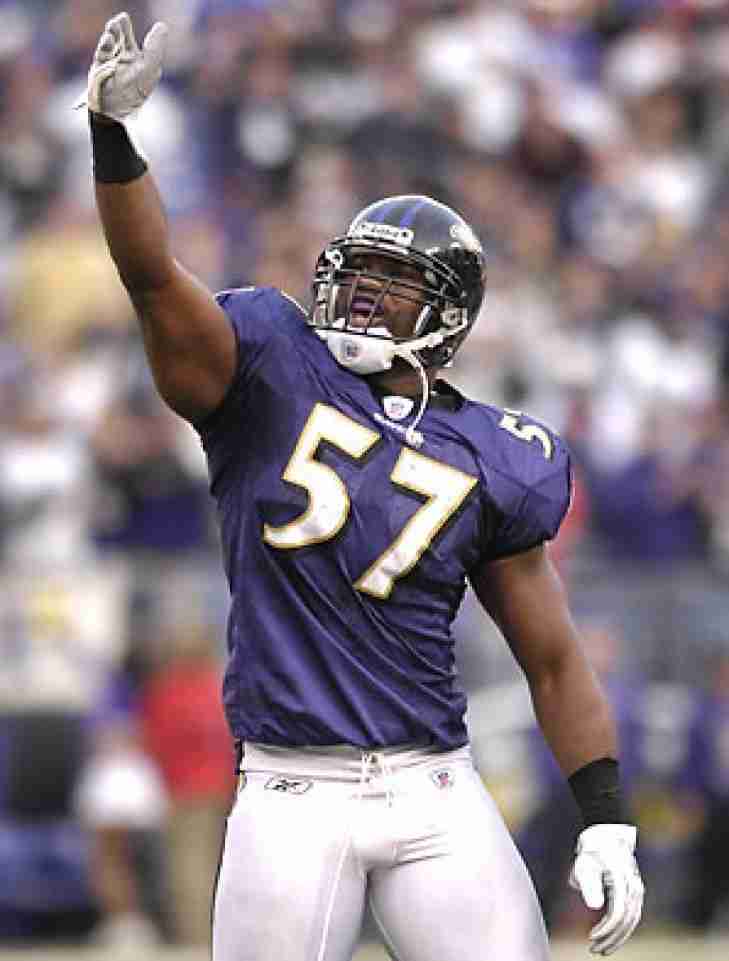
Undrafted out of Southern Illinois in 2002, Bart Scott signed with Baltimore as a relative unknown, earning a spot on the roster strictly through his fiery, relentless motor on special teams. Over seven seasons in Maryland, "Can't Wait" transformed from an unheralded long shot into one of the most feared, high-octane linebackers in football.
Scott infused Baltimore's linebacking corps with raw violence, high energy, and effective pre-snap communication. Working alongside Ray Lewis within Rex Ryan's intricate "Organized Chaos" defense, he served as an ideal downhill hitter. He blended exceptional closing speed with brute strength, penetrating interior gaps to disrupt run plays at the line of scrimmage and occasionally blitzing through A- and B-gaps.
Scott spent his first three years proving himself as a strong special teams player and backup. In 2005, when Ray Lewis was injured for the season, Scott got his chance to start. He took full advantage, recording 119 tackles, 4.0 sacks, and four forced fumbles, showing he was ready for a starting role.
His breakthrough campaign came in 2006, when he anchored a defense that allowed the fewest points in the NFL (12.6 per game) and finished with a 13–3 record. Partnering with Lewis to form the league's most formidable linebacking duo, Scott recorded 103 total tackles, 9.5 sacks, two interceptions, and two forced fumbles. This outstanding season earned him his only career Pro Bowl selection and Second-Team All-Pro honors.
Scott maintained that reckless playing style over the next two seasons, amassing 131 tackles in 2007 and 82 tackles in 2008 while helping lead Baltimore to the AFC Championship Game.
After the 2008 season, Scott became one of the most sought-after defenders in free agency. In 2009, when Rex Ryan, his previous Ravens defensive coordinator, was hired as the head coach of the New York Jets, Scott followed him to New York on a lucrative multi-year contract, where he gained national television recognition while maintaining his aggressive playing style.
With Baltimore, Scott played in 109 regular-season games (53 starts), compiling 448 total tackles, 16.0 sacks, four interceptions, six forced fumbles, and four fumble recoveries.
26. Matt Stover
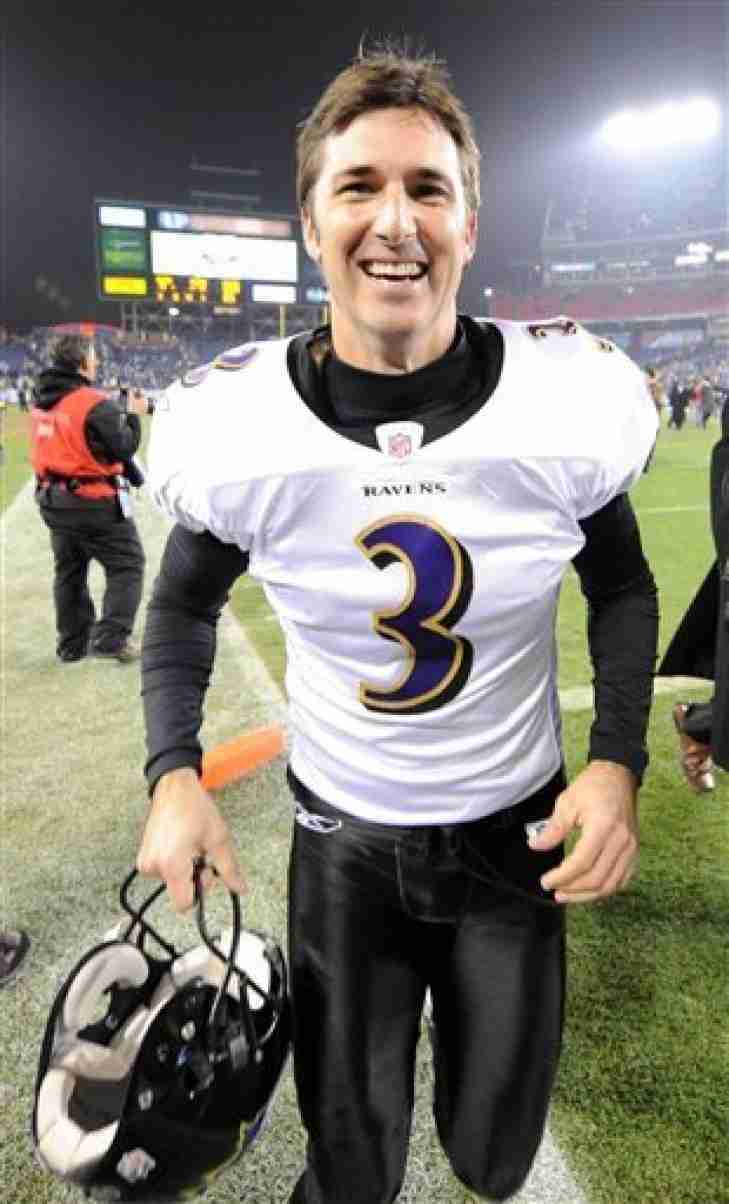
Drafted in the 12th round (329th overall) of the 1990 NFL Draft by the New York Giants out of Louisiana Tech, Matt Stover spent his entire rookie year on injured reserve before signing with the Cleveland Browns in 1991. When the franchise relocated to Maryland in 1996, Stover followed, establishing himself over the next 13 seasons as the original clutch specialist in Baltimore history and a model of consistency in NFL annals.
Stover depended on consistent technique and mental strength rather than pure leg strength. He mastered the challenging wind conditions in M&T Bank Stadium, managing his ball flight with precise contact and a smooth follow-through. His real importance became clear late in close games: when Baltimore's power-running offense struggled inside the opponent's 35-yard line, Stover almost always ensured three points.
Stover smoothly transitioned from Cleveland, scoring 19 field goals in Baltimore's first season in 1996. As the Ravens developed an elite defense later in the decade, Stover became the main contributor to the team's scoring.
His most notable campaign was during the historic 2000 season. In a significant five-game stretch in October, when Baltimore's offense failed to score a single touchdown, Stover carried the team's scoring efforts, accounting for all 49 points scored during those weeks. He ended the regular season as the NFL's leading scorer with 35 field goals on 39 attempts (an 89.7% success rate) and 135 total points, earning his first Pro Bowl selection and First-Team All-Pro honors. His perfect postseason continued, with six field goals and 11 extra points, aiding Baltimore in winning Super Bowl XXXV.
Throughout the 2000s, Stover was known for his consistency. From 2003 to 2005, he achieved over 86% success on field goals each season and was perfect on extra points. In 2006, he had another notable year, tying for the NFL lead in field goal accuracy with 28 of 30 successful attempts (93.3%), which earned him Second-Team All-Pro honors. Moreover, between 2002 and 2004, he set an NFL record by successfully making a field goal in 38 consecutive games.
After the 2008 season, Baltimore chose not to re-sign the 41-year-old veteran, transitioning the kicking role to Stephen Hauschka until Justin Tucker ultimately became the franchise's legendary kicker. Stover's last NFL season was in 2009 with Indianapolis, where he replaced the injured Adam Vinatieri and set the record as the oldest player to kick a field goal in Super Bowl history during Super Bowl XLIV.
Across 13 seasons in Baltimore (1996–2008), Stover appeared in 207 regular-season games, converting 354 of 422 field goals (83.9%) and 402 of 403 extra points to set the franchise's then all-time scoring mark with 1,464 points. His overall NFL career total of 2,004 points ranks sixth in league history.
24. Kelly Gregg
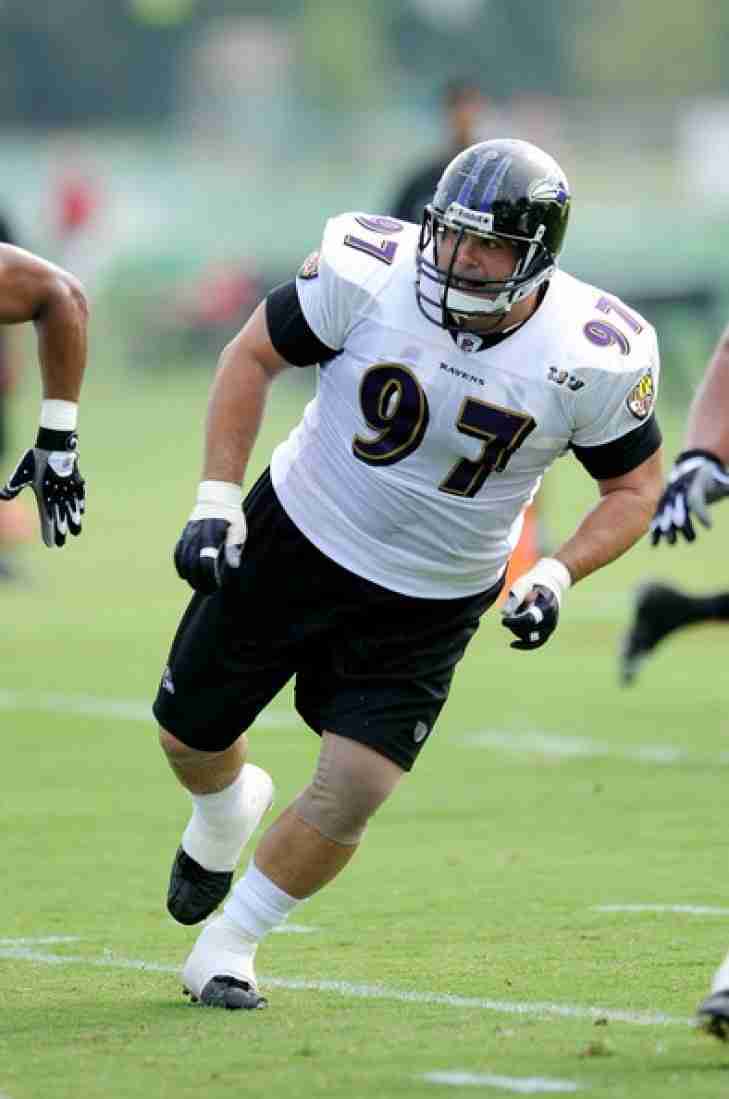
Kelly Gregg was selected in the sixth round of the 1999 NFL Draft by Cincinnati but was released before playing any regular-season games in Ohio. After brief stints with Philadelphia and on Baltimore's practice squad, he proved his resilience by competing in NFL Europe with the Rhein Fire, eventually becoming a regular in Maryland. At 6 feet tall and 320 pounds, Gregg didn’t have long limbs, but he compensated with wrestling leverage, toughness, and relentless energy as a nose tackle.
Gregg was the quintessential gritty interior lineman. Positioned directly over the center, his low center of gravity made him nearly immovable by single blocks. In Baltimore's 3-4 system, his primary role was to handle double-teams from guards and centers, taking the hits so linebackers like Ray Lewis and Terrell Suggs could attack the ball. Despite facing double-teams on almost every snap, Gregg had the lateral quickness to disengage and make tackles in the run gap.
Gregg joined the Ravens' practice squad during their landmark 2000 season and earned a Super Bowl XXXV ring behind the scenes. He made his first rotational appearance in 2001 and became the full-time starting nose tackle in 2002. That breakout year, he recorded 56 total tackles and two sacks, demonstrating he could lead a defense on his own terms.
His best statistical season came in 2003, when he recorded 80 total tackles and 3.0 sacks—unusually high production for a 0-technique nose tackle. Year in and year out, Gregg served as the silent engine of run defenses that routinely ranked near the top of the NFL. In 2007, he posted a career-high 83 total tackles while starting all 16 games.
Though he never earned Pro Bowl recognition—a common fate for non-flashy interior nose tackles—Gregg earned immense respect across the locker room and throughout the league for his durability and toughness. After missing 2008 due to microfracture knee surgery, he returned to start every game in 2009 and 2010, anchoring Baltimore's front five through his age-34 season.
Salary-cap constraints resulted in his release in July 2011, along with veteran teammates Todd Heap and Derrick Mason. He concluded his career with a single season in Kansas City. During his decade with Baltimore (2001–2010), Gregg appeared in 134 regular-season games, starting 124, and recorded 512 tackles, 19.5 sacks, and two forced fumbles.
27. Rob Burnett
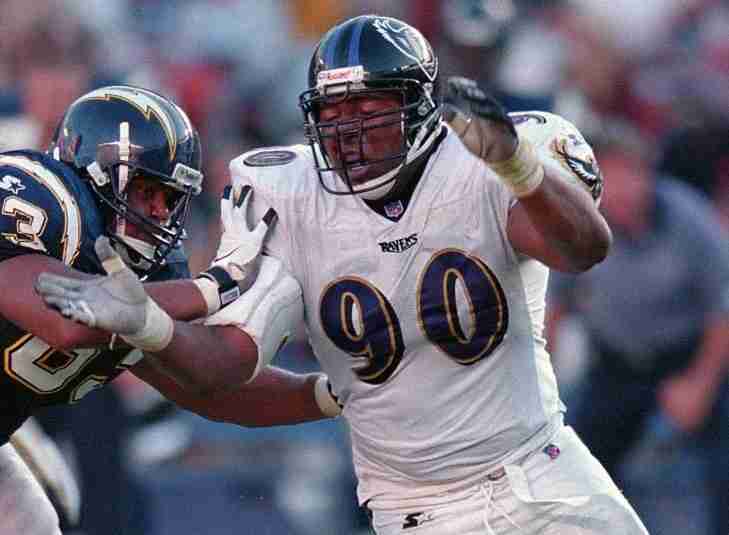
Drafted in the fifth round (129th overall) of the 1990 NFL Draft by Cleveland out of Syracuse, Rob Burnett established himself as an edge anchor over six seasons in Ohio, earning a Pro Bowl selection in 1994. When the organization relocated to Maryland in 1996, Burnett made the move, providing the Baltimore Ravens with six additional years of steady leadership and heavy-handed edge play.
Burnett utilized traditional power tactics, leveraging his length and keen diagnostic skills. Playing at left defensive end, he focused on establishing a solid edge against the run, employing strong hands to control offensive tackles before disengaging to make plays. As a pass rusher, he collapsed pockets with a quick, violent speed-to-power rush, creating openings for blitzing linebackers and recording double-digit sacks.
Burnett joined Baltimore's first 1996 lineup as a main starter, posting 4.0 sacks and helping stabilize a rebuilding defense. During his initial four seasons with the team, he offered a steady veteran influence alongside emerging pass rushers such as Peter Boulware, regularly creating pocket pressure and maintaining the edge.
His standout season came during the historic 2000 championship run. As the leader of a defense that allowed a record-low 165 points, Burnett made a significant impact with 10.5 sacks, five fumble recoveries, and his only career interception. His persistent effort and ability to pressure the quarterback earned him Second-Team All-Pro honors.
He ended that legendary year by starting every postseason game, culminating in a dominant showing in Super Bowl XXXV, where he made an important sack against Kerry Collins to secure Baltimore's 34–7 win.
Burnett returned for one final year in 2001, starting 14 games and adding 3.5 sacks to help Baltimore return to the postseason. After that campaign, salary-cap pressures forced Baltimore to part ways with the veteran edge rusher, leading to two final seasons with Miami before his retirement. In his six seasons as a Raven, Burnett started 82 regular-season games, recording 26.5 sacks, 186 solo tackles, seven forced fumbles, and eight fumble recoveries.
21. Michael McCrary
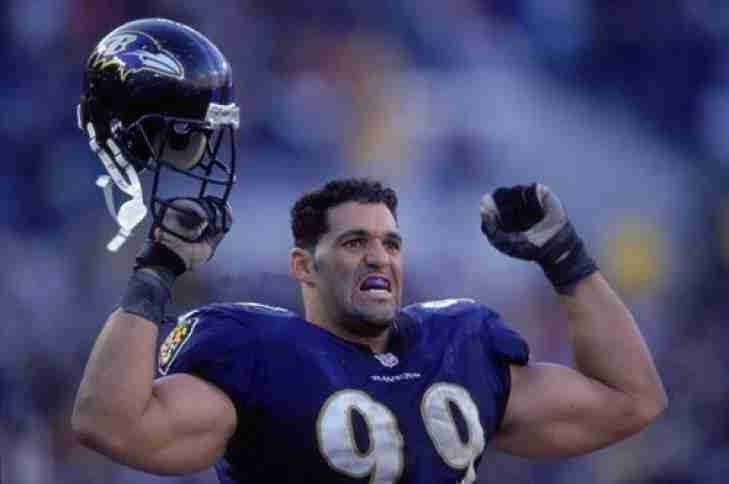
Originally drafted in the seventh round of the 1993 NFL Draft by Seattle, Michael McCrary joined the Ravens in 1997 as a free agent. Playing with a nonstop motor and violent, high-energy effort, he became the ultimate edge-setting motor for Baltimore's burgeoning defense, establishing a template for how a Ravens pass rusher should play.
McCrary did not possess the extensive length typical of conventional pass rushers; however, he compensated through effective leverage, a rapid initial burst, and an indefatigable motor. He employed a swift, forceful bull rush—transitioning from speed to power—to drive offensive tackle pads directly into the pocket. In the rushing game, he established a firm, unrelenting edge, sacrificing his body to disrupt pull blocks and redirect interior cutbacks toward Baltimore's linebackers.
Following a strong 9.0-sack season in his rookie year at Maryland in 1997, McCrary had a remarkable 1998. He recorded a career-high 14.5 sacks and 72 total tackles, leading Baltimore's defensive line and earning his first Pro Bowl selection. He maintained this level in 1999, recording 11.5 sacks and earning his second straight Pro Bowl appearance.
McCrary was a cornerstone of the historic 2000 defense, starting all 16 regular-season games and tallying 6.5 sacks for a unit that allowed an NFL-record low of 165 points. He elevated his play in the postseason, adding 6.0 playoff sacks—including 2.0 sacks in a dominant 34–7 victory in Super Bowl XXXV.
In 2001, his off-field leadership and extensive charitable contributions earned him the prestigious Byron "Whizzer" White NFL Man of the Year Award (now the Alan Page Community Award).
Battling severe knee injuries, McCrary gut-checked his way through his final games before retiring prior to the 2003 season. Across six seasons in Baltimore (1997–2002), he played in 78 regular-season games, compiling 51.0 sacks, 288 tackles, seven forced fumbles, and six fumble recoveries.
