
The Pro Football Hall of Fame Revisited Project: 1992 Final VOTE

1992 Pro Football Hall of Fame Revisited Project Class.
Here we are! Again!!
If you have been following our Pro Football Hall of Fame Revisited Project, you know we have asked the question: What if the PFHOF had begun in January 1946?
After soliciting and obtaining a passionate group of football fans and historians, we sent out a ballot for a Preliminary Vote, in which each voter selected 25 names as their semi-finalists and five names for the Senior Pool. We then asked the group to vote for their 15 Finalists in the Modern Era and 3 in the Senior Category. The final stage was to vote for their five Modern Era inductee and one Senior inductee.
This is the result of the 47th official class.
Below are the final results of this project based on 31 votes.
Remember that we have reverted back to the top five candidates entering the Hall in the Modern Era
This is for the “Modern Era”
*Bold indicates they have been elected to the Pro Football Hall of Fame Revisited Class of 1992:
|
Player |
Year of Eligibility |
Vote Total |
|
Tom Mack G |
9 |
17 |
|
Randy Gradishar LB |
4 |
17 |
|
Dave Casper TE |
3 |
17 |
|
Dave Wilcox LB |
13 |
11 |
|
Elvin Bethea DE |
4 |
11 |
|
Lynn Swann WR |
5 |
10 |
|
Joe Demielleure G |
2 |
10 |
|
Jackie Smith TE |
9 |
9 |
|
Bob Griese QB |
7 |
9 |
|
John Riggins RB-FB |
2 |
8 |
|
Ray Guy P |
1 |
8 |
|
Robert Brazile LB |
4 |
7 |
|
Jan Stenerud PK |
2 |
7 |
|
L.C. Greenwood DE |
6 |
6 |
|
Charlie Joiner WR |
1 |
6 |
This is for the “Senior Era”,
*Bold indicates they have been elected to the Pro Football Hall of Fame Revisited Class of 1992.
|
Joe Fortunato LB |
1 |
11 |
|
Pete Retzlaff E-HB-TE |
1 |
9 |
|
Pat Harder FB |
14 |
8 |
|
None of the Above |
N/A |
3 |
Does this mean we have inducted None of the Above?
This is for the “Coaches/Contributors”,
*Bold indicates they have been elected to the Pro Football Hall of Fame Revisited Class of 1992.
|
Tom Landry (Coach) |
2 |
27 |
|
Wellington Mara (Owner) |
6 |
2 |
|
Gil Brandt (Scout) |
1 |
1 |
|
None of the Above |
1 |
About the 1992 Inductees:
Tom Mack, G, RAM 1966-78: Inducted in the Pro Football Hall of Fame Revisited Project in 1992 on his 9th Ballot. Inducted into the actual Pro Football Hall of Fame in 1999.
Selected second overall in the 1966 NFL Draft out of the University of Michigan, Tom Mack would become the team’s starting Left Guard midway through the 1966 season, and in his sophomore season, he would be named to the Pro Bowl. That year would be the first of eleven trips to the annual game, showcasing the best players in the National Football League. Without question, for over a decade, the Los Angeles Rams never had to worry about Left Guard, as Mack was clearly among the elite in that role. He would appear in 184 straight games for L.A., the only team he ever played professionally for.
Randy Gradishar, LB, DEN 1974-84: Inducted in the Pro Football Hall of Fame Revisited Project in 1992 on his 4th Ballot. Inducted into the actual Pro Football Hall of Fame in 2024.
Tackles were not kept track of when Randy Gradishar played in the NFL, but if they were, Gradishar would be statistically proven as one of the most magnificent tackling machines in the history of Professional Football.
Called by Woody Hayes, the greatest Linebacker that he ever coached, Gradishar would become a starter late in his rookie season (1974) and a Pro Bowl Selection in his second. He would become the leader of the famed “Orange Crush” defense that transformed the Broncos into a league power after years as a laughingstock. He would become the team's leading tackler, and while again this was not an official stat, it has been speculated that he is the all-time leader, which, considering he only played ten seasons, makes this one incredible fact.
The Orange Crush took the Broncos to their first Super Bowl (SBXII), and though they lost, Gradishar was a First Team All-Pro; he would be named again in 1978, this time as the consensus Defensive Player of the Year. The former Ohio State Buckeye played five more years, four of which were deemed worthy of Pro Bowl honors.
With seven Pro Bowls, a Defensive POY, and the reputation of being one of the game’s most prolific tacklers, he is considered one of Canton’s biggest snubs. The Broncos chose Gradishar for their Ring of Fame in 1989.
Dave Casper, TE, OAK 1974-80, HOU, 1980-93, MIN 1983 & RAI 1984. Inducted in the Pro Football Hall of Fame Revisited Project in 1992 on his 3rd Ballot. Inducted into the actual Pro Football Hall of Fame in 2002.
Playing Tight End at the height of the Oakland Raiders' outlaw era, Dave Casper had the quadruple-threat combination of size, speed, blocking, and sure hands. A five-time Pro Bowl and four-time First Team All-Pro, Casper’s biggest moments were synonymous with Oakland football, namely his 42-yard over-the-shoulder catch against Baltimore in the 1977 Playoffs (Ghost to the Post), and being the last player to touch the ball (the Holy Roller play) in the controversial win against San Diego.
The former Notre Dame star played a huge part in the Raiders’ Super Bowl XI win, and he accumulated 5,216 Yards with 52 TDs.
Dave Wilcox, LB, SFO 1964-74. Inducted in the Pro Football Hall of Fame Revisited Project in 1992 on his 13th Ballot. Inducted into the actual Pro Football Hall of Fame in 2000.
Drafted from the University of Oregon in the Third Round in 1964, Dave Wilcox won the Left Linebacker role during his rookie season, and he would hold on to it until he retired after the 1974 Season.
Wilcox went to his first Pro Bowl in 1966 and would begin a six-year streak of that honor in 1968. Twice a First Team All-Pro, Wilcox used his freakish strength to repel blockers and get to his intended target. Wilcox was a devastating tackler and had good hands, as shown by his 14 career Interceptions.
Elvin Bethea, DE, HOU 1968-83. Inducted in the Pro Football Hall of Fame Revisited Project in 1992 on his 4th Ballot. Inducted into the actual Pro Football Hall of Fame in 2003.
Taken in the Third Round in 1968, Elvin Bethea generated colossal value for the Houston Oilers, the only team that the star from North Carolina A&T ever played for in his 210 Games as a pro.
The powerful Defensive End would prove to be one of the top players at his position in the 1970s, going to eight Pro Bowls and recording 105 (unofficial) Sacks for his team. As good as Bethea was as a pass-rusher, he was also a certifiable run stuffer, and thanks to his durability, he often did. Bethea did not miss a game until his tenth season (due to a broken arm), and his leadership on and off the field was also widely known.
The Oilers retired his number in 1983, the year he retired, and, along with George Blanda, he was part of the first class of the Titans Ring of Honor in 1999.
Joe Fortunato, LB, CHI 1955-66. Inducted in the Pro Football Hall of Fame Revisited Project in 1992 on his 1st Ballot. Was never inducted into the actual Pro Football Hall of Fame.
Joe Fortunato played his entire career with the Chicago Bears, the team that drafted him in the 7th Round in 1952.
While the Linebacker was chosen for the 1950's All-Decade Team, many of his accolades took place in the 1960s. Four of his five Pro Bowls came in the '60s, as did all three of his First Team All-Pro Selections. Regarding his team accomplishments, Fortunato was a vital part of the 1963 Bears Championship Team. He would record 16 Interceptions and recover 22 Fumbles over his career, the latter of which was a record when he retired. Not too bad for a guy who looked undersized for his position!
Tom Landry, Coach, SFO 1960-88. Inducted in the Pro Football Hall of Fame Revisited Project in 1992 on his 2nd Coach/Contributor Ballot. Inducted into the actual Pro Football Hall of Fame in 1990.
After six years in pro football, Tom Landry's transition to coaching brought us one of the most technical minds ever to grace the defensive side of the game.
While still playing for the New York Giants, Landry was already developing defensive schemes that the G-Men incorporated. Officially an assistant coach in 1954, Landry's playing career ended a year later, and along with offensive guru Vince Lombardi, the Giants had two future Hall of Fame coaches on their hands.
Landry’s mind came up with the 4-3 defense, a staple now of all NFL teams but utterly foreign at the time. When the NFL expanded to Dallas, Landry was tapped as their first head coach, and he brought unique defensive schemes there, such as the flex defense, which focused on space rather than on an opponent.
Under Landry, the Dallas Cowboys became "America's Team," going to five Super Bowls and winning two (VI & XII). Landry and his signature fedora became a part of the national fabric like any coach in sports.
Landry, who was the Cowboys’ first head coach, was relieved of duty by the new owner, Jerry Jones, in 1988, ending his career with an even 250 wins. It was an abrupt departure and unbecoming of a man of Landry's status, but fences were mended, and he was enshrined in their Ring of Honor in 1993.
9. Tom Mack
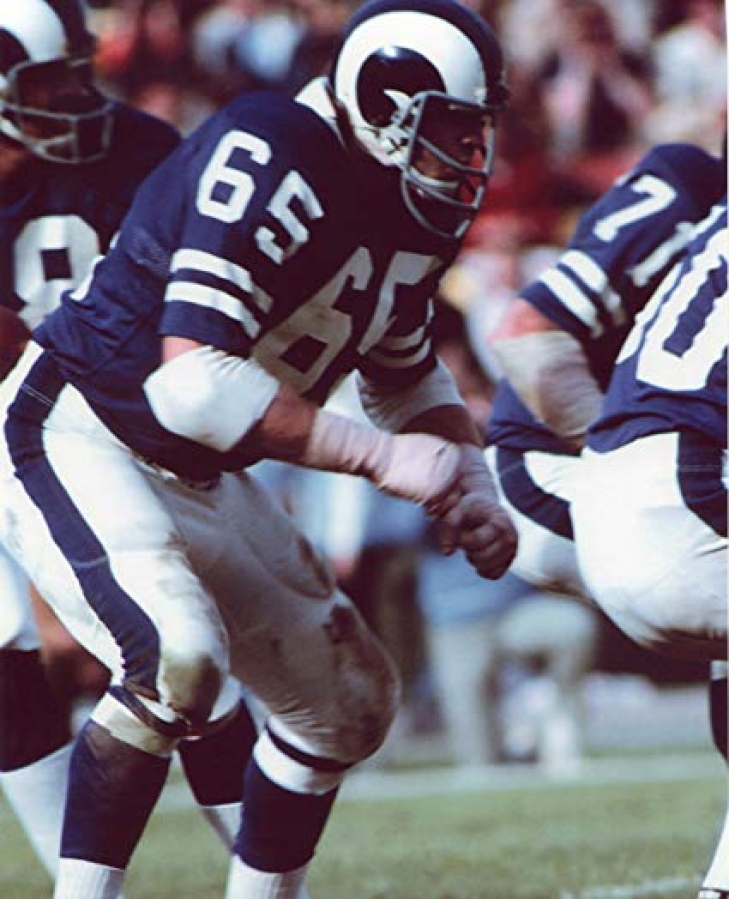
Tom Mack entered the NFL in Los Angeles as the second overall pick in the 1966 NFL Draft out of Michigan, and the Rams quickly figured out what they had. He worked into the starting left guard job midway through his rookie year and never really gave it back. By his second season, he was already a Pro Bowl selection, the first of eleven straight trips that spanned most of his career.
For more than a decade the Rams simply didn’t have to worry about left guard. Mack was a steady, technically sound blocker who preferred the run game and used his speed on sweeps. He wasn’t the biggest or most punishing guard of his era, but he was consistent enough to earn first- or second-team All-Pro honors in most years and keep the left side of the line solid, no matter who played next to him.
The durability was just as impressive as the production. Mack appeared in 184 consecutive games over thirteen seasons and never missed a start once he locked down the job. That streak ranked near the top of Rams history at the time, and it meant the offense could count on the same reliable presence week after week while the team stayed competitive.
During his years, the Rams were one of the league’s better clubs, winning their division eight times and reaching four NFC Championship Games. Mack was a big part of the offensive line that helped make that possible, protecting the quarterback and opening lanes for the running game while the rest of the roster turned over around him. He stayed with the Rams for his entire career and retired after the 1978 season.
He finished with 176 starts and a reputation as one of the most dependable guards of his generation. The individual awards were plentiful, but the real story was the quiet consistency that kept the left side of the line from ever becoming a problem.
The Pro Football Hall of Fame called him in 1999, a well-earned recognition for the second overall pick who turned into an eleven-time Pro Bowler and one of the steadiest offensive linemen the Rams have ever had.
