

From Pro Circuit to Private Coaching in Prague
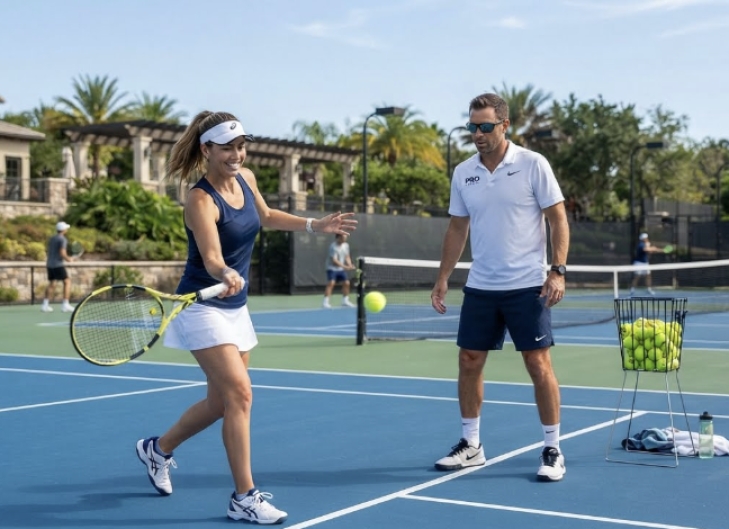
Introduction to Private Adult Tennis Camps in Prague
Adult club players increasingly plan tennis travel around performance work instead of leisure. Rather than joining a mixed-ability group at a holiday resort, they book structured private sessions built around specific questions. Prague suits that approach, with several serious clubs operating within one compact city.
The format is assessment-led and one-to-one from the first minute on court. Players arrive able to sustain rallies, name the areas they want examined, and dig into diagnostic detail. Social programming is secondary; documented instruction that travels home is the real product.
This guide covers the format, the fit, the venues, and the fee structure in full. It also states the boundaries plainly, because a private camp does not suit every adult player. The sections below follow the order most players raise during an enquiry.
Why a Short Private Camp in Prague Works for International Visitors
Coaching is available in English, Czech, and Ukrainian, so American players lose nothing in translation. A player can describe how a stroke feels and hear technical feedback without a language gap. For adults who analyze their own mechanics, that precision outweighs a packed activity list.
Session times are set around confirmed travel dates and goals agreed before arrival. A solo traveller does not need a playing partner, since all court work is delivered one-to-one. The coach feeds, drills, and plays points exactly as the training plan requires.
Courts operate across Prague 3, 4, and 7, which gives visitors options on different sides of the city. A short training block fits neatly inside a longer European itinerary. Players can keep evenings free for ordinary travel plans.
Comparing Generic Resort Tennis Camps with Private Assessment-Led Camps
The two models look similar on a booking page and differ sharply once play begins. The table below sets out the structural differences that matter most to adult players.
|
Factor |
Typical adult group camp |
Private assessment-led camp in Prague |
|
Structure |
Shared court time across a mixed group |
One-to-one sessions with a single coach |
|
Starting point |
General drills at group level |
90-minute diagnostic assessment |
|
Content |
Set curriculum for the week |
Priorities built from the player's goals |
|
Schedule |
Fixed group timetable |
Built around confirmed travel dates |
|
Partner needed |
Often matched or expected |
Not required |
|
Progress record |
Verbal feedback at the end |
Written plan for home practice |
|
Suited to |
Mixed abilities and social players |
Players who can already rally |
Who the Camp Suits (and Who It Does Not)
The program is built for American club and USTA league players at roughly NTRP 3.5 to 4.5. Returning players after time away and solo travellers in the same range fit comfortably. These adults usually know their strokes and want analysis rather than an introduction.
League players often arrive with a specific match problem, such as a second serve breaking down under pressure. Returning players may need footwork patterns rebuilt carefully after a long break. Solo travellers value a format that never depends on finding a partner.
The honest boundaries matter as much as the fit. This work suits players who can already rally, and it is not designed for complete beginners. It is coaching rather than a packaged resort holiday, so meals, accommodation, and sightseeing sit outside the program.
Anyone uncertain about level can describe current match experience and goals in an enquiry. That conversation happens before any schedule or budget is settled.
The Assessment-Led Format and Training Process
Every new court client starts with a 90-minute Performance Assessment priced at 3,800 CZK, roughly EUR 155. The coach observes strokes, movement, and decision-making during rally and point play. Those observations set the priorities for everything that follows.
The camp then moves into focused private sessions on the agreed priorities. Changes are introduced, repeated under controlled conditions, and finally tested in live points. That sequence shows which adjustments hold when score pressure enters the picture.
The same coach follows the full progression, with no rotation between instructors mid-block. Continuity makes it easier to judge whether a technical change is settling or drifting.
The visit closes with a written plan of priorities to continue practising at home. Players keep a record of what was examined, what was changed, and what needs repetition. If a player continues into a program, the assessment fee is credited to the first program period.
Technical and Tactical Focus Areas for Adult Players
Assessment findings set the agenda, so no two training blocks look identical. Common areas include contact point, swing path, footwork patterns, and recovery position after each shot.
Tactical work can cover serve patterns, return positioning, rally direction changes, and point construction under pressure. Adults with analytical habits usually enjoy the measurement side of this process.
Movement sessions may address first-step timing, balance through contact, and spacing on court. Video review, where used, documents positions at contact and helps explain the coaching point.
Every player responds differently to technical change, so outcomes stay framed as possibilities rather than promises. The written plan provides structure, and the player supplies the repetition afterward.
Sample Three-Day Training Schedule
Camps start from three days, and a week or a longer visit gives more time to test changes. The exact plan, hours, and venue are agreed before booking.
|
Day |
Focus |
Typical work |
|
Day 1 |
Assessment and priorities |
90-minute assessment, observation of strokes and movement, written priorities |
|
Day 2 |
Technical change and repetition |
Focused private sessions, controlled drills, repetition of the agreed adjustments |
|
Day 3 |
Match application and plan |
Live points, testing changes under pressure, written take-home plan |
This sample is illustrative, and a longer stay expands the same progression. Practice volume depends on the hours confirmed in advance rather than a fixed daily template.
The Coach: Leonard Stakhovsky
The practice is led by Leonard Stakhovsky, a former professional player on the ATP tour. He also competed as an NCAA Division I athlete before moving into private coaching. Those two environments shape a training method built on measurable assessment.
Adult players seeking high-level European instruction often review options like https://stakhovskytennis.com/best-adult-tennis-camps-europe when choosing qualified private coaching.
Stakhovsky Tennis operates as a private adult coaching practice in Prague centered on one-to-one instruction. The coach works directly with each player across the full block, from assessment to written plan. That continuity lets the same eyes track whether a change holds over several days.
Training Venues Across Prague
Training takes place on courts at TK Spoje, Hodkovicky, and CLTK across Prague 3, 4, and 7. Court access and surfaces are confirmed for specific dates before the schedule is fixed.
Venue choice can follow where a visitor is staying, since the clubs sit in different districts. Court hire is billed separately unless a specific arrangement confirms otherwise. Confirming surfaces early also helps players prepare the right footwear.
Planning Your Trip from Abroad
Most international visitors arrive by air at Prague Václav Havel Airport and continue into the city. From there, the trip is straightforward to organize once training dates are settled.
Dates, session hours, and venues should be agreed before flights are booked. That order prevents schedule conflicts and keeps the training block aligned with the wider trip.
Flights, accommodation, and meals are arranged and paid separately by the player. Court hire is an additional cost unless a confirmed arrangement covers it. Travel insurance and medical cover remain the player's own responsibility.
Pricing Structure and Fee Breakdown
Pricing is clear at the component level and quoted in full at the package level. There is no fixed total camp price; the figure follows the agreed goals, dates, and hours.
|
Item |
Fee |
Notes |
|
Performance Assessment |
3,800 CZK (approx. EUR 155) |
90 minutes; new court clients; plus court hire |
|
Private coaching |
From 1,600 CZK (approx. EUR 65) per hour |
Plus court hire |
|
Assessment credit |
Credited to the first program period |
Applies if the player continues |
|
Full camp package |
Written quote |
Issued after goals, dates, and hours are agreed |
|
Court hire |
Billed separately |
Unless confirmed otherwise |
Hourly rates are stated in Czech crowns, with euro figures offered as a practical reference. Payment terms and confirmation steps are outlined when the written quote is issued.
How to Book Your Camp
- Send an enquiry through the Stakhovsky Tennis website, including current level, goals, and travel window.
- Discuss and agree dates, session hours, venue, and the priorities to work on.
- Receive a written quote covering the assessment, private hours, and the full camp block.
- Confirm the schedule, then book flights and accommodation around the agreed training dates.
- Follow the payment terms set out in the quote and arrive prepared for court work.
An enquiry requires no payment and does not automatically reserve court time. Reservation follows once dates, hours, and venues are confirmed in writing.
Frequently Asked Questions
Is this program suitable for complete beginners?
No. The camp is designed for players who can already sustain rallies and want structured technical analysis. Complete beginners need a different foundation built over a longer period, usually starting with basic stroke mechanics and court movement. Players unsure of their level should describe their current match experience in an enquiry.
Do I need a playing partner to attend?
No partner is required. All instruction is delivered one-to-one, so the coach handles feeding, drilling, and point play as the plan demands. Solo travellers can book and train on exactly the same basis as anyone else, without arranging additional players for the sessions.
How long should a camp last?
Camps start from three days. That allows time for an assessment, focused technical work, and a session applying changes in points. A week or longer offers more practice time to test whether adjustments hold up, which matters when a change affects timing, spacing, or movement patterns.
What does it cost?
The initial 90-minute Performance Assessment costs 3,800 CZK, roughly EUR 155, plus court hire. Private coaching starts from 1,600 CZK, roughly EUR 65 per hour, plus court hire. Full camp pricing is issued as a written quote once goals, dates, and hours are agreed.
Are flights and hotels included?
No. Flights, accommodation, and meals are organized and paid separately by the player. Court hire is also an additional cost unless a specific arrangement confirms otherwise. Keeping these items separate lets each traveller choose the comfort level and budget that suit the wider trip.
Can training be conducted in English?
Yes. Coaching is available in English, Czech, and Ukrainian. American players can work entirely in English, from the first assessment conversation through to the written plan. Technical feedback is delivered in the language the player understands best, which keeps detail precise and practical.
Is the format group or private?
Private. Sessions are one-to-one with Leonard Stakhovsky, and there is no rotation between group coaches. That format gives the coach full visibility of each player's progress across the visit and keeps training priorities consistent from the first session through to the final one.
When should I book?
Start with an enquiry before booking flights, since dates, hours, and venues need to be agreed first. An enquiry requires no payment and does not automatically reserve court time. Once the schedule is confirmed in writing, travel and accommodation can be arranged around it.
Summary and Next Steps
Private coaching in Prague rewards players who arrive with questions and leave with a plan. Start by reviewing the three areas of your game you most want examined. Then send an enquiry describing your level, goals, and travel window, and the details can be settled from there. The written plan that ends the visit keeps the work going long after the flight home.
