

27. Smoky Joe Wood
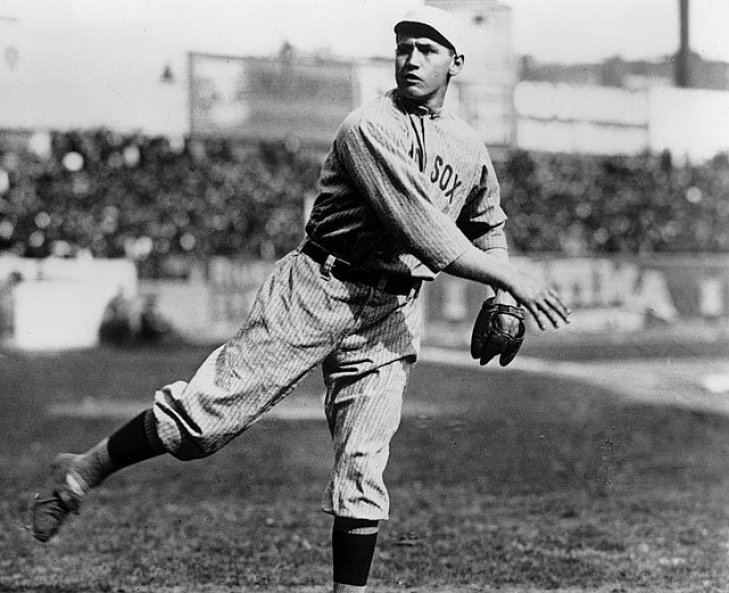
Howard Ellsworth Wood didn't just pitch; he threw "smoke." Debuting as a teenager in 1908, he quickly established himself as the hardest thrower of the Deadball Era. By 1910, he was already an "Efficiency Outlier," posting a 1.69 ERA. In 1911, he led the American League in FIP (2.13) and Strikeouts per 9 innings (7.5), a metric that proved his dominance was no fluke of defense; he was simply missing bats at a rate his peers couldn't match.
The 1912 campaign remains a statistical monument in the Red Sox wing of the Lab. Wood authored a season for the ages, winning a league-leading 34 games against only 5 losses. He paired that massive win total with a 1.91 ERA and a career-best 1.015 WHIP. This was a statistical accomplishment that propelled the Red Sox to the 1912 World Series title. In that Fall Classic, Wood cemented his legacy by winning three games, proving he was the ultimate high-leverage weapon when the championship was on the line.
While arm fatigue eventually caught up to him, Wood’s efficiency remained elite until the very end of his Boston tenure. In 1915, he secured the AL ERA Title with a 1.49 mark, though his declining workload limited him to only 25 appearances. Wood was an exceptional hitting pitcher who batted .244 for Boston, a skill that eventually allowed him to transition into a full-time outfielder later in his career with Cleveland.
Wood departed Boston after 1915 with a staggering 117–56 record and a career 1.99 ERA—one of the lowest marks in franchise history. Though his pitching career was cut short, his impact on the Red Sox's first golden era was undeniable. Inducted into the Red Sox Hall of Fame in 1995, he remains the definitive example of a "shooting star,” a pitcher who burned twice as bright for half as long. In the Lab, Joe Wood is the benchmark for pure, unadulterated power in the Deadball Era.
