

50. Chris Sabo

Before the first pitch of the 1988 season, Chris Sabo was a relatively unknown prospect with a flat-top haircut and a pair of trademark "Rec Specs." By the time the final out was recorded that October, he was the face of a new, hard-nosed era of Cincinnati baseball. Known affectionately as "Spuds" for his resemblance to a popular 80s mascot, Sabo played with a reckless, dirt-stained energy that instantly endeared him to the Riverfront Stadium faithful. He didn't just play third base; he attacked the position, providing the tactical spark and blue-collar grit that would eventually propel the "Nasty Boys" and the rest of the 1990 Reds to the pinnacle of the sport.
Sabo’s entrance into the major leagues was a high-velocity burst of production that caught the entire National League off guard. As a rookie in 1988, he established a model of specialized versatility, leading the Reds in doubles (40) and stolen bases (46) to secure the Rookie of the Year award. He possessed a rare combination of speed and gap power for a third baseman, earning an All-Star nod in his debut summer and proving that his focused intensity was a match for any veteran in the league. He was a model of immediate impact, serving as the high-leverage engine that transformed the Cincinnati infield into a defensive and offensive fortress.
Where Sabo became a local superstar was in the 1990 Season. While he authored a stellar regular season with 25 home runs and 25 stolen bases, it was his performance in the World Series that cemented his legend. Facing the heavily favored Oakland Athletics, Sabo reached a level of specialized dominance rarely seen on the championship stage, batting a staggering .563 with nine hits and two home runs in the four-game sweep. He was the primary driver of the Reds' offensive assault, famously punctuated by his "We’ve got the rings, we’ve got the money" victory speech that captured the swagger of the 1990 squad.
His craftsmanship reached its statistical high-water mark in 1991, a summer where he hit .301 with career highs in home runs (26) and RBIs (88). Sabo was a model of specialized efficiency at the "hot corner," leading National League third basemen in fielding percentage twice during his stay in Cincinnati.
The story in Cincinnati was written over seven seasons, culminating in a sentimental return to the club in 1996 for his final professional act. While injuries eventually slowed his production, he left the organization with 116 home runs and over 100 stolen bases. The organization provided the final punctuation on his legacy in 2010 by inducting him into the Cincinnati Reds Hall of Fame.
49. Reggie Sanders
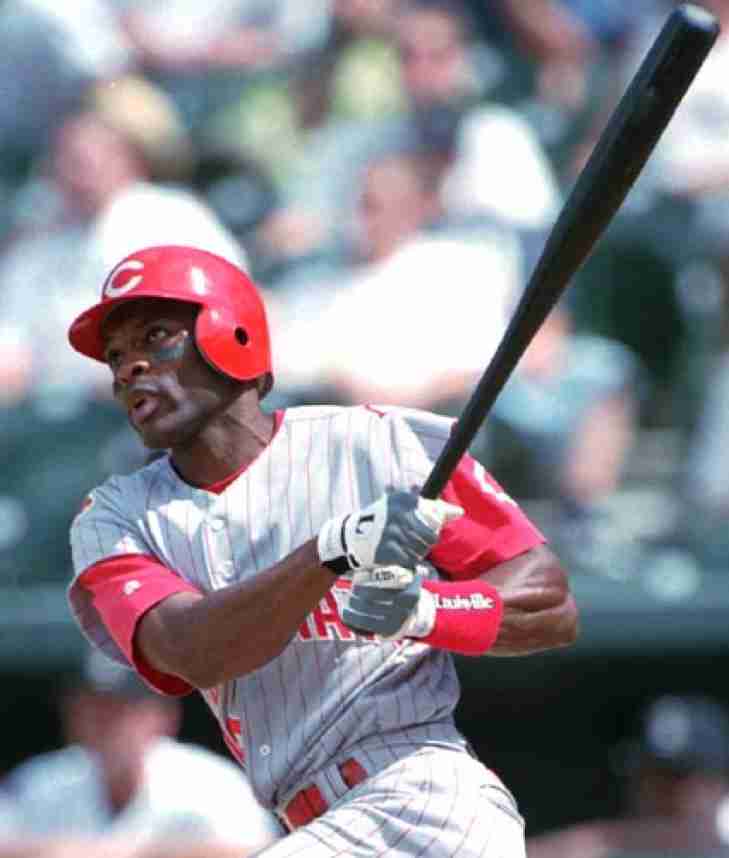
Before he became one of the game’s most traveled and successful outfielders, Reggie Sanders was the homegrown cornerstone of the Cincinnati Reds’ return to relevance in the 1990s. Arriving with a rare combination of pure athleticism and technical discipline, the South Carolina native provided Cincinnati with a specialized "five-tool" threat that kept opposing pitchers and catchers in a state of constant defensive anxiety. While he would eventually go on to play for nearly a third of the league, his initial eight-season stay in Cincinnati remains the definitive chapter of his career.
Sanders’ tenure in Cincinnati was defined by a high-velocity entrance that saw him finish as the Rookie of the Year runner-up in 1992. He established a model of specialized versatility from the jump, blending elite gap power with an aggressive, high-frequency approach on the basepaths. During the 1995 campaign, a summer when he orchestrated a masterclass in modern hitting. As the primary engine of a Reds squad that captured the NL Central title, Sanders earned his first All-Star selection and finished sixth in the MVP voting, posting career highs across the entire slash line (.306/.397/.579) while slugging 28 home runs and swiping 36 bases.
The hallmark of his craftsmanship was a professional resilience that allowed him to anchor the middle of the order during a decade of high-stakes transition for the club. Sanders was a model of the "20-20" archetype, twice reaching that elite plateau in a Reds uniform and serving as a high-leverage threat in every facet of the game. He possessed a specialized ability to manufacture runs through sheer athleticism, utilizing his speed to stretch singles into doubles and his strength to punish any mistake over the heart of the plate. He provided the tactical stability required to keep the Reds competitive, appearing in nearly 800 games and maintaining a slugging percentage well over .500 during his peak years.
After the 1998 season, he was traded to Arizona, but he compiled 125 home runs and 158 stolen bases.
