

Pro Football Hall of Fame Revisited Project: 1961 FINAL VOTE
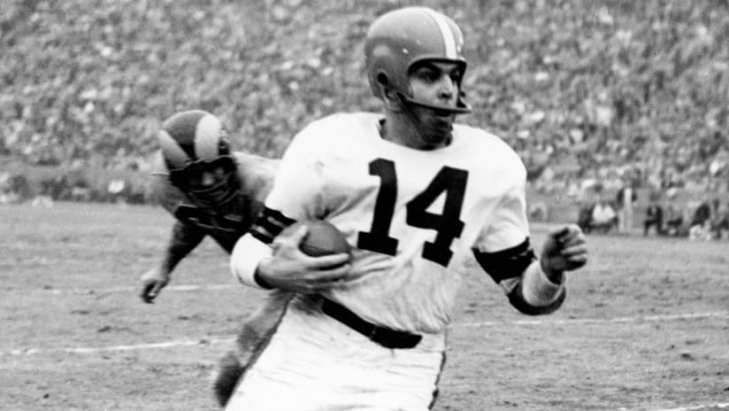
1961 Pro Football Hall of Fame Revisited Project Class.
Here we are! Again!!
If you have been following our Pro Football Hall of Fame Revisited Project, you know that we have asked the rhetorical question: What if the PFHOF began in January 1946?
After soliciting and obtaining a passionate group of football fans and historians, we sent out a ballot for a Preliminary Vote, in which we asked each voter to give us 25 names as their semi-finalists and 5 in the Senior Pool. Following that, we asked the group to vote for their 15 Finalists in the Modern Era and 3 in the Senior Category. The final stage was to vote for their five Modern Era inductee and one Senior inductee.
This is the result of the sixteenth official class;
Below are the final results of this project based on 31 votes,
Remember that the group took a vote in “1961”, and we have reverted back to the top five candidates entering the Hall PROVIDING THEY MAKE 50% of the vote. This will be put to a vote again in “1963”.
This is for the “Modern Era”
*Bold indicates they have been elected to the Pro Football Hall of Fame Revisited Class of 1961:
|
Player |
Year of Eligibility |
Vote Total |
|
Otto Graham QB |
1 |
31 |
|
Marion Motley FB |
1 |
28 |
|
Pete Pihos E-DE |
1 |
19 |
|
Charley Trippi HB-QB-DB |
1 |
17 |
|
Doak Walker HB-DB |
1 |
15 |
|
George Connor T-LB-DT-G |
1 |
10 |
|
Ward Cuff WB-QB-HB |
9 |
6 |
|
Marshall Goldberg FB |
8 |
6 |
|
Joe Kopcha G |
20 |
5 |
|
Dick Barwegan G |
2 |
5 |
|
Buckets Goldenberg G-BB |
11 |
4 |
|
Bill Osmanski FB |
9 |
2 |
|
Lou Rymkus T |
5 |
2 |
|
Ed Sprinkle DE-E-G-LB |
1 |
2 |
|
Pat Harder FB |
3 |
1 |
This is for the “Senior Era”, *Bold indicates they have been elected to the Pro Football Hall of Fame Revisited Class of 1961, though no one made the mandatory 50% threshold to advance.
|
Tony Latone |
6 |
12 |
|
Hunk Anderson |
11 |
10 |
|
None of the Above |
N/A |
5 |
|
Al Nesser |
5 |
4 |
About the 1961 Inductees:
Otto Graham QB-DB, CLE 1946-55: Inducted in the Pro Football Hall of Fame Revisited Project in 1961 on his 1st Ballot. Inducted into the actual Pro Football Hall of Fame in 1965.
Otto Graham was the first player that Cleveland Browns owner; Paul Brown, sought when he assembled his team in 1946 to begin play in the All-American Football Conference. Brown was right to convert the Northwestern Tailback to a pro Quarterback in the T-Formation. Graham and the Browns dominated the AAFC, and without question, Graham was the best player in the upstart league. The Browns won every single title in the four-year existence of the AAFC, and Graham was at the forefront of that success. The AAFC would merge with the NFL, and it was expected that those teams would not be successful in the first few years of the unification. They were wrong. The Browns won the 1950 NFL Championship, thus proving the merit of the AAFC; Graham won two more NFL Championships and was, overall, a five-time league leader in Passing Yards. In the ten years he played, there was never a year where he didn’t at least take the Browns to a Division Title.
Marion Motley FB-LB, CLE 1946-55: Inducted in the Pro Football Hall of Fame Revisited Project in 1961 on his 1st Ballot. Inducted into the actual Pro Football Hall of Fame in 1968.
While there were African Americans in pro football before Marion Motley, they had been phased out, but after World War II, this was about to change. Motley tried out for the Cleveland Browns of the new All-American Football Conference, and he made the team and would become oone f the best players in team history. Motley was an excellent rusher who won the AAFC Rushing Title in 1948, and the NFL Rushing Title in 1950, and he was a large part of the Cleveland juggernaut that won all four AAFC Championships and the 1950 NFL Championship. He was also incredibly valuable as a blocker and helped open up Otto Graham’s passing game. Motley had 5,827 Yards From Scrimmage, an excellent total for his era.
Pete Pihos E-DE, PHI 1947-55: Inducted in the Pro Football Hall of Fame Revisited Project in 1961 on his 1st Ballot. Inducted into the actual Pro Football Hall of Fame in 1970.
A three-time All-American at Indiana, Pete Pihos played his entire nine-year career with the Philadelphia Eagles, beginning as a two-way end, but eventually specializing in the offence. Pihos was one of the top receivers in the late 1940s and early 1950s, aiding the Eagles in back-to-back NFL Championships (1948 & 1949), and securing five First Team All-Pro Selections. In 1953, Pihos began a three-year streak leading the NFL in Receptions, with him also finishing first in Receiving Yards in the bookend seasons. He would accumulate 5,619 Yards with 61 Touchdowns.
Charley Trippi HB-QB-DB, CRD 1947-55: Inducted in the Pro Football Hall of Fame Revisited Project in 1961 on his 1st Ballot. Inducted into the actual Pro Football Hall of Fame in 1968.
Charley Trippi was a coveted player coming out of the University of Georgia, and the New York Yankees of the upstart All-American Football Conference thought they had him locked up. The Chicago Cardinals, who drafted him first overall, earned his services when Cardinals owner, Charles Bidwell signed him to what was a huge contract at the time, $100,000 over four years. Trippi was the heart of what would become Chicago’s “Million Dollar Backfield” and as a rookie in 1947, he would lead the Cardinals to an NFL Championship. Incredibly versatile, Trippi could play any offensive skill position and excelled at rushing, passing and punting. He played until 1955, finishing his career with the Cardinals and amassing 4,827 Yards From Scrimmage.
Pro Football Hall of Fame Revisited Project: 1961 SEMI-FINAL VOTE

1961 SEMI-FINAL RESULTS:
Thank you for all of you who have participated in the Pro Football Hall of Fame Revisited Project. If you are unaware of what that is, we acted as if the PFHOF had its first class in January 1946.
We have completed the years up to 1960.
For “1961,” a Preliminary Vote with over 100 players whose playing career ended by 1954. We are also following the structure in that players have 20 years of eligibility, and if they do not make it into the Hall, they are relegated to the Senior Pool.
Each voter was asked to select 25 names from the preliminary list, and the top 25 vote-getters were named Semi-Finalists.
A week later, the voters were asked to pick 15 names from the 25 Semi-Finalists, and next week, they will pick five from the remaining 15. We will continue this process weekly until we catch up to the current year.
30 Votes took place, with the top five advancing.
This is for the “Modern Era”
Bold indicates they advanced to the Finals:
|
Player |
Year of Eligibility |
Vote Total |
|
Otto Graham QB |
1 |
29 |
|
Marion Motley FB |
1 |
29 |
|
Charley Trippi HB-QB-DB |
1 |
26 |
|
Doak Walker HB-DB |
1 |
23 |
|
Pete Pihos E-DE |
1 |
23 |
|
Dick Barwagen G |
2 |
21 |
|
Marshall Goldberg T |
8 |
20 |
|
George Connor T-LB-DT-G |
1 |
18 |
|
Ward Cuff WB-QB-HB |
9 |
17 |
|
Joe Kopcha G |
20 |
17 |
|
Bill Osmanski FB |
9 |
15 |
|
Lou Rymkus T |
5 |
16 |
|
Buckets Goldenberg G-BB |
11 |
14 |
|
Pat Harder FB |
3 |
14 |
|
Ed Sprinkle DE-E-G-LB |
1 |
14 |
|
George Christensen G-T |
18 |
13 |
|
Ace Gutkowski FB-TB |
17 |
13 |
|
Bruno Banducci G |
2 |
13 |
|
Whizzer White TB-HB |
15 |
12 |
|
Vic Sears T-DT |
3 |
12 |
|
Woody Strode E |
7 |
6 |
|
Glenn Presnell T-B |
20 |
6 |
|
George Svendsen C |
15 |
6 |
|
Spec Sanders TB |
6 |
5 |
|
Frankie Albert QB |
4 |
3 |
This is for the “Senior Era”
*Bold indicates they advanced to the Finals:
|
Tony Latone |
6 |
19 |
|
Al Nesser |
4 |
18 |
|
Hunk Anderson |
11 |
15 |
|
Cub Buck |
11 |
9 |
|
Wildcat Wilson |
7 |
8 |
We will post the Finalists of the Class of the 1961 Pro Football Hall of Fame Revisited Project next Saturday.
Thank you to all who contributed. If you want to be part of this project, please let us know!
9. Marion Motley
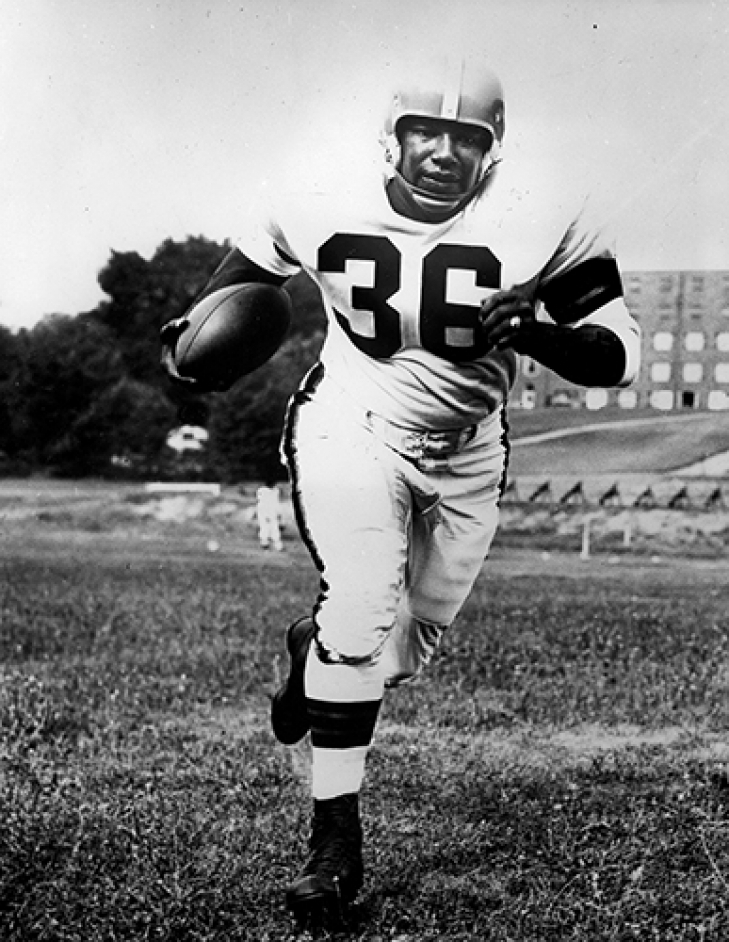
In 1946, Marion Motley signed with the Cleveland Browns, joining his teammate Bill Willis, and reentered professional football. Despite facing significant racial hostility, he emerged as one of the most formidable athletes of his time. During his eight-season tenure with Cleveland, Motley was recognized as an indomitable power runner and an elite pass protector, functioning as the key physical force within Paul Brown's offensive success.
Motley was constructed with the physique of a contemporary interior lineman, yet he played in a manner reminiscent of a backfield player from the 1940s. He exhibited a rare blend of raw power, lateral agility, and explosive speed. Employing the trap-draw formations pioneered by Paul Brown, Motley overwhelmed interior defensive lines through vigorous leg drive and second-level acceleration. In addition to his running capabilities, his blitz pickup was renowned for its physicality, effectively neutralizing rushing linebackers and providing Otto Graham with the unobstructed pocket necessary to execute down-the-seam passes.
Motley assumed leadership of the All-America Football Conference (AAFC) immediately upon entering the field. He secured the 1948 AAFC rushing title with 964 yards, significantly contributing to Cleveland's undefeated season. Throughout the Browns' four-year participation in the AAFC, Motley led the league in career rushing yards with a total of 3,024 yards, while Cleveland secured all four AAFC Championships.
When critics questioned whether the Browns could compete against the established NFL in 1950, Motley responded by securing the NFL rushing title with 810 yards on an impressive 5.8 yards per carry. His notable single-game performance occurred that season against Pittsburgh, where he rushed for 188 yards on only 11 carries (17.1 YPC). Cleveland concluded its inaugural NFL season by winning the 1950 NFL Championship, thereby establishing their position as the preeminent football team of the period.
Motley received his only Pro Bowl selection in 1950 and was honored with two First-Team All-Pro distinctions in 1950 and 1951. He concluded his tenure with Cleveland after the 1953 season, having accumulated 4,712 rushing yards and 31 rushing touchdowns, with an impressive average of 5.7 yards per carry—a record that continues to rank among the highest in the history of professional football.
In 1968, Motley became the second African American in the Pro Football Hall of Fame. In 2010, the Browns honored his groundbreaking career by naming him to the inaugural Cleveland Browns Ring of Honor.
