

The Pro Football Hall of Fame Revisited Project: 2001 Final VOTE
2001 Pro Football Hall of Fame Revisited Project Class.
Here we are! Again!!
If you have been following our Pro Football Hall of Fame Revisited Project, you know we have asked the question: What if the PFHOF had begun in January 1946?
After soliciting and obtaining a passionate group of football fans and historians, we sent out a ballot for a Preliminary Vote, in which each voter selected 25 names as their semi-finalists and five names for the Senior Pool.
We then asked the group to vote for their 15 Finalists in the Modern Era and 3 in the Senior Category. The final stage was to vote for their five Modern Era inductee and one Senior inductee.
These are the results of the 56th official class.
Below are the final results of this project based on 38 votes.
Remember that we have reverted back to the top five candidates entering the Hall in the Modern Era
This is for the “Modern Era”
*Bold indicates they have been elected to the Pro Football Hall of Fame Revisited Class of 2001:
|
Player |
Year of Eligibility |
Vote Total |
|
Jackie Slater T-G |
1 |
25 |
|
Sterling Sharpe WR |
2 |
22 |
|
Bob Griese QB |
16 |
16 |
|
Art Monk WR |
1 |
15 |
|
Lemar Parrish DB |
14 |
13 |
|
Lester Hayes DB |
10 |
13 |
|
Roger Craig RB |
3 |
13 |
|
Cliff Harris DB |
17 |
12 |
|
Billy “White Shoes” Johnson |
8 |
12 |
|
Andy Russell LB |
20 |
9 |
|
Ken Stabler QB |
12 |
6 |
|
Ken Anderson QB |
10 |
6 |
|
Todd Christensen TE |
8 |
6 |
|
Rickey Jackson LB-DE |
1 |
6 |
|
Drew Pearson WR |
13 |
5 |
|
Ken Riley DB |
13 |
5 |
|
Deron Cherry DB |
5 |
3 |
This is for the “Senior Era.”,
*Bold indicates they have been elected to the Pro Football Hall of Fame Revisited Class of 2001.
|
Otis Taylor WR-FL |
1 |
12 |
|
Floyd Little RB |
1 |
11 |
|
Arch Ward CONTRIBUTOR |
12 |
8 |
|
None of the Above |
N/A |
8 |
This is for the “Coaches/Contributors.”,
*Bold indicates they have been elected to the Pro Football Hall of Fame Revisited Class of 2001.
|
Eddie Kotal (Scout) |
6 |
24 |
|
Tom Flores (Coach) |
5 |
8 |
|
Ron Wolf (Executive) |
3 |
3 |
|
None of the Above |
N/A |
4 |
About the 2001 Inductees:
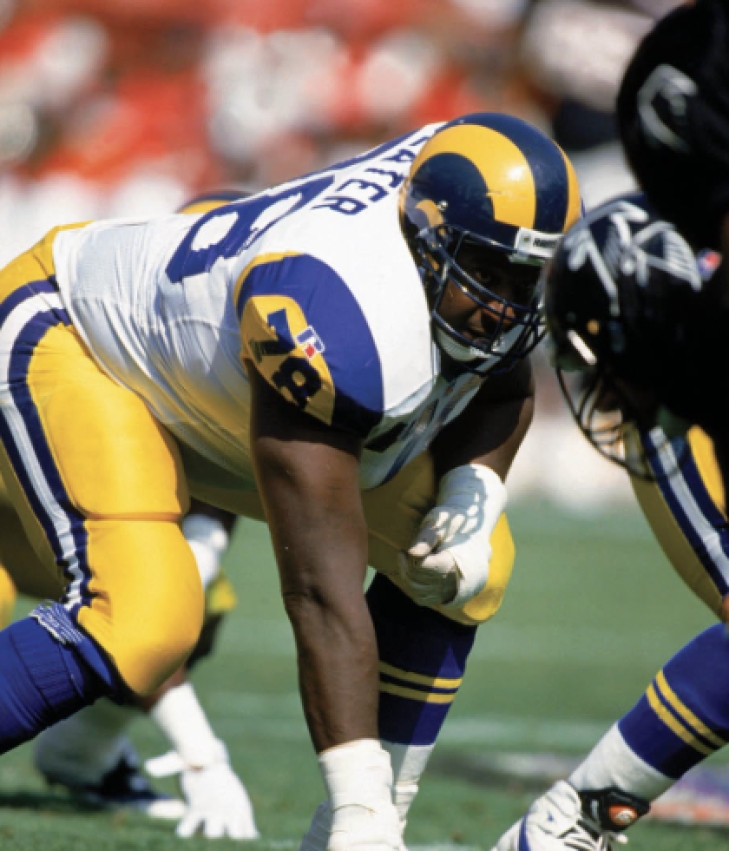
Jackie Slater, T-G, RAM/STL 1976-95: Inducted in the Pro Football Hall of Fame Revisited Project in 2001 on his 1st Ballot. Inducted into the actual Pro Football Hall of Fame in 2001.
Jackie Slater enjoyed one of the most durable and decorated careers in NFL history, anchoring the Los Angeles Rams offensive line for 20 seasons. Drafted out of Jackson State University in the third round of the 1976 NFL Draft, Slater did not become a permanent fixture in the starting lineup immediately, serving primarily as a backup and special teams contributor during his first three seasons. His breakthrough came in 1979, when he earned the starting right tackle position and helped propel the Rams to an appearance in Super Bowl XIV against the Pittsburgh Steelers.
Once established, Slater became a model of consistent dominance and the franchise’s emotional rock. Over the course of his two decades in the trenches, he played in 259 regular-season games, which stood as an NFL record for offensive linemen at the time of his retirement. His legendary work ethic and rigorous film study allowed him to maintain an elite level of play even as he faced younger, faster pass rushers. One of the defining highlights of his career came in the 1989 NFC Wild Card Game, when 35-year-old Slater famously neutralized Philadelphia Eagles legend Reggie White, holding the historic sack-master to zero sacks in a dominant Rams victory.
Slater's longevity meant he blocked for generations of talent, protecting 24 different quarterbacks and paving the way for 37 different running backs. He was an indispensable force out in front of seven different 1,000-yard rushers, most notably Hall of Famer Eric Dickerson. In 1983, Slater spearheaded an offensive front that gave up a league-low 23 sacks while driving Dickerson to a rookie rushing record of 1,808 yards. His unique career also achieved a rare geographical feat: because he played from 1976 through 1995, he became the only player in NFL history to play for the same franchise in three different home locations—Los Angeles, Anaheim, and St. Louis.
Slater earned seven Pro Bowl selections and was named NFC Offensive Lineman of the Year four times (1983, 1986, 1987, and 1989). Following his final season in 1995, the Rams retired his No. 78 jersey. His son, Matthew, had a stellar NFL career, spending 16 years with the New England Patriots as a special teams icon.
Sterling Sharpe, WR, GNB 1988-94: Inducted in the Pro Football Hall of Fame Revisited Project in 2001 on his 2nd Ballot. Inducted into the actual Pro Football Hall of Fame in 2025.
Sterling Sharpe was a force of absolute nature for the Green Bay Packers, establishing a terrifyingly dominant peak that completely redefined the wide receiver position in the late 1980s and early 1990s. Selected seventh overall in the star-studded 1988 NFL Draft, Sharpe instantly became the focal point of the Packers' offense, combining the route-running precision of an elite wideout with the bruising, tackle-breaking physicality of a 207-pound running back. Over his brief seven-season tenure, he proved entirely unguardable, leading the NFL in receptions three separate times (1989, 1992, 1993) and building an almost telepathic chemistry with a young Brett Favre.
Sharpe’s explosive peak arrived during the legendary 1992 season, when he achieved the elusive NFL Wide Receiver Triple Crown. In a mesmerizing campaign, Sharpe paced the entire league by racking up 108 receptions, 1,461 receiving yards, and 13 touchdowns, becoming a consensus First-Team All-Pro. Not content with merely holding the single-season reception record, he shattered his own historic mark the very next year by reeling in 112 catches. Even as opposing defenses explicitly game-planned to take him away, Sharpe remained entirely unstoppable, capping off his final healthy season in 1994 with a jaw-dropping, league-leading 18 receiving touchdowns.
Tragically, this blinding trajectory came to a sudden and heartbreaking halt in December 1994. During a Week 16 matchup against the Atlanta Falcons, Sharpe’s head violently snapped back while delivering a block, leaving him momentarily paralyzed on the turf. Miraculously, he walked off under his own power and—in a testament to his staggering toughness—returned the next week to torch the Tampa Bay Buccaneers for three touchdowns while secretly battling severe cervical spine trauma. Post-season medical evaluations soon uncovered a catastrophic instability between his C1 and C2 vertebrae, requiring an extensive neck fusion surgery that instantly ended his football career at the mere age of 29.
For three decades, Sharpe’s career stood as one of the greatest "what-if" stories in professional sports history, his breathtaking 112-game statistical output frozen in time. Despite this, Sharpe was inducted into both the Pro Football Hall of Fame and, of course, our Revisited Project.
Bob Griese, QB, MIA 1967-80. Inducted in the Pro Football Hall of Fame Revisited Project in 2001 on his 16th Ballot. Inducted into the actual Pro Football Hall of Fame in 1990.
Bob Griese was the principal architect of the Miami Dolphins dynasty of the 1970s, leaving a legacy defined by exceptional situational intelligence and unwavering composure. Drafted fourth overall in the 1967 AFL Draft out of Purdue University, Griese immediately assumed leadership of an expansion franchise in only its second year of existence. He adapted quickly, passing for more than 2,000 yards as a rookie and earning AFL All-Star honors. Known as the "Thinking Man's Quarterback," Griese famously called his own plays at the line of scrimmage, applying astute analysis and precise decision-making to translate head coach Don Shula’s vision into effective on-field execution.
Griese’s career peaked during Miami's legendary 1972 season, which culminated in the NFL's only undefeated and untied 17-0 record. Although a fractured leg and dislocated ankle suffered in Week 5 sidelined him for much of the regular season, Griese's championship mettle was evident in how he completed the journey. Entering the AFC Championship Game in relief during the second half, he sparked a comeback victory over the Pittsburgh Steelers before starting and winning Super Bowl VII against Washington. Griese returned the following year to lead a dominant title defense, guiding the Dolphins to a decisive victory over the Minnesota Vikings in Super Bowl VIII and securing consecutive world championships.
While contemporary critics sometimes mislabeled Griese as a mere "game manager" due to Miami’s historically dominant ground game, his efficiency when called upon was devastatingly lethal. In Super Bowl VIII, he threw the ball just seven times, yet completed six passes to effortlessly dismantle the Vikings' defense. When defenses clogged the running lanes, Griese unleashed his precise aerial attack, culminating in a spectacular 1977 campaign in which he earned First-Team All-Pro honors, won the Bert Bell Award, and led the NFL in both passing touchdowns (22) and passer rating (87.8). Over his 14-year career entirely spent in South Florida, he amassed 25,092 passing yards and 192 touchdowns while piloting the Dolphins to nine winning seasons.
A severe shoulder injury during the 1980 season ultimately forced Griese to retire at the age of 35, leaving him as the undisputed cornerstone of the franchise. His sustained excellence earned him six Pro Bowl selections and consecutive AFL All-Star nods, and the Dolphins permanently honored his leadership by retiring his No. 12 jersey.
Art Monk, WR, WAS 1980-93, NYJ 1994 & PHI 1995. Inducted in the Pro Football Hall of Fame Revisited Project in 2001 on his 1st Ballot. Inducted into the actual Pro Football Hall of Fame in 2008.
Art Monk was the understated force behind the Washington Redskins dynasty of the 1980s and early 1990s. His career stood out for remarkable consistency, physical toughness, and precise route running. Selected by the team in the first round as the 18th overall pick in the 1980 NFL Draft after playing at Syracuse University, the 6-foot-3, 210-pound receiver embodied the physical prototype of the modern big wide receiver. He made an immediate impact, setting a franchise rookie record with 58 receptions and earning unanimous selection to the NFL All-Rookie Team. Under head coach Joe Gibbs, Monk’s fearlessness over the middle and exceptional blocking established him as an outstanding possession receiver, consistently moving the chains; nearly two-thirds of his receptions in Washington resulted in first downs.
Monk's statistical peak came in the historic 1984 season, when he set a then-NFL record with 106 receptions, totaling a career-high 1,372 yards and seven touchdowns. His achievement was particularly notable for its efficiency, preceding the pass-heavy rule changes of the 1990s and making him the only player of his era to record more than 100 receptions in a single season. He followed this performance with consecutive 1,000-yard seasons, becoming the first player in franchise history to achieve three consecutive seasons with at least 1,000 receiving yards. By 1989, Monk had joined Gary Clark and Ricky Sanders to form "The Posse," a formidable wide-receiver trio that challenged opposing defensive backfields and became the first trio in NFL history in which each member surpassed 1,000 receiving yards in the same season.
Monk’s exceptional reliability was a cornerstone of Washington’s success during its golden era, making him an indispensable contributor to three Super Bowl championship teams (XVII, XXII, and XXVI). His career was distinguished by sustained excellence; he became the first player in NFL history to record a touchdown reception and at least 35 receptions in 15 consecutive seasons. His dependable hands helped him maintain a streak of 183 consecutive regular-season games with a reception. In 1992, Monk further solidified his legacy before the home crowd by catching his 820th career pass, officially surpassing Steve Largent's record to become the NFL’s all-time receptions leader. After 14 memorable seasons in Washington, Monk concluded his career with one-year stints with the New York Jets and Philadelphia Eagles, retiring with 940 receptions for 12,721 yards and 68 touchdowns. The Redskins also retired his number, 81.
Lemar Parrish, CB, CIN 1970-77, WAS 1978-81 & BUF 1982. Inducted in the Pro Football Hall of Fame Revisited Project in 2001 on his 14th Ballot. Was never inducted into the actual Pro Football Hall of Fame.
Lemar Parrish, affectionately known as "Leapin' Lemar," was one of the NFL’s most dynamic and versatile playmakers of the 1970s. Selected by the Lincoln Bengals in the seventh round of the 1970 NFL Draft as the 163rd overall pick, the 5-foot-11 cornerback quickly made a significant impact on the league. Combining exceptional coverage skills with remarkable speed, Parrish fit the modern shutdown cornerback profile while also excelling as a game-changing return specialist. During his rookie season with the Bengals, he made an immediate impression, recording five interceptions, averaging an impressive 30.1 yards per kickoff return, and scoring touchdowns on both a kickoff return and a blocked field goal return. His performance earned him the first of many Pro Bowl selections.
During his eight seasons in Cincinnati, Parrish became a cornerstone of Paul Brown's secondary. He became a major scoring threat whenever the ball was in his hands, setting numerous franchise records. In 1974, he established an NFL post-merger record with a league-leading punt return average of 18.8 yards, a historic single-season mark that remains unbroken. Parrish ultimately left Cincinnati as the franchise's highest-scoring defensive player, having recorded 25 interceptions and 13 return or recovery touchdowns: four on punt returns, four on interceptions, three on fumbles, one on a kickoff, and one on a blocked field goal. His distinctive clothing, confident on-field presence, and exceptional athletic quickness earned him six Pro Bowl selections with the Bengals.
Following a contract dispute, Parrish was traded to the Washington Redskins before the 1978 season, where his career reached another defensive peak. Although Washington’s coaching staff removed him from return duties to prioritize his lockdown coverage, the adjustment produced exceptional results. After exchanging his renowned Cincinnati No. 20 for Washington’s No. 24, Parrish became a prolific ball-hawk in the nation's capital. He recorded a career-high nine interceptions in 1979, followed by seven more in 1980. His dominant play in the secondary earned him consecutive First-Team All-Pro honors and brought his career total to eight Pro Bowl selections, demonstrating his exceptional longevity across two distinct franchises.
Parrish concluded his distinguished 13-year professional career in 1982, with his final season split between the Buffalo Bills and another team, leaving behind a record worthy of significant historical recognition. Across 166 career games, he recorded 47 interceptions and 13 fumble recoveries. Today, he is one of only six cornerbacks in NFL history to earn eight Pro Bowl selections. However, he remains the only member of that distinguished group who has not been inducted into the Pro Football Hall of Fame. He is, however, inducted here!
Lester Hayes, CB, OAK/RAI 1977-86. Inducted in the Pro Football Hall of Fame Revisited Project in 2001 on his 10th Ballot. Was never inducted into the actual Pro Football Hall of Fame.
Lester Hayes was one of the NFL’s most feared, theatrical, and fiercely physical cornerbacks, bringing the Raiders’ renegade spirit to life on the field.
Selected in the fifth round as the 126th overall pick of the 1977 NFL Draft out of Texas A&M, Hayes played safety and linebacker in college before legendary head coach John Madden famously transitioned him to cornerback. This change created a formidable challenge for opposing quarterbacks. Standing 6 feet tall and adopting an exceptionally low pre-snap stance, Hayes mastered the aggressive bump-and-run coverage favored by Raiders owner Al Davis, using his strength and elite recovery speed to physically disrupt wide receivers at the line of scrimmage.
Hayes’s 1980 campaign remains one of the greatest individual defensive performances in NFL history. He effectively shut down his side of the field, recording an impressive 13 interceptions during the regular season—just one short of Dick "Night Train" Lane's single-season record. His dominant performance earned him the NFL Defensive Player of the Year award and consensus First-Team All-Pro honors. Hayes continued his exceptional play in the postseason, recording five additional interceptions in four playoff games and helping anchor the Raiders' historic run to a Super Bowl XV victory over the Philadelphia Eagles.
Beyond his coverage skills, Hayes became closely associated with Stickum, a highly adhesive substance that he applied generously to his hands, wrists, and forearms to help secure anything resembling a football. His conspicuous use of the substance attracted intense league-wide scrutiny and directly prompted the NFL to adopt the infamous "Lester Hayes Rule" in 1981, permanently banning it. Although critics speculated that his performance would decline without this chemical advantage, Hayes demonstrated his elite ability by maintaining his dominant form without it. He earned five consecutive Pro Bowl selections from 1980 to 1984. After the franchise added fellow shutdown cornerback Mike Haynes in 1983, the pair formed what was arguably the greatest cornerback tandem in NFL history, leading the team to a decisive victory over Washington in Super Bowl XVIII.
Hayes retired following the 1986 season after spending his entire 10-year career in Silver and Black. He stepped away with 39 career regular-season interceptions, which leaves him tied with Hall of Famer Willie Brown for the Raiders' all-time franchise record.
Roger Craig, RB, SFO 1983-90, RAI 1991 & MIN 1992-93. Inducted in the Pro Football Hall of Fame Revisited Project in 2001 on his 3rd Ballot. Inducted into the actual Pro Football Hall of Fame in 2026.
Roger Craig was a transformative force behind the San Francisco 49ers’ dynasty of the 1980s, redefining the running back position through his exceptional versatility and distinctive high-knee running style. Selected in the second round of the 1983 NFL Draft after playing at the University of Nebraska, Craig combined downhill power with receiver-like route-running ability, making him an ideal centerpiece for Bill Walsh’s innovative West Coast offense. He made an immediate impact as a rookie, but his profile rose to national prominence during Super Bowl XIX. In the decisive victory over the Miami Dolphins, Craig made NFL history as the first player to score three touchdowns in a single Super Bowl, showcasing his ability to challenge defenses both on the ground and through the air.
Craig’s dual-threat dominance reached its height during the historic 1985 season, when he achieved a milestone many had considered impossible. In a remarkable display of athletic endurance, Craig became the first player in NFL history to record more than 1,000 rushing yards (1,050) and 1,016 receiving yards in the same season, while also leading the league with a career-high 92 receptions. This "1,000/1,000" club remained exclusive to Craig for more than a decade and has been matched only twice since. He demonstrated that his peak performance was no anomaly in 1988, transitioning smoothly from fullback to primary halfback and earning NFL Offensive Player of the Year honors. He recorded a league-leading 2,036 yards from scrimmage and set a franchise record with 1,502 rushing yards, helping lead San Francisco to another world championship in Super Bowl XXIII.
Craig’s exceptional courage and willingness to withstand punishing hits across the middle of the field ultimately shortened his peak, as the sustained physical demands of his aggressive playing style began to take their toll. After winning a third Super Bowl ring in Super Bowl XXIV, persistent injuries diminished his renowned explosiveness. His tenure in San Francisco ended on a heartbreaking note when a late-game fumble in the 1990 NFC Championship Game helped derail the 49ers' bid for a historic third consecutive Super Bowl title. He concluded his distinguished 11-year career with brief veteran stints with the Los Angeles Raiders and Minnesota Vikings, retiring after the 1993 season with 13,100 yards from scrimmage and 73 total touchdowns.
Otis Taylor, WR-FL, KAN 1965-75. Inducted in the Pro Football Hall of Fame Revisited Project in 2001 on his 1st Senior Ballot. Was never inducted into the actual Pro Football Hall of Fame.
Otis Taylor was a transformative presence for the Kansas City Chiefs and is widely regarded as a prototype for the modern NFL wide receiver. Legendary head coach Hank Stram famously remarked that he had been seeking a new dimension for his passing game and, upon seeing Taylor, knew he had found it. In an era dominated by powerful rushing attacks, Taylor fundamentally altered defensive coverage strategies, combining reliable hands with an exceptional ability to gain yards after the catch.
The most memorable moment of Taylor's career occurred on January 11, 1970, on the sport's grandest stage: Super Bowl IV. Facing the heavily favored Minnesota Vikings and their legendary "Purple People Eater" defense, Taylor caught a short hitch pass from quarterback Len Dawson, broke a tackle near the sideline, and completed a spectacular, high-stepping 46-yard sprint for a touchdown. The score secured a decisive 23-7 upset, firmly establishing Taylor’s place in championship history and bolstering the AFL's legitimacy shortly before the official league merger. This achievement capped a brilliant period during which he also helped lead the Chiefs to an appearance in the inaugural Super Bowl.
Taylor’s individual dominance reached its statistical peak during the 1971 season, when he proved exceptionally difficult to defend. He led the NFL with 1,110 receiving yards and averaged an impressive 19.5 yards per reception, earning consensus First-Team All-Pro honors and the UPI AFC Player of the Year award. Over his distinguished 11-season career, spent entirely in Kansas City, he recorded 410 receptions for 7,306 yards and 57 touchdowns. Although these statistics may appear modest by today's pass-oriented standards, they were exceptional for their era. Upon his retirement, he held the franchise record for career receptions.
Eddie Kotal, SCOUT, LAR 1946-41. Inducted in the Pro Football Hall of Fame Revisited Project in 2001 on his 6th Coach/Contributor Ballot. Was never inducted into the actual Pro Football Hall of Fame.
Talk about ahead of the times!
Before revolutionizing player personnel, Kotal built a diverse athletic career as a versatile 170-pound quarterback and halfback for the Green Bay Packers from 1925 to 1929, helping Curly Lambeau's team secure its first NFL championship in 1929. He later embarked on a highly successful multisport coaching career at the University of Wisconsin–Stevens Point, leading teams to conference titles in football, basketball, track, and boxing. In 1942, Kotal returned to the professional ranks as a backfield coach and part-time scout for the Packers, laying the foundation for his groundbreaking career transition.
His lasting legacy began in October 1946, when Los Angeles Rams owner Dan Reeves appointed Kotal as the league's first full-time head scout. When other NFL franchises prepared for the draft by casually browsing commercial football magazines such as Street & Smith, Kotal took a far more rigorous approach. He spent nine months each year on the road, driving more than 40,000 miles annually to visit college campuses, consult with coaches, and evaluate players in person. Kotal pioneered the organization of comprehensive player dossiers into library-like systems and introduced the revolutionary draft principle of selecting the "best player available.” This systematic approach laid the foundation for today's computerized personnel departments and established the Rams as a scouting powerhouse ahead of its time.
Beyond establishing standardized scouting protocols, Kotal played a pivotal role in social change and demonstrated foresight in identifying underrecognized talent. He was among the first NFL scouts to cultivate extensive relationships with Historically Black Colleges and Universities (HBCUs). Through these networks, Kotal signed Grambling's Paul "Tank" Younger in 1949, who became the first African-American player from an HBCU to play in the NFL. Kotal’s ability to identify promising prospects at small or unconventional schools also brought future Pro Football Hall of Famers such as Andy Robustelli of tiny Arnold College and Deacon Jones of South Carolina State to the Rams’ attention. He also anticipated cross-sport scouting by recommending that the Rams draft track stars such as Rafer Johnson and basketball standouts such as K.C. Jones, further establishing his reputation as one of the most astute evaluators of athletic talent in football history.
7. Jackie Slater
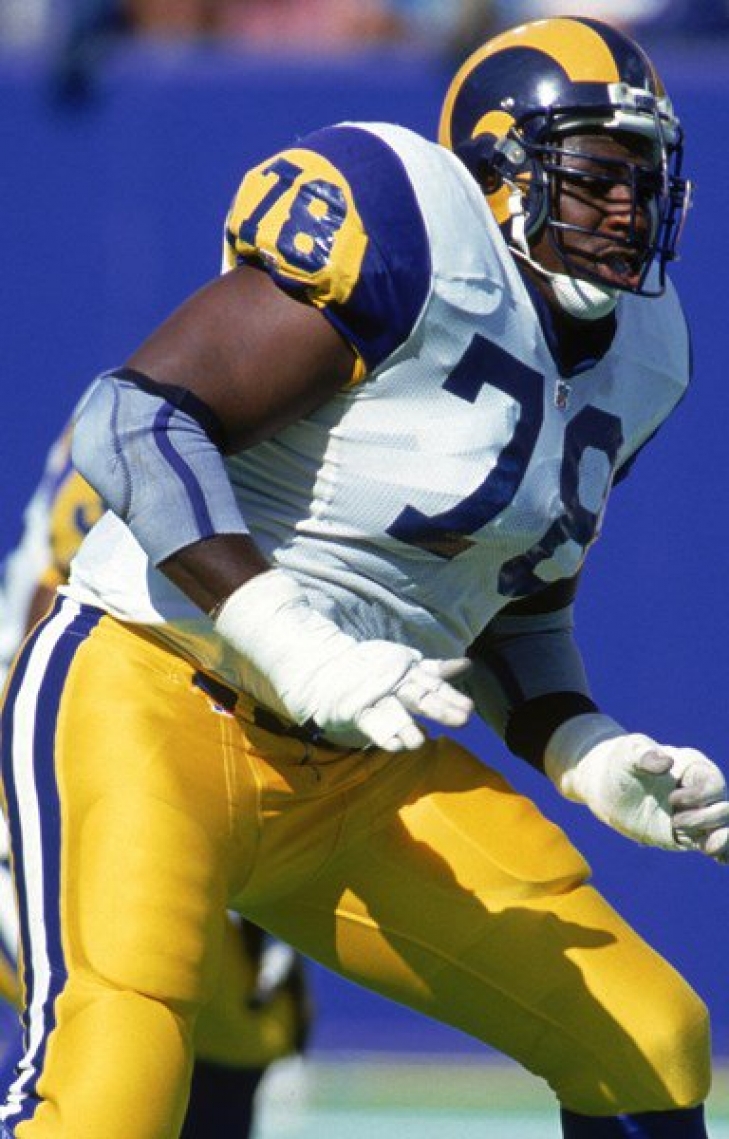
In terms of tenure, there are none in higher standing than Jackie Slater, who played 259 Games in the NFL (plus 18 more in the playoffs) for the Rams in a 20-year career that spanned from 1976 to 1995. Earning the starting Right Tackle job to commence the 1979 season, Slater would be a fixture there starting 211 of the next 211 games he played. Throughout the 1980s, Slater established himself in the upper echelon at his position going to the Pro Bowl seven Times and receiving three Second Team All-Pro Selections. There will never be a more durable player in franchise history than Slater.
