
The Pro Football Hall of Fame Revisited Project: 1958 FINAL VOTE

1958 Pro Football Hall of Fame Revisited Project Class.
Here we are! Again!!
If you have been following our Pro Football Hall of Fame Revisited Project, you know that we have asked the rhetorical question: What if the PFHOF began in January 1946?
After soliciting and obtaining a passionate group of football fans and historians, we sent out a ballot for a Preliminary Vote, in which we asked each voter to give us 25 names as their semi-finalists and 5 in the Senior Pool. Following that, we asked the group to vote for their 15 Finalists in the Modern Era and 3 in the Senior Category. The final stage was to vote for their five Modern Era inductee and one Senior inductee.
This is the result of the thirteenth official class;
Below are the final results of this project based on 30 votes,
Remember that the group took a vote, and we have reverted back to the top five candidates entering the Hall. This will be put to a vote again in “1960”.
This is for the “Modern Era”
*Bold indicates they have been elected to the Pro Football Hall of Fame Revisited Class of 1958:
Player | Year of Eligibility | Vote Total |
Sammy Baugh QB | 1 | 30 |
Bulldog Turner C-T-LB-G | 1 | 21 |
Bob Waterfield QB | 1 | 18 |
Tony Canadeo TB-HB | 4 | 11 |
Steve Owen T-G | 20 | 12 |
Wayne Millner E | 8 | 10 |
Mac Speedie E | 1 | 9 |
Whizzer White TB-HB | 12 | 7 |
Marshall Goldberg FB | 5 | 5 |
Buckets Goldenberg | 8 | 3 |
Ward Cuff WB-QB-HB | 6 | 3 |
Bill Osmanski FB | 6 | 3 |
Ken Kavanaugh E | 3 | 3 |
George Christensen T-G | 15 | 2 |
Ace Gutkowski FB-TB | 14 | 2 |
Woody Strode E | 4 | 1 |
This is for the “Senior Era”, *Bold indicates they have been elected to the Pro Football Hall of Fame Revisited Class of 1958, though no one made the mandatory 50% threshold to advance.
Tony Latone | 3 | 12 |
Hunk Anderson | 8 | 10 |
Al Nesser | 2 | 5 |
None of the Above | N/A | 3 |
About the 1958 Inductees:
Sammy Baugh QB-TB, WAS 1937-52: Inducted in 1958 on his 1st Ballot. Inducted into the actual Pro Football Hall of Fame in 1963.
In 1937, The Boston Redskins relocated to Washington, and that year's First Round Pick was Sammy Baugh. Baugh was initially listed as a Tailback, but passing was not the norm. But he became one of the first accurate passers and the prototype for the modern Quarterback. He won two NFL Championships for Washington (1937 and 1942), and he led the NFL in Pass Completion Percentage eight times, Passing Yards four times, Touchdown Passes twice and Passer Rating three times.
Baugh was not just a Quarterback; he was also an excellent Punter. Before he was exclusively playing offence, he netted 31 interceptions on the defensive side of the ball. In the Pro Football Hall of Fame, Baugh may not be the best Quarterback, but historically speaking, he is considered the most important.
Bulldog Turner C-T-LB-G, CHI 1940-52: Inducted in 1958 on his 1st Ballot. Inducted into the actual Pro Football Hall of Fame in 1966.
Clyde “Bulldog” Turner lived up to his nickname, playing at Center and Linebacker in a ferocious and skilled fashion.
Turner was a First-Round Pick in 1940 and played his entire career in Chicago. He was one of the best blockers in the decade, and his freak athleticism matched anyone on the field. Turner proved to be the lynchpin to four NFL Championships and was also the league leader in Interceptions (8) in 1942.
Bob Waterfield QB-K-P, RAM 1945-52: Inducted in 1958 on his 1st r Ballot. Inducted into the actual Pro Football Hall of Fame in 1965.
Bob Waterfield had one of the most remarkable rookie seasons as a quarterback in NFL history. He graduated from UCLA and led the league in touchdown passes (14), was named the Most Valuable Player (MVP), and took the Cleveland Rams to an NFL Championship by defeating Sammy Baugh and the Washington Redskins.
After the Rams relocated to Los Angeles, Waterfield remained with the team until he retired in 1952. He was a three-time First Team All-Pro and led the Rams to another NFL Championship in 1951. Additionally, he played defensive back during the first half of his professional career and was an exceptional kicker and punter in the pros.
Tony Canadeo HB-TB-FB-DB, GNB 1941-52: Inducted in 1958 on his 1st r Ballot. Inducted into the actual Pro Football Hall of Fame in 1974.
One of the most versatile players in Green Bay Packers history, Tony Canadeo did it all for the team. As an NFL Champion in 1944, Canadeo became the third player in the NFL to rush for over 1,000 yards and the first Packer to do so. He would play good defense, was their kick returner, and was occasionally used as a Quarterback.
Steve Owen T-G, KAN 1924-25, CLE 1925, NYG 1026-33: Inducted in 1958 on his 20th Ballot. Inducted into the actual Pro Football Hall of Fame in 1966 as a Coach.
Owen was inducted into the actual Hall of Fame as a Coach, but that section has been paused until 1963, and you elected him on his last “Modern” ballot as a player. Named to the 1930’s All-Decade Team as a player, he was the captain of the team that won the 1927 NFL Championship, and in 1930 he became a player/coach. Owen held that latter role until 1953, and won two more NFL Championships.
8. Bob Waterfield
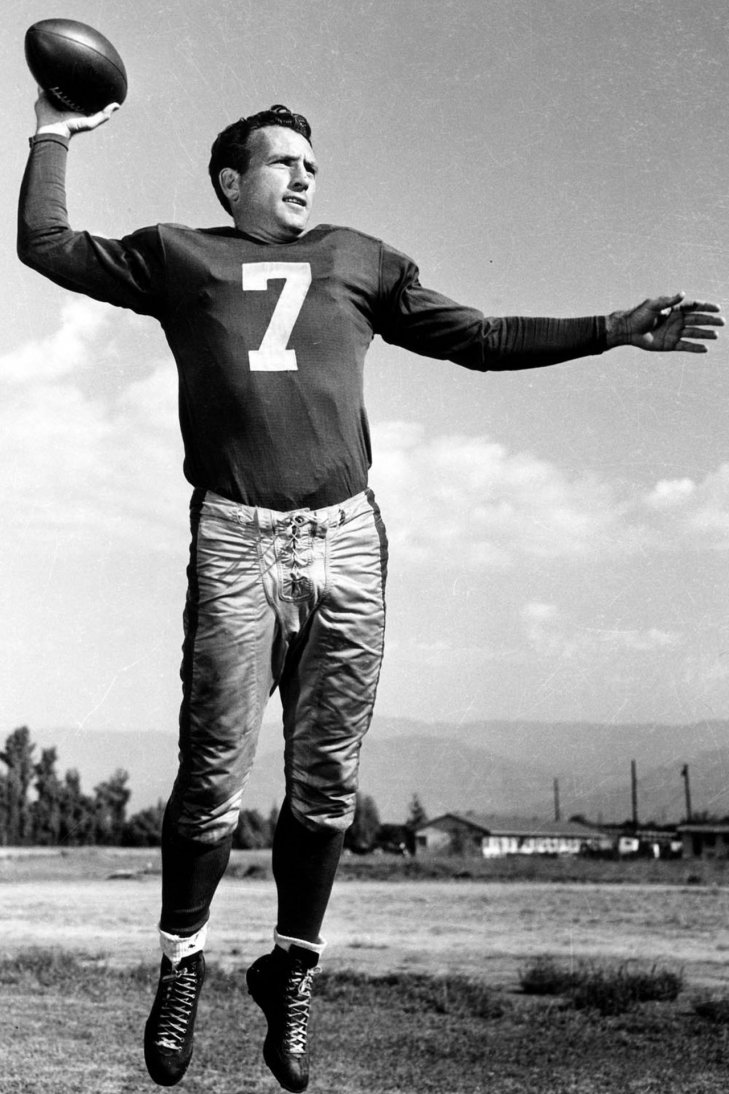
Selected in the fifth round (42nd overall) of the 1944 NFL Draft out of UCLA—where he led the Bruins to their first Rose Bowl appearance—Bob Waterfield stepped into professional football and delivered one of the most remarkable rookie campaigns in gridiron history. Debuting for the Cleveland Rams in 1945, the multi-talented phenom led the league with 14 touchdown passes while guiding the franchise to a 9–1 record and a 15–14 victory over the Washington Redskins in the NFL Championship Game. For his extraordinary debut, Waterfield was named NFL Most Valuable Player, becoming the first rookie in league history to capture the award.
Waterfield was the quintessential triple-threat star of pro football's single-wing transition era, influencing games on offense, defense, and special teams. Beyond his aerial distribution at quarterback, he served as the team's primary placekicker and punter, leading the league in field goals twice and average punting yards in 1948. On defense, his ball-hawking instincts at defensive back produced 20 career interceptions across eight seasons, showcasing an all-around athletic versatility modern football rarely sees.
After their 1945 title, the Rams relocated west to become the Los Angeles Rams in 1946, and Waterfield quickly became a Southern California sports icon. He picked up right where he left off in his new home, finishing second in passing yards (1,747) and throwing a league-high 17 touchdown passes while earning his second consecutive First-Team AP All-Pro selection. Off the field, his star power burned just as brightly when he married Hollywood superstar Jane Russell, turning the couple into one of Los Angeles's original glamour pairings.
While his statistical efficiency fluctuated in subsequent campaigns, Waterfield regained top form in 1949 to earn his third First-Team AP All-Pro selection after leading the NFL with 1,608 passing yards and 23 touchdown passes. He remained at the top of his game as the league entered the 1950s, earning selections to the first two Pro Bowls in 1950 and 1951. His steady leadership in the pocket helped propel Los Angeles to three straight NFL Championship Game appearances from 1949 through 1951.
The peak of the Rams' Southern California revival arrived in 1951, when Waterfield anchored a high-powered offense that captured the NFL Championship with a 24–17 victory over the Cleveland Browns. Managing the offense alongside head coach Joe Stydahar, Waterfield shared signal-calling duties with fellow future Hall of Famer Norm Van Brocklin, creating a lethal two-quarterback system that confounded opposing defensive coordinators and produced one of the most prolific passing attacks of the mid-century era.
Waterfield played one final season in 1952, splitting snaps with Van Brocklin before retiring at age 32 to transition into film production and coaching. He later returned to the franchise as head coach of the Los Angeles Rams from 1960 to 1962. In 1952, the Rams honored his foundational contributions by officially retiring his #7 jersey, ensuring no future Ram would wear his iconic number.
His legacy as one of football's greatest pioneers was permanently sealed in 1965 when he was enshrined in the Pro Football Hall of Fame in Canton, Ohio.
With the Rams, he threw for 814 completions on 1,617 attempts, 11,849 passing yards, and 97 touchdown passes, plus 60 field goals, 315 extra points, and 20 defensive interceptions.
