

25. Tony Mullane

Mullane arrived in Cincinnati as a seasoned veteran of the professional game and immediately matured into the centerpiece of the rotation. He was a pioneer in every sense, most famously for his ability to throw with either hand, a switch-pitching prowess that allowed him to alternate arms based on a hitter’s weakness or to combat the immense fatigue of the era. He emerged as a statistical titan from the moment he joined the club, using this tactical outlier to navigate a grueling schedule that would break most arms.
The absolute pinnacle of his effectiveness was reached in the late 1880s, a period when he served as an iron man for the franchise. Mullane was a master of endurance, spanning three seasons in which he surpassed 400 innings pitched, a workload that stands as a monument to his physical resilience. He wasn't just piling up innings; he was an efficiency machine who secured five separate 20-win campaigns and a pair of extraordinary 30-win seasons for the Reds. He possessed a rare blend of speed and deception that made him a perennial threat on the leaderboard and served as the high-stakes anchor for the Cincinnati staff during its formative years.
His identity was synonymous with a refined, "gentlemanly" persona that made him a massive draw at the gate, though he played with a fierce, competitive resolve that often put him at odds with management. Mullane was the tactical heartbeat of the team for nearly a decade, using his unique arm flexibility to remain a high-leverage producer even as the rules of the game evolved around him. Whether he was baffling a hitter with a left-handed curve or overpowering them with a right-handed heater, he competed with a professional poise that made him a local immortal.
The chapter concluded in 1893, when the veteran workhorse finally parted ways with the organization. He left the city as a statistical pillar and one of the most prolific winners in the history of the sport, having secured 163 of his 284 career victories in a Cincinnati uniform.
While his lack of a plaque in Cooperstown remains one of the great debates of the 19th-century game, his impact on the franchise was finally etched in stone a century later. In 2010, the organization provided the long-overdue punctuation on his legacy by inducting Tony Mullane into the Cincinnati Reds Hall of Fame.
24. Tony Mullane
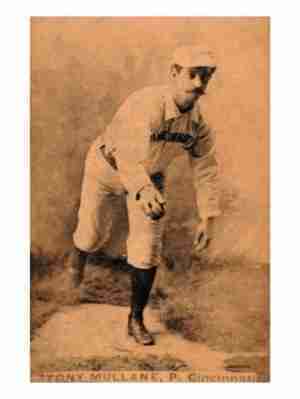
How many people pointed at Bert Blyleven’s 287 career wins year after year and championed his Hall of Fame cause? We don’t know the exact number, but we are sure that it is a lot more than those who created logs extolling the virtues of Tony Mullane’s 284 Major League victories.
Maybe people should marvel at those wins. Mullane was an ambidextrous hurler who could easily baffle batters, as back in his day, pitchers did not wear gloves, thus they had no idea which arm he would throw with. Mullane was an innings-eater who recorded 30 wins on multiple occasions. Like many in his day, Mullane was a very much a free spirit who challenged the reserve clause, was suspended for the 1885 season, and sat out part of the 1892 season in protest over pay cuts. This may have cost him the magical 300-win number, and the fact that he played in the American Association (and not the National League) and had subpar seasons late in his career has made the switch-pitching Tony Mullane a distant afterthought among the folks at Cooperstown.
Should Tony Mullane be in the Hall of Fame?
