

Site Admin
78. Rod Smith

It is one thing to be highly touted out of college and rack up serious statistics in the National Football League. It is quite another to do that when you go undrafted. Rod Smith lit up the league when nobody saw it coming.
After going virtually unnoticed at Missouri Southern State, Rod Smith was signed by the Denver Broncos and, by his third year, fought his way to the starting roster. He would go for 1,000 receiving yards eight times in his stellar career and was a huge part of the Broncos winning two consecutive Super Bowls.
Rod Smith may be overlooked as his offensive stats came at a time when many others accomplished the same, but no one can ever take away that he will go down as one of the good guys of the game and has earned his respect in the Rocky Mountains. A model of consistency, Smith might be the most overlooked wide receiver of all time, and think what company that keeps?
Should Rod Smith be in the Hall of Fame?
36. Tommy Nobis
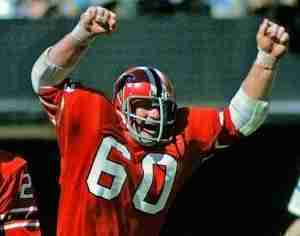
In the first incarnation of our Football list, how could we forget about a legendary Atlanta Falcon? Granted, there have not been that many in the past history of the Falcons, but we may very well have forgotten about a solid Linebacker in Tommy Nobis, who was easily the first bright spot of the Southern franchise.
As one of the finest linebackers in collegiate history, Tommy Nobis was the first draft pick (and first overall of 1966) for the expansion Atlanta Falcons. Nobis was a feared tackler and was the star of the early Falcons defensive squads. He was a Pro Bowler in his first three seasons and would lead the Falcons in tackles on nine occasions.
Tommy Nobis is justifiably placed in the Falcons Ring of Honor, but he was not as dominant in the Pro ranks as he was at college. His post-career accolades will likely never leave the state of Georgia, though the Finalist slot at the 100th Centennial Class offers hope.
Should Tommy Nobis be in the Hall of Fame?
53. Bret Saberhagen
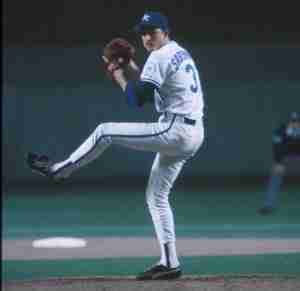
Baseball Players are notorious for being superstitious. We really don’t know if Bret Saberhagen consulted the Psychic Friends Network, but it always seemed curious that he performed significantly better in years that ended in odd numbers than he did in even ones.
Saberhagen is one of the rare pitchers in Major League history to win two Cy Young Awards. When he was on, Saberhagen exercised pinpoint control and often performed well in pressure situations, as evidenced by his 1985 World Series performance. The problem with Saberhagen, though, is that despite his two Cy Young Awards, the rest of his campaigns were basically average. He was an All-Star only three times, which is a little surprising considering the two dominant campaigns that he had. Basically, you would think that he was capable of having at least a few “Very Good” seasons, but he didn’t exactly accomplish that.
It isn’t likely that the Veterans Committee will be calling, but given the individual and team accolades Bret Saberhagen achieved, he likely retired feeling his career goals were accomplished.
Should Bret Saberhagen be in the Hall of Fame?
92. Tommy Leach
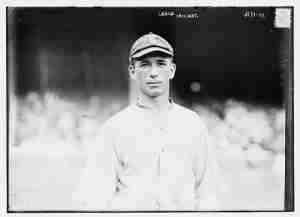
How many times is an athlete described as “small in stature but big in heart”? This analogy has been used more times than we can determine, but far too often, and it was an accurate assessment when describing the turn-of-the-century ballplayer Tommy Leach.
“Wee” Tommy Leach was a triples machine and one of the fastest ballplayers of his day. Leach hit a few Home Runs in the dead-ball era, though most of them were of the inside-the-park variety. For all intents and purposes, Leach was a power hitter and often cleared the bases, or would himself get on base for the legendary Honus Wagner, who batted behind him during his heyday in Pittsburgh. It was fitting that it was Tommy Leach who would get the first hit and first run in World Series history. Injuries would catch up to him by 1910, and he wasn’t the same player, but Leach is a forgotten star in the first century of the 1900’s.
Should Tommy Leach be in the Hall of Fame?
