


Site Admin
312. Natasha Hansen

311. Paula Creamer

18. Ruben Sierra
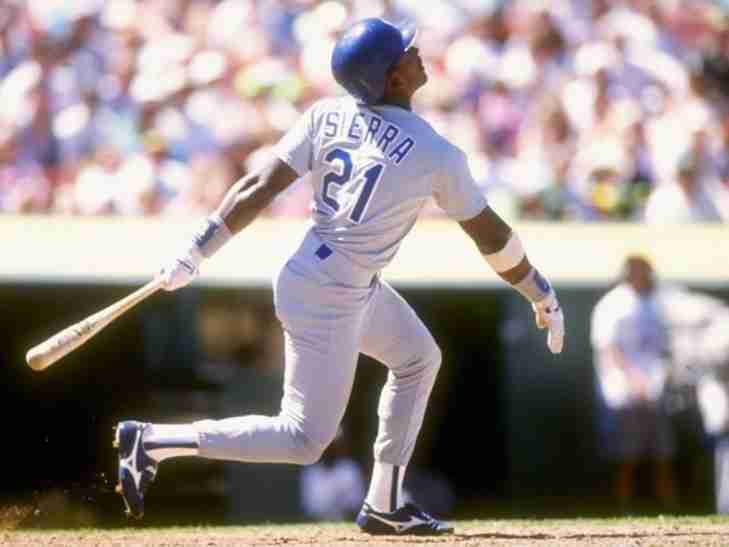
When 18-year-old Rubén Sierra first came to Arlington from Puerto Rico, he brought a powerful, switch-hitting style that aimed to transform the Texas batting lineup. With a quick, explosive swing and exceptional athletic ability, this young outfielder quickly matured from a raw talent into a top American League star, leading the team's offense in the late 1980s.
His early years with the Rangers were marked by remarkable achievements, especially during the breakout campaign of 1989. Sierra dominated the junior circuit that summer, hitting 29 home runs and leading the major leagues with 119 RBIs, 14 triples, and 343 total bases. His aggressive batting style earned him a league-high .543 slugging percentage, his first Silver Slugger Award, and a starting spot in the All-Star Game. Although he narrowly lost the AL MVP to Robin Yount in a close vote, finishing second, Sierra had already established himself as one of baseball’s most formidable offensive players.
He sustained that elite baseline over the next few summers, earning two more All-Star nods and routinely clearing the 20-home run mark. However, with his contract nearing its end and the front office looking to shore up the pitching staff, his first stint concluded in shocking fashion at the 1992 August trade deadline. In a blockbuster challenge trade that shook the sport, Texas packaged their star slugger to the Oakland Athletics in exchange for an elite, high-profile package centered around former dynamic MVP and home run king José Canseco.
After a decade-long journey that saw him suit up for seven different franchises, the gravitational pull of Arlington brought the veteran home in 2000. Sierra returned for a highly productive second act, flashing his vintage power to blast 34 home runs over a two-season reunion stretch and capturing the 2001 AL Comeback Player of the Year award. He hit free agency again that winter and signed with Seattle, but his connection to the Rangers wasn't quite finished.
In February 2003, the franchise welcomed Sierra back for a brief, unexpected third stint. Serving primarily as a designated hitter and veteran bench bat, he provided a steady hand over 43 games, adding three more home runs to his franchise tally. By June, with the rebuilding Rangers looking to inject youth into the roster and the New York Yankees hunting for a proven switch-hitting weapon for their pennant push, Texas traded the veteran to the Bronx in exchange for a young Marcus Thames.
Across 11 seasons in Texas (1986–1992, 2000–2001, 2003), Sierra played 1,178 games, with 1,208 hits, 183 home runs, 754 RBIs, and 77 stolen bases, posting a .270/.322/467 slash line (114 OPS+). He was inducted into the Rangers Hall of Fame in 2009.
10. Josh Hamilton
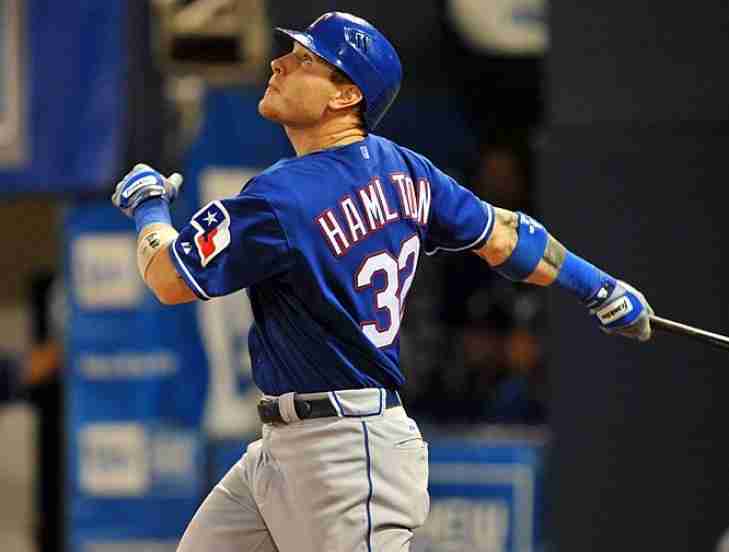
The revival of Josh Hamilton’s baseball career stands as one of the most remarkable and cinematic human-interest narratives in the annals of contemporary sports. Selected first overall in the 1999 draft by the Tampa Bay Devil Rays as a renowned five-tool talent, his career was notably disrupted by severe substance abuse issues, resulting in over three years of absence from the sport. Following a brief period of redemption through a Rule 5 draft appearance with Cincinnati in 2007, he was subsequently acquired by the Texas Rangers during a December transaction. Upon entering the intense summer heat of Arlington, his innate baseball brilliance was fully realized, establishing him as a pivotal middle-of-the-order superstar and fundamentally transforming the organization into a formidable powerhouse.
Hamilton’s time with the Rangers was marked by an extraordinary level of offensive power. During his breakout in 2008, he quickly gained the admiration of fans by leading the American League with 130 RBIs and impressing the nation with a remarkable, 28-home-run performance at the Yankee Stadium Home Run Derby. Each time he made contact, the ball produced a unique, powerful sound that few could mimic, earning him three Silver Slugger Awards in his first five seasons with Texas.
His unequivocal professional masterpiece emerged during the remarkable 2010 campaign. Operating with an exceptionally aggressive approach, Hamilton completely dominated Major League Baseball's pitching staffs, securing the American League batting title with a record-setting .359 average and leading all of baseball with an astounding .633 slugging percentage. He combined this remarkable efficiency at the micro level with 32 home runs and 100 RBIs, thereby earning the 2010 American League Most Valuable Player Award despite missing the majority of September due to a fractured rib. Hamilton transferred that excellence from the regular season directly into October, hitting four home runs with seven RBIs against the New York Yankees to be named the 2010 ALCS Most Valuable Player and guiding the Rangers to their inaugural pennant in franchise history.
Hamilton demonstrated remarkable consistency in maintaining elite performance over the subsequent two summers, contributing significantly to the Rangers securing their second consecutive American League pennant in 2011. In 2012, he achieved a career-high of 43 home runs and 128 RBIs. Notably, during that year, he exhibited one of the most explosive single-game performances in baseball history: on a May night in Baltimore, he hit four two-run home runs within a single game, establishing an American League record with 18 total bases. After a highly turbulent two-year period as a free agent with division-rival Los Angeles Angels, Hamilton returned to Texas for a final, emotionally significant 50-game tenure in 2015. Nevertheless, persistent knee injuries ultimately compelled him to retire from the sport.
Hamilton compiled 744 hits, 150 home runs, and a spectacular .302/.359/.542 slash line over 647 games. Texas inducted Hamilton into their franchise Hall of Fame in 2019.
