


Site Admin
1. Barry Sanders
Witch Doctor
David Seville
Witch Doctor
48. Danny Darwin
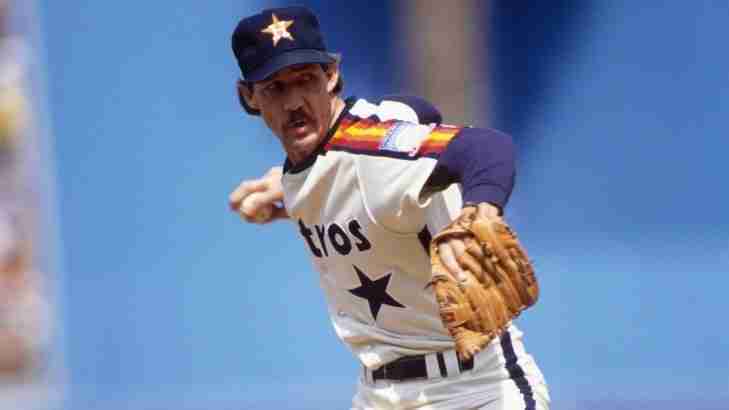
Danny Darwin arrived in the Houston organization via a mid-1986 trade from Milwaukee, providing an immediate spark for the division-winning "Mike Scott Era" staff. Known by the chilling nickname "Dr. Death" for his intense competitive fire and willingness to protect his teammates, Darwin spent six seasons in the Space City across two different stints.
The best season of Darwin’s Astros run was in 1990. That summer, he demonstrated a specialized ability to dominate in any capacity, appearing in 48 games but making only 17 starts. He showed the organization he was a foundational ace by leading the National League with a 2.21 ERA and a major league-best 1.027 WHIP, making him the third Astro in five years to claim the league's ERA crown. This specialized "swingman" dominance earned him the 1990 Houston Astros MVP award.
His first tenure was defined by high-frequency reliability; between 1986 and 1990, he provided the club with nearly 700 innings of quality work while primarily neutralizing right-handed hitters. After leaving for a four-year contract in Boston, everything culminated in a brief, nostalgic return in 1996. Acquired from the Pirates in a July trade, the 40-year-old veteran showed the organization he was still a professional by helping the club during the final two months of the season, recording his final three wins in a Houston uniform to finish his Astros career with a combined 47-35 record.
49. Mike Cuellar
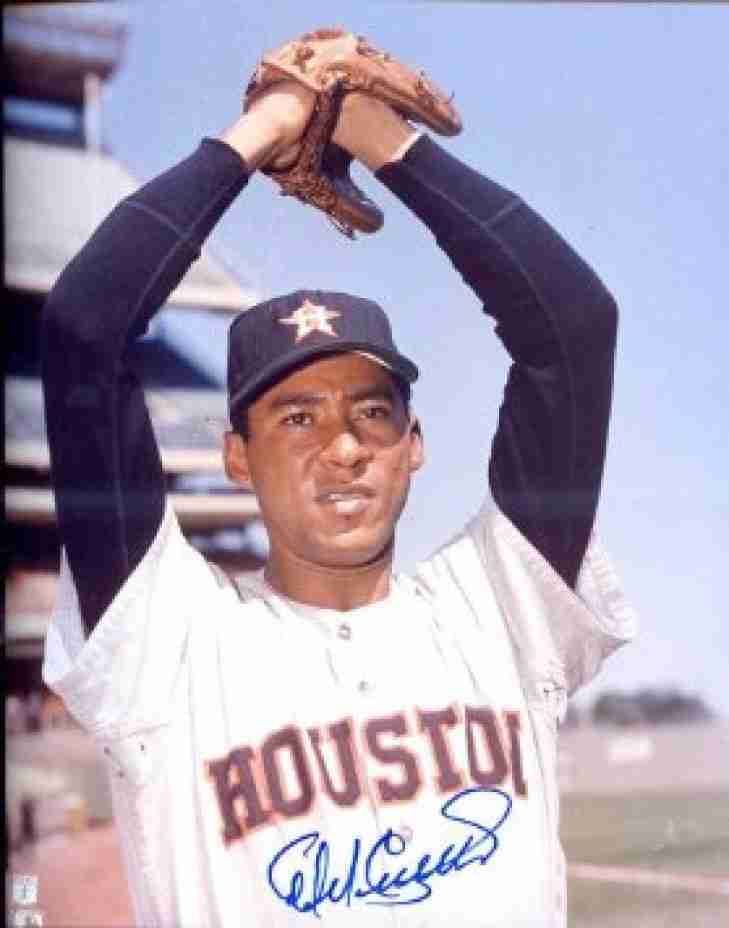
Mike Cuellar arrived in the Houston organization in mid-1965 via a trade with the St. Louis Cardinals, a crafty left-hander who had spent years searching for a permanent home in the Major Leagues. While he would later become a legend in Baltimore, it was in the Space City where he truly refined his specialized repertoire, most notably a darting screwball that baffled National League hitters.
Cuellar reached his first peak of individual efficiency during a brilliant 1966 campaign. That summer, he demonstrated a specialized ability to suppress runs, recording a 2.22 ERA that ranked second in the National League only to the legendary Sandy Koufax. He showed the organization he was a foundational professional by throwing over 200 innings and proving that his frequent use of the screwball made his fastball appear significantly faster than its actual velocity.
The season after, Cuellar recorded a career-high 16 wins and was selected to his first career All-Star Game, where he tossed two shutout innings in Anaheim. He showed the organization he was a foundational workhorse by leading the staff with 16 complete games and recording a career-best 203 strikeouts. Despite a dip in run support during the 1968 season, he remained highly effective, maintaining a specialized 2.74 ERA and providing a veteran presence for a young rotation that included Larry Dierker and Don Wilson.
Cuellar’s stay in Houston ended in a 1968 trade to the Baltimore Orioles in exchange for Curt Blefary. The move, often cited as one of the most lopsided in Astros history, was driven by a desire for more offensive production in Houston, but it also allowed Cuellar to reach his ultimate potential, during which he won the 1969 Cy Young Award and a World Series title.
As an Astro, Cuellar had wins, 557 strikeouts, and a 2.74 ERA.
