


Site Admin
35. Steve Foley
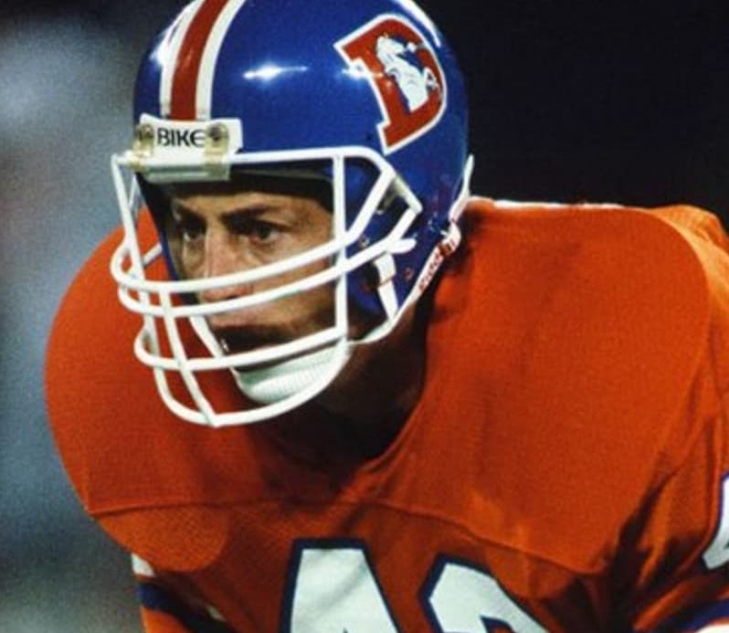
A converted college quarterback out of Tulane, Steve Foley entered pro football with a lot to prove at defensive back. Selected by Denver in the eighth round of the 1975 draft, he spent his first professional season with the Jacksonville Express of the short-lived World Football League to learn the defensive secondary. When the WFL folded, Foley arrived in Mile High in 1976 and immediately proved his instincts and ball-tracking skills were tailored for the NFL.
Foley's fluid athleticism allowed him to excel at both cornerback and safety over his decade-plus career. He became a central pillar of the legendary "Orange Crush" secondary, earning a starting job during his 1976 rookie campaign and intercepting Hall of Famer Dan Fouts twice in his second career start. His preparation and range helped anchor a defense that captured six playoff berths and four AFC West titles during his tenure.
His longevity stood out across two distinct eras of franchise success. Foley is one of only three Broncos to start in both of the team's first two Super Bowl appearances—starting at cornerback in Super Bowl XII and returning as a safety in Super Bowl XXI for the final game of his career. Foley logged five separate seasons with at least five interceptions. He generated two defensive touchdowns in 1984 alone—including a memorable fumble return score during "The Blizzard Game" against Green Bay on Monday Night Football.
Over his career, Foley compiled 44 interceptions, 622 return yards, 877 combined tackles, four fumble recoveries, and two defensive touchdowns and is still the all-time pick leader for the squad. Foley was inducted into the Broncos Ring of Fame in 2024.
37. Ken Lanier
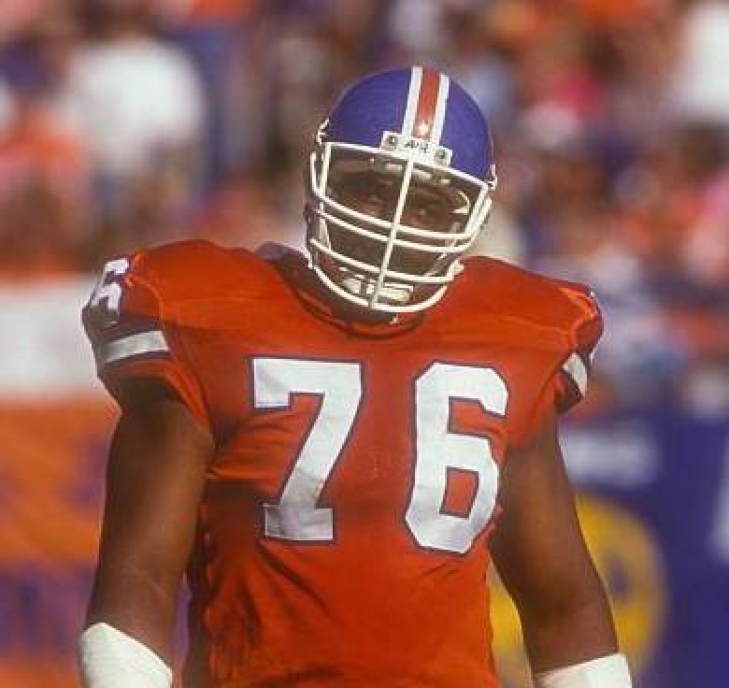
When the Denver Broncos selected Ken Lanier in the fifth round of the 1981 draft out of Florida State, nobody expected a late-round flyer to become a decade-long fixture on the offensive line. After using his rookie year to adapt to the speed of the pro game, Lanier took over as the starting right tackle in 1982 and locked down the position for nearly the next decade.
Lanier’s promotion to the starting lineup coincided perfectly with the arrival of John Elway in 1983, making the right tackle Elway's primary front-side protector during his legendary early scrambles and fourth-quarter comebacks. Lanier proved to be a durable iron man, stringing together 178 consecutive starts (including postseason play) while rarely surrendering a snap. From 1982 through 1992, he missed just four regular-season games, anchoring an offensive line undergoing constant retooling around him.
His consistent performance was crucial to Dan Reeves' offense, guiding Denver through three AFC Championship appearances and starting at right tackle in Super Bowls XXI, XXII, and XXIV. Showing leadership in the locker room, his teammates chose him as a team captain for Super Bowl XXIV.
Following a brief two-game stint with the Los Angeles Raiders in 1993, Lanier returned to Mile High for a final four-game run in 1994 to finish his career where it all started. Overall, he started 165 games for the team.
36. Haven Moses
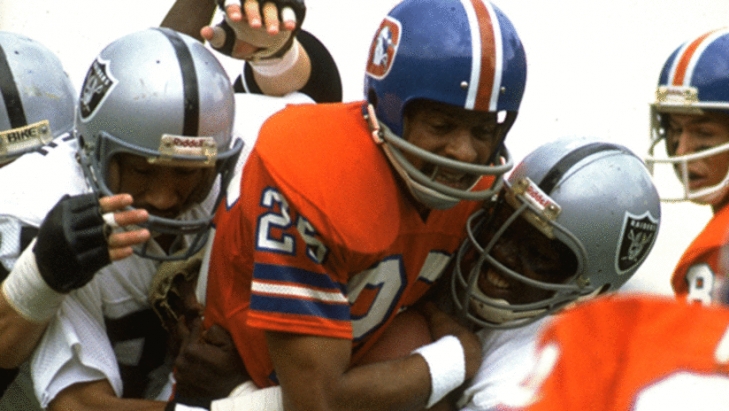
Acquired midseason in 1972 from the Buffalo Bills in exchange for wideout Dwight Harrison, Haven Moses quickly turned a straight-up trade into one of the most lopsided swaps in early franchise history. A former first-round pick out of San Diego State, Moses possessed long stride length and an uncanny ability to track deep balls over his shoulder, giving the Broncos a perimeter weapon capable of stretching defenses at any moment.
Moses wasted little time making his presence felt in Colorado. During his first full season in 1973, he snagged a career-high eight touchdown passes to lead Denver to its first winning season in franchise history, earning his second career Pro Bowl nod. Operating as Craig Morton’s primary deep target in the late 1970s, Moses teamed up with the quarterback to form the "M&M Connection," providing the explosive counterpunch to Denver’s stifling "Orange Crush" defense.
His defining moment in Mile High came on the biggest stage imaginable during the 1977 AFC Championship Game against the rival Oakland Raiders. Moses turned in a historic postseason performance, hauling in five receptions for 168 yards and two touchdowns—including a 74-yard bomb—to propel the Broncos to a 20-17 victory and secure the franchise's first-ever Super Bowl trip.
Moses retired after the 1981 season and, as a Bronco, compiled 302 receptions, 5,450 receiving yards, and 44 receiving touchdowns. He was inducted into the Denver Broncos Ring of Fame in 1988.
24. Rick Upchurch

Taken in the fourth round of the 1975 NFL Draft out of Minnesota, Rick Upchurch arrived in Denver as a blazingly fast athlete whose multi-purpose speed gave opposing special teams coordinators sleepless nights. While he operated as a vertical threat at wide receiver—averaging a whopping 16.4 yards per catch over his career—his true magic happened with the football in his hands on punt and kickoff returns. Whenever #80 trotted out to field a punt at Mile High, the stadium erupted in anticipation of an instant touchdown.
Upchurch took the league by storm in 1976 when he set an NFL record by returning four punts for touchdowns in a single season—a mark that remains unbroken to this day. That electrifying campaign launched a legendary run where he was named a First-Team All-Pro three times (1976, 1978, 1982) and earned four Pro Bowl nods. In 1977, his league-leading 653 punt return yards helped fuel the "Orange Crush" era all the way to Super Bowl XII, where Upchurch provided Denver's spark with a then-Super Bowl record 67-yard kickoff return that set up the team's only touchdown.
Though return duties were his primary claim to fame, Upchurch grew into a highly capable starting receiver as well. His offensive peak arrived in 1979 when he led the Broncos across the board with 64 receptions, 937 receiving yards, and seven touchdown catches. Rare versatility defined his entire nine-year run in Denver, as he led the NFL in punt return average twice (1978, 1982) and was selected to both the NFL's 1970s and 1980s All-Decade Teams—the only player in Broncos franchise history to earn inclusion on two separate All-Decade rosters.
By the time he hung up his cleats following the 1983 season, Upchurch retired as the NFL's all-time career leader in punt return yards and tied for the most career punt return touchdowns (eight). Upchurch played in 119 regular-season games with 69 starts. He compiled 267 receptions, 4,369 receiving yards, 24 receiving touchdowns, 3,008 punt return yards (8 TDs), 2,355 kickoff return yards, and 10,081 all-purpose yards. The Broncos inducted Upchurch into their Ring of Fame in 2014.
