


Site Admin
The Buck Stops Here -- Hall of Fame News -- Season 1 Episode 35
5. Mel Renfro
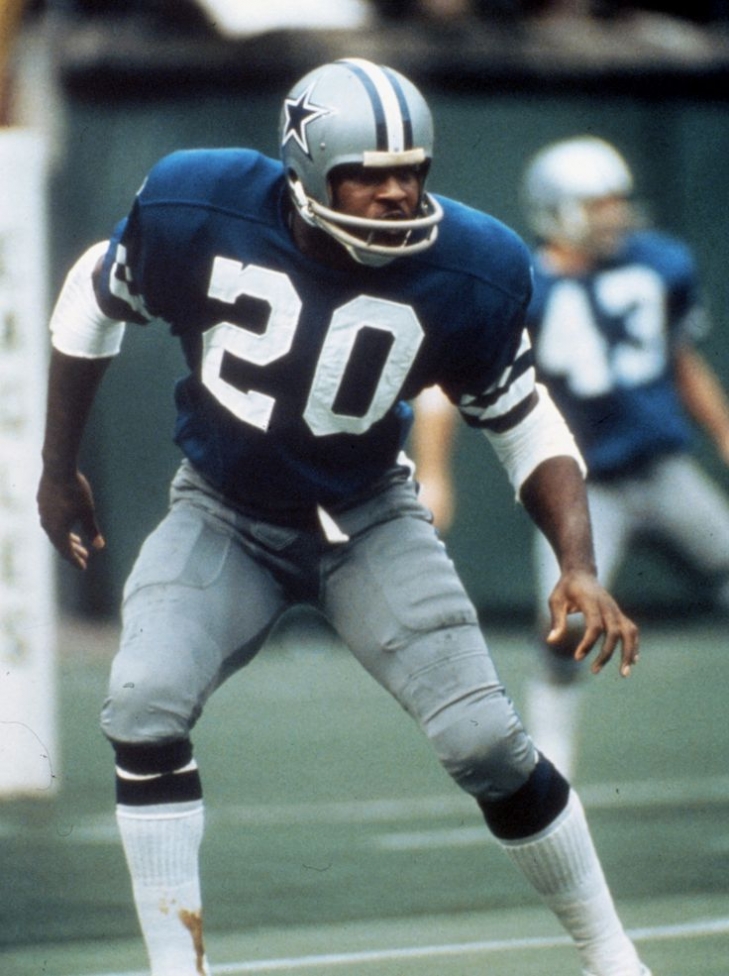
Taken in the second round (17th overall) of the 1964 NFL Draft from Oregon, Mel Renfro joined the Dallas team with a background as a standout collegiate running back and track star. Head coach Tom Landry quickly saw how his speed and natural instincts on the field could boost the Dallas secondary, so he transitioned him into a defensive back. During an impressive 14-season career all with Dallas, Renfro proved Landry's foresight true by becoming one of the most talented and adaptable players in NFL secondary history.
Renfro demonstrated exceptional acceleration, seamless hip transitions, and superior ball-tracking instincts developed through experience on the track and in the backfield. He transitioned effortlessly from safety to cornerback during his career, effectively neutralizing deep vertical threats and compelling opposing quarterbacks to avoid his side of the field. His background as a ball-carrier enhanced his threat level following turnovers, as he reliably converted interceptions and kickoff returns into immediate scoring opportunities.
Renfro made an immediate impact during his rookie season in 1964, leading the National Football League in punt returns (29), punt return yards (418), kickoff returns (40), and kickoff return yards (1,017), while also intercepting seven passes. This outstanding debut earned him his first Pro Bowl selection and initiated an impressive streak of ten consecutive Pro Bowl appearances from 1964 to 1973. He reached his personal statistical zenith in 1969, leading the NFL with 10 interceptions for 222 return yards and one touchdown, thereby earning First-Team All-Pro honors.
Renfro dedicated the initial phase of his career to establishing himself as the premier free safety within the league; however, Tom Landry’s defensive scheme necessitated utmost adaptability. In 1970, Landry made the strategic and decisive choice to reassign Renfro to the position of cornerback to better contend with the league's swift split ends. The transition was executed flawlessly. Leveraging his exceptional speed in track recovery and meticulous boundary technique, Renfro effectively covered half the field for opposing passers. His proficiency in restricting primary targets through man-to-man coverage permitted Landry to fully activate the formidable capabilities of the "Doomsday Defense" front line.
Beyond his individual accolades, Renfro was the common denominator across the most iconic era in franchise history. He played in an astounding 21 playoff games for Dallas, appeared in four Super Bowls, and served as a steadying veteran presence as the secondary transitioned between generations. He started at cornerback in Dallas's victory over Miami in Super Bowl VI and contributed to another championship triumph in Super Bowl XII against Denver to cap off his career.
Renfro hung up his cleats following the 1977 season and played all 174 of his career games exclusively in Dallas. His 52 career interceptions remained the Dallas Cowboys' all-time franchise record for decades, while his 62 total takeaways (including 10 fumble recoveries) showcased his relentless nose for the football.
Over his career, Renfro recorded 52 interceptions, 13 fumble recoveries, and 2,246 return yards. In 1981, the franchise recognized his immense contributions by inducting him into the Dallas Cowboys Ring of Honor. His career reached the ultimate pinnacle in 1996, when he was enshrined in the Pro Football Hall of Fame.
4. Randy White
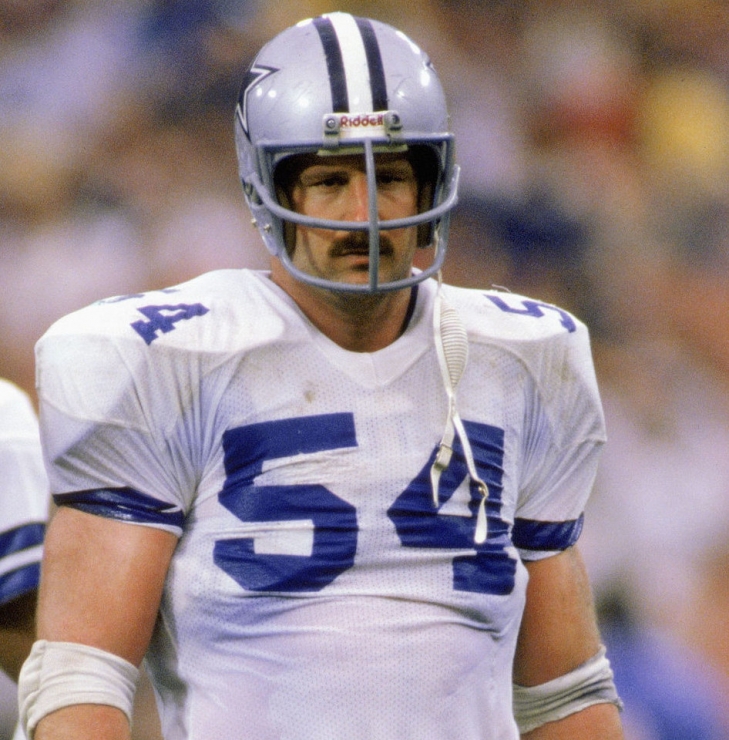
Selected second overall in the 1975 NFL Draft from Maryland—where he was awarded the Outland Trophy, Lombardi Award, and ACC Player of the Year honors as a distinguished college athlete—Randy White joined Dallas as a highly valued defensive prospect. Following two transitional seasons playing at linebacker, White was repositioned to right defensive tackle in 1977, a move that unlocked his full potential and initiated a legendary career, earning him the nickname "The Manster" (a combination of man and monster).
White established a new standard for interior defensive line performance. Demonstrating exceptional strength in the weight room, explosive initial speed, and a hand technique infused with martial arts, he consistently outpaced interior offensive linemen before they could establish their blocks. White was a persistent and relentless player who transformed quickness into power, forcefully disengaging from double-teams to collapse pockets, disrupt rushing plays, and pursue ball carriers from behind.
What distinguished White from nearly all defensive tackles of his era was his pioneering collaboration with renowned martial artist Dan Inosanto, integrating hand-fighting and strike-redirection techniques into his pass-rush repertoire. While conventional defensive tackles depended on sheer bulk, White employed rapid hand strikes, swim moves, and rip-swipes to deflect guards' hands before they could execute punches.
His low-center-of-gravity anchor enabled him to resist double-teams during running plays, while his relentless pursuit effort ensured that plays were never finished. Whether positioning himself directly over the center in Tom Landry's "Flex" defense or executing stunt rushes alongside the defensive end, White consistently maintained the opposing interior offensive lines in a continuous state of challenge throughout all four quarters.
In 1977, White's shift to right defensive tackle sparked an immediate breakout, taking over from Bob Lilly and anchoring Dallas' "Doomsday II" defense. This led to his first Pro Bowl and First-Team All-Pro selections. He reached the peak of his career in Super Bowl XII, dominating the Denver Broncos' offense in a 27–10 win. White recorded a sack and helped lead a defense that forced eight turnovers, sharing Super Bowl XII Co-MVP honors with teammate Harvey Martin—the only time in NFL history two players shared the award.
Building on his Super Bowl breakout, White embarked on a dominant six-year period, cementing his status as the top interior lineman in professional football. In 1978, he achieved a career-high 16.0 unofficial sacks and helped Dallas return to Super Bowl XIII. The following year, he recorded 10.0 sacks and earned another First-Team All-Pro honor, leading a defensive line that secured three straight NFC East titles.
When sacks officially became a stat in 1982, White did not slow down; he logged 6.0 sacks in an abbreviated nine-game strike season to earn his fourth First-Team All-Pro honor. In 1983, he delivered a statistical masterclass, racking up 12.5 official sacks and forcing three fumbles across 16 starts. Opposing coordinators routinely slid double-team help his way, yet White continually blew up backfields, recording double-digit sacks in three different seasons while disrupting both passing windows and running lanes.
White maintained his dominance into the mid-1980s, achieving his sixth and seventh First-Team All-Pro honors in 1984 with 12.0 sacks and in 1985 with 10.5 sacks. His tenth straight Pro Bowl appearance in 1986 cemented a ten-year run of top-tier performance rare among interior defenders.
Although sacks did not become an official NFL statistic until 1982, film reviews and team records credit White with 111.0 career sacks over his tenure—making him one of the most prolific interior pass rushers in league history.
In 1994, White received a double crown of football immortality: he was inducted into the Dallas Cowboys Ring of Honor and elected to the Pro Football Hall of Fame in his first year of eligibility. The NFL also named him to the 1980s All-Decade Team.
3. Roger Staubach
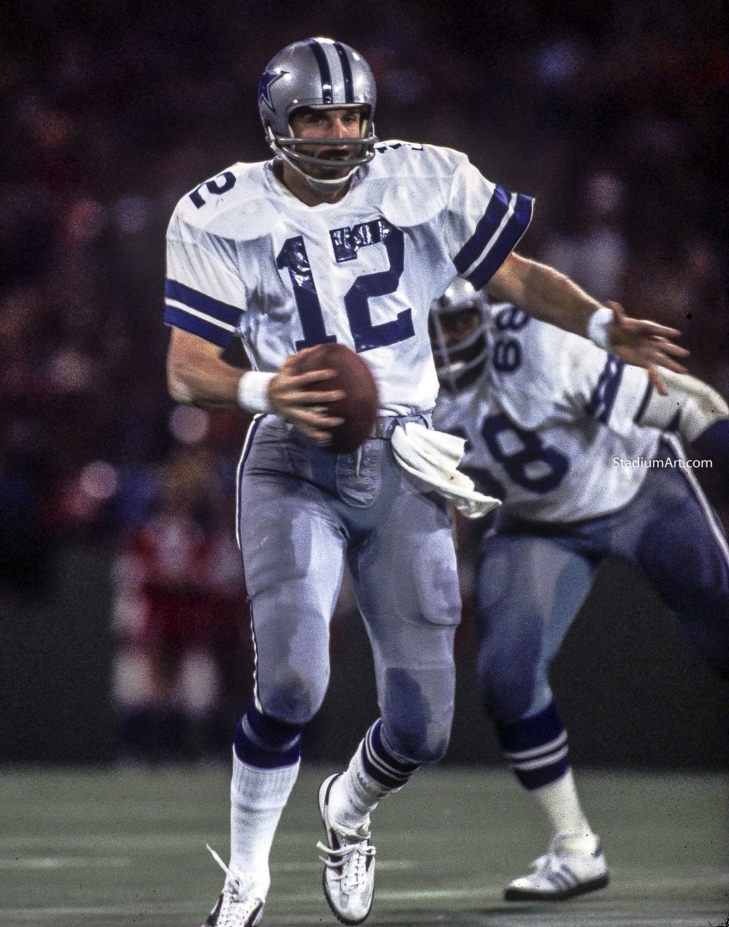
While a case could have been made for Roger Staubach to be at #1, #3 for this team still means you are an absolute legend.
Drafted in the tenth round of the 1964 NFL Draft from the Naval Academy—where he won the 1963 Heisman Trophy—Roger Staubach had to wait five years to start his professional football journey while fulfilling his active-duty military commitment, including a tour of duty in Vietnam. When he finally arrived in Dallas as a 27-year-old rookie in 1969, "Captain Comeback" quickly made up for lost time, leading the team through a string of exciting victories and guiding America's Team to the top of professional football.
Staubach infused Tom Landry's disciplined offense with a fervent and competitive spirit. He exhibited a robust arm, precise accuracy over long distances, and exceptional scrambling skills, rendering him particularly dangerous when plays deviated from the expected. Esteemed for his calm disposition under pressure, Staubach often transformed late-game fourth-quarter deficits into memorable comeback victories, notably coining the term "Hail Mary" through his legendary 50-yard game-winning touchdown pass to Drew Pearson during the 1975 playoffs.
What truly distinguished Staubach’s playing style was his remarkable ability to transform chaotic, broken plays into devastatingly explosive gains. Reluctant to accept a sack or an inconsequential throwaway, Staubach demonstrated swift lateral footwork and exceptional vision while maneuvering outside the pocket. He would deftly spin away from unblocked pass rushers, prolong plays for five or six seconds, and execute precise throws at full speed toward the sideline.
Defenses confronted an insurmountable dilemma: if they retreated into coverage, Staubach would tuck the ball and scramble downfield to secure vital first downs; if they advanced to contain him, he would drop a precise pass over their heads. His unwavering physical determination and steadfast refusal to concede defeat earned him 23 fourth-quarter comeback victories throughout his career, setting the benchmark for exceptional quarterback performance under pressure.
After spending his initial two seasons sharing responsibilities at quarterback, Staubach assumed full control of the starting position in 1971 following his mid-season substitution of Craig Morton. He remained undefeated in all ten of his regular-season starts, led the National Football League (NFL) with an impressive 104.8 quarterback rating, and received his inaugural Pro Bowl selection. He concluded the remarkable season by guiding Dallas to its inaugural franchise championship in Super Bowl VI, where he was named Super Bowl Most Valuable Player (MVP) in a 24–3 victory over Miami.
After missing most of 1972 due to a shoulder injury—only to come off the bench in the playoffs to orchestrate a renowned 30–28 comeback victory over San Francisco—Staubach returned as the full-time leader in 1973, leading the NFL in touchdown passes (23) and passer rating (94.6) while earning his second Pro Bowl invitation.
Between 1975 and 1979, Staubach distinguished himself by securing five consecutive Pro Bowl selections and guiding the Cowboys to three Super Bowl appearances within four years. The zenith of this period was reached during the 1977 season, when Staubach led the NFC in passing yards with 2,620 and achieved a passer rating of 87.0, spearheading Dallas's formidable postseason campaign that concluded with a victory over Denver in Super Bowl XII.
Staubach reached his ultimate personal passing peak during his final two seasons. He led the National Football League in passer rating in 1978 with a score of 84.9 and in 1979 with a score of 92.3. During the 1979 season, at the age of 37, he attained career highs with 3,586 passing yards and 27 touchdown passes, culminating in a memorable 35–34 comeback victory over the Washington Redskins in the regular-season finale before retiring at the pinnacle of his career.
Staubach appeared in 131 regular-season games, recording an impressive 85–29–0 as a starter with a .746 winning percentage. He threw for 22,700 yards and 153 touchdowns, adding 2,264 rushing yards and 20 rushing touchdowns. In 1983, he was honored with induction into the Dallas Cowboys Ring of Honor, and in 1985, he was inducted into the Pro Football Hall of Fame on the first ballot. The NFL also included him in the 1970s All-Decade Team and the 100th Anniversary All-Time Team.
