Site Admin
50. Mario Williams
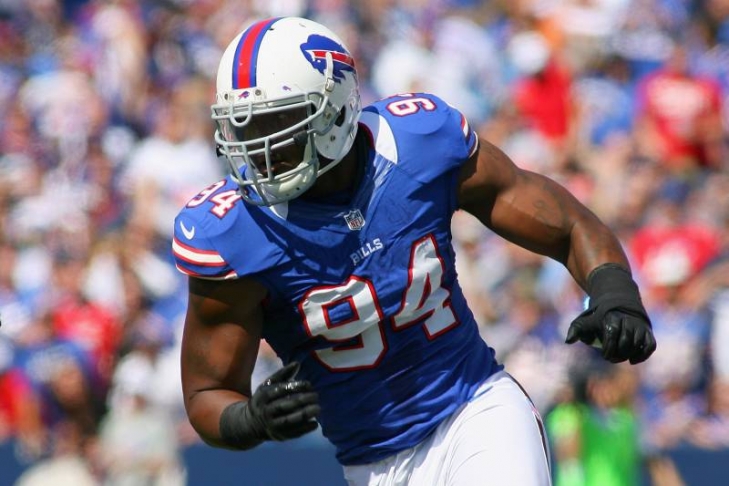
In 2002, Mario Williams was the first overall pick in the draft, and he played his first four seasons in football with the team that drafted him, the Houston Texans. Mario Williams signed a massive free-agent contract with the Buffalo Bills in March 2012. Landing in Western New York as the cornerstone of the defense, Williams immediately validated the record-breaking deal by establishing himself as one of the most dominant edge rushers in franchise history.
Williams was a rare physical specimen combining elite size, functional strength, and explosive initial quickness. Operating primarily as a 4-3 defensive end, his primary trait on tape was converting speed into power; he routinely overwhelmed offensive tackles with a punishing bull rush, using his long reach to disengage and collapse backfields toward the quarterback.
Williams made an immediate impact in his inaugural season in Western New York (2012), leading the Bills with 10.5 sacks despite competing through a wrist injury. In 2013, he received his third career Pro Bowl selection and Second-Team All-Pro honors after accumulating 13.0 sacks, including a franchise single-game record-tying 4.5-sack performance against the Carolina Panthers.
His remarkable peak came in 2014 when he played a vital role in Buffalo’s well-known "Cold Front" defensive line, teaming up with Marcell Dareus, Kyle Williams, and Jerry Hughes. Williams achieved a career-best 14.5 sacks, 19 tackles for loss, 18 Approximate Value (AV), and two forced fumbles. His outstanding performance earned him First-Team All-Pro honors and his fourth Pro Bowl selection, contributing to Buffalo leading the NFL in total sacks with 54.
Following a coaching change and scheme shift in 2015 (5.0 sacks), Williams was released and signed with division rival Miami for his final NFL season in 2016. Over his four years with the Bills (2012–2015), Williams started all 63 games, recording 43.0 sacks, 52 tackles for loss, 193 tackles, and seven forced fumbles.
42. LeSean McCoy
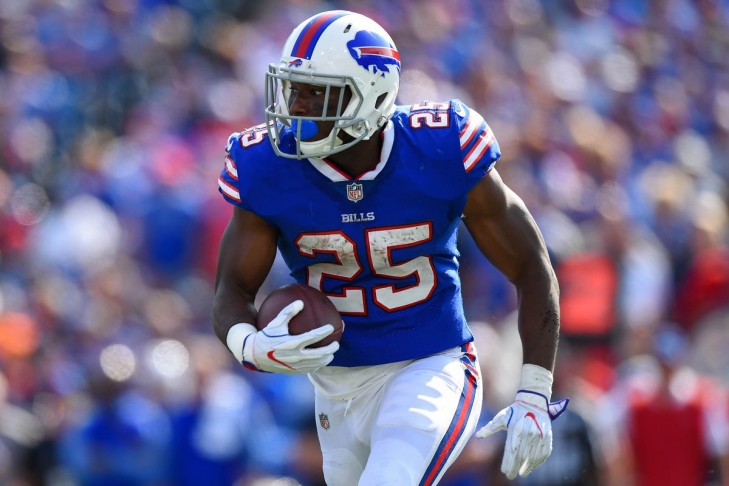
Following a high-profile offseason blockbuster trade in March 2015 that sent him from Philadelphia to Buffalo, LeSean "Shady" McCoy stepped into the Bills' backfield as an immediate franchise cornerstone. Bringing elite open-field agility to Western New York, McCoy anchored Buffalo’s ground game across four seasons.
McCoy used exceptional lateral agility, quick jump-cuts, and deceptive stop-and-start acceleration. As a versatile dual-threat back from single-back and shotgun formations, his main on-film skill was avoiding unblocked defenders in tight spaces. This enabled him to cut back against over-pursuing defenses and turn otherwise dead plays into positive yardage.
McCoy earned a Pro Bowl selection in each of his first three seasons with the Bills (2015–2017). In 2015, despite being sidelined for four games due to injury, he amassed 1,187 yards from scrimmage over 12 starts. His career-best performance with the Bills came in 2016, when he rushed for 1,267 yards at 5.4 yards per carry, scored 14 touchdowns, and totaled 1,623 yards from scrimmage.
In 2017, with first-year head coach Sean McDermott, McCoy gained 1,138 rushing yards and totaled 1,586 yards from scrimmage, becoming the key offensive player that ended Buffalo's 17-year playoff drought. His standout moment was during the famous "Snow Bowl" versus Indianapolis, where he rushed for a season-best 156 yards and scored the game-winning touchdown in overtime.
Following an offensive line overhaul that led to a drop in 2018 (514 rushing yards), McCoy was released before the 2019 season. He later won Super Bowl titles with the Kansas City Chiefs (2019) and Tampa Bay Buccaneers (2020) before retiring.
McCoy was the NFL’s top rushing leader throughout the 2010s, with 10,434 yards from 2010 to 2019. During his four seasons with the Bills (2015–2018), he played in 56 of 57 regular-season games, earning 3,814 rushing yards, 1,334 receiving yards, and totaling 5,148 yards from scrimmage, along with 30 touchdowns.
34. Joe Cribbs
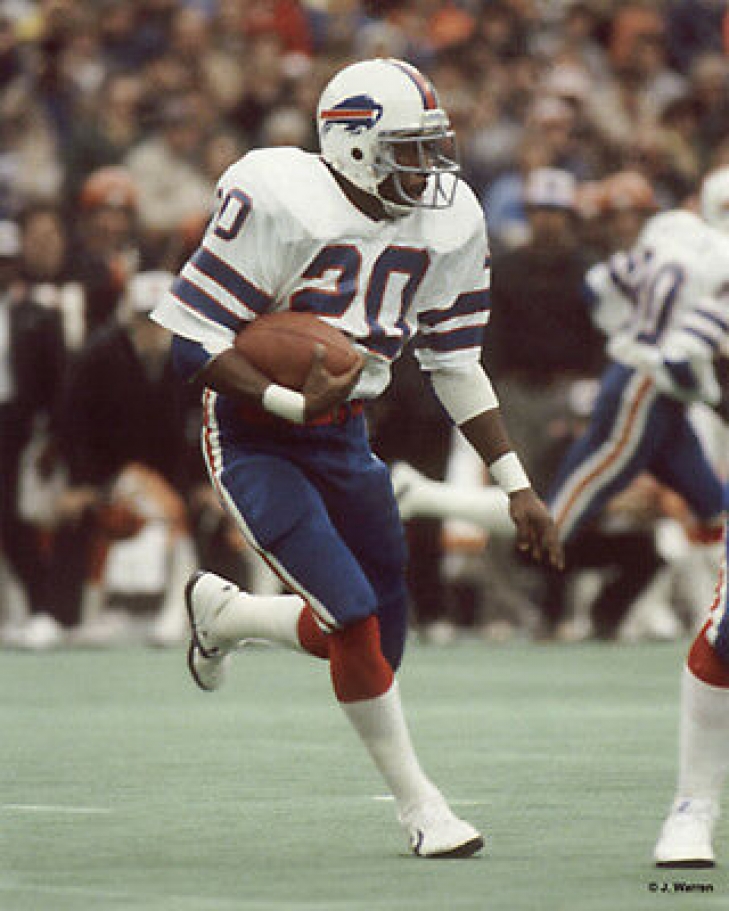
Drafted in the second round (29th overall) of the 1980 NFL Draft out of Auburn—where he was a First-Team All-SEC selection—Joe Cribbs arrived in Western New York as an instant offensive focal point. Functioning as a dual-threat weapon out of the backfield, Cribbs gave Buffalo a dynamic dual-threat running back who could slice through interior defensive lines or swing out wide as a lethal pass-catcher.
Cribbs relied on rapid lateral vision, smooth cutback agility, and soft hands out of the backfield. Equally dangerous between the tackles and in open space, he excelled at reading blocking schemes, pressing the hole, and accelerating into the secondary. As a receiver, Cribbs posed a mismatch for linebackers, running sharp wheel and angle routes that allowed him to turn short dump-off passes into massive gains downfield.
Cribbs made an immediate statement during his 1980 rookie campaign, rushing for 1,185 yards and 11 touchdowns while adding 52 receptions for 415 yards. Despite leading the league with 16 fumbles, his 1,600 yards from scrimmage helped lead Buffalo back to the playoffs and earned him UPI AFC Rookie of the Year honors alongside his first Pro Bowl selection.
Cribbs significantly improved his ball security while maintaining his elite production over the next three seasons. In 1981, he turned in 1,700 total scrimmage yards (1,097 rushing, 603 receiving) and 10 total touchdowns to earn his second Pro Bowl nod. After a strike-shortened 1982 season where he still rushed for 633 yards in just seven games, Cribbs returned to peak form in 1983, tallying 1,131 rushing yards and 57 receptions for 524 receiving yards to secure his third Pro Bowl selection. In each of his three Pro Bowl seasons, Cribbs ranked among the top 10 in the NFL in yards from scrimmage.
Seeking better compensation, Cribbs signed a contract with the USFL's Birmingham Stallions in 1983, jumping leagues to play the 1984 and 1985 USFL spring seasons. Following the resolution of legal disputes, he returned to the Bills in the fall of 1985, appearing in 10 games (399 rushing yards). Prior to the 1986 season, the Bills traded Cribbs' NFL rights to the San Francisco 49ers, bringing his time in Western New York to an official close.
With the Bills (1980–1983, 1985), Cribbs played in 64 regular-season games, accumulated 4,445 rushing yards, 1,783 receiving yards, 6,228 yards from scrimmage, and 36 total touchdowns.
Season 1 Episode 11, Somebody That I Used to Know, Gotye