


Site Admin
33. Phil Hansen
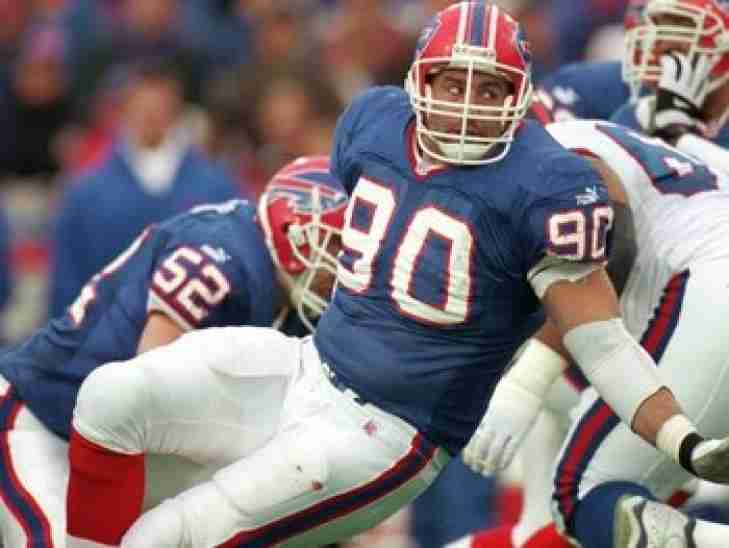
Drafted in the second round (54th overall) of the 1991 NFL Draft from Division II powerhouse North Dakota State, Phil Hansen made his way to Western New York as a determined and unassuming defensive end. Throughout his 11-season NFL journey, Hansen grew into a quiet hero of Buffalo's defense, constantly fighting to contain the run with fierce determination and pairing up with Bruce Smith to challenge opposing offensive lines.
Hansen demonstrated optimal length, leverage, and an unwavering motor at the defensive end position. Predominantly operating on the left side, he excelled in establishing a firm boundary against the run, employing a powerful bull-rush to collapse the pocket, thereby enabling linebackers to execute plays in open space. Although he seldom garnered national headlines, his exemplary technique against double-teams and persistent second-effort rushes rendered him an essential component of Buffalo's defensive strategies.
Hansen distinguished himself as a rookie in 1991, starting in 10 games and receiving PFWA All-Rookie Team honors as the Buffalo Bills advanced to their second consecutive AFC Championship. He rapidly became a regular starter, playing a crucial role on the offensive line during the team's postseason campaigns to Super Bowl XXVII and Super Bowl XXVIII.
One of his defining postseason moments came in the 1992 AFC Championship Game against Miami, when he made a crucial interception off Dan Marino, helping seal a 29–10 victory and sending Buffalo to its third consecutive Super Bowl. Hansen reached a personal peak in 1995, recording a career-high 10.0 sacks, followed by a career-best 132 tackles in 1996.
After the 2001 season, Hansen retired from professional football, having spent 11 years in Western New York and playing exclusively for the Bills. In 2011, the franchise honored his enduring contributions by inducting him into the Buffalo Bills Wall of Fame.
26. Reggie McKenzie
37. Henry Jones
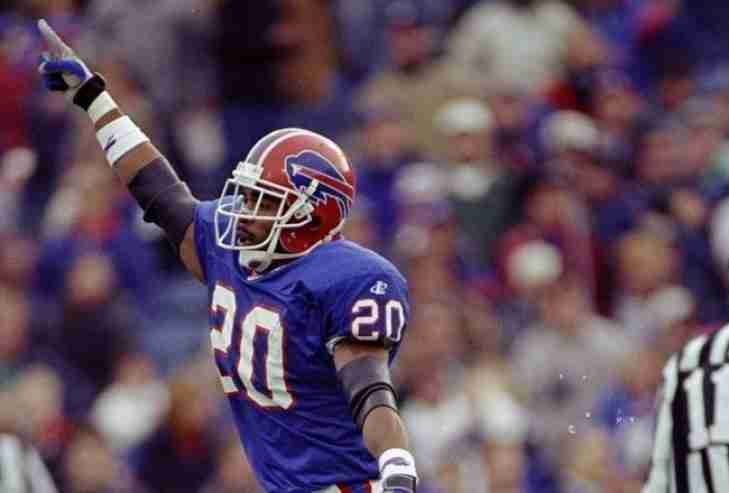
Taken in the first round (26th overall) of the 1991 NFL Draft out of Illinois, Henry Jones joined the Buffalo Bills during the peak of their championship contention. Stepping into the secondary as a strong safety, Jones combined hard-hitting physicality in run support with sharp defensive instincts, making himself a staple in Buffalo's defensive backfield for a decade.
Jones possessed the size to defend against physical running backs in close proximity and the range to retreat into deep zone coverage. From his position as a strong safety, he demonstrated exceptional skill in reading the quarterback's eye progression, utilizing a rapid closing burst to intercept intermediate passing lanes or deliver powerful hits to receivers over the middle. His capacity to transform pass defenses into immediate high-yardage return opportunities rendered him a consistent and formidable threat for big plays during his prime.
Following his initial season in 1991, during which he primarily participated as a special teams player and a rotational defensive back, Jones distinguished himself dramatically in 1992 by ascending to prominence on the national stage. In one of the most exemplary individual seasons by a safety in franchise history, Jones jointly led the entire National Football League (NFL) with eight interceptions, which he returned for a league-leading 263 yards and two touchdowns. He also contributed 92 tackles and two forced fumbles, resulting in his inclusion on the 1992 Pro Bowl roster and his designation as a First-Team All-Pro. His outstanding performance played a pivotal role in guiding the Buffalo team to its third consecutive Super Bowl appearance.
Although Jones never replicated those extraordinary statistical contributions again, he established a notably consistent role as a reliable, multi-season starter within Buffalo's defensive backfield. Throughout the remaining years of the 1990s, he continued to serve as a durable enforcer, starting all 16 games in five separate seasons for the Bills.
After ten seasons as a Western New York anchor (1991–2000), Jones left the Bills after 2000 during their rebuilding phase. He played two final NFL seasons: 2001 with the Minnesota Vikings and 2002 with the Atlanta Falcons before retiring. With the Bills, Jones appeared in 148 games (129 starts), with 18 interceptions, 455 return yards, and four touchdowns.
28. Shane Conlan
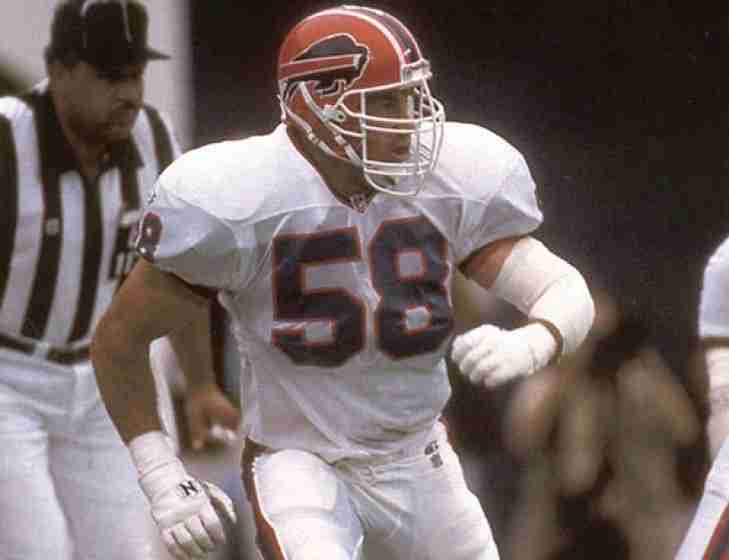
Drafted eighth overall in the first round of the 1987 NFL Draft from Penn State—where he earned unanimous All-American honors and helped the Nittany Lions win a national title—Frewsburg native Shane Conlan quickly became a beloved hometown hero in Western New York. Playing a vital role in Buffalo’s defense alongside stars like Bruce Smith and Cornelius Bennett, Conlan brought lively, relentless tackling that truly helped turn the Bills into a formidable team.
Conlan integrated instinctive diagnostic speed with formidable open-field tackling skills. Positioned as the inside linebacker within Buffalo’s 3-4 defensive scheme, he diligently analyzed pre-snap formations, diagnostic pull blocks, and flow plays to strategically shoot gaps before offensive guards could advance to the second level. His proficiency in lateral quickness against perimeter sweeps, combined with his closing speed in pass coverage, enabled him to neutralize running backs in space and disrupt screen plays.
Conlan made an immediate impact upon entering the professional ranks. During his 1987 rookie campaign, he racked up 114 tackles and led Buffalo's defense, earning AP NFL Defensive Rookie of the Year honors and a spot on the PFWA All-Rookie Team.
Building on that rookie success, Conlan launched into an elite three-year stretch, earning three consecutive Pro Bowl selections (1988–1990) and three Second-Team All-Pro nods. His relentless tackling and run defense anchored a unit that captured three straight AFC East titles, setting the defensive foundation for Buffalo's legendary championship runs.
Conlan was a cornerstone during the early phase of Buffalo’s unprecedented four-straight Super Bowl appearances, starting at middle linebacker in Super Bowls XXV, XXVI, and XXVII. His big-game heroics were showcased in Super Bowl XXV, where he recorded eight tackles against the New York Giants.
Following the 1992 season, Conlan departed as a free agent to sign with the Los Angeles Rams, where he played his final three NFL seasons (1993–1995). With Buffalo, Conlan appeared in 88 regular-season games, racking up 545 combined tackles, 5.5 sacks, and 5 interceptions.
